




 18 days China, End to End Beijing → Xi'an → Chuanzhusi → Jiuzhaigou → Chengdu → Zhangjiajie → Guilin → Yangshuo → Shenzhen From $6,360 View route
  3 days 4-Day Tour of Siguniang Mountain, Biepa Gou, and Dagu Glacier Chengdu → Lixian → Heishui County From $1,599 View route
  5 days Above the Pillars, Then Below Zhangjiajie From $1,430 View route
 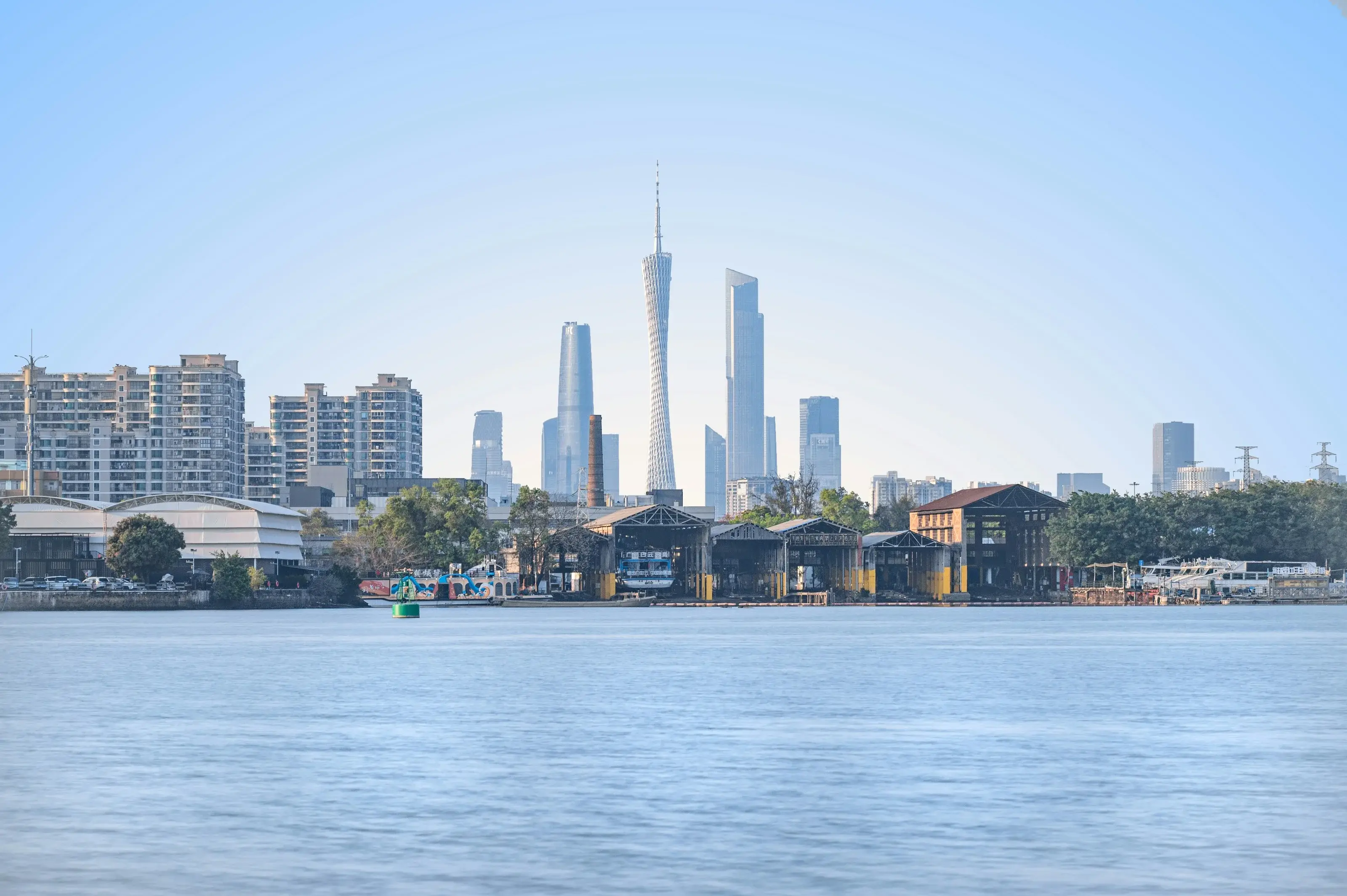 3 days After the Last Booth Guangzhou From $840 View route
 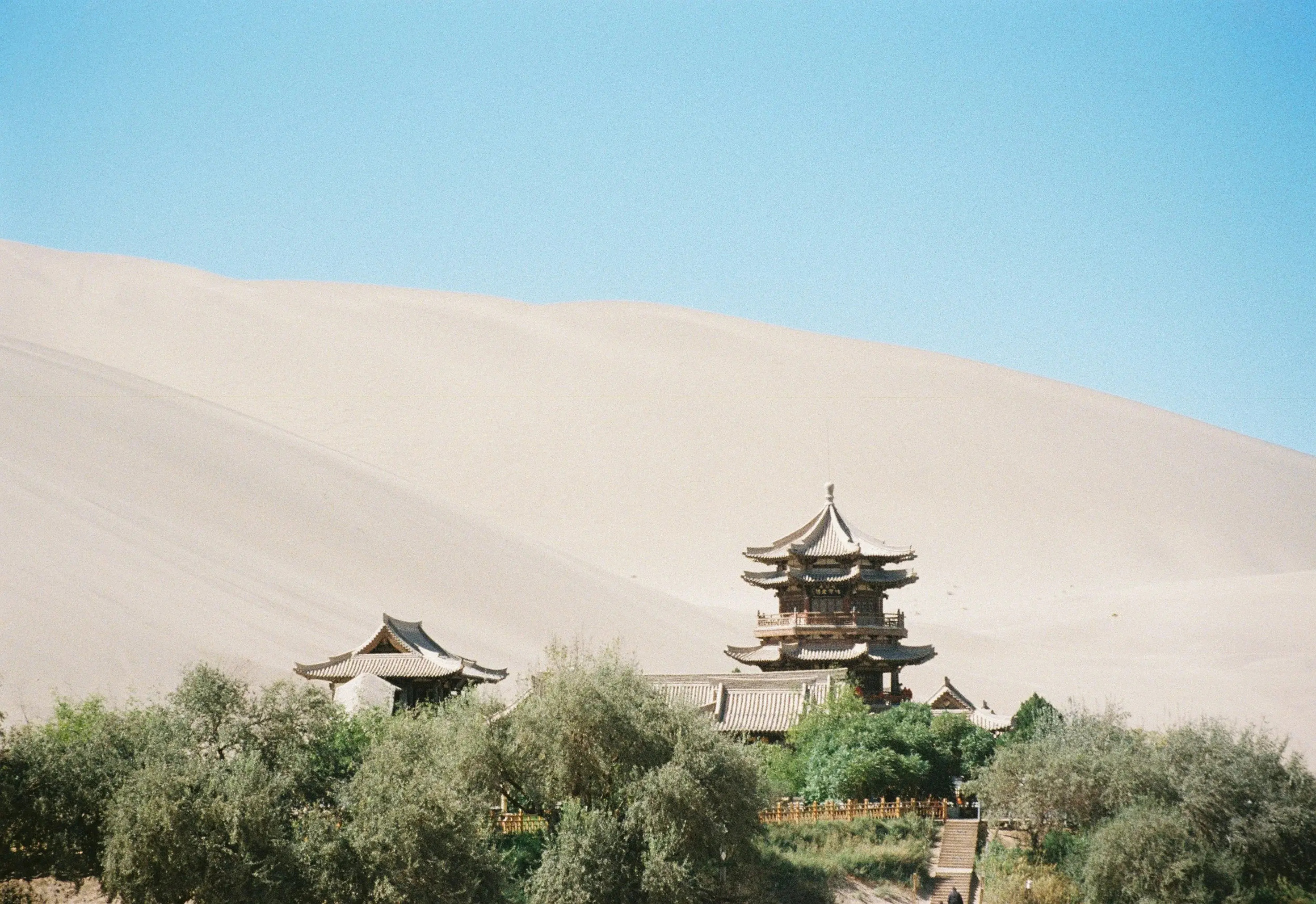 13 days All the Way West Xi'an → Dunhuang → Turpan → Kashgar → Shanghai From $3,500 View route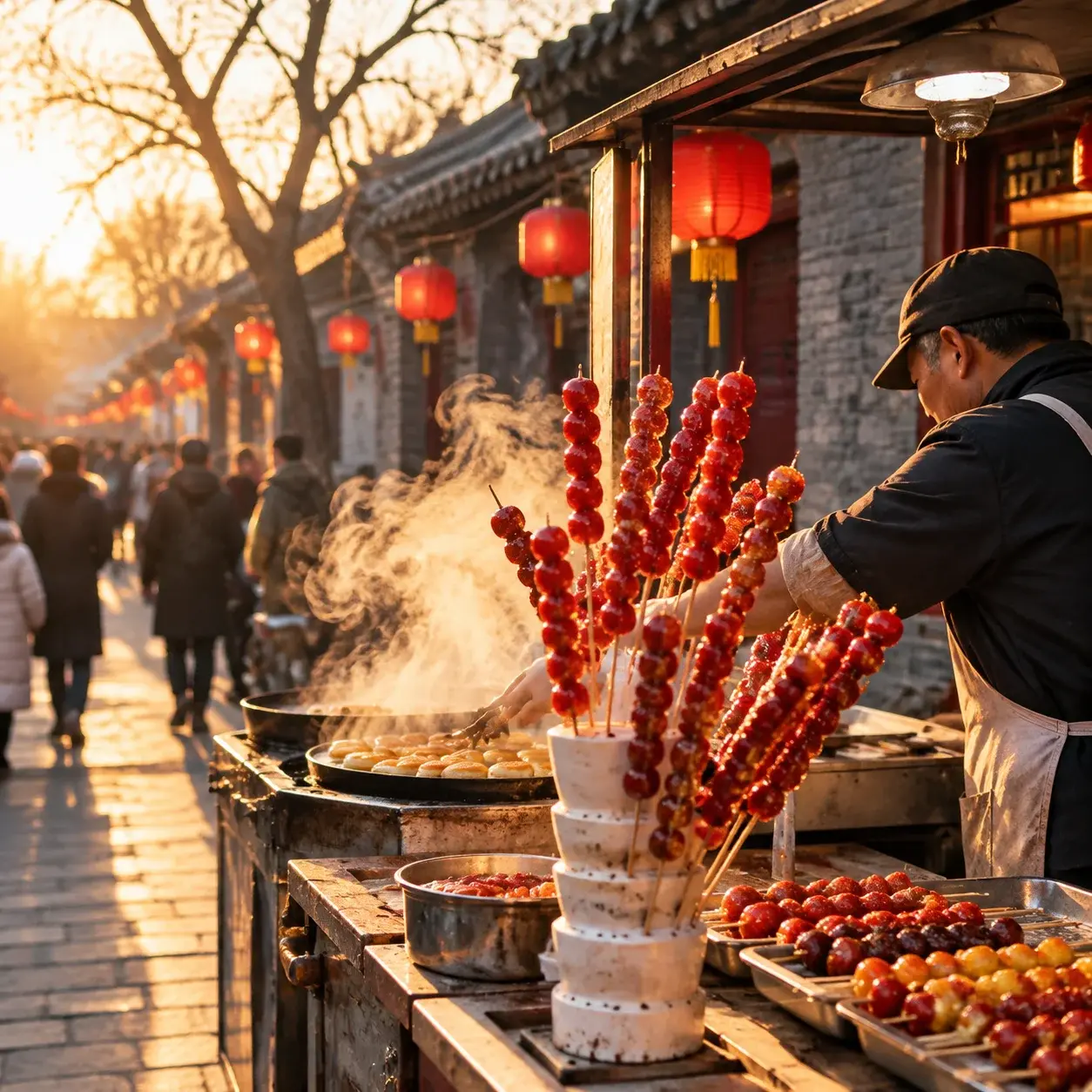
What Are Old Beijing Snacks Made Of — and Which Palace Stories Are True?
Beijing's snacks come from four sources at once: northern wheat, Manchu court kitchens, Hui Muslim vendors, and southern cooks the emperors brought back from the Yangtze. Most of the "imperial" origin stories you'll read on a stall sign are folklore — but a few are documented, and the most famous one of all, the Manchu-Han Imperial Feast, is one the Palace Museum itself says never existed in the palace.
We're a China travel company, not a restaurant. This guide doesn't tell you where to queue — it tells you what the thing in your hand actually is, what it will taste like, why it has such a strange name, and whether the story on the sign is history or marketing. For where to eat these, see our Beijing street food guide.
Key Takeaways (TL;DR)
- Beijing food has four parents, not one: wheat-based northern cooking, Manchu court cuisine, Hui Muslim street vending, and Jiangnan chefs brought north by Qing emperors.
- The Manchu-Han Imperial Feast was never served in the Forbidden City. In 2018 the Palace Museum's then deputy director said plainly there was no "full banquet" — only a Manchu banquet and a Han banquet, and nothing like 108 dishes.
- Beijing's humblest bowl has the grandest pedigree. Luzhu huoshao descends from a dish an imperial chef cooked for the Qianlong Emperor — the traffic ran out of the palace, not into it.
- Douzhi is fermented mung bean, not soy, and contrary to the usual line it was never just a poor person's drink.
- Tanghulu isn't from Beijing. The legend places it in Southern Song Hangzhou, and that legend doesn't survive scrutiny either.
You've Just Walked Out of the Forbidden City. What's Within Walking Distance?
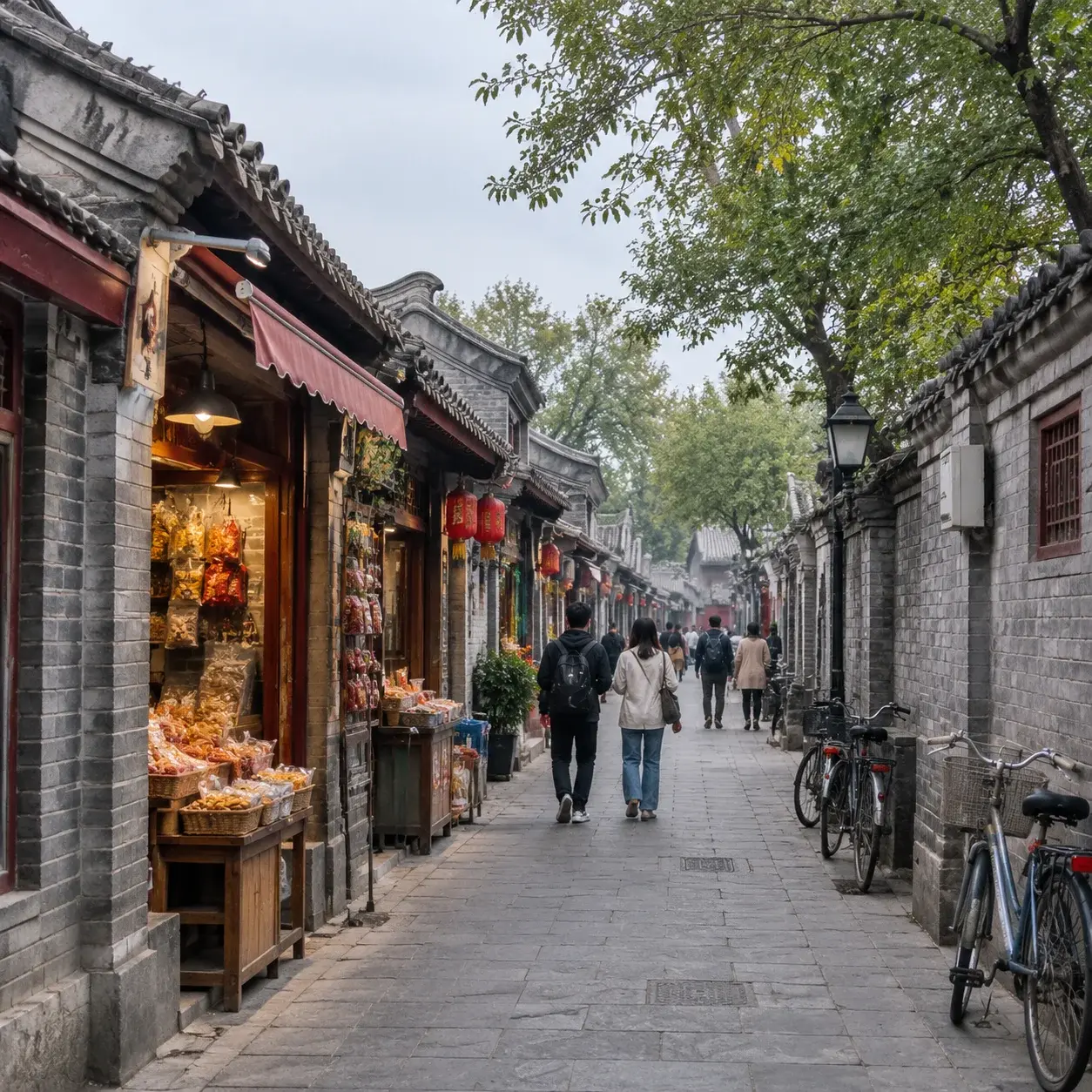
Which snack street you get depends entirely on which gate you leave from — and the three exits lead to three genuinely different food neighbourhoods.
- Shenwu Gate (north). You come out facing Jingshan Park. Head north-east and you reach the hutong grid around Nanluoguxiang, which is where the sweets — tanghulu, aiwowo, lvdagunr — are thickest and most photogenic.
- Meridian Gate / Tiananmen (south). This puts you on the imperial axis heading toward Qianmen Street and the Dashilan lanes, the old-brand district, and further south-west toward Niujie, the Hui Muslim quarter that supplies much of what follows.
- Donghua Gate (east). The shortest walk to Wangfujing — convenient, but the most touristed of the three.
If you haven't done the palace itself yet, our Forbidden City guide covers tickets, gates and timing. A five-day Beijing itinerary puts the palace and these neighbourhoods on separate days, which is the right way round — the Forbidden City alone will eat most of a morning.
What Is Beijing Cuisine, Actually? Four Sources in One City
Beijing cuisine is not one tradition but four, layered on top of each other over roughly seven centuries. Knowing which layer a dish belongs to explains almost everything about how it tastes.
Wheat, not rice. The dry, cold north grows wheat far better than rice, so the staples are noodles, pancakes, steamed buns and flatbreads. When you see a bowl of noodles rather than a bowl of rice, that's climate, not preference.
The Manchu court. The Qing ruling house brought its own repertoire — a category of steamed and fried pastries the court called 餑餑 (bobo). Several snacks sold today as "old Beijing" are Manchu in origin and were logged in the palace under Manchu names.
Hui Muslim vendors. This is the layer English-language guides almost always miss, and it may be the most important one. Beijing's snack culture is predominantly halal in origin. According to the book Beijing Niujie, food vendors from the Niujie neighbourhood once made up more than half of all small traders in the city. The Hui community's trades were summarised locally as the "three knives" — the mason's trowel, the butcher's knife and the cake knife. You can still read this history in the names: Beijing snack sellers are known by dish-first, surname-second — Yangtou Ma (sheep's head Ma), Doufunao Bai (tofu-pudding Bai), Niangao Qian (rice-cake Qian), Xianbing Zhou (meat-pie Zhou). Nearly all of those families were Hui, and nearly all lived around Niujie, whose mosque dates to 996 CE. If you keep halal, our halal food in China guide covers the practicalities.
Jiangnan imports. The Qing emperors toured the south and brought cooks back. One of them changed Beijing street food permanently — see luzhu, below.
Which Beijing Snacks Came From the Palace — and Which Went the Other Way?
The traffic ran in both directions, and the single most famous "peasant" dish in Beijing is the one that came out of the palace. Every guide presents court food as trickling down to the people. Here's the fuller picture.
| Direction | Dishes | Evidence |
|---|---|---|
| ⬆️ Street → palace | Douzhi; wandouhuang and yundoujuan; lvdagunr | Douzhi: documented. Lvdagunr: listed as palace food in the Qing. Wandouhuang: traditional attribution only |
| ⬇️ Palace → street | Luzhu huoshao (from suzaorou) | Documented |
| ↔️ Never in the palace at all | The Manchu-Han Imperial Feast; tanghulu | Contradicted by the Palace Museum / by the legend's own implausibility |
Because origin stories on stall signs are free to invent, we grade every claim in this article:
- 📗 Documented — supported by a Qing-era text, a modern scholarly source, or an official institution. - 📙 Traditional attribution — widely repeated, no documentary support. We say "reportedly". - 📕 Contradicted — an authoritative source says the popular version is wrong.
Was the Manchu-Han Imperial Feast Ever Real?
📕 Not as it's usually described. The 108-dish, three-day imperial banquet is one of the most repeated facts about Chinese food, and it does not survive contact with the Qing court's own paperwork.
In 2018, Ren Wanping, then deputy director of the Palace Museum in Beijing, told the press that there was no "full banquet" at all — only a Manchu banquet and a Han banquet, and nothing approaching 108 dishes; the real number was closer to a dozen. Under the Collected Statutes of the Great Qing (《钦定大清会典》), palace banquets were formally divided into those two categories. The Manchu banquet ran to six grades, and the top three were sacrificial banquets for imperial ancestors rather than dinners.
Where did the phrase come from, then? The earliest appearances are outside the palace. A menu labelled a Manchu-Han banquet appears in Li Dou's Records of the Painted Boats of Yangzhou (《扬州画舫录》, 1764), and Yuan Mei's Recipes from the Garden of Contentment (《随园食单》, also Qianlong-era) describes 满汉席 as officialdom's term — a banquet "for when new in-laws call, or a superior arrives in the district". It was a provincial-bureaucrat display, later inflated by restaurants into a legend about emperors.
So when you see a restaurant in Beijing advertising an imperial banquet: the dishes may well be authentic Qing recipes. The frame is a 20th-century invention. Our imperial Beijing guide covers the sites where the court actually ate.
Luzhu Huoshao: Why Beijing's Humblest Bowl Has an Imperial Pedigree
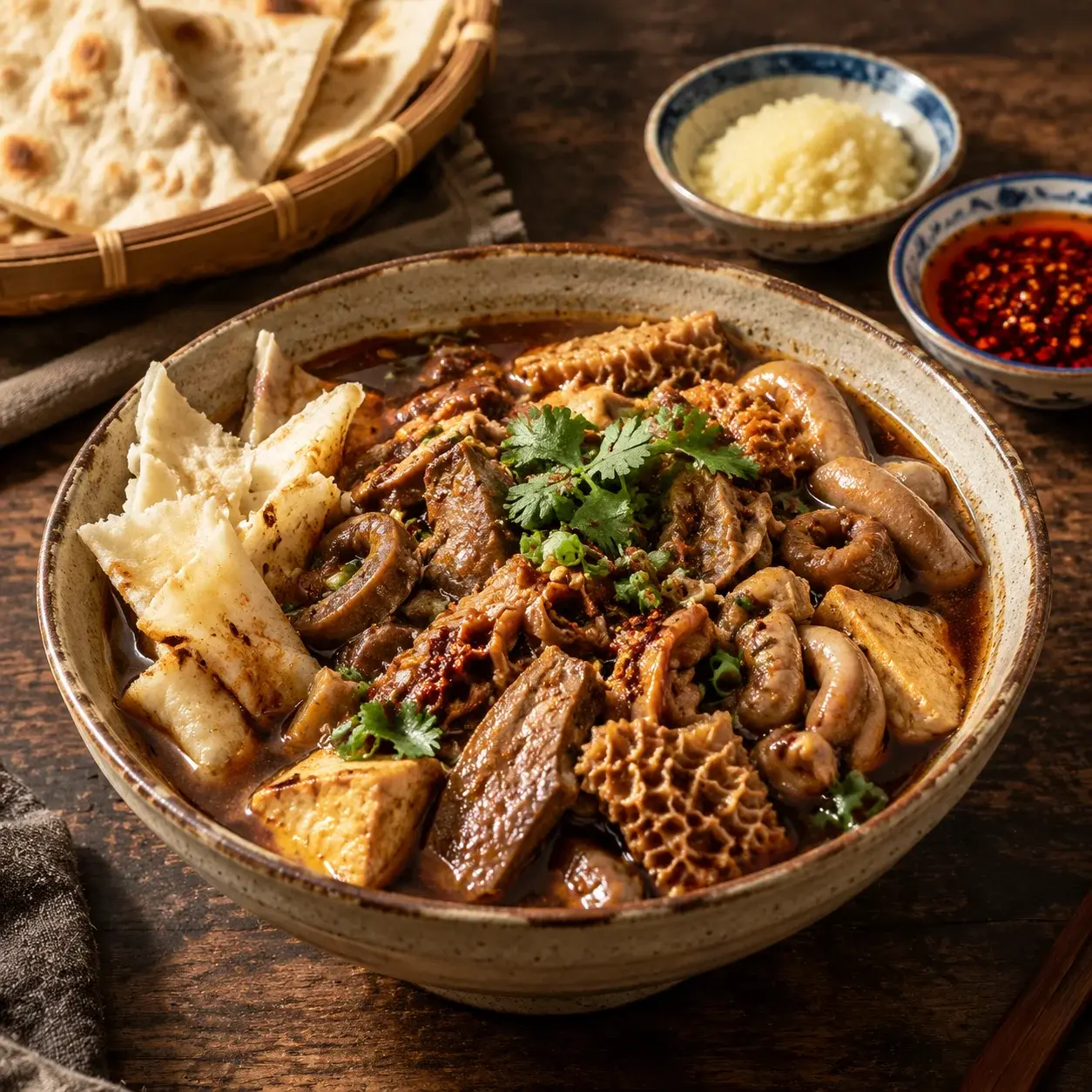
📗 Luzhu is a bowl of pork offal and flatbread in a dark, heavily spiced broth — and it is the direct descendant of a dish cooked for the Qianlong Emperor.
What it is and how it tastes: pig intestine and lung, firm tofu, sometimes belly pork, and pieces of huoshao flatbread, all simmered in a long-running master broth. It's rich, savoury, deeply offal-forward, and served with garlic paste, fermented tofu sauce, chilli oil and coriander stirred in to taste. This is the most challenging dish on this page for most visitors. If you don't eat offal, skipping it is not a failure.
Where it comes from: the ancestor dish is suzaorou (苏造肉), itself derived from a braised-meat recipe from Suzhou. When it entered the Qing palace, the original name was thought inelegant and it was renamed. In 1780, during a southern tour, the Qianlong Emperor stayed at the Yangzhou residence of Chen Yuanlong, whose household chef Zhang Dongguan so impressed him that Zhang followed the emperor back to the palace. Zhang's version used pork belly simmered with a nine-spice blend — clove, cassia, liquorice, cardamom, cinnamon and others. A Qing-era verse collection, Songs of Yandu Snacks (《燕都小食品杂咏》), describes the street version: buyers stuffing the meat inside the flatbread, and complaining it left grease down their shirts.
How it became poor people's food: pork belly was expensive. In 1886, Chen Zhao'en and his son Chen Shirong substituted pig's head and offal, which cost a fraction as much. That substitution created luzhu huoshao, and their shop — Xiaochang Chen, near Nanheng Street in the south of the city — is still trading through the fourth generation. The technique was added to Beijing's municipal intangible cultural heritage list in 2014.
One practical detail nobody explains: the flatbread has to be huoshao, which is unleavened. Leavened bread disintegrates in the pot. That's why it's never a steamed bun.
Douzhi: What Is It, Why Does It Smell Like That, and Who Drinks It?
📗 Douzhi is fermented mung bean liquid — not soy milk, and not sweet. It is sour, pungent, faintly cheesy, and served warm, traditionally with a deep-fried dough ring called jiaoquan and a dish of pickles.
Two corrections worth making. The first is botanical: despite "bean juice" as a translation, douzhi has nothing to do with soy. It's the by-product of making mung bean starch noodles, fermented rather than discarded.
The second is social. Douzhi is almost always described as a drink of the Beijing poor. Chinese Wikipedia flatly contradicts this: people of every class drank it. During the Qianlong reign, the Imperial Household Department recruited skilled douzhi makers from the street into the palace kitchens so the emperor could have it. A drink that gets requisitioned by the court is not a poverty food — it's an acquired local taste that happened to cross class lines.
Our honest advice: most visitors will not like it. Order a small bowl, take it with the jiaoquan ring, and treat it as a badge rather than a breakfast. Buying a large bowl and pouring it away is the common mistake.
Wandouhuang: The Snack a Street Vendor Reportedly Sold to Cixi
📙 Wandouhuang is a pale-yellow set pudding of skinned yellow peas, sugar and sometimes osmanthus — mild, cool, faintly sweet, and it melts rather than chews. It is the gentlest thing on this list and the safest bet for children.
The story attached to it: the Empress Dowager Cixi, taking summer air at the Jingxin Studio in Beihai Park, heard a vendor's gong outside the wall, had him brought in, tasted his wandouhuang and yundoujuan (a rolled kidney-bean sweet), and kept him on at the palace to make them. It is a good story. It is also only a story — it is repeated everywhere and documented nowhere, so treat it as folklore.
The distinction that actually matters to you is not the legend but the grade, because you will be sold one of two quite different things:
| Type | How it's made | Where you'll meet it |
|---|---|---|
| Coarse (糙豌豆黄) | Peas cooked down with sugar, jujube pieces mixed in, cut into diamonds | Temple fairs and street stalls — the traditional sign of spring |
| Fine (细豌豆黄) | Pea purée pushed through a fine sieve, sugar and osmanthus added, set and cut into neat squares | The court version; what the old teahouse brands sell |
Street vendors near the tourist lanes usually sell the coarse kind. Neither is wrong — but if someone charges you a court price for a jujube-studded diamond, you now know the difference.
Why Is It Called "Donkey Rolling"?
📗 Because it's rolled in soybean flour, and the cloud of yellow powder looks like a donkey rolling in the dust. That really is the whole explanation.
Lvdagunr is a glutinous roll filled with sweet red bean paste and dusted in roasted soybean flour — soft, sticky, nutty and mildly sweet. It's Manchu in origin; in Qing times it was also called doumianzi bobo, and the palace logged it under the Manchu name turga efen. It was listed as a palace food during the dynasty.
The best detail is that Qing-era Beijingers also thought the name was ridiculous. Songs of Yandu Snacks includes a verse on it that ends, roughly: why does everyone call this thing "donkey rolling"? The name verges on the comic. Complaining about the name is itself a two-hundred-year-old Beijing tradition.
Two footnotes. There was an officials' version called damiancang — sesame instead of soybean flour, fried instead of steamed, eaten at New Year for the auspicious sense of "full granaries". And what you buy today is probably not what the name describes: the original used proso millet flour, while most modern versions use glutinous rice. Chengde, north-east of Beijing, claims the dish going back two or three centuries on the strength of its millet crop.
While you're on the sweets: aiwowo is the white one — a steamed glutinous rice ball with a sweet filling, dusted in flour. Mild, chewy, completely safe.
Tanghulu: Is the Song-Dynasty Empress Story True?
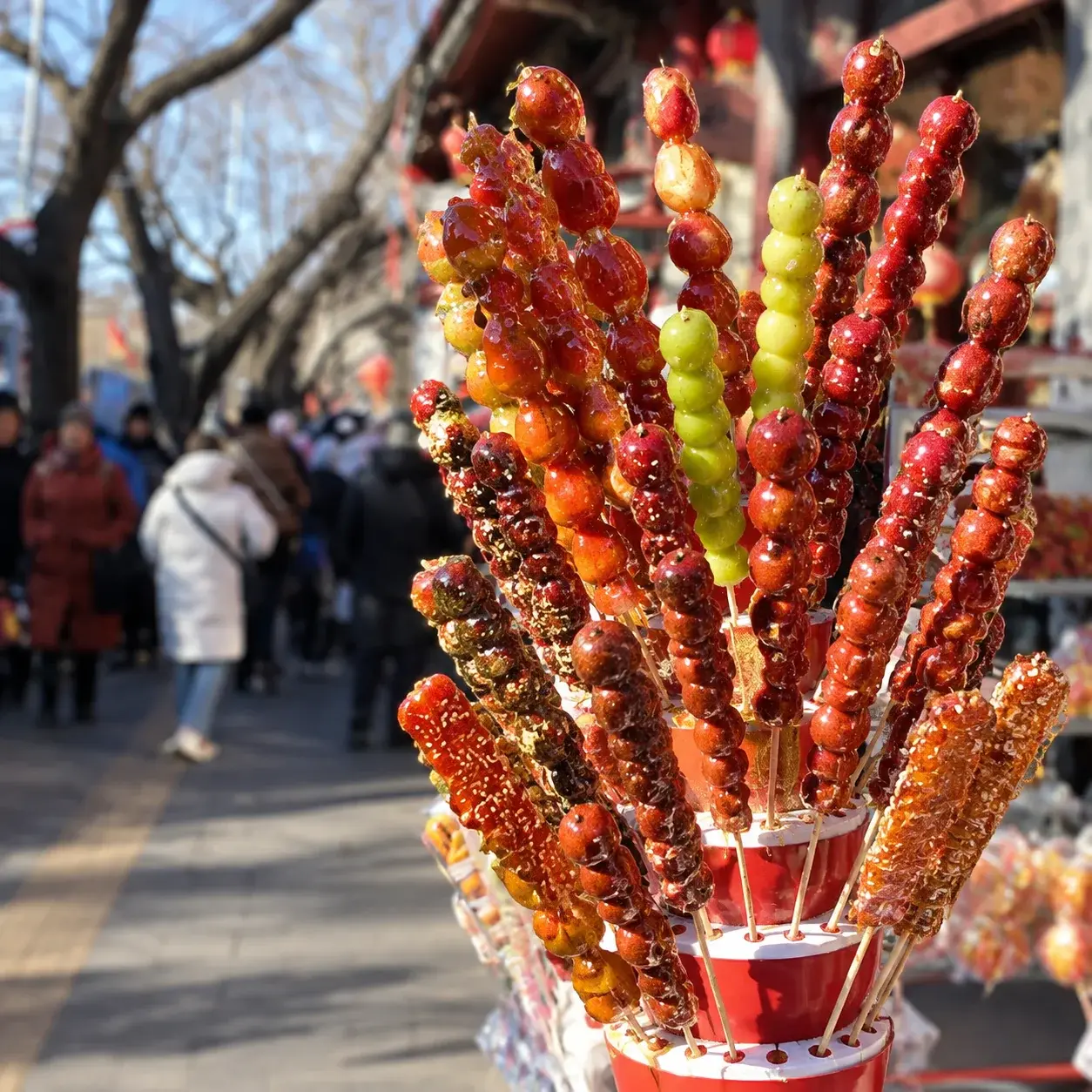
📕 Probably not — and tanghulu isn't a Beijing invention either. The candied-fruit skewer is the most photographed snack in the city and the one with the shakiest history.
What it actually is: Chinese hawthorn berries — tart, apple-like, quite firm — threaded on a bamboo skewer and dipped in molten sugar that sets to a glass shell. The taste is sharp underneath and sweet on top; the hawthorn is the point. Strawberry, grape and orange versions are recent, driven largely by social media, and they're sweeter and much less interesting.
The legend: in the Shaoxi era of the Southern Song (1190–1194), the Guangzong Emperor's favourite consort fell ill and stopped eating. Court physicians failed. A folk doctor answered the palace's public appeal and prescribed hawthorn simmered with rock sugar before meals. She recovered, the recipe reached the public, and tanghulu was born.
Why it doesn't hold up: writing in China Youth Daily in December 2017, the food writer Xinyousheng pointed out that this story follows a template used for dozens of Chinese dishes — the food must be linked to a named emperor, a folk remedy must succeed where the court failed, and the dish must turn out to be medicinal. The specific problem here is that hawthorn's use for undigested meat is recorded in the Compendium of Materia Medica and was standard knowledge. A court physician being stumped by it is not credible. His verdict: it's just a story.
Note also what the legend concedes: the setting is Lin'an — today's Hangzhou — not Beijing. Beijing's signature photo snack is a southern import that the north adopted, much like the street food traditions we trace across the country in our Chinese street food guide.
Jianbing and Zhajiangmian: The Two You'll Eat Most
These are the two dishes you're most likely to eat without thinking about, and both reward a little decoding.
Jianbing is the breakfast crepe. A thin batter — in the Tianjin style, mung bean flour, which gives it a faint green cast — is spread on a hot circular griddle, an egg is cracked over it and spread flat, then it's scattered with sesame and spring onion, flipped, brushed with a savoury-sweet bean sauce and chilli, wrapped around either a crisp fried cracker (baocui) or a length of fried dough stick, and folded into a parcel. It's savoury, soft-and-crunchy at once, and about as approachable as Chinese street breakfast gets. To order without Mandarin: point, and say bú yào là if you don't want chilli.
Zhajiangmian is thick wheat noodles under a dark sauce of fermented soybean paste fried with diced pork, served with shredded cucumber, radish and beansprouts on top. The one instruction that matters: mix it thoroughly before you eat. The sauce is intensely salty on its own and is meant to be distributed through the whole bowl. Served unmixed, it looks like a small portion of sauce on plain noodles; mixed, it's a complete dish. It's a mild, familiar flavour — closer to a savoury bean ragù than to anything spicy.
Baodu: The Dish That Explains the City's Halal Backbone
📗 Baodu means "exploding tripe", which sounds alarming and describes nothing more violent than a very fast boil. Sheets of beef or lamb tripe are dropped into boiling water for a matter of seconds — long enough to firm up, not long enough to toughen — then eaten with a sesame-paste dip. The texture is crisp and springy; the flavour is mild. It is offal, and it is one of the oldest continuously sold snacks in the city.
Baodu is a halal dish, traditionally made by Hui Muslim cooks, and it sits at the centre of the Niujie tradition described earlier. Lamb and beef rather than pork, sesame paste rather than soy, a specialist shop rather than a general restaurant — that combination is the signature of Beijing's Hui food culture, and it's the layer that most visitors eat all week without ever being told about.
If food is the reason you're travelling rather than a bonus, a 12-day Beijing–Xi'an–Chengdu route strings together the three cities where regional cooking differs most sharply; a Beijing tea-and-crafts afternoon is the slower, in-city version of the same idea.
Frequently Asked Questions
What is Beijing cuisine known for? Wheat-based staples rather than rice, roast duck, heavy fermented bean sauces, Manchu court pastries, and a large body of Hui Muslim snacks built on lamb and beef.
What did emperors in the Forbidden City actually eat? Under the Collected Statutes of the Great Qing, palace banquets were divided into Manchu banquets (six grades, the top three of which were ancestral sacrificial rites) and Han banquets. Day to day the court ate far more modestly than legend suggests.
Is the Manchu-Han Imperial Feast real? Not as popularly described. In 2018 the Palace Museum's then deputy director, Ren Wanping, stated there was no "full banquet" — only Manchu and Han banquets — and that the famous 108 dishes are an embellishment of something closer to a dozen.
What is tanghulu made of? Traditionally Chinese hawthorn berries in a hard shell of set sugar. Strawberry, grape and orange versions are modern variants.
What is douzhi made from? Fermented mung bean liquid, a by-product of mung bean starch noodle production. It is not soy milk and it is not sweet.
Which Beijing snack should a first-timer try first? Jianbing for breakfast or tanghulu for a walk — both are near-certain wins. Leave douzhi until last, and order a small bowl.
The Bottom Line
Start with jianbing and a tanghulu skewer, work up to baodu, and try douzhi only when you're ready to be surprised. The story worth telling the person you're travelling with isn't the one about the 108-dish imperial banquet — it's that the banquet never happened, and that the cheapest, most defiantly unglamorous bowl in the city, luzhu huoshao, is the one with a real emperor's chef behind it.
Where to eat all of this is a separate question, and we've answered it elsewhere: our Beijing street food guide covers the markets and the ordering, and the hutong neighbourhood guide covers the lanes worth walking. If you want a trip built around eating rather than one that fits meals in around monuments, we can plan a private China trip that way.