




 18 days China, End to End Beijing → Xi'an → Chuanzhusi → Jiuzhaigou → Chengdu → Zhangjiajie → Guilin → Yangshuo → Shenzhen From $6,360 View route
  3 days 4-Day Tour of Siguniang Mountain, Biepa Gou, and Dagu Glacier Chengdu → Lixian → Heishui County From $1,599 View route
  5 days Above the Pillars, Then Below Zhangjiajie From $1,430 View route
  3 days After the Last Booth Guangzhou From $840 View route
  13 days All the Way West Xi'an → Dunhuang → Turpan → Kashgar → Shanghai From $3,500 View route
 For many travelers, Chinese kung fu begins with a movie image: flying kicks, temple courtyards, silent masters, and impossible speed. The real experience in China is different — and often more interesting.
Kung fu is not just one style, one temple, or one performance. It can mean Shaolin monks training in Henan, tai chi practiced at sunrise in a city park, Wing Chun heritage in Foshan, or a short hands-on class arranged as part of a private China itinerary. Some experiences are highly polished for visitors. Others are quieter, slower, and more local.
If you are planning a trip to China and want to see or try kung fu in a meaningful way, the key is knowing where to go, what to expect, and how much time each place deserves.
Quick Answer: Where Should You Experience Kung Fu in China?
| Place | Best For | What to Expect |
|---|---|---|
| Shaolin Temple, Henan | First-time visitors, classic kung fu image, families | Temple visit, kung fu performance, martial arts schools nearby, Central China route planning |
| Wudang Mountains, Hubei | Slower travel, Taoist culture, mountain scenery | Taoist temples, mountain walks, and a slower martial arts atmosphere that makes more sense when you have time to stay |
| Chenjiagou, Henan | Tai chi enthusiasts, serious learners | Birthplace of Chen-style tai chi, specialized training environment |
| Foshan, Guangdong | Wing Chun, southern martial arts, Bruce Lee / Ip Man interest | Martial arts heritage, museums, local culture, more niche than Shaolin |
| Beijing, Shanghai, Chengdu, Xi’an | Short cultural experience within a classic China trip | Tai chi class, kung fu show, park practice, family-friendly introduction |
For most first-time travelers, Shaolin Temple is the most recognizable kung fu destination in China. For travelers who want atmosphere, mountains, and Taoist culture, Wudang is more immersive but needs more time. If you only want a light introduction, a short tai chi or kung fu class in a major city may fit better than a long detour.
What Does “Kung Fu” Actually Mean in China?
In English, “kung fu” is often used to describe Chinese martial arts in general. In Chinese, the word gongfu can also mean skill developed through long practice. It does not only refer to fighting.
That difference matters for travelers.
Kung fu in China is not only about performance. It is connected with:
• physical training; • discipline and repetition; • Buddhist and Taoist traditions; • regional schools and family lineages; • health practices such as tai chi; • modern stage performance and tourism; • everyday public exercise in parks and squares.
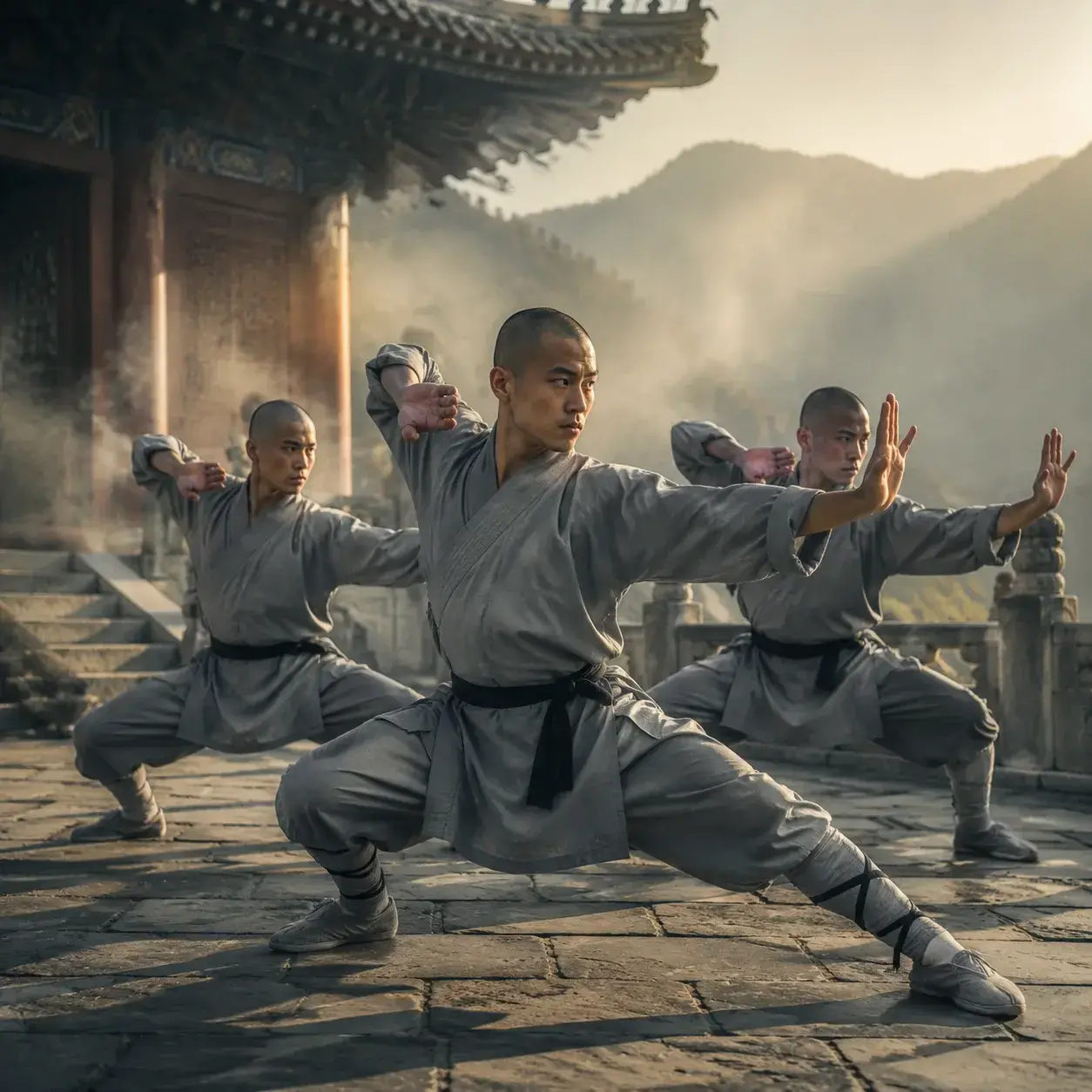
This is why a kung fu experience in China can look very different depending on where you go. At Shaolin, it may feel powerful and theatrical. In Wudang, it may feel slower and more meditative. In a Beijing park, it may look like older residents moving quietly before breakfast.
None of these is “fake” simply because they are different. They are different ways Chinese martial culture appears today.
Shaolin Temple: The Classic Kung Fu Destination
Shaolin Temple in Henan Province is the place most international travelers associate with Chinese kung fu. Located near Mount Song, it is one of China’s most famous Buddhist temples and has become closely linked with martial arts training, performance, and popular culture.
For first-time visitors, Shaolin is usually the easiest place to connect the idea of kung fu with a real destination.
A typical visit may include:
• the main Shaolin Temple complex; • the Pagoda Forest; • a kung fu performance; • views of nearby Songshan scenery; • martial arts schools in the surrounding area.
The kung fu show is one of the most accessible parts of the visit. It is designed for visitors, so it is polished and theatrical rather than a private training session. Still, it gives travelers a clear sense of Shaolin movement, weapons, discipline, and physical control.
For families, Shaolin is often a strong choice. Children usually understand the experience quickly because it is visual, active, and easy to connect with what they may already imagine kung fu to be.
Planning a Shaolin Temple Visit: Zhengzhou, Luoyang, and Songshan
For planning purposes, Shaolin Temple works best as part of a Henan or Central China route, rather than as a random standalone detour.
The most common gateway is Zhengzhou, the capital of Henan Province. From Zhengzhou, Shaolin Temple usually takes around two hours by road, depending on traffic and the exact starting point. During Chinese public holidays or busy travel periods, road conditions can change, so it is worth checking the timing in advance.
Many travelers also combine Shaolin with Luoyang, especially if they want to visit the Longmen Grottoes. A practical route may look like this:
• arrive in Zhengzhou; • visit Shaolin Temple and the Songshan area; • continue to Luoyang; • visit Longmen Grottoes; • connect onward by high-speed train.
This works better than trying to force Shaolin into a Beijing, Shanghai, or Xi’an itinerary without considering travel time.
It also helps to understand that “Songshan” and “Shaolin” are not exactly the same thing for travelers. Songshan is the broader mountain area. Shaolin Temple is one famous site within that area. Shaoshi Mountain and Taishi Mountain are also different parts of the Songshan region. If you are planning a deeper hiking or cultural route, these distinctions matter. If you only want the classic Shaolin experience, a focused temple and performance visit is usually enough.
That does not make the visit meaningless. It simply means Shaolin is not a hidden mountain monastery untouched by tourism. It is a religious-cultural site, a famous martial arts destination, and a busy visitor experience all at once.
Wudang Mountains: Taoist Martial Arts and Slower Travel
If Shaolin represents the most famous Buddhist kung fu image, Wudang is often associated with Taoist martial arts, internal styles, and a quieter mountain atmosphere.
The Wudang Mountains are located in Hubei Province. They are known for Taoist temples, mountain paths, and martial arts traditions linked with tai chi and internal practice. Compared with Shaolin, Wudang usually feels less direct and less performance-driven. It asks for more time.
A Wudang visit may include:
• Taoist temple complexes; • mountain walks; • cable car or shuttle transfers; • martial arts demonstrations or classes; • quiet time in a slower mountain setting.
Wudang is better for travelers who are interested in the atmosphere around martial arts, not only the movements themselves. The appeal is not just “watching kung fu.” It is seeing how Taoist architecture, mountains, ritual spaces, and martial arts ideas fit together.
For travelers on a very tight first China trip, Wudang may be harder to justify unless it is a personal interest. It is more rewarding when you can stay at least one or two nights and avoid rushing through the mountain as a checklist stop.
Shaolin vs Wudang: Which Is Better for Travelers?
Shaolin and Wudang are often compared, but they offer very different experiences.
| Question | Shaolin Temple | Wudang Mountains |
|---|---|---|
| Best for first-time visitors? | Usually yes | Better for slower or repeat travelers |
| Main association | Buddhist temple, Shaolin kung fu, performance | Taoist culture, internal martial arts, tai chi |
| Travel style | Easier to fit into a Henan route | Needs more time and planning |
| Atmosphere | Famous, busy, energetic | Mountain-based, slower, more reflective |
| Family-friendly? | Very suitable | Suitable, but less immediately exciting for young children |
| Best paired with | Zhengzhou, Luoyang, Longmen Grottoes | Hubei, mountain travel, Taoist culture routes |
Choose Shaolin if this is your first time in China and you want the classic kung fu image with relatively easy logistics.
Choose Wudang if you are more interested in Taoist culture, mountain scenery, tai chi, and a slower pace.
For many travelers, the better question is not “Which one is more authentic?” but “Which one fits the route and the kind of experience I actually want?”
Chenjiagou: For Travelers Seriously Interested in Tai Chi
Chenjiagou in Henan Province is known as the birthplace of Chen-style tai chi. It is an important destination for people who already have a serious interest in tai chi or Chinese martial arts history.
For most first-time tourists, however, Chenjiagou may be too specialized. It does not have the same broad visitor appeal as Shaolin Temple, and it is less likely to fit naturally into a general China itinerary unless tai chi is one of the main reasons for the trip.
That said, for the right traveler, Chenjiagou can be meaningful. It offers a different side of Chinese martial arts: less about stage performance, more about lineage, training, and long-term practice.
Chenjiagou is best for:
• tai chi practitioners; • martial arts enthusiasts; • travelers with a specific interest in Chen-style tai chi; • repeat visitors to China who want a more specialized cultural route.
If your interest in kung fu is casual, Shaolin or a city-based tai chi class will usually be a better fit.
Foshan: Wing Chun, Southern Martial Arts, and Local Heritage
Foshan in Guangdong Province is another important martial arts destination, especially for travelers interested in Wing Chun, Ip Man, Bruce Lee, and southern Chinese martial arts.
Compared with Shaolin, Foshan is more niche. It does not usually deliver the same “temple and kung fu show” experience that many first-time visitors expect. Instead, its appeal lies in local heritage, museums, ancestral halls, and the broader culture of southern China.
Foshan may be a good choice if you are already traveling in the Greater Bay Area, especially Guangzhou, Shenzhen, or Hong Kong. It can work as a cultural extension rather than a main national destination.
A Foshan martial arts visit may include:
• Wing Chun-related heritage sites; • local museums; • Lingnan architecture; • ancestral halls; • food and neighborhood culture.
For travelers who grew up watching Bruce Lee or Ip Man films, Foshan can add a personal connection to a South China itinerary. But for a first China trip focused on Beijing, Xi’an, Shanghai, and Guilin, it may not be the most efficient kung fu stop.
City Kung Fu Experiences: Beijing, Shanghai, Chengdu, and Xi’an
Not every traveler needs to visit a famous martial arts mountain or temple. If your itinerary is already full, a short city-based kung fu or tai chi experience may be the most practical option.
In cities such as Beijing, Shanghai, Chengdu, and Xi’an, travelers may find:
• morning tai chi in parks; • private tai chi classes; • short kung fu workshops; • evening kung fu performances; • family-friendly cultural classes; • martial arts demonstrations arranged through guides or local schools.
These experiences are usually easier to fit into a classic China itinerary. They work especially well for families, first-time visitors, and travelers who want a taste of kung fu without dedicating two or three extra days to a special detour.
Beijing is particularly convenient because it already appears on most first-time China routes. A morning tai chi class after visiting the Temple of Heaven, for example, can feel natural rather than forced. Xi’an can also work well if the focus is on culture, history, and family activities. Shanghai is less connected with traditional kung fu imagery, but it can still offer polished cultural workshops. Chengdu may be better for a relaxed, lifestyle-focused experience.
The main limitation is depth. A one-hour class will not turn anyone into a kung fu student. But it can help travelers understand posture, rhythm, balance, and the difference between watching martial arts and trying even a simple movement themselves.
Can Tourists Learn Kung Fu in China?
Yes, tourists can learn kung fu in China, but the right format depends on how much time you have.
For most travelers, the options fall into three categories:
| Type of Experience | Time Needed | Best For |
|---|---|---|
| Short class | 1–2 hours | Families, first-time visitors, cultural introduction |
| Half-day or full-day workshop | Half day to one day | Travelers who want a more hands-on experience |
| Training stay | Several days to weeks | Serious learners or martial arts enthusiasts |
A short class is enough if you want to understand basic movements and have a memorable cultural experience. A longer workshop allows for more explanation, repetition, and context. A training stay is a different kind of trip altogether and should not be treated as a normal sightseeing add-on.
It is also important to keep expectations realistic. Real martial arts training is repetitive and physically demanding. Much of it is not dramatic. Beginners may spend time learning basic stances, balance, breathing, and simple sequences. That is part of the experience.
If you only want a fun introduction, do not book a serious training program. If you want real practice, do not expect it to feel like a movie scene.
How to Add Kung Fu to a China Itinerary
The best way to include kung fu in a China trip is to match the experience to your route instead of forcing the route around the idea.
For a first-time China itinerary, these combinations work well:
| Route Type | Kung Fu Add-On |
|---|---|
| Beijing – Xi’an – Shanghai | Tai chi or kung fu class in Beijing or Xi’an |
| Beijing – Xi’an – Luoyang – Zhengzhou | Shaolin Temple and Longmen Grottoes |
| Central China route | Shaolin Temple, Luoyang, Zhengzhou, possibly Chenjiagou |
| Hubei-focused route | Wudang Mountains |
| South China / Greater Bay Area route | Foshan Wing Chun heritage |
| Family China tour | Shaolin Temple or a short city kung fu class |
For most first-time travelers, Shaolin works best when paired with Luoyang and Zhengzhou. Wudang works best when you are willing to slow down. Foshan works best when you are already in southern China. A city class works best when time is limited.
This kind of planning matters because China is large. A place may sound culturally important but still be difficult to add smoothly to a route. The most enjoyable kung fu experience is often the one that fits naturally into the trip.
What Should You Expect from a Kung Fu Show in China?
Kung fu shows in China are usually designed for visitors. They may include choreographed fighting, weapons, group formations, acrobatics, and demonstrations of strength or flexibility.
This does not make them worthless. It simply means they are performances, not private training sessions.
A good kung fu show can be a useful introduction because it makes different styles and movements visible within a short time. It is especially effective for children and travelers who do not have prior martial arts knowledge.
However, travelers should not expect a show to explain the full cultural background of kung fu. For that, it helps to combine the performance with a temple visit, a guide’s explanation, a class, or a deeper route.
In general:
• choose a show if you want something visual and easy to understand; • choose a class if you want to try movements yourself; • choose Shaolin if you want the classic temple-and-kung-fu image; • choose Wudang if you want mountain atmosphere and Taoist context; • choose Chenjiagou if tai chi is a serious interest.
Is Kung Fu in China Too Touristy?
Some kung fu experiences in China are touristy. Shaolin Temple, in particular, is a famous site with large visitor numbers, performances, and commercial activity around it.
But “touristy” does not automatically mean “not worth visiting.”
Many important cultural sites in the world are busy because they are important. The real question is whether you understand what kind of experience you are choosing.
Shaolin today is not a secluded monastery where a few monks train in silence away from the world. It is a living religious-cultural site, a famous symbol of Chinese martial arts, and a major visitor destination. If you arrive expecting total quiet and isolation, you may be disappointed. If you arrive expecting a layered place where religion, performance, training, tourism, and national memory all overlap, the visit becomes much more interesting.
The same applies to other kung fu experiences. A short class in Beijing may be designed for travelers, but it can still be well taught. A park tai chi session may look simple, but it may reflect years of daily practice. A performance may be choreographed, but the bodies performing it are often highly trained.
The best approach is not to chase a fantasy of “untouched authenticity,” but to choose experiences with clear expectations.
Best Kung Fu Experiences for Different Travelers
| Traveler Type | Best Choice |
|---|---|
| First-time visitor to China | Shaolin Temple or a city kung fu class |
| Family with children | Shaolin Temple, kung fu show, short class |
| Serious martial arts fan | Shaolin, Chenjiagou, Foshan, or Wudang depending on interest |
| Tai chi practitioner | Chenjiagou or Wudang |
| Traveler short on time | Beijing or Xi’an tai chi / kung fu class |
| Traveler interested in Taoism | Wudang Mountains |
| Bruce Lee / Ip Man fan | Foshan |
| Luxury private tour traveler | Custom route combining cultural context, logistics, and private instruction |
This is why private planning can make a big difference. The question is not only where kung fu exists in China. It is which version of kung fu belongs in your trip.
FAQ
Where is the best place to see kung fu in China?
Shaolin Temple in Henan is the best-known place to see kung fu in China, especially for first-time visitors. It combines temple history, martial arts performance, and the classic image many travelers associate with Chinese kung fu.
Is Shaolin Temple worth visiting?
Yes, Shaolin Temple is worth visiting if you are interested in Chinese kung fu, Buddhist culture, or iconic cultural sites. It is not a quiet hidden monastery, so travelers should expect crowds and a visitor-oriented experience. It works best as part of a Henan route with Zhengzhou and Luoyang.
How do I get to Shaolin Temple?
Most travelers reach Shaolin Temple from Zhengzhou by road. The drive usually takes around two hours, depending on traffic and the exact starting point. Many visitors combine Shaolin with Luoyang and the Longmen Grottoes.
What is the difference between Songshan and Shaolin?
Songshan is the broader mountain area in Henan. Shaolin Temple is one famous site within that area. Shaoshi Mountain and Taishi Mountain are different parts of the Songshan region. For most first-time visitors, a focused Shaolin Temple visit is enough, but deeper hiking routes require more careful planning.
Is Wudang better than Shaolin?
Wudang is not necessarily better than Shaolin; it is different. Shaolin is better for first-time visitors who want the classic kung fu image. Wudang is better for travelers interested in Taoist culture, mountain scenery, tai chi, and slower travel.
Can foreigners learn kung fu in China?
Yes, foreigners can learn kung fu in China. Options range from short tourist-friendly classes to longer training programs. For most travelers, a short private class or half-day workshop is the easiest way to try kung fu without changing the whole itinerary.
Can children join a kung fu experience in China?
Yes, many kung fu experiences are suitable for children, especially short classes and performances. Shaolin Temple is often a good family choice because the experience is visual, active, and easy for children to understand.
Is tai chi the same as kung fu?
Tai chi is part of the broader world of Chinese martial arts, but it is very different from the fast, explosive kung fu many travelers imagine. Tai chi is slower, more internal, and often practiced for health, balance, and long-term discipline.
Should I visit Chenjiagou?
Chenjiagou is best for travelers who are seriously interested in tai chi, especially Chen-style tai chi. For casual visitors, it may be too specialized. Shaolin, Wudang, or a city-based class may be easier to include in a general China trip.
Is Foshan good for kung fu travel?
Foshan is a good choice for travelers interested in Wing Chun, Ip Man, Bruce Lee, and southern Chinese martial arts. It is especially practical if you are already visiting Guangzhou, Shenzhen, or Hong Kong. For first-time visitors focused on northern or central China, Shaolin is usually more direct.