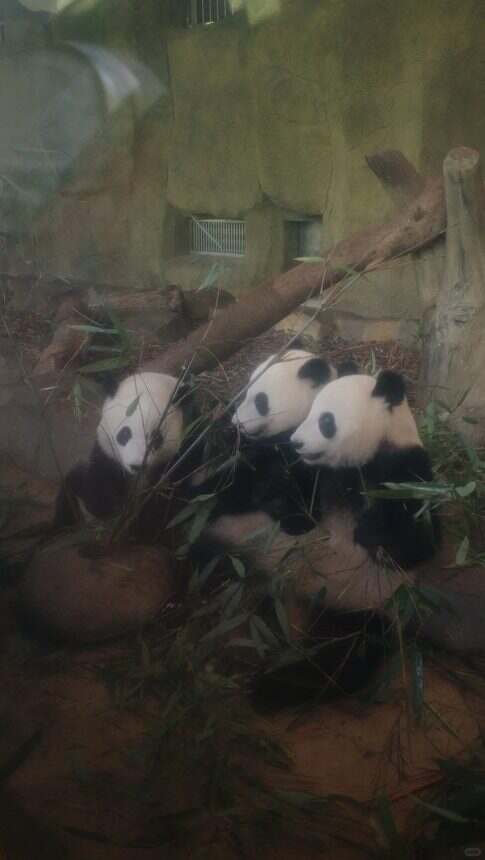


Chengdu Research Base of Giant Panda Breeding

The Chengdu Research Base of Giant Panda Breeding is a 3,570-mu breeding and conservation park on the north-east edge of Chengdu. The full walk runs from the South Gate to the West Gate — twelve stops, about 7.6 km. Tickets are 55 RMB and booked online.

成都大熊猫繁育研究基地

The Chengdu Research Base of Giant Panda Breeding is a 3,570-mu breeding and conservation park on the north-east edge of Chengdu. The full walk runs from the South Gate to the West Gate — twelve stops, about 7.6 km. Tickets are 55 RMB and booked online.

Ticket
55 RMB
Booking
Required
Online up to 14 days ahead; daily cap 85,000
Closed
No weekly closing day for the park

When to go

There is no weekly closing day for the park, but heat decides what you actually see: once the recall threshold is reached, pandas are moved indoors. The Base names the venues that have indoor viewing — villas 1, 2, 3 and 7, and the Star, Moon and Sun nurseries. Come at opening.

Tickets

55 RMB, booked online with real-name registration up to 14 days ahead; the daily cap is 85,000 and same-day sales stop once it sells out. If you hold a foreign passport you book the same way but enter through a different lane.

With a foreign passport

The Base addresses this directly, in English, in its own announcement: “Foreign visitors who are unable to purchase tickets online due to not having Chinese mobile phone number can purchase tickets at ‘trip.com’ or go to the ‘Cash and Cards service window’ when there are remaining tickets.” So there are two documented routes without a Chinese phone number: book on Trip.com, or buy at the cash-and-cards window on the day if any tickets are left — and with a daily cap of 85,000 that is a fallback, not a plan. Entry is a separate matter. Chinese ID holders swipe a card at the Original ID Card Verification Lane; if you hold a passport, a Mainland Travel Permit for Taiwan Residents, an Exit-Entry Permit for Hong Kong and Macao Residents or a household register, the Base directs you to the Lane for Passport & Other Documents, where you present a photo of the document you booked with. Book under the exact passport you will carry: one ticket is tied to one document and entry is refused if the details do not match.

Channel Works with a foreign passport When What actually happens
Official WeChat account / mini program unverified Up to 14 days ahead The Base's own channel. Requires WeChat, and refunds can only be processed on the platform you booked with. We have not verified whether it accepts a foreign passport at the booking step.
Trip.com yes Up to 14 days ahead Named by the Base itself as the route for foreign visitors who cannot book online for lack of a Chinese mobile number. Full English interface.
Meituan / Douyin / Tongcheng apps unverified Up to 14 days ahead Also named as authorised platforms on the official English page. All are Chinese-language apps that generally expect a mainland phone number and payment method.
Cash and Cards service window (on site) yes Same day, only while tickets remain The Base's own English wording for the walk-up option, available “when there are remaining tickets”. With an 85,000 daily cap that is a fallback only.
Ways people get turned away:
  • Booking for 6 September 2026 and later is frozen right now. The Base announced on 24 August 2026 that it suspended those bookings while it replaces the ticketing system, with the new system expected live on 3 September. If your dates are after 6 September and the page shows nothing available, that is the freeze, not a sell-out — retry after 3 September or call 028-83510033.
  • Joining the wrong entry lane. Chinese ID holders swipe a card at the Original ID Card Verification Lane; a foreign passport goes to the Lane for Passport & Other Documents. Follow the crowd and you queue twice.
  • Storing bags at one gate and leaving from the other. The South and West Gates are at opposite corners and the lockers are not interchangeable — a keypad bank at the South Gate, a barcode system at the West Gate. Whichever gate you stored at is the gate you must come back to.
  • Assuming the 30 RMB shuttle ticket is hop-on hop-off all day. It is valid at any stop, but once you reach either terminal you must queue and have it checked again to ride further.
  • Booking under a different passport from the one you carry. One ticket is tied to one document, and entry is refused if the details do not match.

ID you need at the gate

Entry is real-name. The Base accepts a Mainland Resident Identity Card, Social Security Card or Foreign Permanent Resident ID Card at the card-swipe lane; a Passport, Mainland Travel Permit for Taiwan Residents, Exit-Entry Permit for Hong Kong and Macao Residents, or Household Register at the staffed Lane for Passport & Other Documents, where you present a photo of the document. Seniors 60+ and children 6 and under or below 1.3 m need no reservation but still show ID.

Refunds

Read this one at the gate rather than trusting either page. Once a ticket is used there is no refund. For an unused ticket the Base's Chinese page (rule effective 27 August 2026) allows a refund within 30 days from 17:00 on the visit date with no fee mentioned, while its English page says a 20% per-ticket service fee applies within 7 days from 17:00 and nothing after that. Both are official pages of the same operator, read the same day; only the Chinese one carries a commencement date. Plan on the stricter English reading and confirm with the channel you booked through.

The route, with a story at every stop
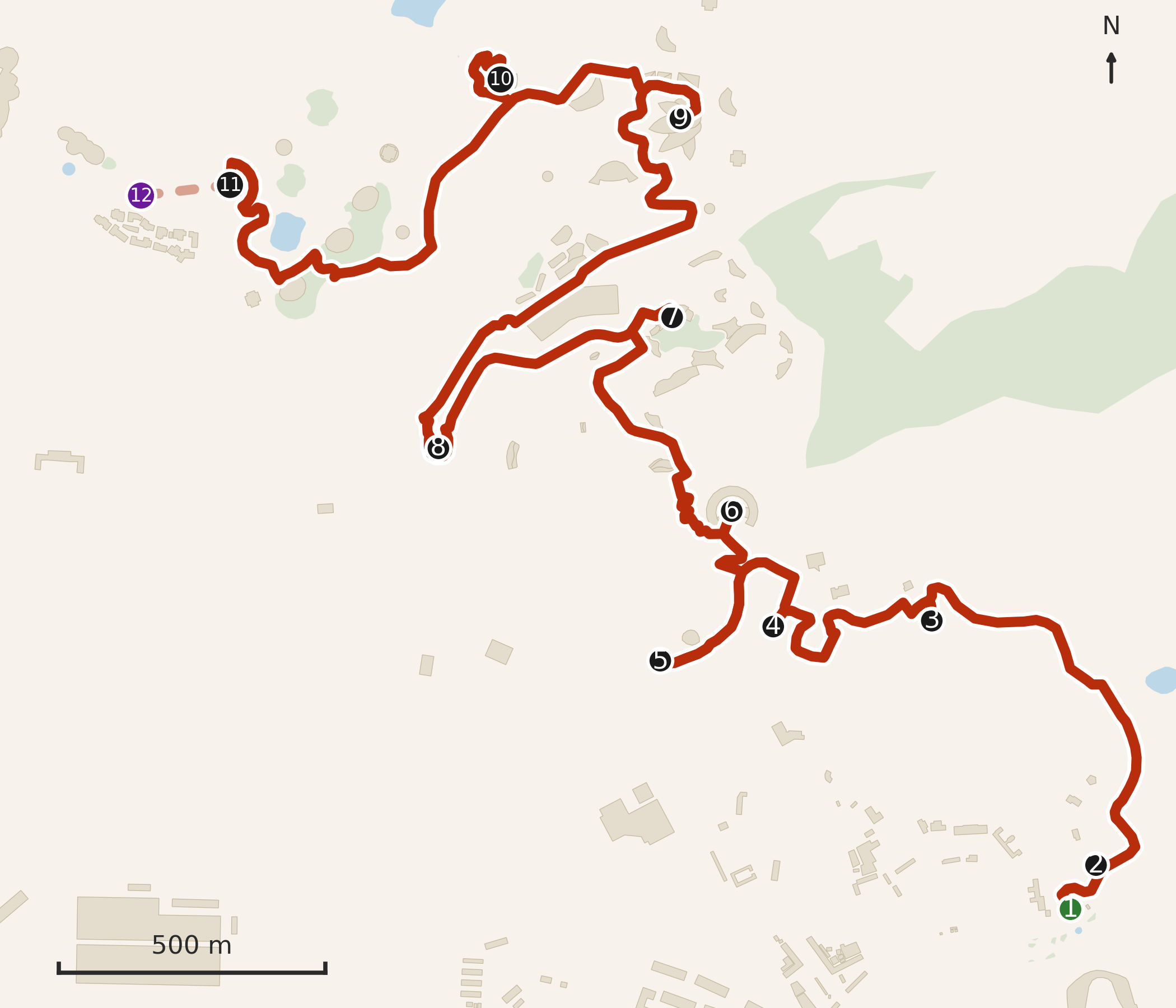
Total walking7.6 km
Stops + walking6 h 35 m
Stops12
DirectionOne-way
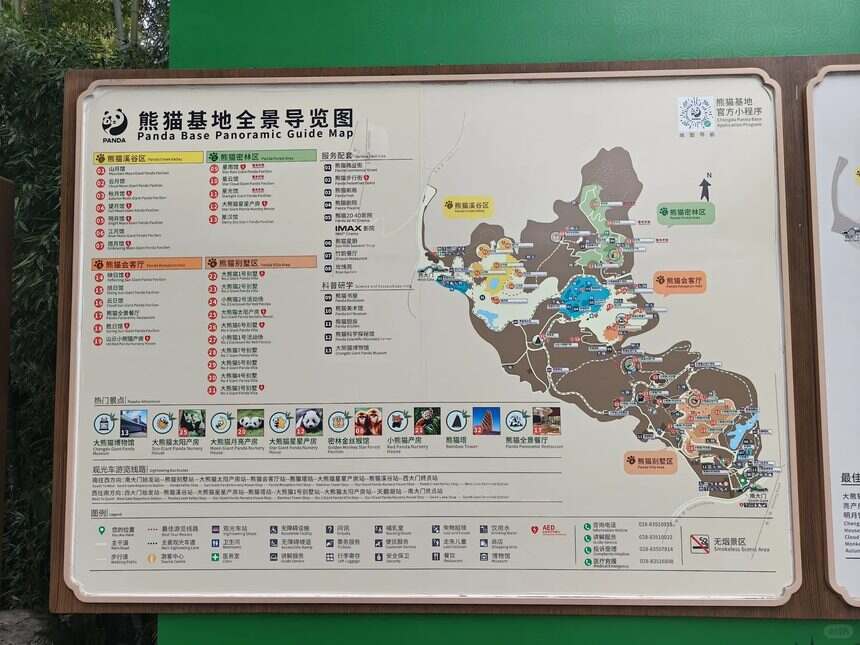
The full south-to-west route, twelve stops, drawn on the actual footpaths
The full south-to-west route, twelve stops, drawn on the actual footpaths © OpenStreetMap contributors, ODbL
1

South Gate 南大门

Stay 15 min

The South Gate is where nearly everyone starts: the tourist centre, the free lockers, the shuttle's first stop. It is also where a foreign passport stops being ordinary. Two verification lanes run side by side here, and only one of them is yours. Work out which before you join a queue.

Read the story 6:17

Narrated with synthetic voices. Script written and source-checked by our editorial team.

The South Gate is where nearly everyone starts: the tourist centre, the free lockers, the shuttle's first stop. It is also where a foreign passport stops being ordinary. Two verification lanes run side by side here, and only one of them is yours. Work out which before you join a queue.

The building

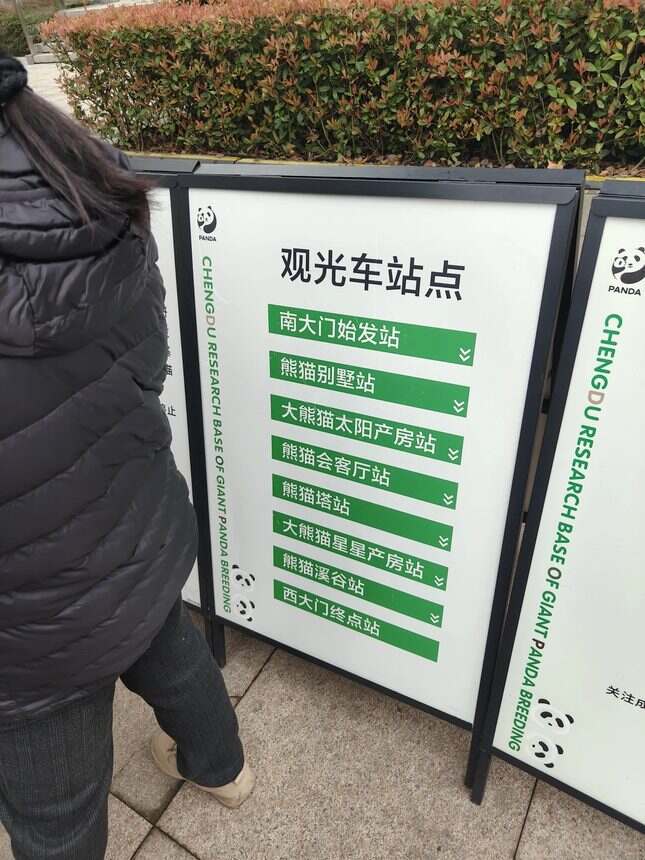
Nothing about entering the Panda Base is difficult, but almost every step assumes you are holding a Chinese ID card. Here is the foreign-passport version. Book before you go. The official English ticket page states that "The maximum daily visitor capacity is 85,000. All visitors are required to make an online real-name reservations and present the original valid ID document used for that reservation upon entry." The booking window is short: "Tickets may be reserved online up to 14 days in advance." An adult ticket is CNY 55 per person, a student ticket CNY 27 per person, and an individual annual pass CNY 168 per year. If you do not use WeChat, the same page lists the authorised alternatives as "Meituan APP, Trip.com APP, Douyin APP, Tongcheng Travel APP" plus the Chengdu Scenic Shuttle Bus WeChat account, and it links Trip.com directly. In practice Trip.com is the only one of those with a full English interface and international card checkout. Book under the exact passport name and number you will carry, because the ticket is bound to that document: "Each ticket is valid for one person only and must correspond to a single valid ID." Now the part Chinese-language guides never explain. The gate has two separate verification lanes. In the Base's own English words: "After successful booking, visitors must enter once by swiping the original document (Mainland Resident Identity Card, Social Security Card, or Foreign Permanent Resident ID Card) at the Original ID Card Verification Lane. Visitors holding a Passport, Mainland Travel Permit for Taiwan Residents, Exit-Entry Permit for Hong Kong and Macao Residents, Household Register, or those who have lost their ID card, should proceed to the Lane for Passport & Other Documents and present a photo of the relevant valid document." So do not join the turnstile queue where everyone is tapping a card. Find the staffed Passport & Other Documents lane, and have both your physical passport and a clear photo of the data page ready on your phone. Get your session right. March to October: "Morning Entry: 7:30 – 12:00; Afternoon Entry: 12:00 – 17:00. Park clearance begins at 18:00." November to February: "Morning Entry: 8:00 – 12:00; Afternoon Entry: 12:00 – 16:30. Park clearance begins at 17:30." Afternoon-ticket holders are told not to turn up early: "Visitors with afternoon tickets should not arrive early to avoid long waits." Arriving. The official transit guidance for this gate reads: "Take Metro Line 3 to Panda Avenue Station and exit at Exit A. Transfer to Shuttle Bus 408 directly to the Base South Gate." Alternatively, "Take Metro Line 3 to Zoo Station and exit. Transfer to Buses 655 or 87 directly to the Base South Gate." By taxi the Base publishes reference fares and durations: Chengdu East Railway Station "About CNY 40" and "25–30 mins"; downtown Chunxi Road "About CNY 40" and "25–35 mins"; Shuangliu International Airport "About CNY 100" and "40–50 mins"; Tianfu International Airport "About CNY 200" and "60–70 mins". Once through, use the South Gate Tourist Center before you start walking. It is open "7:30 to 18:00 (March to October) and from 8:00 to 17:30 (November to February)." Luggage storage here is free and self-operated: "Simply open an unused locker, set a 1-8 digit password, and press the “#” key to confirm and lock." Oversized bags go to the manual counter, and "Both luggage storage methods are free of charge". The same desk lends, at no cost, "strollers, wheelchairs, umbrellas, walking sticks, sewing kits, and microwaves", and the gate area has a nursing room, a rest and reading area, and a free drinking-water dispenser. Two things worth buying at the gate. The shuttle costs "Full-price Ticket: CNY 30 per person", with sales hours of "Summer (March-October): 7:30 - 17:30, service ends at 18:00;" and "Winter (November-February): 8:00 - 17:00, service ends at 17:30." Its southbound run is "South Gate Departure Station → Panda Villa Stop → Sun Giant Panda Nursery House Stop → Panda Reception Hall Stop → Bamboo Tower Stop → Star Giant Panda Nursery House Stop → Panda Creek Valley Stop → West Gate Terminal Station." Self-service audio rental costs "Entire Park: CNY 30/audio guide/day; Museum Only: CNY 20/audio guide/day;" it "supports multiple language options including Chinese and English" and can be returned at any kiosk in the park. Live guides work from the "South Gate Guide Service Point", with service hours of "7:30 – 17:30" on 028-83510022.

Look for

  1. Two different verification lanes at the gate. One is a turnstile bank where Chinese visitors tap a card — the "Original ID Card Verification Lane". The other is the staffed "Lane for Passport & Other Documents", where a person checks your passport and the photo of it. Look for the staffed counter, not the card readers, and do not let the flow of the crowd carry you into the wrong one.
  2. The South Gate Tourist Center, open "7:30 to 18:00 (March to October) and from 8:00 to 17:30 (November to February)". Inside: the front desk that lends "strollers, wheelchairs, umbrellas, walking sticks, sewing kits, and microwaves" free of charge, the nursing room, and the lost-and-found desk (028-83507814).
  3. The South Gate self-service locker bank. It is the keypad type, not the barcode type used at the West Gate: "Simply open an unused locker, set a 1-8 digit password, and press the “#” key to confirm and lock." There is no fee. If your case is too big, ask the front desk for the manual storage service.
  4. The self-service audio guide kiosk. Rental is "Entire Park: CNY 30/audio guide/day; Museum Only: CNY 20/audio guide/day", it "supports multiple language options including Chinese and English", and you can drop it at any kiosk in the park rather than walking back here.
  5. The sightseeing bus boarding point: "South Gate Departure Station", the first stop on the "(1) South to West" route. CNY 30 per person, and note that "Upon arrival at the South Gate or West Gate Terminal Station, passengers must re-queue and have their tickets checked again if they wish to take another ride."
  6. The "South Gate Guide Service Point" for live human guides (service hours "7:30 – 17:30", hotline 028-83510022), and the free drinking-water dispenser listed at the South Gate Tourist Center — fill your bottle before you start the climb into the park.
  7. The bronze panda statue just inside the gate — the official notice places the South Gate clinic next to it: "South Gate Clinic is located next to the Bronze Panda Statue". Useful to register on arrival, especially in summer heat.

Sources for this stop: s_0ad6d2f9 · s_07d052ab · s_1693bcba · s_a6ffb383 · s_a7f25fa3 · s_4316e0ab · s_d5c61fd9 · s_05dd879b · s_1428660c · s_69930053 · s_b5334016 · s_750d3464 — documented

2

Chengdu Giant Panda Museum 大熊猫博物馆

Stay 40 min 167 m from stop 1

Push open the doors and the lobby stages a giant book: turning its pages starts the route. Everything past it is under a roof — a time tunnel, a dig pit, a dome cinema, a live video feed from wild panda reserves. The bears are outside; the reasoning behind them is in here.

Read the story 8:57

Narrated with synthetic voices. Script written and source-checked by our editorial team.

Push open the doors and the lobby stages a giant book: turning its pages starts the route. Everything past it is under a roof — a time tunnel, a dig pit, a dome cinema, a live video feed from wild panda reserves. The bears are outside; the reasoning behind them is in here.

The building

The Chengdu Giant Panda Museum is the Panda Base's indoor argument, and the Base is precise about its dates. The museum was first established in 1992; fit-out of the new building began in August 2019; it opened to the public on 3 March 2021. The building covers 7179 square metres, of which 4342 square metres is exhibition space, and it is organised into seven main galleries plus one 3D cinema and one dome cinema. The Base describes it as the world's first interactive-experience museum devoted to the giant panda. That is worth reading as the institution's own claim rather than as an independently audited one. Why it exists is better explained by the Base's education record than by its architecture. The Base was founded in 1987. In 2000 it set up a dedicated science-education department, the first inside China's wildlife conservation system, eventually staffed with 32 people including 23 full-time science educators and one foreign environmental-education specialist. Over the past decade the Base says it has run or co-run more than 3,600 science-education activities. The museum is the flagship among eight science-display settings spread across a core area of 3,570 mu, roughly 238 hectares, and it underpins nine study-tour course programmes. The building is the physical form of a department that existed long before it. The route is fixed, chronological, and published by the Base: Museum Lobby, Time Tunnel, Panda Prequel, Archaeology Room, Bamboo Grove Hermit, Habitat Exploration Centre, Discovering the Panda, Scientific Discovery Centre, Endangered Era, Endangered Rescue Centre, Road of Conservation, Research Laboratory, Ecological Homeland, Creating the Future. Read as a sequence it makes an argument in stages: deep time first, then biology, then the human history of finding and removing pandas, then the crisis and the institutional response to it. The stated design theme is the harmony of people, giant pandas and nature, delivered through interactive stations, scene reconstruction and immersive rooms rather than through cases of objects. The first movement opens in the lobby, where oversized book pages are turned to begin the journey of discovery, and continues into a time tunnel that carries visitors back eight million years. Panda Prequel handles prehistoric scene restoration, the evolutionary path of the giant panda, its former range and its classification; the adjoining archaeology room has an excavation sandpit. Bamboo Grove Hermit turns to the living animal: how it grows, how it chooses what to eat, and what its digestive tract looks like. The Habitat Exploration Centre covers biodiversity, how pandas communicate, and panda behaviour. The Scientific Discovery Centre is where the anatomy sits, including the pseudo-thumb, the teeth, panda vocal communication, and the skeleton, musculature and gut. Together these rooms make the point that matters most and that no enclosure can make: this is a bear carrying a carnivore's digestive plumbing that has committed to bamboo, and most of what looks lazy or strange about panda behaviour follows from that mismatch. Discovering the Panda is the most historically loaded room, and the Base's own contents list is blunt about it: the scientific discovery of the giant panda, the pandas Chi-Chi and Su Lin, a reconstruction of the Wuyipeng field-survey hut, the leading figures of panda conservation, and displays of field survey work and the equipment it used. Very different histories are stacked into one space. One is the Western collecting era, when live pandas left China as trophies and zoo attractions: the Field Museum in Chicago records that in 1936 Ruth Harkness, a New York dressmaker, set off for China meaning to bring a panda back alive, became the first to do so, and set in motion a public fascination that has not stopped since. The other history is Chinese field science, represented by the reconstructed hut and the survey gear. The museum puts the celebrity animals and the working hut in the same room, and it is worth noticing which one it gives more floor space to. The second half of the route turns to loss and to institutions. Endangered Era deals with wild habitat, with the concepts of umbrella species and flagship species, and with China's protected animals more broadly. The Endangered Rescue Centre carries a live video link to field monitoring cameras inside giant panda nature reserves. Road of Conservation combines immersive habitat reconstruction with material on wild population surveys, Giant Panda National Park, and the reintroduction of captive-bred animals to the wild. Then comes a gallery on the research laboratory, and here the museum is unusually well placed, because the laboratory it depicts is a working facility on the same site rather than a metaphor. That laboratory was established in 1997, was formally approved as a Sichuan provincial key laboratory in 2001, and in 2007 became a state key laboratory cultivation base jointly built by ministry and province, hosted by the Base together with Sichuan University. By the end of 2022 the Base reported that its Chengdu giant panda population had reached 237 animals, on the back of more than 400 research projects, more than 400 published papers, and more than 80 national patents, over 40 of them invention patents. It is worth being clear about what the museum is not. There are no live pandas inside it. Visitors who arrive expecting animals and find galleries sometimes turn around at the door, which throws away the clearest explanation of pandas available anywhere in the park. The museum also has two indoor neighbours that are easy to confuse with it. The Panda Scientific Discovery Centre is an older and smaller venue of about 1000 square metres, built around six display themes and 40 touch screens covering panda reproduction, genetics, nutrition and endocrinology. The Panda Art Museum is different again: a two-storey building in the Forest zone on a 2004-square-metre plot, holding 49 works by 15 artists, run as a non-profit venue for collecting and exhibiting panda-related art. Practically, the museum is the strongest wet-weather and hot-weather asset in the park. The Base warns that when temperatures reach its threshold for bringing pandas in, the animals are moved indoors and visitors are directed to venues with indoor viewing areas; it separately warns about slippery paths in rain and snow. A large roofed building answers both problems. Park entry runs from 7:30 to 12:00 for morning tickets and 12:00 to 17:00 for afternoon tickets between March and October, with clearing from 18:00; from November to February the windows are 8:00 to 12:00 and 12:00 to 16:30, with clearing from 17:30. Adult admission is 55 yuan, booking is online and under real name up to 14 days in advance, and foreign passport holders use the entry lane for visitors without a Chinese identity card. Audio guides rent at 30 yuan per day for the whole park or 20 yuan per day for the museum alone, with Chinese and English available. One caution: many travel sites state that the museum closes on Mondays. The Base's official visitor notice names as Monday closures only the Panda Art Museum, for maintenance, and the busiest villa enclosure, under an animal rest-rotation trial, with national public holidays excepted in each case. Nothing published on the official site says the museum itself closes on Mondays. Until the Base confirms it, treat the Monday claim as unverified rather than as a fact to plan around.

Look for

  1. The lobby's oversized book pages — the official route starts by turning them, and immediately behind is the Time Tunnel that sets the museum's opening date at eight million years ago. If you skip the lobby you lose the whole chronological logic of the floor plan.
  2. In the Scientific Discovery Centre: the pseudo-thumb case, the teeth, and the mounted skeleton, musculature and digestive tract shown together. This is the single set of objects that explains why a bear eats bamboo and why it must eat so much of it — nothing outside in the enclosures can show you this.
  3. In Discovering the Panda: the reconstruction of the Wuyipeng field-survey hut, plus the cases of field survey equipment beside it. Compare the amount of space given to that hut with the space given to the Chi-Chi and Su Lin panel — the balance is the museum's editorial position on whose history matters.
  4. In the Endangered Rescue Centre: the screens carrying the live link to field monitoring cameras inside giant panda nature reserves. Check whether the feed is actually running when you visit; when it is, it is the only place on site showing wild pandas' habitat in real time.
  5. The Archaeology Room's excavation sandpit — the one hands-on station that works for children, and a useful reason to let a family group split up for ten minutes.
  6. The two auditoria: one 3D cinema and one dome (planetarium-style) cinema. Screening times are not published online, so look for the board or ask at the desk on the way in rather than on the way out.

Sources for this stop: s_ad6959fb · s_ea77917b · s_8ae3f9f7 · s_d25003da · s_bdd25e18 · s_9bef8faf · s_bff3d344 · s_05dd879b · s_0ad6d2f9 · s_821c4705 · s_d699fd93 · s_4906e010 · s_383c8e18 — documented

3

Sun Giant Panda Nursery House 大熊猫太阳产房

Stay 30 min 907 m from stop 2

This stop is a working maternity building, not a display pavilion. Behind the glass, panda cubs born at around 120 grams are raised in incubators, and twins are swapped in and out of their mother's care around the clock. What you actually see depends on the season: sleeping infants in autumn, climbing juveniles by spring.

Read the story 8:45

Narrated with synthetic voices. Script written and source-checked by our editorial team.

This stop is a working maternity building, not a display pavilion. Behind the glass, panda cubs born at around 120 grams are raised in incubators, and twins are swapped in and out of their mother's care around the clock. What you actually see depends on the season: sleeping infants in autumn, climbing juveniles by spring.

The building

The Sun Giant Panda Nursery House is not a viewing pavilion that happens to hold pandas. It is a working maternity and rearing facility that the Base opens to visitors along one edge. The official English name used on the Base's own tour-bus route is "Sun Giant Panda Nursery House Stop," and it sits second on the South-to-West line, between the Panda Villa Stop and the Panda Reception Hall Stop. The Chinese name, 太阳产房, literally means "sun delivery room." The Base's own introduction lists what the park is built out of in this order: giant panda nursery houses, panda husbandry zones, scientific research laboratories, and a panda hospital. The nursery houses come first because, for a species this difficult to breed, they are the point. To understand why a delivery room needs to exist at all, start with the newborn. The Base's popular-science page states that a newborn cub weighs only one-thousandth of its mother's weight, averages around 120 grams, with the lightest recorded at 51 grams and the heaviest at 225 grams; its skin is pink, it is covered in white fur, and its eyes, ears and immune system are not yet fully developed. A 2018 peer-reviewed study in PLOS ONE puts the same fact in comparative terms: giant panda neonates are "the most altricial of all eutherian mammals having the smallest neonate-maternal weight ratio." A cub that small cannot regulate its own temperature, cannot see, and cannot urinate without being stimulated. Left to chance, it dies. So the building around it becomes part of its physiology. The second problem is arithmetic. The PLOS ONE paper notes that twinning "occurs in about half of all litters," and that mothers who initially try to care for both cubs generally give up and rear only one. Two cubs, one functioning mother: that is the bottleneck that the whole discipline of panda neonatal care was built to break. The answer, developed and refined across Chinese breeding institutions, is swap-rearing. In the words of the same paper, "nearly all females readily accept either twin if presented to them individually, which led to the current zoo practice of swapping twins back and forth between the mother and a nursery every few days or even hours, so each cub is half mother- and half hand reared." Chengdu has a specific claim on that history. In a 2017 anniversary article, the Base recounts that after the birth of the twins Yaya and her brother Xiangxiang, its specialists exploited the good maternal instincts and human-cooperativeness of a female named Qingqing, combining maternal rearing with an infant incubator so that the twin brother and sister took turns nursing while both were kept under strict health monitoring. The result, the Base writes, was that both twins developed well, opening a new and successful path for rearing giant panda twins. Yaya is described in the same article as the "elder sister" of the world's first successfully artificially bred giant panda twins, born on the opening day of the 1990 Beijing Asian Games, and later a prolific mother herself with 13 cubs across 9 litters, 12 of which survived. The technique you are looking at through the glass is, in part, hers. What that looks like operationally was documented in a 2021 paper in Animals by researchers from the Chengdu Base itself, which followed nine captive adult females under different nursing regimes. In the twin group, "the twin mothers only nursed one cub at a time, and the two cubs were constantly swapped for feeding," and cubs on the artificially assisted method "were mainly raised in incubators during the nursing period." This is the invisible half of the nursery house. The incubators, the weighing scales, the round-the-clock keeper shifts and the swap schedule are behind the wall; what visitors see is the outcome. The scale is real and it is seasonal. In a September 2022 announcement, the Base reported that it had successfully bred 15 giant pandas that year, including four sets of twins, with the heaviest birth weight reaching 218.5 grams. By late September those cubs were, in the Base's words, in good condition with the heaviest approaching 6 kilograms, and they were housed across the Sun Nursery House and the Moon Nursery House; 13 of them took part in the public debut. The Base added that visitors could see them lying asleep on their beds inside the viewing areas of the Sun and Moon Nursery Houses, with a display window of 8:00 to 18:00, and that before long the cubs would move out to the outdoor exercise yards to play. Individual birth weights the Base has published elsewhere show how much variation there is: in 2017 the twins Zhishi and Zhima weighed 104.9 and 110.7 grams, while another pair that year weighed 203.6 and 90.8 grams. Knowing the developmental timetable tells you what you are actually looking at. Per the Base's own science page: at one month a cub weighs 1 to 2 kilograms and still cannot walk; at six to eight weeks it can open its eyes; at three months it can slowly crawl; at half a year it can walk freely and begins learning to eat bamboo; at one and a half years it leaves its mother and lives independently. The PLOS ONE study describes the denning period as lasting "approximately three to four months after parturition." So an autumn visit in a birth year may show you a motionless, sleeping, thermally managed infant behind glass. A visit in spring shows you a very different animal: a mobile, climbing, bamboo-curious juvenile in an outdoor yard. Both are the same building's product; neither is on a schedule you control. There is a cost side, and the Base's own scientists have published it. The 2021 Animals paper found that, compared with the artificially assisted method, females on singleton parent-rearing spent significantly more time in mother-cub interaction and significantly less of their daily budget on pacing and railing-directed behaviour. Its conclusion is blunt: the artificially assisted nursing method "significantly increased the time the dam spent engaged in pacing behavior and the frequency of railing-directed behavior, and increased the length of the maternal deprivation, causing the captive adult female giant pandas to develop severe psychological anxiety, damaging the relationship between the mothers and their cubs." Swap-rearing saves cubs that would otherwise die. It is also measurably hard on the mother. A nursery house is where that trade-off is made, daily, by people who publish the downside in peer-reviewed journals rather than hide it. That is worth more of your attention than the cuteness. Finally, the practical judgement. The Base's visitor notice states plainly that giant pandas are by nature fond of cool weather and afraid of heat, and that when the temperature reaches the indoor-recall threshold, staff will guide pandas back inside to rest, directing visitors instead to venues that have indoor display areas. The same notice warns that areas may temporarily close, or animals be temporarily invisible, because of bad weather, animal care, venue maintenance or park management. Translated: on a hot Chengdu afternoon, outdoor yards can be empty, and an enclosed nursery house with an indoor viewing area is one of the better bets in the park. Combine that with the Base's admission windows — morning entry from 7:30 to 12:00 and clearing from 18:00 between March and October, morning entry from 8:00 to 12:00 and clearing from 17:30 from November to February — and the answer for a nursery-house visit is: arrive at opening, walk or ride to this stop first, and treat anything you see as a bonus rather than a booking.

Look for

  1. The tour-bus stop sign itself. The Base's official route lists "大熊猫太阳产房站" / "Sun Giant Panda Nursery House Stop" on both directions of the sightseeing bus: second stop after South Gate on the South-to-West line (after Panda Villa Stop, before Panda Reception Hall Stop), and after No.1 Giant Panda Villa Stop on the West-to-South line. Use it to locate yourself. A full-price bus ticket is CNY 30 per person, valid for boarding at any stop on the day of purchase. (Source: official 观光车服务 / Tour Bus Service pages)
  2. The indoor viewing area versus the outdoor exercise yard. These are two different things at a nursery house. In its 2022 debut announcement the Base said visitors could see the cubs lying asleep on their beds inside the viewing areas of the Sun and Moon Nursery Houses, with a display window of 8:00–18:00, and that the cubs would later move out to the outdoor exercise yards. The 2017 debut description also mentions a visitor walkway (游客道) running outside the Moon Nursery House's exercise yard. (Source: official 2022 and 2017 debut articles)
  3. Which nursery house is actually in use. The Base runs more than one: 太阳产房 (Sun) and 星星产房 (Star) are both sightseeing-bus stops, and 月亮产房 (Moon) appears in the Base's own articles as a cub-housing and debut venue. In 2022 the newborn cohort was split between the Sun and Moon houses; the 2017 debut was staged at the Moon house. Occupancy moves between buildings, so check on the day rather than assuming. (Source: official bus route page + 2022 and 2017 debut articles)
  4. Body size as an age clue. The Base's own science page gives the scale: a newborn averages about 120 grams (lightest recorded 51 g, heaviest 225 g); at one month a cub weighs 1–2 kg and still cannot walk; eyes open at six to eight weeks; it can crawl slowly at three months; at six months it walks freely and starts learning to eat bamboo. If the animal in front of you is climbing and mouthing bamboo, it is past six months and no longer a nursery infant. (Source: official 【熊猫知识】大熊猫生长发育)
  5. Empty outdoor yards on hot days. The Base's visitor notice states that pandas are by nature cool-loving and heat-averse, and that once the indoor-recall ("收猫") temperature threshold is reached, staff will guide them back indoors and direct visitors to venues that have indoor display areas. An empty yard in July is a management decision, not bad luck. (Source: official 游客须知)

Sources for this stop: s_8ae3f9f7 · s_d25003da · s_69930053 · s_1428660c · s_9cea68b6 · s_bb8f550e · s_33101c45 · s_05dd879b · s_a6ffb383 · s_085d7070 · s_eceb59ea — documented

4

Red Panda Nursery House 小熊猫产房

Stay 20 min 568 m from stop 3

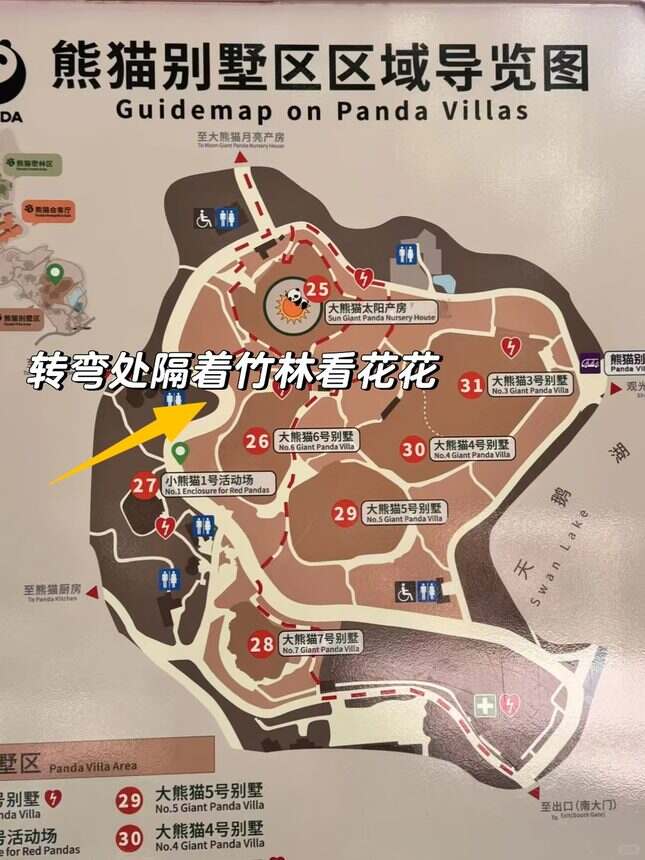
Number 21 on the Panda Base guide map is not a small giant panda. The red panda is the last surviving member of its own family, Ailuridae. Some red panda areas here are walk-through, meaning you share the ground with the animals, and the Base requires you to keep three metres away.

Read the story 7:15

Narrated with synthetic voices. Script written and source-checked by our editorial team.

Number 21 on the Panda Base guide map is not a small giant panda. The red panda is the last surviving member of its own family, Ailuridae. Some red panda areas here are walk-through, meaning you share the ground with the animals, and the Base requires you to keep three metres away.

The building

On the Panda Base's own Panoramic Guide Map, the Red Panda Nursery House is site No. 21, and it is one of the eight sites the map singles out under the heading 热门景点 / "Popular Attractions". Get the names right before you walk, because the map shows four separately named red panda sites: No. 21 小熊猫产房 Red Panda Nursery House, No. 19 山丘小熊猫产房 Hill Red Panda Nursery House in the Panda Reception Hall district, and two open yards, No. 27 小熊猫1号活动场 No.1 Enclosure for Red Pandas and No. 24 小熊猫2号活动场 No.2 Enclosure for Red Pandas, both in the Panda Villa Area. Asking staff for "the red panda place" will not narrow anything down. The single most useful thing to know here is a negative one: the red panda is not a small giant panda, and the two are not close relatives. The red panda is the sole living species of its own family. A 2024 anatomical study in BMC Veterinary Research states flatly that "The red panda is currently the only surviving member of the Ailuridae family in the Caniformia suborder," and traces the long taxonomic argument behind that sentence: early work placed the red panda in Procyonidae partly because it was "thought to be related to the giant panda," a comparative study in 1982 moved it into its own family Ailuridae, and, as the paper puts it, "Ultimately, after extensive genetic research, the red panda was assigned to the clade Musteloidea, which also encompasses the Procyonidae, Mustelidae, and Mephitidae families." Musteloidea is the branch that holds the raccoons, the weasels and the skunks. The giant panda sits somewhere else entirely: the same BMC paper groups it with Ursidae, "including the giant panda (Ailuropoda melanoleuca), American black bear (Ursus americanus), brown bear (Ursus arctos), and the polar bear (Ursus maritimus)." Giant pandas are bears. Red pandas are not. So why do both eat bamboo and both have a "thumb"? Because they arrived at the same solutions independently. A study in the Proceedings of the National Academy of Sciences explains that the panda "false thumb" is not a thumb at all but "a carpal bone, the radial sesamoid, which has been enlarged and functions as an opposable thumb," and that a shared version of it in two unrelated animals "implies a remarkable convergence." Fossils of a Miocene relative of the red panda, Simocyon batalleri, showed the same enlarged bone in a meat-eating, tree-climbing animal, which led the authors to conclude that "whereas the false thumb of the giant panda probably evolved for manipulating bamboo, the false thumbs of the red panda and of S. batalleri more likely evolved as an aid for arboreal locomotion." The giant panda's grip is a bamboo tool; the red panda's is a climbing tool that was later repurposed. Watch the forepaws and you are watching one of the better-documented cases of convergent evolution in mammals. The red pandas are not a sideline here. The Base's official introduction describes the institution as "globally renowned for protecting and breeding giant pandas, red pandas and other rare wild animal species endemic to China," and its panda hospital page lists responsibility for "大熊猫、小熊猫等濒危珍稀野生动物" — giant pandas, red pandas and other endangered rare wildlife. Real research runs through these enclosures. A 2017 study in PLOS ONE measured the resting metabolic rate of red pandas at this Base, reporting 0.290 ml/g/h in summer and 0.361 ml/g/h in winter, with a sample of 17 animals; the authors note that they "studied red pandas at the Panda Base in Chengdu, China" in cooperation with its research, veterinary and husbandry staff. Now the part that changes how you behave. Unlike the giant panda enclosures, some red panda areas at this Base are walk-through: there is no glass and no moat between you and the animal, and red pandas may cross the path in front of you. The Base's Visitor's Info states the rule directly — "keep at least 3 meters away from any free-roaming animals and red pandas in walk-through areas. Do not sit or stand on railings or in other hazardous locations, and never climb over protective barriers." The Chinese original is identical in force: "与园区内散养动物及进入式参观的小熊猫保持3米以上距离,请勿坐或站在栏杆及其他危险位置,切勿翻越防护栏。" The same Park Rules prohibit "throwing debris, spitting, or feeding animals in animal enclosures" and "making loud noises or using camera flashes." The three-metre rule is not decoration. A 2025 study in Zoo Biology surveying 150 zoos in the red panda Global Species Management Plan describes the species as "a characteristically cautious species and prone to disturbance," and notes that concern "has been raised as to their suitability for encounters" — 39% of surveyed zoos offer red panda encounters, most of them feeding experiences. In a walk-through space the animal cannot retreat behind a barrier from you; the distance is the barrier, and you are the one who maintains it. Step back rather than lean in, keep bags and selfie sticks low, and let the animal choose the path. Timing. Published activity data do not all point the same way, so plan for the morning and accept variance. A 2023 study in Animals tracking seven captive red pandas at three Australasian zoos found they "followed a crepuscular activity pattern, with another short peak of activity around midnight," and that "red panda allocated more time to resting and sleeping when temperatures increased." A 2026 camera-trap study in Sichuan's Liziping National Nature Reserve found wild red pandas "peaked mainly at 8:00-10:00." Both favour arriving early. The Base opens for morning entry at 7:30 (March to October) and 8:00 (November to February), so walking straight to No. 21 at opening is your best window, and a hot Chengdu afternoon is your worst. Note also that the Base's sightseeing bus route has no red panda stop — the published stops are Panda Villa, Sun Giant Panda Nursery House, Panda Reception Hall, Bamboo Tower, Star Giant Panda Nursery House and Panda Creek Valley — so you reach No. 21 on foot.

Look for

  1. The forepaw when the animal takes hold of a bamboo culm or a branch. What looks like a thumb is the enlarged radial sesamoid wrist bone described in the PNAS study — and in the red panda it is thought to have evolved first for climbing, not for eating. Compare the grip you see here with the giant panda's grip an enclosure or two away; that comparison is the whole point of this stop.
  2. The map number on the signage before you commit. No. 21 小熊猫产房 Red Panda Nursery House, No. 19 山丘小熊猫产房 Hill Red Panda Nursery House, No. 27 小熊猫1号活动场 No.1 Enclosure for Red Pandas and No. 24 小熊猫2号活动场 No.2 Enclosure for Red Pandas are four different places on the official guide map, and only some red panda areas are walk-through.
  3. Whether there is any barrier at all between you and the path. In a walk-through area there is no glass and no moat, so scan the ground ahead of you rather than only the trees. If an animal moves toward the path, step back — the Base's rule is at least 3 metres, and in a walk-through space you are the one who maintains the distance.
  4. Where the animals have chosen to sit relative to sun and shade. The 2023 Animals study found captive red pandas 'allocated more time to resting and sleeping when temperatures increased'; on a warm Chengdu afternoon expect a motionless animal wedged high in a fork of a tree rather than anything at eye level.
  5. The 熊猫龙门阵 / 'Panda Chat' interpretive sessions. The Base's own introduction says the programme is delivered in front of the giant panda and red panda enclosures, so if a keeper-led talk is running at a red panda site, that is the one place you will get species-specific information rather than generic panda content.

Sources for this stop: s_05dd879b · s_d5c61fd9 · s_8ae3f9f7 · s_d25003da · s_a477358a · s_d07ae1d1 · s_1693bcba · s_1428660c · s_ce6c61de · s_57d9f1f4 · s_8651eec2 · s_cd0ab788 · s_c04e8046 · s_8126f2a3 · s_8d52bcc7 · s_5be560eb — documented

5

No.1 Giant Panda Villa 大熊猫1号别墅

Stay 20 min 478 m from stop 4

“Villa” is the Panda Base’s official word for an adult giant panda’s own enclosure, and No.1 Giant Panda Villa is the first of seven in the Panda Villa Area. The name sounds like marketing; it is actually a husbandry decision. Wild giant pandas are solitary, and adults are housed apart.

Read the story 6:14

Narrated with synthetic voices. Script written and source-checked by our editorial team.

“Villa” is the Panda Base’s official word for an adult giant panda’s own enclosure, and No.1 Giant Panda Villa is the first of seven in the Panda Villa Area. The name sounds like marketing; it is actually a husbandry decision. Wild giant pandas are solitary, and adults are housed apart.

The building

“Villa” is not a tour-operator flourish. It is the Panda Base’s own word. The base’s official English introduction describes how “the park’s landscaping recreates the giant pandas’ native wild habitats. Giant panda nursery houses, panda husbandry zones, scientific research laboratories, and a panda hospital are neatly laid out, while a number of premium panda ‘villas’ are scattered among the mountains and forests,” and it divides the 3,570-mu core area (approx. 238 hectares) into four themed zones, one of which is the Panda Villa Area. On the base’s own panoramic guide map, that zone holds seven numbered giant panda villas, No.1 through No.7, alongside the Sun Giant Panda Nursery House and two red panda enclosures. No.1 Giant Panda Villa is map point 22. Strip the word back and what a villa denotes is an outdoor enclosure for adult giant pandas, paired with indoor quarters, each unit separately fenced and separately numbered. The number is the point. Seven villas exist because the animals inside them cannot be pooled. Giant pandas are not social. A 2022 study in Movement Ecology, which genetically identified an entire local wild population, puts it flatly: “The giant panda (Ailuropoda melanoleuca) is a solitary and non-cooperative bamboo eater species with a promiscuous mating system.” The same paper notes that pandas “rarely encounter each other, except for copulatory behavior during the mating season,” and that telemetry shows they “have highly overlapped home ranges but no direct contact during most of the year.” Their social information travels by scent rather than by contact: they are “highly dependent on chemical communication and can detect the presence of other individuals at great distances as well as information from pheromones deposited in the environment.” The authors conclude that these indirect interactions “potentially function to reduce competition for resources and inbreeding.” Solitude is not deprivation for this species; it is the arrangement its behaviour assumes. Captive management modifies that at one life stage only. Research conducted at this base and published in Animals in 2024 explains that “given their highly solitary nature, sub-adult giant pandas typically undergo a phase of group living during the ex situ protection process aimed at optimizing space and management efficiency,” after weaning, “which typically occurs between 1.5 and 2 years old.” Comparing six sub-adults at this base, three managed individually and three managed as a group, the study found the group-housed animals played significantly more and showed significantly less stereotyped behaviour, with no significant difference in urine cortisol or heart rate variability. So young pandas can be roomed together. Adults are the ones who get a villa each. The base now also treats visitor pressure as a welfare variable. On 22 December 2023 it announced a trial rotational rest system for animals (动物轮休制度), and its current visitor notice states that “No.6 Giant Panda Villa, an area with consistently high visitor traffic, will be closed to the public every Monday (except on national statutory holidays) as part of this initiative.” Read the number carefully. That closure applies to No.6, not to No.1, and no Monday closure has been published for No.1 Giant Panda Villa. The 2024 study, separately, lists “tourist noise, changes in enclosures, and unfamiliar odors” among the non-natural stressors of the captive environment, which is the logic such a closure rests on. Heat empties this yard more often than any schedule does. The official notice states that “giant pandas naturally prefer cool weather and are sensitive to heat,” and that “when the temperature reaches the ‘indoor recall’ threshold, we will guide them indoors in due course, taking into account both enclosure conditions and the animals’ behavioral patterns.” The base does not publish that threshold as a number. On a hot afternoon the villa’s outdoor yard may simply be empty, and the notice’s own advice is to visit “pavilions with indoor viewing areas” instead. One practical trap: there are two differently named shuttle stops here. The paid sightseeing bus (CNY 30 per person) runs one-way, and the official route list places “No.1 Giant Panda Villa Stop” only on the West-to-South direction, between Bamboo Tower Stop and Sun Giant Panda Nursery House Stop. The South-to-West direction instead has a separate “Panda Villa Stop.” If you board at the South Gate, the bus will not stop at No.1 Villa. Time your visit for the morning. Park entry opens at 7:30 from March to October and at 8:00 from November to February. In the 2024 study, the base’s animals “were released into the outdoor playgrounds at 8:30 each day and brought indoors at 17:30,” with feeding “at 8:00 and 13:00 daily with an ample bamboo supply available.” That is a research protocol rather than a park-wide guarantee, but it matches what visitors report: activity early, and an adult asleep in a corner by mid-afternoon, which is normal behaviour, not a bad day.

Look for

  1. The single-occupancy layout: one fenced outdoor yard with its own climbing structures, and indoor quarters behind it. Compare it with the Sun Giant Panda Nursery House a few minutes away in the same zone, where cubs are handled together — the villas are built on the opposite assumption. The official guide map lists seven of them, No.1 through No.7, in this zone alone.
  2. Scent-marking surfaces low down: posts, tree bases, wall corners. Zhou et al. (2022) note that giant pandas are “highly dependent on chemical communication and can detect the presence of other individuals at great distances as well as information from pheromones deposited in the environment.” This is how a solitary animal holds a conversation with neighbours it never meets.
  3. The sightseeing-bus plate marked on the official map immediately below the villa: 大熊猫1号别墅站 / No.1 Giant Panda Villa Stop. It serves the West-to-South direction only, so if you rode in from the South Gate you were set down at the separately named “Panda Villa Stop” instead.
  4. The AED marker. On the official panoramic guide map, No.1 Giant Panda Villa carries the red AED (automated external defibrillator) icon — only a handful of park locations do. Worth registering if you are visiting with elderly travellers on a hot day. The base’s medical emergency line is 028-83516808.
  5. Whether the outdoor yard is occupied at all, before concluding the panda is “missing.” The base’s own notice warns that animals are led indoors above a heat threshold, and that areas may close temporarily for animal husbandry, venue maintenance or park management reasons.

Sources for this stop: s_8ae3f9f7 · s_d25003da · s_2881b7b1 · s_05dd879b · s_d5c61fd9 · s_69930053 · s_1428660c · s_1693bcba · s_a477358a · s_c4b6d25b · s_f2985695 — documented

6

Moon Giant Panda Nursery House 大熊猫月亮产房

Stay 30 min 461 m from stop 5

Moon Giant Panda Nursery House is where the Base concentrates its youngest pandas, and where visitors concentrate too. It is also one of the few venues the Base itself names as having an indoor display area, which can decide whether you see anything at all on a hot Chengdu day, once pandas are recalled indoors.

Read the story 11:05

Narrated with synthetic voices. Script written and source-checked by our editorial team.

Moon Giant Panda Nursery House is where the Base concentrates its youngest pandas, and where visitors concentrate too. It is also one of the few venues the Base itself names as having an indoor display area, which can decide whether you see anything at all on a hot Chengdu day, once pandas are recalled indoors.

The building

The Moon Giant Panda Nursery House is one of three nursery buildings that the Chengdu Research Base of Giant Panda Breeding names in its own announcements. In the heat-season notice it published on 16 July 2026, the Base listed the venues that have indoor display areas as "熊猫别墅区的1、2、3、7号别墅,星星产房、月亮产房、太阳产房,以及熊猫会客厅、熊猫密林区和熊猫溪谷区的室内展厅" — the Star, Moon and Sun nurseries standing side by side in the same sentence. That single line tells you two things before you arrive: the Moon nursery is not a one-off building, and it has an indoor gallery. Both facts matter more than they sound, and I will come back to the second one. The Base presents itself as a breeding and research institution before it presents itself as an attraction. Its official introduction describes a park in which "大熊猫产房、熊猫饲养区、科研实验室、熊猫医院分布有序" — nursery houses, keeper areas, research laboratories and the panda hospital, laid out in order — across a core area the same page gives as 3570亩 (3,570 mu, roughly 238 hectares by the standard conversion). A 产房 is literally a delivery house. In practice such a building covers the whole early-life stage rather than birth alone: females close to term, mothers with dependent young, and groups of older cubs. That is why this stop reads differently from the adult enclosures. The animals here are smaller, kept closer together, and far more likely to be doing something. It helps to know what "young" means in the literature rather than in marketing copy. A 2023 study in Animals of thirteen zoo-housed giant pandas states that "The life stages follow those determined by Hu [46] of cub (0–1.5 years), sub-adult (1.5–6 years), and adult (6+ years)." So a "cub" is anything under about eighteen months. Within that window the animal changes shape fast. Peng and colleagues, working from "11 male and nine female giant panda Ailuropoda melanoleuca cubs born at Beijing Zoo from 1985 to 1998," reported that "Cubs started to grow teeth when they were 3 months old. By the age of 1 year, the cubs had fully grown deciduous teeth," that "The body length of the cubs increased rapidly after birth; 8-month-old cubs were three times longer than newborn cubs," and that "Tail length relative to body length was reduced from 14.9% at birth to about 8.6% in 8-month-old cubs." Some of this you can read off an animal through glass. A cub with a proportionally long tail and a body that still looks stubby is very young; one whose tail has nearly disappeared into its rump is closer to the eight-month mark. Behaviour is the other clue, and here the honest answer is that much of what you will see is clumsiness. Snyder and colleagues compared mother-reared and peer-reared cubs and found that "MR cubs spent more time manipulating bamboo and fell more often than PR cubs. PR cubs spent more time inactive," and that "Twins spent more time play fighting with their mothers than with their siblings." Their conclusion was blunt: "The results suggest that peer-rearing does not provide young pandas with the same level of social stimulation as mother-rearing." Falling, in other words, is documented, ordinary, and a by-product of the physical exploration that mother-reared cubs do more of. The wrestling you may see between two cubs on a platform is not a performance; it is the same play fighting that study measured. What any individual animal's rearing history is at a given moment is not posted on the enclosure, so treat confident on-the-spot explanations from fellow visitors with scepticism. Now the question everyone actually asks: when should you come to see active young animals? The best evidence I can find is not from Chengdu. The 2023 Animals study, which tracked its pandas by webcam across six zoos, reports "the following three peaks in activity: the largest peak in the early morning, a second peak spread throughout the afternoon, and a third peak in the middle of the night." The Base's published entry windows are "March to October: Morning Entry: 7:30 – 12:00; Afternoon Entry: 12:00 – 17:00. Park clearance begins at 18:00," and "November to February: Morning Entry: 8:00 – 12:00; Afternoon Entry: 12:00 – 16:30. Park clearance begins at 17:30." Read together, these say the first entry window overlaps the largest documented activity peak, and that the night peak is simply unavailable to you. So: get in at opening. But be clear about what that inference rests on. It is a general finding about captive giant pandas at other institutions, not a measurement of the Moon nursery, and the same study found "There were also lower levels of activity in the cub and higher levels of activity in the mother when compared to the grand mean of all life stages" — though it also found that "the sub-adults are more likely to show true zeros for locomotion, while the cub is more likely to show some level of locomotion." Cubs are not uniformly the busiest animals in the park; they are the most consistently fidgety. One more sobering finding from the same paper, drawn from a single mother-and-cub pair, is that they "concentrate maternal behaviors to mainly after closing hours." On that evidence the tenderest part of a cub's day is the part no ticket buys. A widely copied Chinese visitor post from 2019 offers a different rule of thumb — "上午11点投食前是熊猫最活跃的时候" (pandas are at their most active before the 11am feed) — which is unverified and rests on a different mechanism, feeding anticipation rather than an internal rhythm, but points at the same half of the day. Season pulls the same way. The 2023 paper summarises earlier work: "Zhang et al. [44] found that activity peaked in the Spring, was reduced in the Summer and Autumn, then increased again in the Winter," and notes that "Giant pandas are seasonal breeders that mate between March and April [42]." Chengdu's summer is therefore the worst combination on offer: reduced activity, high heat, and peak domestic travel. Which brings us to crowding, and to the only hard numbers the Base itself publishes. For the 2026 Spring Festival holiday its notice set a cap of "每日限量8.5万人次,其中上午4.5万人次,下午4万人次;当园区瞬时游客量达到3.6万人次时,将暂停游客入园" — 85,000 people a day, 45,000 in the morning and 40,000 in the afternoon, with admission suspended once 36,000 are inside at one time. Those are holiday figures rather than everyday ones, but the shape is instructive: the Base allocates more capacity to the morning than to the afternoon, and it plans for tens of thousands of people to be inside simultaneously. Nearly all of them want what you want, and cub-dense enclosures are a small fraction of a park measured in thousands of mu. The same notice advises that "南大门游客量较大,建议广大游客乘坐公共交通工具前往熊猫基地西大门,从西大门入园可缩短入园排队时间" — the South Gate carries heavier traffic, and entering by the West Gate shortens the queue. At busy hours, expect a short turn at the glass with people behind you. That is the trade, and no amount of planning removes it entirely. The heat rule is the piece of operational policy that most often decides whether you see anything at all. The Base states it in Chinese as "大熊猫天性喜凉怕热,为呵护国宝健康,营造舒适的栖息环境,当温度达到“收猫”温度阈值,我们会综合场馆条件与动物行为表现,适时引导大熊猫返回室内休憩" and in its own English as "when the temperature reaches the “indoor recall” threshold, we will guide them indoors in due course, taking into account both enclosure conditions and the animals’ behavioral patterns." Note what is not said: no temperature figure is published, and the decision is explicitly discretionary, weighing enclosure conditions against the animals' own behaviour. This is exactly where the Moon nursery earns its place on a hot day. Because it is one of the venues the Base itself directs visitors towards when pandas have been recalled — "您可前往园内设有室内展示区的场馆游览" — an indoor nursery is a better bet in August than an outdoor villa, even though it will be busier for precisely the same reason. On the difference between the Moon and Sun nurseries I would rather say less than guess. Officially, both are nurseries, both appear on the same list of indoor-display venues, and there is a third, the Star nursery. Beyond that, the two popular explanations circulating among visitors — that the buildings are named for their shapes ("月亮产房因为房子形状就像一轮弯月,所以叫月亮产房"), and that cubs born by day go to one house and cubs born by night to the other — are visitor lore, they are not the same explanation, and I could not verify either from the Base. Nor could I find any official statement that one house holds younger animals than the other. Treat the distinction as a name rather than a category, and read the on-site signage when you get there. Finally, the etiquette, which at a nursery is not decoration. The Base's own rules prohibit "Making loud noises or using camera flashes" and require visitors to "keep at least 3 meters away from any free-roaming animals and red pandas in walk-through areas." It also reserves the right to show you nothing: "We appreciate your understanding if some areas are temporarily closed or some animals are not visible due to severe weather, animal conservation, venue maintenance, or park management needs." And it has begun restricting access for welfare reasons, piloting "a rotational rest system for the pandas," under which "No.6 Giant Panda Villa, an area with consistently high visitor traffic, will be closed to the public every Monday (except on national statutory holidays)." The Moon nursery is not named in that rotation, but the direction of policy is clear. You are a guest in a working breeding facility, and its animals are not obliged to appear. Two practical notes for this stop: the Base lists the Moon nursery among its free drinking-water points — "南大门游客中心、西大门游客中心、医务室、月亮产房、熊猫塔等众多位置均设有直饮机" — which is worth knowing in August; and its self-guided audio unit is priced at "全园区30元/台/天" and "支持中、英文多语言选择", so English commentary is available without booking a human guide.

Look for

  1. The indoor viewing gallery, not just the outdoor yard. The Base's own summer notice lists 月亮产房 among the venues that have indoor display areas ("您可前往园内设有室内展示区的场馆游览(熊猫别墅区的1、2、3、7号别墅,星星产房、月亮产房、太阳产房,以及熊猫会客厅、熊猫密林区和熊猫溪谷区的室内展厅参观)"). On a hot day this is where the animals will be, so walk the indoor side before writing the stop off.
  2. Body proportions, as a rough age gauge. Peng et al. (2001) recorded that "Tail length relative to body length was reduced from 14.9% at birth to about 8.6% in 8-month-old cubs" and that "8-month-old cubs were three times longer than newborn cubs." A stubby body with a relatively prominent tail means a very young cub; a long body with the tail almost lost in the fur means something closer to eight months or older.
  3. Bamboo handling and falls. Snyder et al. (2003) found that "MR cubs spent more time manipulating bamboo and fell more often than PR cubs. PR cubs spent more time inactive." Watch a cub try to hold and strip a bamboo culm; the fumbling and the occasional drop off a platform are documented developmental behaviour, not distress.
  4. Play fighting between siblings or with a mother. The same study reported that "Twins spent more time play fighting with their mothers than with their siblings." If you see two cubs wrestling, that is the behaviour the literature measures, and it is the single most reliable thing to actually watch at this stop.
  5. Free drinking water. The Base's visitor notice names this building as a water point: "以下是部分直饮机点位介绍:南大门游客中心、西大门游客中心、医务室、月亮产房、熊猫塔等众多位置均设有直饮机". Useful in a Chengdu summer, and one of the few facilities officially tied to this exact stop.
  6. Per-animal signage boards. A 2019 Chinese visitor account reports that "每只熊猫都有自己的名字,在今日住客上可以看到他的性格,爱好和家族血缘关系" — today's residents, with names and family lines. This is a visitor report from 2019, not an official statement, so check whether such boards are still posted rather than expecting them.

Sources for this stop: s_05dd879b · s_d5c61fd9 · s_f4409451 · s_7d50be4b · s_1693bcba · s_8ae3f9f7 · s_821c4705 · s_a5a3a7d6 · s_16abddab · s_c6431fa5 · s_095e5cb9 · s_d25003da — documented

7

Rising Sun Giant Panda Pavilion 旭日馆

Stay 20 min 792 m from stop 6

Number 15 on the Base's own map, Rising Sun Giant Panda Pavilion sits in the Panda Reception Hall - one of the four signature districts, and the one where every panda house is named for the sun. It is also the last easy place for a restroom and a coffee before a long, thin stretch of path.

Read the story 7:23

Narrated with synthetic voices. Script written and source-checked by our editorial team.

Number 15 on the Base's own map, Rising Sun Giant Panda Pavilion sits in the Panda Reception Hall - one of the four signature districts, and the one where every panda house is named for the sun. It is also the last easy place for a restroom and a coffee before a long, thin stretch of path.

The building

Start with what the Base itself says, because it is less than you might expect. The Chengdu Research Base of Giant Panda Breeding sorts its grounds into four signature districts, and its own official introduction names them in a single sentence: Panda Creek Valley, Panda Forest Area, Panda Reception Hall and Panda Villa Area, laid out — in the Base's own words — by using landscape-gardening technique to simulate the giant panda's wild ecological environment, across a core area of 3,570 mu. You are standing in the third of those four. On the Panda Base Panoramic Guide Map that the Base publishes on its own website, in the edition dated 2 February 2026, the Panda Reception Hall block lists six numbered points: 14 Reflecting Sun Giant Panda Pavilion, 15 Rising Sun Giant Panda Pavilion, 16 Cloud Sun Giant Panda Pavilion, 17 Panda Panoramic Restaurant, 18 Spring Sun Giant Panda Pavilion and 19 Hill Red Panda Nursery House. Rising Sun is number 15, and those English names are the Base's own, not ours. Now the honest part, because it shapes the rest of this stop. The Base publishes no description of the Rising Sun Pavilion as a building. There is no dedicated page for it, no floor area, no architect, no opening date of its own, and no published list of which pandas live inside — the residents rotate, and the Base does not maintain a public who-lives-where index. There is also no official explanation, anywhere we could find on panda.org.cn, of why these houses carry sun names or why the district is called a "reception hall". So everything solid that can be said here is said about the district, and that is where this stop puts its weight. What is documented is where the pavilion came from. It arrived with the Base's expansion, which opened for trial operation on 1 January 2022 and added 2,535 mu, taking the whole site to 3,570 mu. Contemporary reporting from Chinanews on 2 January 2022 records the layout as it was then: the expansion was divided into Adventure Creek Valley, Infinite Hills, Treasure Lakes (the old park), Exploration Forest, Heroes' Farm and a research-and-office area, and two of those — Infinite Hills and Adventure Creek Valley — opened first, with eleven panda viewing houses between them. Infinite Hills held four: Rising Sun, Reflecting Sun, Cloud Sun and Spring Sun. Adventure Creek Valley held seven, all named for the moon. Forty-three pandas had moved in by that first day, most of them sub-adults. So the pavilion in front of you is one of the four original Infinite Hills houses; "Panda Reception Hall" is the name the district carries on today's map, and the two names describe the same ground. The naming logic is worth looking at even though nobody official will explain it, because the map makes the pattern unmistakable. Panda Creek Valley's seven pavilions are all moons — Mountain Moon, Cloud Moon, Autumn Moon, Full Moon, Bright Moon, River Moon, Embracing Moon. Panda Forest Area's are all stars — Star Rain, Star Cloud, Starlight, Starry Sky, plus the Star Giant Panda Nursery House. And here, the four are all suns. Sun, moon and star, one series per district. That is an observation off the official map, not an official statement of intent, and we will not invent one for you. The design ideas behind these enclosures are documented, and they explain something you will notice within a minute of arriving: you often cannot see the pandas. That is deliberate. Chinanews reported that in the expansion each panda viewing area was given only one or two relatively large viewing faces, with the rest of the enclosure screened off, specifically so the animals are not over-disturbed by visitors. The same reporting describes bark spread thickly across both outdoor yards and indoor display halls, because pandas dislike hard ground, and a misting system fitted to every habitat zone, because pandas want cool and hate heat. If a yard looks empty, the panda is very likely in it, behind the screening or indoors in the air. The centrepiece of the district is number 17, the Panda Panoramic Restaurant — the only point in the Panda Reception Hall that the Base lists among the map's Popular Attractions, alongside heavyweights like the Chengdu Giant Panda Museum and Bamboo Tower. It is a glass-walled building with a coffee bar in the middle, and Chinanews described its selling point plainly: from inside you can see the panda activity areas of Rising Sun, Reflecting Sun, Cloud Sun and Spring Sun at the same time. In other words the four sun pavilions ring it, and the restaurant is the hub they face. A visitor writing on Trip.com in June 2025 put the practical version better than any brochure: the circular canteen has bar-style window seating facing the enclosures, so you watch without walking, which makes it a good call if anyone in your group is elderly or tired. Finally, where you are on the map. The Base's sightseeing shuttle, CNY 30 for a day on the south-to-west route, runs South Gate to Panda Villa Stop to Sun Giant Panda Nursery House Stop to Panda Reception Hall Stop, then Bamboo Tower Stop, then Star Giant Panda Nursery House Stop, then Panda Creek Valley Stop, then West Gate. You are at stop four of eight — squarely mid-park, between the South Gate and the tower. The Base's own English catering page pins the district precisely: the Sun Hills Souvenir Shop, it says, "is situated in the Panda Reception Hall, at the junction of the Base's new and old zones", offering rest, dining and restrooms. Take that literally. This district is where the old park hands over to the 2022 expansion, and it is well served — the guide map marks restroom symbols beside Rising Sun, beside Cloud Sun and beside Spring Sun, and the Sun Hills Souvenir Shop has its own indoor toilet. Ahead of you is the thin stretch. Our own routing over OpenStreetMap path data — our figure, not the Base's — puts about 1,487 metres and roughly 22.5 minutes of walking between here and the Star Giant Panda Nursery House with no public restroom on the way. Eat here, drink here, and use the facilities here before you climb out of the Reception Hall.

Look for

  1. The screening. Each enclosure here was built with only one or two relatively large viewing faces and the rest deliberately blocked off. Walk the whole perimeter of Rising Sun rather than giving up at the first empty-looking gap — the open face may be round the other side.
  2. The ground and the air. Look for thick bark litter across both the outdoor yard and the indoor hall (pandas dislike hard surfaces), and for the misting nozzles fitted to every habitat zone for cooling. On a hot Chengdu afternoon you can often see the mist running.
  3. The glass ring at number 17. Go inside the Panda Panoramic Restaurant, stand at the central coffee bar, and count how many of the four sun pavilions — Rising Sun, Reflecting Sun, Cloud Sun, Spring Sun — you can see enclosures of from one spot. That single sight line is the whole design idea of this district.
  4. The name series on the signage. Every house here ends in 日 (sun): 旭日 Rising Sun, 映日 Reflecting Sun, 云日 Cloud Sun, 胜日 Spring Sun. Compare with the 月 (moon) names in Panda Creek Valley and the 星 (star) names in Panda Forest Area — one celestial series per district, visible on every sign you pass all day.
  5. Number 19, the Hill Red Panda Nursery House, on the southwest edge of the district. Different species, much smaller, much more active, and easy to walk straight past on the way to the shuttle stop.

Sources for this stop: s_8ae3f9f7 · s_a477358a · s_4d358dbe · s_7fb993d5 · s_1428660c · s_69930053 · s_76d95ef3 · s_8994ae10 · s_99e7d7db — documented

8

Bamboo Tower 熊猫塔

Stay 30 min 645 m from stop 7

A 69.8-metre bamboo shoot built from steel stands at the highest point of the Panda Base expansion. A lift takes about a minute to the top, and on the way up you look through 81 gold hibiscus petals stacked over 11 floors. Admission is free, but you must book a slot online first.

Read the story 7:43

Narrated with synthetic voices. Script written and source-checked by our editorial team.

A 69.8-metre bamboo shoot built from steel stands at the highest point of the Panda Base expansion. A lift takes about a minute to the top, and on the way up you look through 81 gold hibiscus petals stacked over 11 floors. Admission is free, but you must book a slot online first.

The building

Bamboo Tower is the observation tower in the expansion area of the Chengdu Research Base of Giant Panda Breeding. On the base's official Panoramic Guide Map it is listed among the Popular Attractions as number 32, with the English name Bamboo Tower, and the sightseeing shuttle calls at Bamboo Tower Stop on both of its routes. The base's own introduction describes the tower as one of three cultural landmark venues it has created, alongside the Panda Art Museum. Its formal Chinese title on the day it was unveiled to media was the Chengdu Panda Base Sightseeing Observation Tower. The tower is 69.8 metres tall. Reporting by Sichuan Daily's Cbgc news service on 24 November 2021, the day the structure was shown to the press, records the design concept as "spring bamboo shoots breaking through the soil, hibiscus flowers blooming" — a phrase that explains both the outside and the inside of the building. Bamboo shoots are what giant pandas eat, and the shoot is also a standard Chinese image for something newly emerging. Seen from the south side, the tower reads as a shoot pushing up out of the ground; seen from the north side, the whole thing reads as a shoot sliced open lengthways, which is why the north face is far more open than the south face. The load-bearing form is what the contractor, China Wuye Group (中国五冶集团), called the "steel shoot husk": narrower at the top, wider at the base, weighing 1300 tonnes, and woven from 720 curved steel structural components of differing shapes. Because every component has its own dimensions and its own angle of tilt, each one was custom-made and none is interchangeable. The project team used BIM modelling to calibrate each piece repeatedly before fabrication, then assembled the steelwork on the ground in small sub-units to check for error, and only lifted those sub-units into place with several cranes working together once they met tolerance. The outer skin is a separate layer of work. To imitate the grain and veining of a real bamboo shoot, the fit-out team used nearly 672 single-curvature crescent-shaped grilles, none of them repeated, to weave a fully curved curtain wall. Each grille differs in size and shape; the largest is 13.688 metres long and weighs more than 600 kilograms. The installation angle of every grille is different, and the site team quoted a tolerance of one centimetre, describing the work as embroidering from the seat of a crane. Two coordinated fluorocarbon paints were chosen after repeated full-scale mock-ups, so that the pale-brown outer grilles take on a faint reddish-gold cast in late-afternoon light against the gold GRP-wrapped steel frame behind them. Inside, the design switches from bamboo to Chengdu's city flower, the hibiscus. Standing at the bottom of the shaft and looking straight up, you see 81 golden "hibiscus petals" arranged in clusters. Those petals are the tower's visitor platforms: 81 load-bearing platforms distributed progressively up the interior across 11 floors, each shaped as a hibiscus petal, each usable for viewing and resting. The architect who designed the tower's scheme, Zeng Zi, pointed out the rule behind the arrangement — the number of petals decreases floor by floor, forming an arithmetic sequence — and suggested that the hidden mathematics is part of why people find it good to look at. The platform floors are terrazzo in a finish the team called "gold-ground stone", and the railings around each platform are shaped like bamboo nodes. The crown holds the tower's least obvious feature. It carries an opening-and-closing mechanism of 75 rods, the longest of them 18 metres, described at the time as the first building in China to use a "sprouting" concept. Each rod has a displacement sensor so that all 75 open or close in step, meeting a two-minute target for the movement. The crown normally sits closed. It is opened for occasions — the birth of a panda cub, the birthday of a star panda, statutory public holidays. Construction acceptance was completed shortly before 24 November 2021. The expansion area around the tower opened for trial operation on 1 January 2022, and Chinanews reported that during trial operation the tower, along with the West Gate viewing platform, would be open to the public. The expansion divides into zones named Adventure Creek Valley, Infinite Hills, Treasure Lakes (the old base), Exploration Forest, Heroes' Farm and the research and office area; the tower stands in the Heroes' Farm zone, at the project's highest point. A lift takes about one minute to reach the top. From up there you look down over the whole of the Panda Base, and out across the Chengdu skyline to city landmarks including the 339 TV Tower and Shufeng 468. The relationship also works in reverse at ground level: from the viewing platform inside the expansion area's West Gate you look down on seven enclosures, including the circular and oval-plan houses, and across to the tower standing on the opposite hillside. The forecourt at the tower's foot is used for base events, and there is a drinking-water dispenser at the tower — one of the points the base lists alongside the South Gate and West Gate visitor centres, the clinic and the Moon Nursery. Practicalities are set by the base rather than by a separate operator, and they are stricter than for the rest of the park. The tower is open 9:00 to 17:00, with last entry at 16:30 — a shorter window than the park itself, so do not leave it until the end of the day. Admission is free but ticketed: you need an advance online reservation, one QR code per person, though one mobile number can book for several people. Visitors aged 60 and over may enter by swiping an ID card without booking. Real-time crowd control applies: when the number of visitors reaches 200, the system automatically suspends admission and arrivals wait in the designated waiting area, so queuing at the door is normal at peak times. The tower and its sightseeing lift may close temporarily for weather, equipment maintenance or other reasons, and the base's visitor notice repeats separately that the tower suspends opening in unusual weather. There is no weekly closure day: a base announcement dated 1 April 2026 cancelled the former Tuesday closure and put the tower on daily opening, with the 9:00 to 17:00 window unchanged, so any online source telling you it shuts on Tuesdays is out of date. Minors and people with limited legal capacity must be accompanied throughout; older visitors are advised not to go up alone; and the base advises people with high blood pressure, heart conditions or other medical complaints not to ascend.

Look for

  1. Stand at the bottom of the shaft and look straight up before you get in the lift. The 81 gold "hibiscus petals" are the visitor platforms, and the number of petals decreases floor by floor across the 11 floors — the tower's own architect described the pattern as an arithmetic sequence.
  2. The crown. It is an opening-and-closing mechanism of 75 rods, the longest 18 metres, each fitted with a displacement sensor so the whole set moves in step within two minutes. It normally sits closed and is opened for panda births, star pandas' birthdays and statutory public holidays — so check whether it is open before you assume it is fixed.
  3. The grille skin from close range at the tower's foot. Nearly 672 single-curvature crescent grilles, none repeated, each set at its own angle; the largest is 13.688 metres long and weighs over 600 kilograms. In late-afternoon light the pale-brown grilles take on a reddish-gold cast against the gold GRP-wrapped steel frame behind.
  4. From the top: the whole of the Panda Base below, and on the Chengdu skyline the 339 TV Tower and Shufeng 468.
  5. The reverse view at ground level. From the viewing platform inside the expansion area's West Gate you look down on seven enclosures, including the circular and oval-plan houses, with the tower on the hillside opposite — the cheapest way to photograph the whole silhouette.
  6. The platform detailing: terrazzo floors in the finish the team called "gold-ground stone", and railings shaped like bamboo nodes.

Sources for this stop: s_a6ffb383 · s_1693bcba · s_1765f566 · s_05dd879b · s_8ae3f9f7 · s_d25003da · s_9bf17ae7 · s_473ca2c5 · s_f7717452 · s_76d95ef3 — documented

9

Star Giant Panda Nursery House 大熊猫星星产房

Stay 30 min 1.3 km from stop 8

A tiered gallery where you can actually sit down and watch panda mothers and cubs from every angle, inside a building that did not exist a few years ago. The Star Nursery is the clearest evidence of how Chengdu rebuilt its panda park around the animals rather than around the crowd.

Read the story 7:11

Narrated with synthetic voices. Script written and source-checked by our editorial team.

A tiered gallery where you can actually sit down and watch panda mothers and cubs from every angle, inside a building that did not exist a few years ago. The Star Nursery is the clearest evidence of how Chengdu rebuilt its panda park around the animals rather than around the crowd.

The building

The Star Giant Panda Nursery House sits in the Panda Forest Area, one of the four themed zones the base's own introduction lists: "The Base is divided into four distinctive themed zones: Panda Creek Valley, Panda Forest Area, Panda Reception Hall and Panda Villa Area." That sentence is doing quiet work. It tells you the modern park is not one continuous zoo but a set of districts, and the Star Nursery belongs to the newest of them, well away from the crowded original grounds most tour groups still enter through the South Gate. The reason a new district exists at all comes down to arithmetic. The base's Chinese introduction gives its core area as 3,570 mu. Chinese state media reporting the opening explained where that number came from: the expansion measured 2,535 mu on its own, and "扩建完毕后,成都熊猫基地总面积达3570亩" - once the expansion was finished the total reached 3,570 mu. In other words, most of the ground you can walk today is expansion land. The old core was small, dense and, on a busy morning, uncomfortable. The expansion was the answer. It opened on 1 January 2022, and it opened in stages. The launch report describes two zones released to the public that day, "无限山丘" and "冒险溪谷", containing eleven panda viewing pavilions between them, with 43 pandas already moved into the new housing. The Star Nursery's own district was not among the first two. The same report lists it as still in preparation: "成都熊猫基地也正在紧密筹备扩建区的暂未开放区域,包括:探索密林、英雄农场、科学珍探." So the Star Nursery arrived later than the first wave of new pavilions, which is worth knowing, because it means this is one of the more recently completed visitor buildings in the park rather than a January 2022 opening. What actually differs between here and the old nursery buildings is worth being precise about, because the difference is deliberate and it cuts both ways. The launch report is unusually candid: "扩建区的动物场馆十分注重动物隐私,各个场馆只设置了1-2个较大的参观区域,而更多的地方则进行了遮挡" - the new pavilions give each building only one or two large viewing areas, and screen off the rest. It also states that the outdoor yards were enlarged relative to the old area, that the yards were planted with trees and shrubs suited to panda habitat, that bark was laid over the ground, and that the indoor exercise areas carry varied enrichment props. Compare that with the old grounds, where enclosures are ringed by railings and you can often walk most of the perimeter. Here, you get fewer windows onto more animal. That trade-off is not decoration. Research from the base itself supports it. A 2024 study by Chengdu Research Base staff, published in Animals, notes that "captive giant pandas exhibit a suite of stereotyped behaviors, including circling, pacing, and head shaking, a phenomenon that has not been documented in their wild counterparts," and that stereotyped behaviour "is widely believed to reflect a suboptimal environment and inadequate animal welfare conditions." The same paper names the culprits: "spatial constraints, the impact of feeding schedules, limitations on environmental control, and a lack of stimulation." It also flags visitors directly, listing "tourist noise, changes in enclosures, and unfamiliar odors" among the non-natural stressors that can stress females during the maternal period. An older Zoo Biology study of captive pandas reached the same conclusion from the opposite direction: "females housed in the seminatural environment spent significantly less time engaged in stereotyped behavior than did females housed in the traditional enclosure, indicating that an enclosure environment affects the behavior of giant pandas." A nursery building screened on most sides is, in that light, a design decision about mothers and cubs rather than about you. The viewing method here is also different, and this is the part visitors notice. The base's own visitor guide describes it plainly: "来到'大熊猫星星产房'后,游客朋友们可以坐在梯阶式参观区域,360°全方位轻松观看大熊猫的日常" - at the Star Nursery you can sit in a stepped, tiered viewing area and watch the pandas from all around. That word "sit" matters. Almost nowhere else in the park invites you to stop moving. If you have small children, tired legs, or a long lens, a tiered gallery with seating is a materially better proposition than shuffling along a railing behind three rows of phones. The building holds two other things the same official guide confirms. There is a souvenir shop, described as "园区最全的纪念品店也坐落在'大熊猫星星产房'" - the park's most complete souvenir shop is located here. Note the wording carefully: the official phrasing is "most complete", not "largest", and the guide adds only the informal "纪念品商店真的很大". There is also a cafe: the guide suggests resting at the panda coffee house inside the Star Nursery or the Panda Art Museum. The Art Museum is nearby in the same district, and the launch report gives its exhibition area as about 1,700 square metres. Getting here is the practical crux. The official shuttle route puts the stop sixth out of eight running south to west - "南大门始发站→熊猫别墅站→大熊猫太阳产房站→熊猫会客厅站→熊猫塔站→大熊猫星星产房站→熊猫溪谷站→西大门终点站" - and third out of eight running the other way from the West Gate. Read that as a map: from the South Gate you cross most of the park to reach it; from the West Gate you are almost there. The base's own Spring Festival route guide is built around the West Gate for exactly this reason, sending visitors from the West Gate departure stop straight to the Star Nursery stop. The shuttle costs CNY 30 per person, valid for the day at any stop. So: worth a dedicated trip? If you enter at the West Gate, yes, without hesitation. It is close, it is comfortable, and it is one of the few places you can sit down and still see animals. If you enter at the South Gate on a packed morning, treat it as an afternoon destination reached by shuttle rather than a walk, and accept you will spend the crossing. The park opens for morning entry at 7:30 from March to October and 8:00 from November to February, with clearance from 18:00 and 17:30 respectively. Pandas are most active early. Visitor accounts of the Star Nursery are consistent on timing - one Trip.com contributor writes "Arrive before 9 AM to avoid the busiest periods and get unobstructed photo ops. The nursery gets crowded, so be patient" - though that is a traveller's impression, not a measurement, and the base publishes no hourly crowd data for this building.

Look for

  1. The stepped, tiered viewing gallery. The base's own visitor guide describes it as 「梯阶式参观区域,360°全方位轻松观看大熊猫的日常」 — a seated, all-round viewing area. Take the seat. It is one of very few places in the park where standing in a queue is not the default posture, and the rise of the tiers lets the row behind you see over your head.
  2. How much of the building is deliberately screened off. The 2022 launch reporting states the expansion pavilions 「只设置了1-2个较大的参观区域,而更多的地方则进行了遮挡」 — only one or two large viewing areas per building, the rest blocked from view. Count the windows. What you cannot see is the point: research by the base's own staff lists 'tourist noise, changes in enclosures, and unfamiliar odors' among the stressors on females during the maternal period.
  3. The outdoor yards, and what the pandas are standing on. The same launch report says the expansion yards were enlarged relative to the old grounds, planted with 「乔、灌木类植物」 and floored with 「大量树皮」 — trees and shrubs, and thick bark litter rather than swept hard surfacing. It is the single most visible design change between the old area and here.
  4. The souvenir shop and the cafe inside the building. Officially 「园区最全的纪念品店也坐落在『大熊猫星星产房』」 — the park's most complete souvenir shop is here — and the same guide points visitors to the panda coffee house inside the Star Nursery for a rest. If you intend to buy anything, buy it here rather than carrying it across the park.
  5. The Panda Art Museum, a short walk away in the same district. The base groups 「大熊猫星星产房」「星汉馆」「熊猫美术馆」 in one zone, and the 2022 report gives the museum's exhibition area as about 1,700 square metres. Treat the two as a single stop rather than two separate trips.
  6. The 星汉馆 pavilion next door. The base's own route guide names it in the same breath as the Star Nursery and the Art Museum, and describes the district as the place to see 「大熊猫母子日常」 plus 「亚成年及成年大熊猫」 — mothers with cubs at the nursery, sub-adults and adults in the neighbouring pavilion. Two different life stages within a few minutes' walk.

Sources for this stop: s_8ae3f9f7 · s_d25003da · s_494786c7 · s_69930053 · s_1428660c · s_1693bcba · s_2881b7b1 · s_79310d27 · s_bc7b4e8e · s_8994ae10 · s_7d7b263b — documented

10

Golden Monkey Star Forest Pavilion 密林金丝猴馆

Stay 20 min 713 m from stop 9

Almost every visitor walks straight past building 08. Inside the Golden Monkey Star Forest Pavilion live golden snub-nosed monkeys: Endangered on the IUCN Red List, Class I protected in China, and the only non-panda flagship species on show at this base. They share the panda's mountains, and the room is usually nearly empty.

Read the story 6:56

Narrated with synthetic voices. Script written and source-checked by our editorial team.

Almost every visitor walks straight past building 08. Inside the Golden Monkey Star Forest Pavilion live golden snub-nosed monkeys: Endangered on the IUCN Red List, Class I protected in China, and the only non-panda flagship species on show at this base. They share the panda's mountains, and the room is usually nearly empty.

The building

On the official Panda Base panoramic guide map, the Golden Monkey Star Forest Pavilion carries the number 08 and sits in the block of photographs headed "热门景点 | Popular Attractions" — the only entry there that is not a giant panda, a red panda, a tower or a restaurant. It stands in the 熊猫密林区 Panda Forest Area, on the western edge of the expansion zone. The base's own catering page places it precisely: the 熊猫驿站 rest stop, newly opened in early 2026, "坐落于熊猫密林区,紧邻星星产房、星汉馆、密林金丝猴馆" — next door to the Star Giant Panda Nursery House and the Starry Sky Pavilion. Note what the map does not show: the shuttle route runs South Gate — Panda Villa — Sun Nursery — Reception Hall — Bamboo Tower — Star Giant Panda Nursery House — Panda Creek Valley — West Gate. There is no golden monkey stop. You reach it on foot, from the Star Nursery, or you never reach it at all. The animal inside is the golden snub-nosed monkey, Rhinopithecus roxellana, a colobine endemic to China. The IUCN Red List lists it as Endangered under criteria A2cd+4cd; the assessment was last done on 22 November 2015 and published in its current amended form in 2021, with population trend "Decreasing" and a generation length of 13 years. Its native range is given as China only — Gansu, Hubei, Shanxi and Sichuan — between 1,400 and 2,800 metres. Other published figures are wider: 1,000 to 4,100 metres in one primatological review, 1,300 to 3,500 metres in another. Under Chinese law it is at the top tier: the National Key Protected Wildlife List approved by the State Council on 4 January 2021 lists 川金丝猴 Rhinopithecus roxellana as 一级, Class I — the same rank as the giant panda, one rank above the red panda. How many are left is genuinely contested, and this is worth knowing before a guide tells you a number. The Red List figure quoted in the literature is a wild population of 16,470 to 16,500, based on surveys roughly twenty years old. A 2022 range-wide field survey published in Zoological Research found 188 to 220 wild multilevel societies holding an estimated 22,710 to 26,130 individuals in 2019, plus a 3.5% increase in potential habitat between 1992 and 2018, with about 95% of wild monkeys inside 47 nature reserves, 28 of them national. Those authors recommended the species be reassessed and possibly downgraded from Endangered to Vulnerable. The Red List has not changed. What makes this species unusual is not its face but its society. Golden snub-nosed monkeys live in a multilevel society: one-male units, each a single adult leader male with 1–7 adult females and their dependent offspring, aggregate into a breeding band, and that band is shadowed by an all-male band of excluded sub-adult and adult males that periodically try to unseat the leaders. Most primates live in groups of 4–30 individuals; snub-nosed monkey bands run from 50 to several hundred, split across four to more than 25 one-male units. The long-term Qinling study that mapped this recorded a breeding band of 13 one-male units with 138 individuals, trailed by 3 all-male units holding 28 bachelor males, and a second band of 7 units with 87 individuals plus an all-male unit of 16. So why is it here, in a giant panda institution? The base describes itself as "以保护和繁育大熊猫、小熊猫等中国特有珍稀野生动物而闻名于世" — famous for conserving and breeding giant pandas, red pandas and other rare wildlife endemic to China. Its own science-education library is more specific: under "伴生动物", the panda's associated species, it names 金丝猴 first, ahead of the red panda, takin and blood pheasant, and says these animals "基本上都与熊猫生活在同一环境中" — essentially live in the same environment as the panda. The scientific literature treats that overlap as the basis for the umbrella-species argument. A 2025 study in npj Biodiversity assessed giant panda reserves against 12 co-occurring endangered species, Rhinopithecus roxellana among them, and concluded that panda conservation measures "have also provided significant protection for co-occurring wildlife" — while noting, honestly, that suitable habitat for the snub-nosed monkey and the Chinese red panda actually decreased. The umbrella is real; it is not uniform. Two things about the wild animal will shape what you see in the enclosure. It is a highly folivorous foregut-fermenting primate: in the Shennongjia population, young leaves and buds account for more than 60% of summer feeding time, while in winter lichen and bark make up about 40%. Captive diets do not swing like that, which is why zoo animals look steadier than the season would suggest. And breeding is strictly seasonal — mating from late September to December, all births between March and May, gestation of approximately 6–7 months, and normally one infant every 2 years. Practically: it is a short uphill walk from the Star Giant Panda Nursery House shuttle stop, on the western edge of the Panda Forest Area, with the 熊猫驿站 rest stop — seating, Dandan noodles and hot drinks, souvenirs — immediately beside it. No separate ticket. Because it is off the shuttle line and contains no pandas, it draws a small fraction of the crowd you will have just pushed through at a nursery house; no official visitor count is published for it, so treat this as an inference rather than a measurement — but the structural reason is printed on the map. Go in. It is the highest information-per-minute stop in the park: an Endangered, Class I primate whose entire world range is Gansu, Hubei, Shanxi and Sichuan, in a room where you may well be alone.

Look for

  1. Tell the sexes apart by bulk, not colour. The species shows pronounced sexual dimorphism in body size — captive adult males average about 15.0 kg against about 9.5 kg for adult females (Fan et al. 2018). In a mixed group the single heavy animal holding the high perch is almost always the adult male.
  2. Look for the social unit, not the crowd. Wild golden snub-nosed monkeys live in one-male units of a single adult leader male, 1–7 adult females and their dependent offspring, with excluded sub-adult and adult males forming a separate all-male band (Wu et al. 2025). Even in an enclosure, animals cluster on this template rather than mixing evenly.
  3. Watch where they sit and how they move. The species is primarily arboreal but sometimes descends to the ground to forage (Fan et al. 2018), so expect most activity on ropes, platforms and upper structures, with brief ground trips.
  4. Check the food tray against the season. Wild winter diet is dominated by lichen, pine seeds and bark and summer diet by leaves, buds and fruits, but captive diet is similar across seasons (Zhang et al. 2025) — what you see on the tray is a zoo diet, not a wild one.
  5. Time your visit for infants. Births in this species fall entirely between March and May, after a gestation of roughly 6–7 months, with females normally producing one infant every 2 years (Wu et al. 2025). A spring visit is the only realistic chance of seeing a very young animal.

Sources for this stop: s_8ae3f9f7 · s_a477358a · s_7fb993d5 · s_5bbe3e26 · s_30fad300 · s_0c3eaab4 · s_730ee4a3 · s_81e76efc · s_5645cfba · s_ec5c5a69 · s_fe5a05dc · s_f0e27a03 · s_a2edb21f · s_129833fc · s_89e23851 — documented

11

Mountain Moon Giant Panda Pavilion 山月馆

Stay 20 min 1.3 km from stop 10

Mountain Moon Giant Panda Pavilion is the first panda house inside the West Gate — and the last one for anyone walking up from the South Gate. Whichever door you chose this morning decides whether you meet it fresh and early or footsore at the end of a long day. Plan accordingly.

Read the story 6:13

Narrated with synthetic voices. Script written and source-checked by our editorial team.

Mountain Moon Giant Panda Pavilion is the first panda house inside the West Gate — and the last one for anyone walking up from the South Gate. Whichever door you chose this morning decides whether you meet it fresh and early or footsore at the end of a long day. Plan accordingly.

The building

Mountain Moon Giant Panda Pavilion has almost no published history of its own, and it is more honest to say so than to invent one. What it has is a position, and the position is the entire point. The Panda Base's official introduction divides the park into four themed zones — Panda Creek Valley, Panda Forest Area, Panda Reception Hall and Panda Villa Area — and the Base's own Panda Base Panoramic Guide Map lists Mountain Moon as number 01 in Panda Creek Valley, the zone that fills the north-western corner of the park, directly behind the West Gate. Panda Creek Valley holds seven panda houses, and every one of them is named for the moon. The official map gives them as Mountain Moon, Cloud Moon, Autumn Moon, Full Moon, Bright Moon, River Moon and Embracing Moon. The pattern repeats across the park: the pavilions in Panda Reception Hall are named for the sun — Reflecting Sun, Rising Sun, Cloud Sun, Spring Sun — and those in Panda Forest Area for stars, as Star Rain, Star Cloud, Starlight and Starry Sky. Sun, moon and stars, one family of names per zone. That much you can read straight off the official map. Why the designers chose the scheme, and what each moon word is meant to evoke, the Base has never published, and this guide will not fill the gap with a guess. The zone is young. A cost-review notice issued by the Base records that the city launched planning and construction of the new area in 2018 and that the new area entered trial opening on 1 January 2022, covering 2,535 mu. A notice published on the last day of 2021 had already set that trial opening for eleven o'clock on the morning of 1 January. For scale, the Base's core area covers 3,570 mu, roughly 238 hectares. So when you stand in front of Mountain Moon you are standing in a part of the Panda Base younger than most of the photographs that made the place famous. Now the fact that will shape your day more than any panda biography. The Base's official bus route sheet reads, west to south: West Gate Departure Station, then Panda Creek Valley Stop, then Star Giant Panda Nursery House Stop, and onward to the South Gate Terminal Station. Running the other way, Panda Creek Valley Stop is the last stop before the West Gate terminal. This zone is one end of the park, and Mountain Moon is the pavilion closest to that end. Enter by the West Gate and it is the first panda house you meet, a short walk down the steps from the ticket gate. Enter by the South Gate and it is the last, at the far side of a walk across the entire park. The Base itself steers visitors toward the West Gate. Its holiday notices state that the South Gate draws heavy crowds and advise taking public transport to the West Gate because entry queues there are shorter, while warning that the West Gate has no car park. Its own West Gate walking guide tells visitors to head down the steps, with the valley zone ahead on the left, and says the visit begins there. Follow that advice and Mountain Moon is your opening scene, met early, before the heat and the crowds arrive. Plan for the reverse case too. Arriving from the South Gate late in the day, you reach the Moon pavilions tired, and clearing of the park begins at 18:00 in the March-to-October season and at 17:30 from November to February. There is also a heat rule. An official summer notice explains that when the temperature reaches the threshold the pandas are guided back indoors, and it directs visitors to venues with indoor display areas, naming the indoor halls of Panda Creek Valley among them. On a hot Chengdu afternoon that indoor hall may be the only place in this zone where a panda is actually visible. One warning no official page gives you. Our own routing over OpenStreetMap footpaths measured about 1,180 metres, roughly 17.9 minutes of walking, between the golden monkey house in Panda Forest Area and Mountain Moon, with no toilet anywhere along it. Walking westward toward this pavilion, use the facilities before you set off. Once you reach Mountain Moon you are almost at the West Gate service cluster, where the map marks restrooms, an information point, a clinic and an AED. Practical notes for a foreign passport. Admission is booked online under your real name, and the Base's notice tells foreign visitors without a Chinese mobile number that they can buy through trip.com or at the Cash and Cards service window while tickets remain; passport holders then use the no-ID-card verification lane instead of the card-swipe gates. The park bus is 30 yuan for the day and can be boarded at any stop, but at a terminal you must queue and have the ticket checked again. A self-guided audio unit is 30 yuan per day for the whole park, offers Chinese and English, and shows toilets, bus stops and restaurants on its map; the West Gate has a staffed guide service point and a visitor centre open 7:30 to 18:00 from March to October and 8:00 to 17:30 from November to February. Leaving from here, the West Gate is the nearest exit, and the Base's own transport page runs the connection in reverse: Metro Line 3 at Junqu Zongyiyuan station exit B, reached by the 409 shuttle in about ten minutes, or by bus 110, 110A or 659 from Yuleilu Cuiweilu Kou after a 600-metre walk.

Look for

  1. The 月 (moon) character on the pavilion's own sign. Mountain Moon is 01 of seven moon-named houses in Panda Creek Valley; walk on and you get Cloud Moon, Autumn Moon, Full Moon, Bright Moon, River Moon, Embracing Moon. Cross the park and the names switch families — sun names in Panda Reception Hall (Reflecting Sun, Rising Sun, Cloud Sun, Spring Sun), star names in Panda Forest Area (Star Rain, Star Cloud, Starlight, Starry Sky). The naming system is the most reliable thing on this site; no official rationale for it has been published.
  2. The indoor display hall. The Base's summer notice lists the indoor halls of Panda Creek Valley among the places to go when heat drives the pandas inside — on a hot afternoon this is where the animal will be, not on the outdoor slope.
  3. The West Gate service cluster, a short walk downhill to the west: the guide map marks restrooms, an information point, a clinic, an AED and the West Gate Departure Station of the sightseeing bus right there. This is the densest facility cluster you will find at this end of the park.
  4. Which way the crowd is flowing. Foot traffic streaming past you toward the east came in through the West Gate and is starting its day; traffic arriving from the east has crossed the whole park from the South Gate and is finishing. Read the direction and you know how long the queues ahead of you will be.
  5. The neighbouring pavilions' opening status. The guide map flags three houses in Panda Forest Area (Star Rain, Star Cloud, Starlight) as 暂未开放 / not yet open — a reminder that on this side of the park a pavilion on the map is not always a pavilion you can enter.

Sources for this stop: s_8ae3f9f7 · s_d25003da · s_5be560eb · s_a477358a · s_494786c7 · s_1e34f1d8 · s_d7c38980 · s_69930053 · s_1428660c · s_f4409451 · s_2b028d06 · s_a6ffb383 · s_821c4705 · s_4316e0ab — documented

12

West Gate 西大门

Stay 5 min 168 m from stop 11

The West Gate is where the sightseeing bus starts and where a lot of exit plans quietly fall apart. It sits at the far northwest end of the base, a different gate from the South Gate, on a different metro station, with a different luggage locker system. Decide here, not later.

Read the story 6:11

Narrated with synthetic voices. Script written and source-checked by our editorial team.

The West Gate is where the sightseeing bus starts and where a lot of exit plans quietly fall apart. It sits at the far northwest end of the base, a different gate from the South Gate, on a different metro station, with a different luggage locker system. Decide here, not later.

The building

The base has two public gates and they are not interchangeable. The South Gate is the one most taxis, tour buses and metro riders use; the West Gate is the northwest corner and the terminus station of the shuttle. An OpenStreetMap foot-routing query between the two shuttle terminus stops returns "distance":3003.4 metres, and that is the outside-the-park pedestrian line, not the winding in-park path, which is considerably longer. Treat the two gates as two separate transport hubs that happen to belong to one park. The single most common mistake is luggage. Both gates have free self-service lockers, but they are different machines and there is no cross-gate retrieval. The official notice describes the South Gate visitor centre lockers as ones where you open an unused locker, set a 1 to 8 digit code yourself and press "#" to confirm; to retrieve, you enter that code and press "#" again. The West Gate visitor centre lockers are described as digital: you press the "存" (deposit) button on the number screen, choose a large or small locker, the system prints a barcode slip, and when you take the slip the locker pops open. You get your bag back by scanning that slip at the scanning area on the locker body. Lose the slip or forget the code and you go to the visitor centre front desk, where staff will help. Both storage methods are free, and there is also staffed manual storage if your item is too big for a locker or the lockers are full. The practical rule: whichever gate you stored at is the gate you must return to. If your bags are at the South Gate and you have walked out at the West Gate, the sightseeing bus is the way back. The official west-to-south route is: 西大门始发站→熊猫溪谷站→大熊猫星星产房站→熊猫塔站→大熊猫1号别墅站→大熊猫太阳产房站→熊猫别墅站→天鹅湖站→南大门终点站. A full-price ticket is 30 yuan per person, required for anyone taller than 1.3 metres, valid only for the named holder on the day, and it lets you board at any stop. The catch is written into the rules: after arriving at the South or West terminus, if you want to ride again you must queue again and have your ticket checked again. So a one-ticket day is not an unlimited hop-on-hop-off day once you reach an end station. Watch the clock, because three different cut-offs apply. Sightseeing bus ticket sales run 7:30 to 17:30 in summer (March to October) with operations stopping at 18:00; in winter (November to February) sales run 8:00 to 17:00 with operations stopping at 17:30. The park itself begins clearing at 18:00 from March to October and at 17:30 from November to February. The West and South Gate visitor centres are open 7:30 to 18:00 from March to October and 8:00 to 17:30 from November to February; if you need to collect luggage or return borrowed equipment after the visitor centre staff have gone home, on-site security can help. In practice, if you are standing at the West Gate near closing with bags at the South Gate, the bus may already have stopped running. Leaving from the West Gate itself: the official transit page routes you to Metro Line 3, Junqu Zongyiyuan (Chengdu Junqu General Hospital) station, Exit B, then 20 metres on foot to the bus stop, then the 409 shuttle direct to the West Gate, about a 10 minute ride. Alternatively buses 110, 110A or 659 to Yuleilu Cuiweilu Kou, then a 600 metre walk. The South Gate is served by a completely different set: Line 3 to Xiongmao Dadao (Panda Avenue) station Exit A and the 408 shuttle, or Line 3 to the Zoo station and bus 655 or 87. Choosing your exit gate is therefore also choosing your metro station. For taxis, the official reference table gives roughly 100 yuan and 40 to 50 minutes from Shuangliu International Airport, roughly 200 yuan and 60 to 70 minutes from Tianfu International Airport, roughly 40 yuan and 25 to 35 minutes from the city centre at Chunxi Road, and roughly 40 yuan from Chengdu East Railway Station; the page notes cost and time depend on traffic. The West Gate visitor centre is a real service point, not just a turnstile. The official notice lists free strollers, wheelchairs, umbrellas, walking sticks, sewing kits and microwaves at both the West and South Gate visitor centres. There is a baby care room at both gates stocked with changing pads, diapers, bottle warmers and sanitizing wipes. Direct-drinking water dispensers are installed at the South Gate visitor centre, the West Gate visitor centre, the clinic, the Moon Nursery and Panda Tower among other locations. Both gates also have rest and reading areas with free books and newspapers, which the notice asks you to leave behind for the next visitor. There is a staffed interpretation service point at the West Gate as well as the South Gate, on 028-83510022, service hours 7:30 to 17:30. One asymmetry worth knowing: the rented audio guide does not follow the locker rule. It costs 30 yuan per unit per day for the whole park or 20 yuan for the museum, and the official page states it supports borrow-anywhere-return-anywhere, so you can drop it into any self-service audio guide cabinet inside the base. Your luggage cannot do that. Plan the bag first and the audio guide second.

Look for

  1. The West Gate visitor centre self-service lockers: look for the number screen with a 存 (deposit) button and the slot that prints the barcode slip, plus the scanning area on the locker body you will use to reopen it. If your bag is at the South Gate instead, these are the wrong lockers.
  2. The 西大门始发站 (West Gate departure station) sign at the sightseeing bus terminus - this is where the west-to-south run starts, and where you queue if you need to get back to the South Gate. Check the last-run time against the 18:00 (Mar-Oct) or 17:30 (Nov-Feb) stop of operations posted at the stand.
  3. The direct-drinking water dispenser at the West Gate visitor centre - refill before you leave, since the 409 ride to the metro is only about 10 minutes but the Line 3 trip back into town is not.
  4. The 409 shuttle bus stop outside the gate, and the walking direction back to Metro Line 3 Junqu Zongyiyuan station Exit B (20 metres from the bus stop on the arrival side). If you see stops for 110, 110A or 659 instead, that is the Yuleilu Cuiweilu Kou option with a 600 metre walk.
  5. The West Gate interpretation service point and the visitor centre front desk - the place to go if you lost your locker barcode slip, and the place to ask security for help retrieving luggage after the visitor centre closes at 18:00 (Mar-Oct) or 17:30 (Nov-Feb).

Sources for this stop: s_05dd879b · s_69930053 · s_4316e0ab · s_a6ffb383 · s_821c4705 · s_891755a7 — documented

Toilets, shade and somewhere to sit
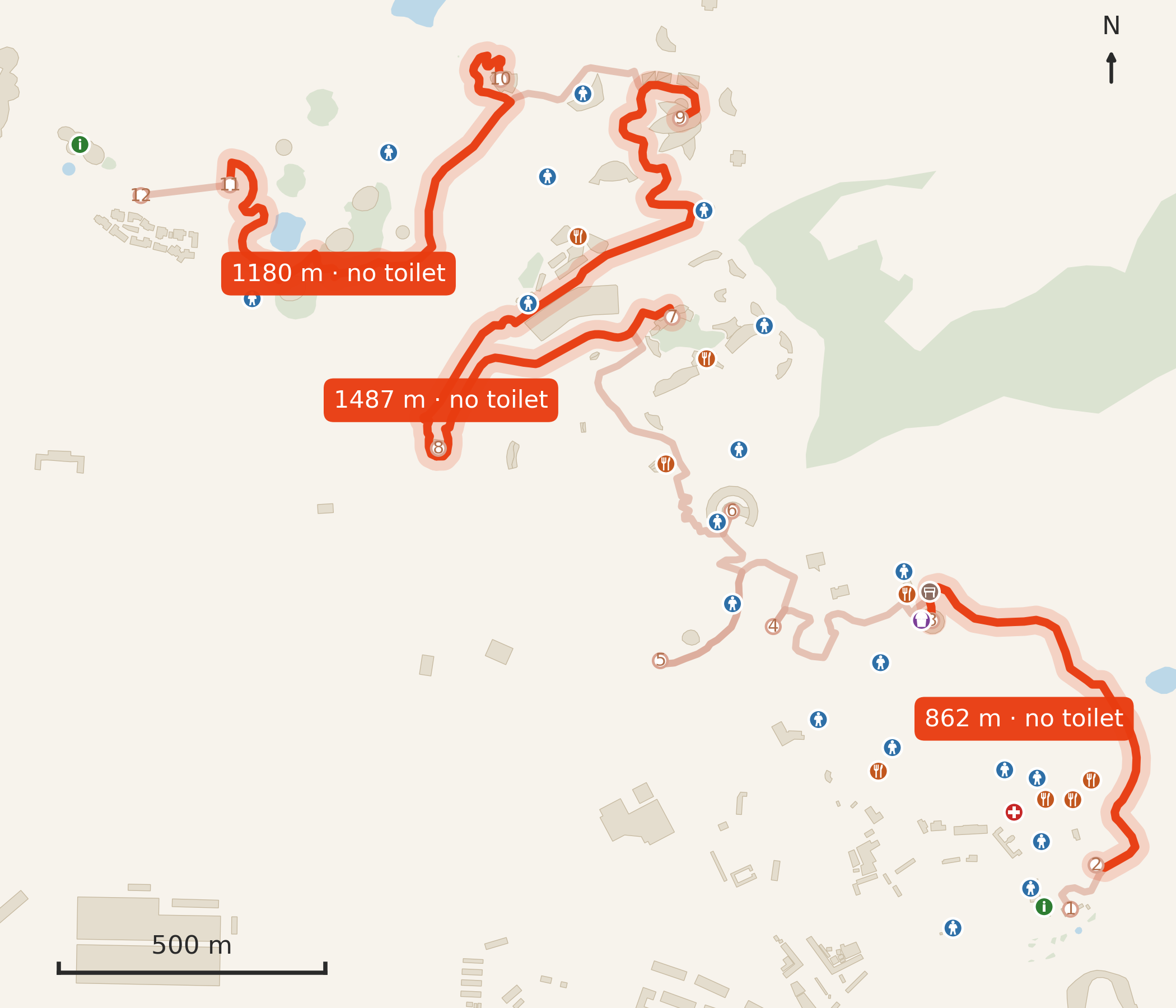
862 m
≈ 13 min walk
Stops 2 3
1.5 km
≈ 23 min walk
Stops 7 9
1.2 km
≈ 18 min walk
Stops 10 11
Toilets, food and drinking water across the park, with the longest stretch without a mapped toilet marked
Toilets, food and drinking water across the park, with the longest stretch without a mapped toilet marked © OpenStreetMap contributors, ODbL

Getting out

Two gates, and they are 2.4 km apart on opposite corners of the park. The South Gate is the main one, with a bus stop 129 metres out and the car parks beside it. The West Gate has the shuttle terminus at the door. Decide which one you are leaving from before you start walking.
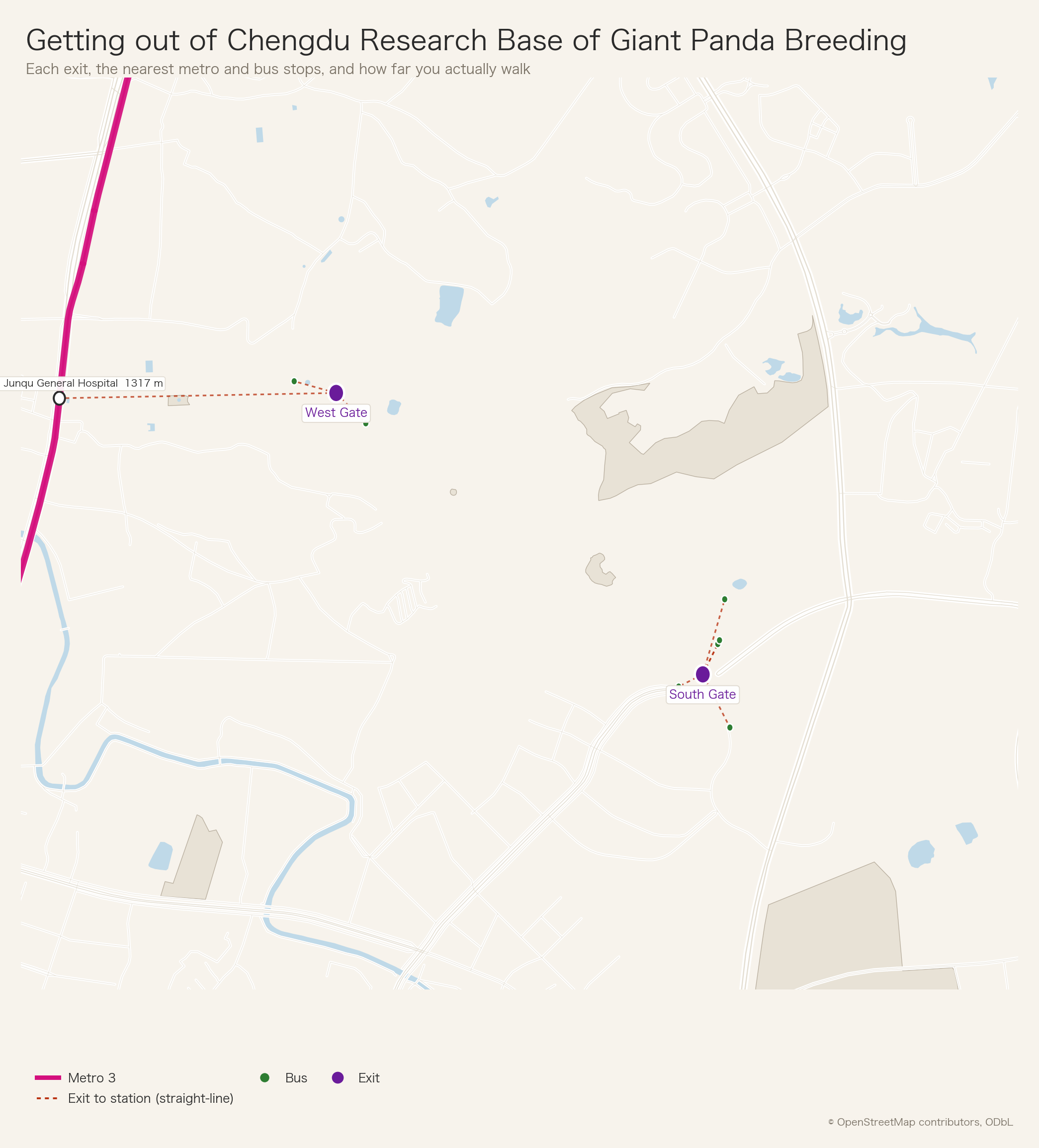
Both gates, the nearest metro and bus stops, and how far you actually walk
Both gates, the nearest metro and bus stops, and how far you actually walk © OpenStreetMap contributors, ODbL
South Gate 南大门
Metro
Panda Avenue (Line 3), Exit A + shuttle bus 408
West Gate 西大门
Metro
Chengdu Junqu General Hospital (Line 3), Exit B + shuttle bus 409, about 10 minutes

Where the photographs are

01

From the top of the Bamboo Tower

Where to stand
The upper viewing platforms of the Bamboo Tower, reached by the lift — about one minute from the ground floor. Free, but you need a separate online booking, one QR code per person.
Facing
North and west over the whole park for the enclosure layout; east and south for the Chengdu skyline, where the 339 TV Tower and Shufeng 468 are the recognisable markers.
Best time
The tower opens 9:00–17:00 with last entry 16:30 — a shorter day than the park itself. Go early: admission is suspended automatically once 200 people are inside. Late afternoon gives the warmest light on the city but risks the 16:30 cut-off.
02

The tower from the West Gate viewing platform

Where to stand
The viewing platform just inside the West Gate of the expansion area.
Facing
Across and down onto seven enclosures — including the circular and oval-plan houses — with the Bamboo Tower on the hillside opposite as the background.
Best time
Late afternoon, when the pale-brown grille skin takes a reddish-gold cast. This is also the cheapest way to photograph the tower's whole silhouette, since you cannot see the outside of the tower while you are standing in it.
03

Straight up the inside of the tower

Where to stand
The ground floor of the Bamboo Tower shaft, before you get into the lift.
Facing
Vertically up the shaft. The 81 gold 'hibiscus petals' are the visitor platforms, stacked across 11 floors, and the count decreases floor by floor — the tower's architect described the arrangement as an arithmetic sequence.
Best time
Any time the tower is open; this shot is interior and does not depend on daylight. Do it on the way in — people queue at the lift, not at the floor.
04

The glass ring of the Panda Panoramic Restaurant

Where to stand
Inside the Panda Panoramic Restaurant (map point 17) in the Panda Reception Hall district, at the bar-style window seating that rings the building.
Facing
Outward through the glass onto the yards of the four 'sun' pavilions — Rising Sun, Reflecting Sun, Cloud Sun and Spring Sun — which surround the restaurant.
Best time
Mid-morning, after the animals are out and before the lunch crowd. This is the one place in the park where you can sit down and still have enclosures in frame, which makes it the practical choice if anyone in the group is tired.
05

Indoor viewing halls, on a hot day

Where to stand
The indoor display areas the Base names itself: villas 1, 2, 3 and 7 in the Villa Area; the Star, Moon and Sun nurseries; and the indoor halls of the Reception Hall, Forest and Creek Valley zones.
Facing
Through the indoor viewing glass. Expect reflections — shoot with the lens close to the glass and no flash, which the Base prohibits.
Best time
Whenever the outdoor yards look empty in summer. Once the Base's recall threshold is reached the animals are moved inside, so an empty yard in July means the picture has moved indoors rather than gone away.
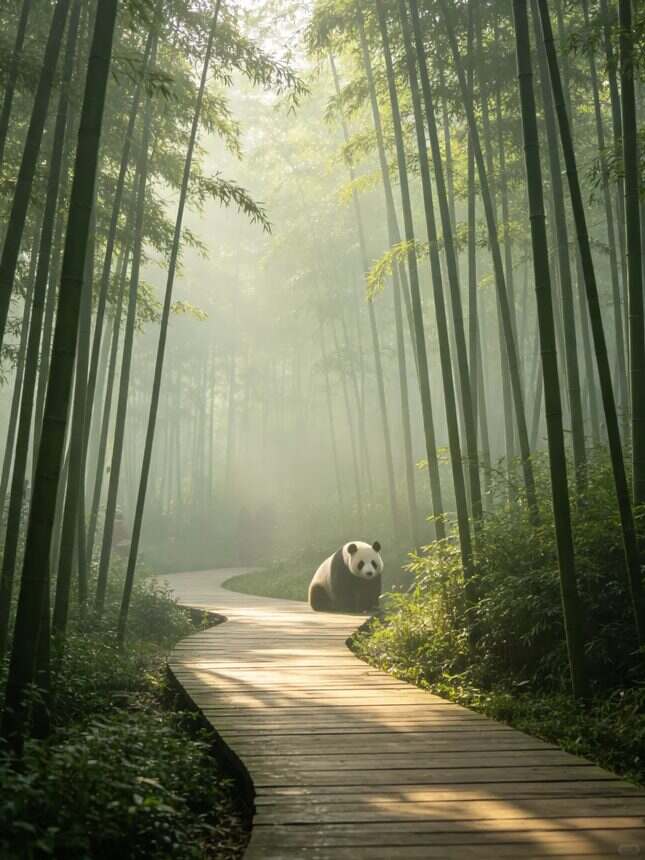
The bamboo walkway between enclosures
06

The bamboo walkway between enclosures

Where to stand
The planted bamboo corridors that link the villa area to the nurseries — the stretch either side of stops 3 to 6.
Facing
Along the path rather than across it: the bamboo closes overhead and the enclosures open on one side, so a shot down the corridor reads as habitat rather than as a zoo path.
Best time
Early morning, before the corridors fill up. These are walking routes, not viewing platforms — standing still in one blocks the flow once crowds build.
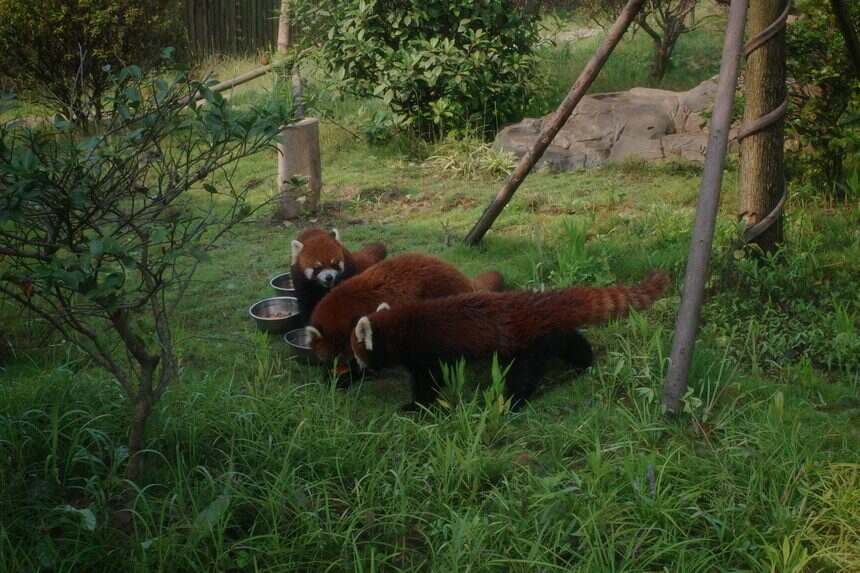
The red panda walk-through
07

The red panda walk-through

Where to stand
The red panda areas near stop 4, where there is no glass between you and the animal.
Facing
Low and level with the animal rather than down at it. Keep the required three metres — in a walk-through space the distance is the only barrier there is.
Best time
Early morning. Red pandas rest more as temperature rises, so by a warm afternoon expect a motionless animal high in a fork.

What other travellers shot here
Tips

What catches people out

Arriving late morning and expecting to see pandas outside

Several traveller accounts describe the same afternoon: one arrived at 10:30 on a 40°C day, walked two hours and saw a single active panda. The Base's own recall rule explains it — once the heat threshold is reached the animals are brought indoors, and Hua Hua's villa may simply not open that day.

Do this instead Be at a gate for the 7:30 opening. Travellers consistently name 7:40–9:20 as the window when pandas are out and feeding; by 10:30 the same people report empty yards.

Entering by the South Gate because it is the famous one

The South Gate is where tour groups and the Hua Hua queue concentrate. One visitor logged a 50-minute shuttle queue there. Travellers who use the West Gate report the same pandas with markedly fewer people at the same hour.

Do this instead Enter by the West Gate and walk south. You end at the South Gate for the metro, and you meet the crowded zone late in the morning rather than head-on at opening.

Walking to the Bamboo Tower to see pandas

There are no pandas in the tower. It is a viewpoint. Travellers who detour there specifically for animals describe it as the one stop they would cut.

Do this instead Go for the view over the new zone, or skip it. If you are short on time it is the easiest thing to drop.

Queueing an hour for Hua Hua as the fixed plan

Her villa is the single busiest point in the park and she is not always out — heat, and the Monday rest day, both take her off view. Travellers who build the day around her frequently report seeing her briefly or not at all.

Do this instead Treat her as a bonus, not the itinerary. The new zone's Adventure Creek Valley and Infinite Hills districts hold dozens of pandas with no queue at all.

Buying the shuttle ticket expecting hop-on hop-off all day

Traveller accounts disagree here, and so do the sources. Some call the 30 RMB day ticket essential; another queued 50 minutes to ride one minute to the next stop and calls it not worth it. Our tickets section records the Base's own condition: it is valid at any stop, but at either terminal you rejoin the queue and have the ticket checked again.

Do this instead Decide by legs, not by day. The one stretch where it genuinely saves you is the roughly 1,487 m between the Reception Hall and the Star Nursery, which has nothing to look at and no toilet.

Wearing ordinary flat shoes

The paths climb and descend continuously between districts. Travellers repeatedly single out the slopes rather than the distance as what tires them.

Do this instead Wear shoes with grip. Plan on 3.5–5 hours of walking if you cover both the west and south zones.

Planning lunch inside the park

Travellers describe the in-park catering as priced for a captive audience and worth skipping for anything beyond a drink or a snack.

Do this instead Eat before or after. The old streets north of the Base are a short ride away and are where visitors say the food actually is.

Working it out yourself when a house looks empty

Enclosures are deliberately screened on most sides, and closures are not always signposted — one visitor was turned back by a guard halfway down a path. Staff, by several accounts, keep an internal channel about which pandas have just been let out where.

Do this instead Ask a member of staff. Travellers describe them as consistently willing to say which house is worth walking to right now.

Eating, inside and out

Inside the park
Catering inside the park
Panda Panoramic Restaurant in the Panda Reception Hall; kiosks and the Sun Hills Souvenir Shop elsewhere

Traveller accounts agree on the pattern rather than on specific dishes: convenient, and priced accordingly. The Panoramic Restaurant earns its place for the view — a glass ring facing four panda houses — more than for the food.

Just outside the gates
Wan za mian (pea and minced pork noodles)
Old streets in the Chenghua district north of the Base

Named by travellers as the thing to eat straight after the walk. They point to long-standing neighbourhood noodle shops rather than any one address.

Lu tu tou (braised rabbit head)
Same northern old-street area

Sold in a five-spice and a mala version. A Chengdu speciality that visitors flag as worth trying here rather than in the tourist centre.

Bing zui dou hua (chilled tofu pudding in fermented rice)
Same northern old-street area

Travellers recommend it specifically as relief after a hot walk — sweet, cold, and light.

Bo bo ji (skewers in chilli and sesame oil)
Same northern old-street area

Traveller advice is to pick an established local shop over the ones marketed on social media.

Want someone who knows the place to show you round?

Tell us your dates and how you like to travel, and we will match you with a licensed guide — several languages to choose from, all of them people who know the ground: they will steer you clear of the crowds and take you straight to what matters. Need a car? Want the itinerary tailored? We will sort that out too.

Asking costs nothing — talk to us first, decide later.

Start planning

What we checked, and how

Show all sources (78)

Image and data credits

Our fulfilment partner Tuniu works with national tourism boards including

Ready when you are.

No pressure. Browse our trips, or talk to a real person. Either way, your inbox stays clean.