





 18 days China, End to End Beijing → Xi'an → Chuanzhusi → Jiuzhaigou → Chengdu → Zhangjiajie → Guilin → Yangshuo → Shenzhen From $6,360 View route
  3 days 4-Day Tour of Siguniang Mountain, Biepa Gou, and Dagu Glacier Chengdu → Lixian → Heishui County From $1,599 View route
  5 days Above the Pillars, Then Below Zhangjiajie From $1,430 View route
  3 days After the Last Booth Guangzhou From $840 View route
  13 days All the Way West Xi'an → Dunhuang → Turpan → Kashgar → Shanghai From $3,500 View route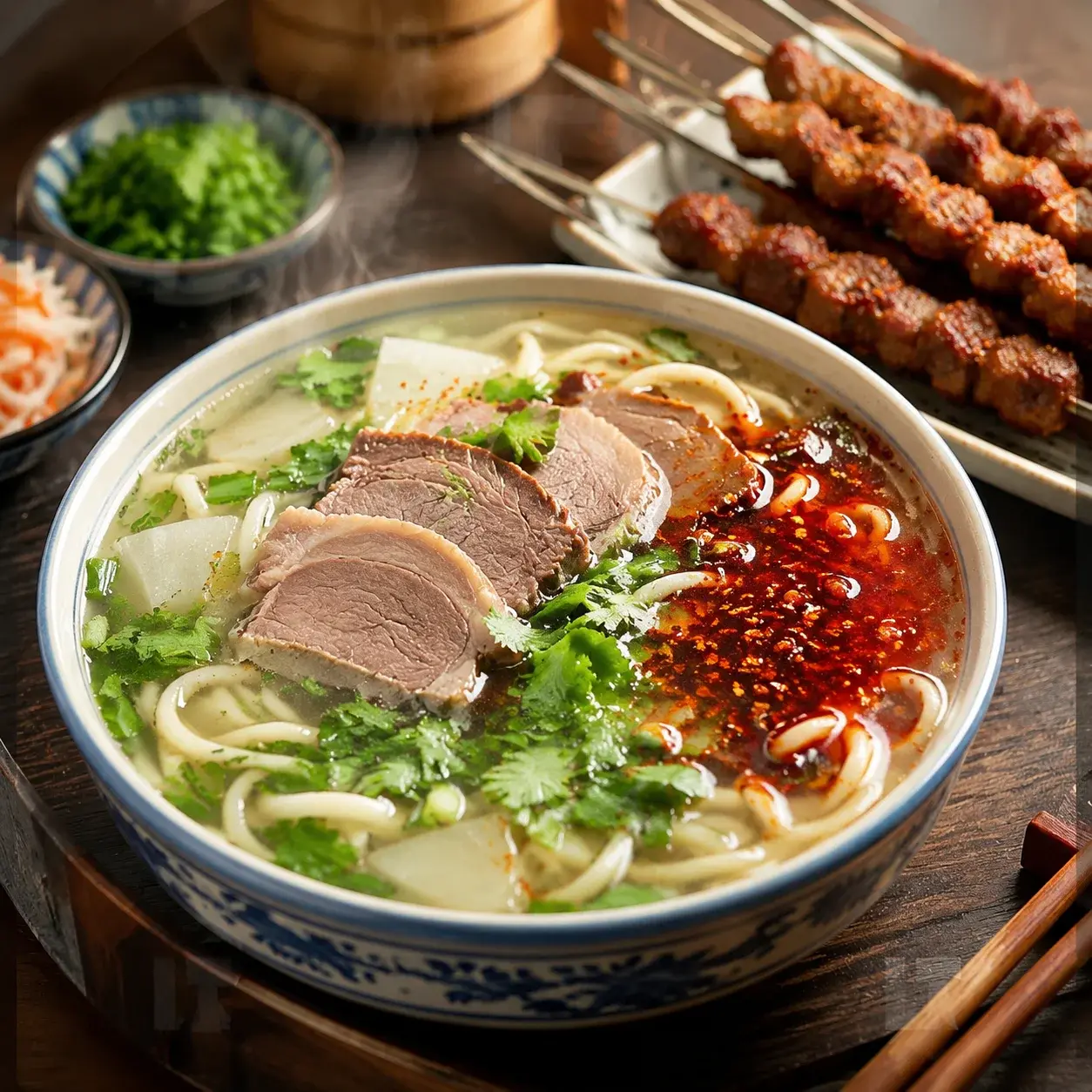
Is It Easy to Find Halal Food in China? A Muslim Traveler's Guide
Yes — finding halal food in China is easier than most travelers expect. The key is the 清真 (qingzhen) system: a nationwide network of Muslim-run restaurants marked with a green sign and Arabic script, found in every province. Learn to spot that sign and you can eat well almost anywhere.
For an observant Muslim planning a first trip, China can look daunting — a vast country where mainstream cooking leans heavily on pork. But China has had Muslim communities for over a thousand years, and they built an entire parallel food culture: 清真 (qingzhen, literally "pure and true"), China's homegrown halal standard. Qingzhen restaurants serve no pork, are run by Muslim families, and cluster densely in some cities while appearing on ordinary street corners in others. This guide teaches the one skill that unlocks the country — reading the qingzhen sign — then maps the best halal cities, the dishes to seek out, and how to order safely.
Our stance is simple — dare to eat, eat right. We are not a recipe site and we are not selling a set menu. We are here to help you make good decisions: how to recognize a genuinely halal kitchen, what to order, roughly what it costs, and where to be careful. For strict observance, we also tell you exactly where a traveler's confidence should end and where a direct question to the restaurant should begin.
Key Takeaways
- 清真 (qingzhen) is China's halal standard. A qingzhen kitchen serves no pork, uses Islamic slaughter, and is usually alcohol-free. Learn the green sign with Arabic script — it is the single most useful skill for eating in China.
- Halal food is nationwide, not just the northwest. Qingzhen restaurants exist in every province, run mostly by the Hui — ethnically Chinese Muslims — and supermarkets stock qingzhen-labeled goods.
- Xi'an is the easiest city to start. Its Muslim Quarter is wall-to-wall halal. Lanzhou is the beef-noodle heartland, Beijing's Niujie is the capital's Muslim hub, and Xinjiang is effectively a fully halal region.
- The must-eat canon is generous: Lanzhou beef noodles, yang rou pao mo, halal roujiamo, cumin lamb skewers, Xinjiang pilaf, and big-plate chicken.
- Mainstream Chinese food is pork-heavy — assume a non-qingzhen restaurant uses pork and lard unless told otherwise. When in doubt, choose a qingzhen place rather than trying to modify an order.
- Prices below are approximate 2026 RMB ranges and vary by city and by tourist-vs-local location. For strict certification needs, confirm with the individual restaurant.
What does 清真 (qingzhen) mean, and is Chinese food halal?
清真 (qingzhen) is China's own word for halal — it marks food and restaurants that follow Islamic dietary law: no pork, meat from Islamic slaughter, and (almost always) no alcohol. Mainstream Chinese food is not halal by default, but qingzhen food is everywhere, so you eat within that system rather than trying to convert ordinary restaurants.
Islam arrived in China more than a thousand years ago, carried along the Silk Road and by sea trade, and Muslim communities have been part of Chinese life ever since. The largest are the Hui — ethnically Chinese Muslims who live in every province, speak Chinese, and are recognizable in restaurants by the white skullcaps (taqiyah) many of the men wear. The Hui built qingzhen cuisine (清真菜), a distinct culinary tradition centered on beef, lamb, and wheat, entirely free of pork and lard (Chinese Islamic / Hui cuisine and the qingzhen tradition: Wikipedia, "Chinese Islamic cuisine"; qingzhen recognition cues: NebulaTrip, "Halal & Muslim-friendly China." Last verified: 2026-07).
Two things follow from this, and both matter for how you plan meals:
- Qingzhen is genuinely reliable on pork. A restaurant displaying the 清真 sign does not serve pork or use lard in its cooking — that is the whole point of the designation, and it is taken seriously.
- Qingzhen is not confined to the northwest. Many travelers assume halal food only exists in Xinjiang or Gansu. In fact qingzhen restaurants appear on ordinary streets nationwide, from Beijing to Guangzhou, and Chinese supermarkets stock qingzhen-labeled packaged goods.
The honest caveat for strict observance: "清真 by Chinese community standard" is a real and meaningful designation, but it is not identical to a specific international halal certification (such as those from a particular foreign halal authority). For everyday eating it is trustworthy; for the strictest requirements, it is still worth confirming the specifics with the individual restaurant.
How do you spot a 清真 (qingzhen) halal restaurant in China?
Look for the green sign with Arabic script and the two characters 清真 — often beside a crescent moon or a small mosque motif — and for staff wearing white skullcaps (taqiyah) or headscarves. Together these are a dependable signal of a pork-free, Muslim-run kitchen. This is the single most useful skill for a Muslim traveler in China, because once you can read the sign, the whole country opens up. Use the checklist below as your visual field guide.
| Signal to look for | What it looks like | Why it matters |
|---|---|---|
| The 清真 characters | The two Chinese characters 清真 on the sign, menu, or window — usually prominent | This is the explicit halal marker; its presence is the core designation |
| Arabic script | Arabic lettering (often ḥalāl حلال or a Quranic phrase) alongside or above the Chinese | Reinforces the halal claim; a strong visual confirmation |
| Green color | Green signage, awnings, or lettering — green is the conventional color of the qingzhen trade | Lets you spot a halal spot from down the street before reading anything |
| Crescent / mosque motif | A crescent moon, star, or small mosque-dome icon on the sign | A common decorative cue paired with the qingzhen designation |
| Taqiyah / headscarves | Staff in white skullcaps (taqiyah) or women in headscarves | Signals a Muslim (often Hui) family kitchen behind the food |
| No pork on the menu | Beef, lamb, mutton, chicken, and noodles — never pork (猪肉) | A genuine qingzhen kitchen simply does not cook pork or use lard |
| Usually no alcohol | Little or no beer/baijiu served or displayed | Most qingzhen restaurants are alcohol-free, in line with Islamic practice |
A few practical notes on using the checklist. You do not need every signal at once — the green 清真 sign with Arabic script is the anchor, and the crescent, skullcaps, and pork-free menu are confirming details. Near a working mosque (such as Xi'an's Great Mosque or Beijing's Niujie Mosque) qingzhen restaurants cluster thickly, so the whole neighborhood becomes easy. And supermarkets apply the same logic: packaged goods carry a 清真 label, so you can shop for snacks by the same sign. These recognition cues are evergreen and you can rely on them; only a specific restaurant's current certification is worth confirming in person for strict observance.
Which Chinese cities are best for halal food?
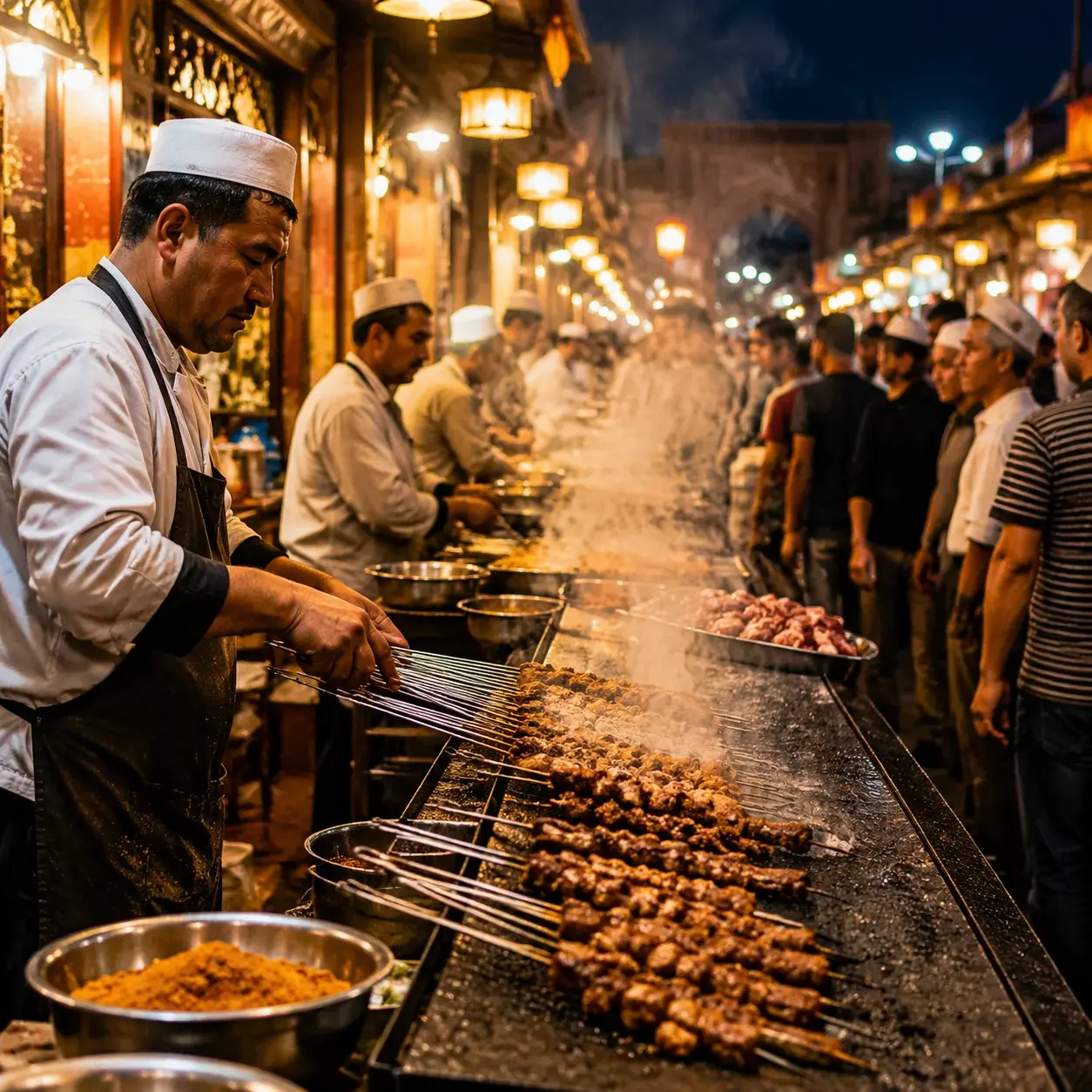
Start with Xi'an — its Muslim Quarter is the easiest halal eating in China — then look to Lanzhou for beef noodles, Beijing's Niujie district for the capital's Muslim hub, and Xinjiang, which is effectively a fully halal region. These four give a Muslim traveler enormous range, from a single walkable food street to an entire province where halal is the default. Here they are ranked from easiest to most immersive.
| Rank | City / area | Why it's great for halal | What to eat there |
|---|---|---|---|
| 1 | Xi'an — Muslim Quarter 回民街 / Beiyuanmen | The easiest halal city in China. A whole quarter of qingzhen stalls around the Great Mosque, where halal is the norm, not the exception | Yang rou pao mo, halal roujiamo (beef), cumin lamb skewers, biang biang noodles |
| 2 | Lanzhou 兰州 (Gansu) | The heartland of Lanzhou beef noodles and a major Hui Muslim center; qingzhen noodle shops on nearly every block | Lanzhou beef noodles, lamb dishes, hand-pulled noodles |
| 3 | Beijing — Niujie 牛街 | The capital's historic Muslim quarter, centered on the Niujie Mosque; a concentrated halal district in a huge city | Hui-style mutton stew, fried buns, halal hotpot, sesame-paste snacks |
| 4 | Xinjiang 新疆 | China's northwest frontier — a predominantly Muslim region where the everyday cuisine is halal by default | Lamb pilaf (手抓饭), big-plate chicken, naan, kebabs, lamb everything |
Two honest planning notes. First, the Muslim Quarter in Xi'an gets very crowded after about 6pm — going at lunch or early evening trades some of the night-market atmosphere for a far easier meal. Second, well-known sit-down spots that guides repeatedly name include Lao Mi Jia (老米家) for yang rou pao mo in Xi'an and the long-standing halal restaurants around Niujie in Beijing — mentioned here for their reputation rather than as our own verified pick, so confirm the current queue and quality on the ground. For a deeper walk through Xi'an specifically, see our  Xi'an food guide.
What halal dishes should you try in China?
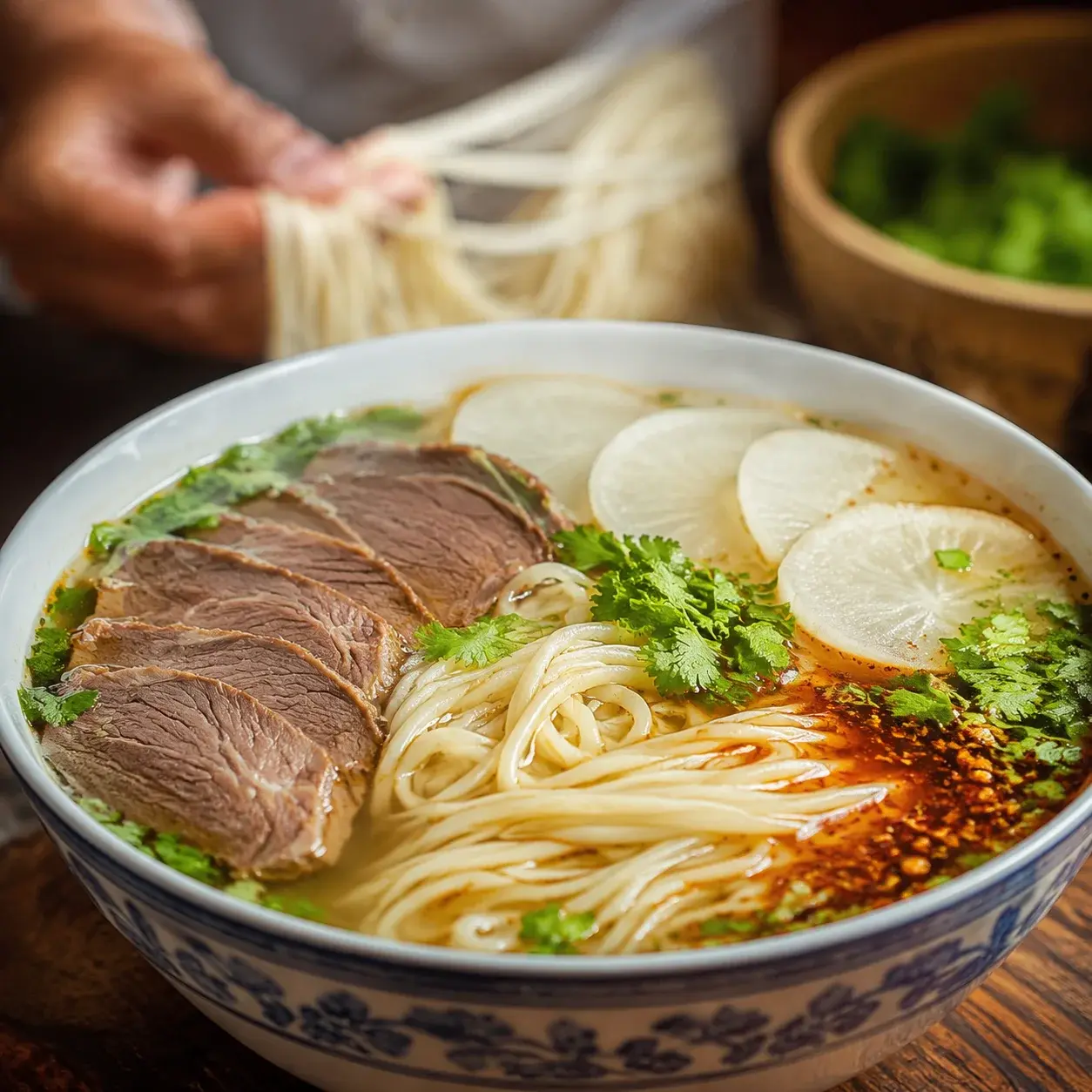
Build your list around Lanzhou beef noodles, yang rou pao mo, halal roujiamo, cumin lamb skewers, Xinjiang lamb pilaf, and big-plate chicken — the core canon of Chinese Muslim cooking. These dishes are beef-and-lamb-forward, wheat-heavy, and generously spiced with cumin and chili — and every one of them is served in qingzhen kitchens across the country. Here is the must-eat table, decoded for a first-timer.
| Dish (EN / 中文) | What it is | Where it shines | Approx. RMB (2026) |
|---|---|---|---|
| Lanzhou beef noodles 兰州牛肉面 | Hand-pulled wheat noodles in a clear, aromatic beef broth with chili oil, radish, and cilantro — the icon of Chinese halal food | Lanzhou; qingzhen noodle shops nationwide | ~12–25 / bowl |
| Yang rou pao mo 羊肉泡馍 | Torn flatbread simmered in rich lamb (or beef) broth — you crumble the bread yourself before it's cooked | Xi'an Muslim Quarter | ~25–45 / bowl |
| Roujiamo 肉夹馍 (halal) | China's "hamburger": chopped braised meat in a crisp griddled bun — beef or lamb in qingzhen kitchens, never pork | Xi'an and Hui restaurants nationwide | ~10–18 each |
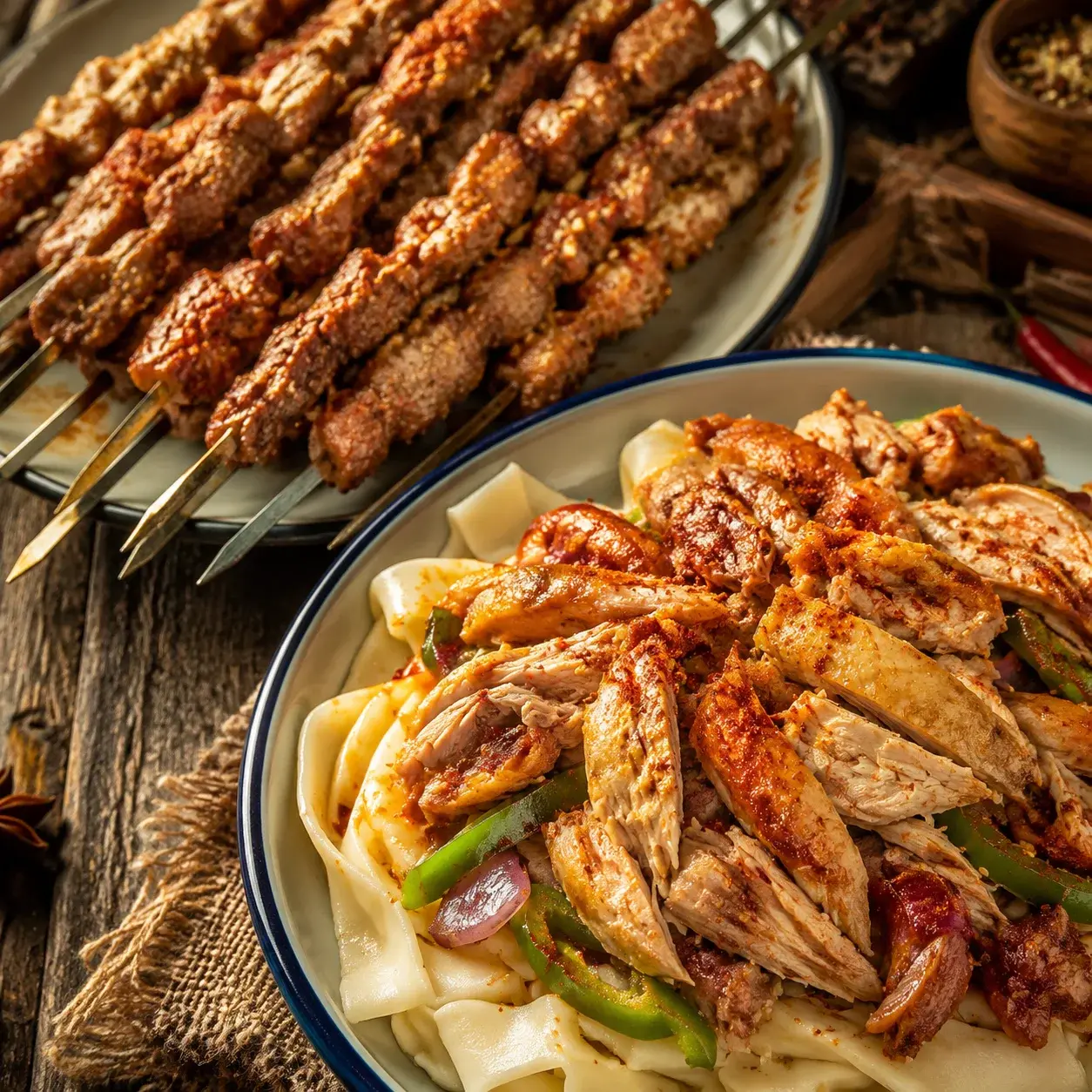
| Lamb skewers 羊肉串 | Charcoal-grilled lamb dusted with cumin and dried chili — the smoky heartbeat of any Muslim food street | Xi'an, Xinjiang, night markets everywhere | ~2–4 / stick |
| Xinjiang lamb pilaf 手抓饭 (polo) | Rice cooked with lamb, carrot, and onion until fragrant and glistening — hearty and homey | Xinjiang; Xinjiang restaurants nationwide | ~20–35 / plate |
| Big-plate chicken 大盘鸡 | A huge shared platter of chicken, potato, and peppers in a spiced sauce, often served over wide belt noodles | Xinjiang restaurants | ~60–120 (shared, 2–4 people) |
| Naan 馕 | Chewy Xinjiang flatbread baked in a clay oven — a staple carried and eaten all day | Xinjiang; Uyghur bakeries | ~3–8 each |
If you try only three things, make them Lanzhou beef noodles (the definitive halal bowl), yang rou pao mo (the sit-down ritual — half the fun is tearing the bread), and cumin lamb skewers (the universal Muslim-street snack). The underrated sleeper is naan, which is cheap, keeps for hours, and pairs with everything. Dish identities here are evergreen and you can trust them; the RMB figures are approximate 2026 ranges that vary by city and by how touristy the location is — a bowl on a tourist food street runs higher than a neighborhood shop two minutes away.
How do you order halal food safely in China?
The safest strategy is to eat inside the qingzhen system rather than trying to modify a mainstream order — because ordinary Chinese restaurants use pork and lard as default ingredients, sometimes invisibly. Choose a 清真 restaurant, and a few phrases handle the rest. Mainstream Chinese cooking is genuinely pork-heavy: pork is the default "meat" in countless dishes, lard turns up in fillings and stir-fries, and pork stock hides in soups and sauces. That is exactly why the qingzhen sign is your anchor — it removes the guesswork instead of relying on you to catch every hidden ingredient.
| Situation | Phrase (pinyin) | Chinese | What it does |
|---|---|---|---|
| Ask if a place is halal | Zhè shì qīngzhēn ma? | 这是清真吗? | "Is this halal (qingzhen)?" — the core question |
| Say you eat only halal | Wǒ zhǐ chī qīngzhēn. | 我只吃清真。 | "I only eat halal food" |
| Say you don't eat pork | Wǒ bù chī zhūròu. | 我不吃猪肉。 | "I don't eat pork" — the essential red line |
| Check the broth/oil | Yǒu zhūyóu ma? | 有猪油吗? | "Is there lard (pork fat) in this?" |
| Find a halal restaurant | Fùjìn yǒu qīngzhēn cāntīng ma? | 附近有清真餐厅吗? | "Is there a halal restaurant nearby?" |
The critical caveat, stated plainly: in a non-qingzhen restaurant, do not assume that ordering a beef or vegetable dish makes the meal safe. The same kitchen, oil, and utensils handle pork, and stocks or seasonings may be pork-based even when the headline ingredient is not. For anyone observant, the reliable move is to walk to a qingzhen restaurant — which, thanks to the sign you now know how to read, is rarely far. Save a couple of the phrases above as screenshots, and consider a translation app for menus. And once more on strict certification: the qingzhen designation is dependable on pork and Islamic slaughter, but if your practice requires a specific certifying body, confirm the details directly with the restaurant.
Frequently Asked Questions
Is it easy to find halal food in China? Easier than most expect. China has Muslim communities in every province and a nationwide network of 清真 (qingzhen) halal restaurants marked by a green sign and Arabic script. Once you can spot that sign, you can eat well almost anywhere — and cities like Xi'an make it effortless.
What does 清真 (qingzhen) mean? 清真 (qingzhen) is China's word for halal — literally "pure and true." A qingzhen restaurant serves no pork, uses Islamic slaughter, and is usually alcohol-free. It is run mostly by Hui Muslims and marked with a green sign, Arabic script, and often a crescent or mosque motif.
Which Chinese city is best for halal food? Xi'an is the easiest, thanks to its Muslim Quarter, where halal is the norm. Lanzhou is the beef-noodle heartland, Beijing's Niujie is the capital's Muslim hub, and Xinjiang is effectively a fully halal region. Any of these makes eating simple for Muslim travelers.
Is Chinese food halal? Mainstream Chinese food is not halal — it relies heavily on pork and lard. But China's qingzhen (清真) cuisine is a large, separate halal tradition found nationwide. The strategy is to eat within the qingzhen system rather than trying to modify pork-heavy ordinary restaurants.
What halal dishes should I try in China? Start with Lanzhou beef noodles, yang rou pao mo (lamb-and-bread soup), halal roujiamo, and cumin lamb skewers. Add Xinjiang lamb pilaf, big-plate chicken, and naan. All are beef-or-lamb based and served in qingzhen kitchens across the country. They are hearty, wheat-heavy, and cumin-spiced.
How do I know a restaurant is halal in China? Look for the green 清真 sign with Arabic script, often beside a crescent or mosque motif, plus staff in white skullcaps and a pork-free, usually alcohol-free menu. These cues are reliable. For strict certification requirements, confirm the specifics directly with the restaurant.
Conclusion
China is far more welcoming to Muslim travelers than its pork-heavy reputation suggests — you just need the right key, and that key is the 清真 (qingzhen) sign. Learn to spot the green board with Arabic script, and a thousand-year-old halal food culture opens up: Lanzhou beef noodles pulled fresh, a bowl of yang rou pao mo you tear apart by hand, cumin lamb skewers smoking over coals, and whole cities — Xi'an above all — where halal is simply the default. Eat with confidence while keeping a safety net: stay inside the qingzhen system, carry a few ordering phrases, and confirm certification directly when your practice requires it. Dare to eat, eat right.
If you'd rather have the halal eating navigated for you — the real qingzhen spots, minus the language and logistics guesswork — a private-customized food experience does exactly that.
Keep exploring: our pillar on China's street-food scene, the deep-dive on Xi'an food and its Muslim Quarter, how night market food works across the country, and whether a guided food tour is worth it.