




 18 days China, End to End Beijing → Xi'an → Chuanzhusi → Jiuzhaigou → Chengdu → Zhangjiajie → Guilin → Yangshuo → Shenzhen From $6,360 View route
  3 days 4-Day Tour of Siguniang Mountain, Biepa Gou, and Dagu Glacier Chengdu → Lixian → Heishui County From $1,599 View route
  5 days Above the Pillars, Then Below Zhangjiajie From $1,430 View route
  3 days After the Last Booth Guangzhou From $840 View route
  13 days All the Way West Xi'an → Dunhuang → Turpan → Kashgar → Shanghai From $3,500 View route
Mutianyu Great Wall: Which Ticket Do You Buy, and How Do You Get Up and Down?
There is no single Mutianyu Great Wall ticket. Entry, the shuttle bus, the cable car, the chairlift and the toboggan are five separate products, which is why you will see CNY 40, 45, 60, 180 and 200 all quoted as "the price". Most first-time visitors should buy the combined package, indicatively CNY 180–200.
Already picked Mutianyu? Good — this page is the execution: which combination to buy, how you get up, how you get down, and how you get home. Still deciding which stretch of wall to visit at all? Start one level up with which Great Wall section should you visit, then come back here.
At LyrikTrip we plan Beijing itineraries for first-time visitors to China, so this page is written as the logistics answer we give them rather than as a sales pitch — including the parts that are inconvenient for us to say.
One piece of honesty before anything else. Every English source we checked in August 2026 quotes a different Mutianyu price, and they are not contradicting each other so much as describing different products. The one place that looked like a real conflict — the entrance fee, 40 versus 45 — turned out on checking to be the same thing again: those are two different tickets, not two guesses at one ticket. The section below names which is which.
Key Takeaways
- The cheap ticket is not the wall ticket. Entry is CNY 40 for the plain ticket, or CNY 45 for the postcard version of the same entry — two products, not two prices for one. The scenic area's own visitor notice, read on 2026-08-13, confirms it: a postcard ticket is exchanged for a commemorative postcard on the day, and a regular electronic ticket does not include one. Either way it buys you into the scenic area and does not carry you up. That single misunderstanding is behind almost every confused Mutianyu ticket question.
- Most people should buy the combined package, indicatively CNY 180–200, which bundles entry, the shuttle bus and a round-trip cable car. It is the ticket that matches what a first-time visitor imagines they are buying.
- The shuttle is not an optional extra. The same visitor notice puts the shuttle-bus service station about 3 km from the ticket gate. Skipping it is not saving a short hop; it is adding three kilometres on foot before the climb starts.
- Cable car up, cable car down is the safe default. Chairlift up and toboggan down is the fun one. The two are run by different companies, and their tickets are not interchangeable — that is the operator's own published rule, so buying the wrong one is a mistake you cannot undo at the top. The stairs are genuinely free — and genuinely steep.
- Concessions apply to the entry ticket only. Children of 1.2 m and under ride the shuttle bus and cable car free; above 1.2 m everyone pays the full transport fare, and the notice lists no child, senior or disability discount on any of the transport.
- The toboggan is the thing people remember, and it costs the same as the chairlift you would otherwise ride down. Age and height rules and weather closures vary, so confirm on the day.
- Mutianyu is not suitable for wheelchair users. There are stairs between the cable car and the wall (source: The China Guide, checked 2026-08). Know this before you book, not after.
- Treat every number here as indicative and verified 2026-08. Chinese scenic-area prices move seasonally and English sources lag. Confirm on the official English site, en.mutianyugreatwall.com, the week you travel.
How Much Is a Mutianyu Great Wall Ticket — and Which Combination Should You Buy?
There is no single "Mutianyu ticket". Entry to the scenic area, the shuttle bus to the ticket gate, the cable car, the chairlift and the toboggan are five separate products sold in overlapping bundles — and the cheapest ticket, CNY 40, gets you into the scenic area but does not carry you up to the wall. Most first-time visitors should buy the combined package, indicatively CNY 180–200, which bundles entry, shuttle and a round-trip cable car.
That structural fact is why Mutianyu Great Wall tickets look so confusing from abroad. A reader who sees "CNY 40" and a reader who sees "CNY 200" are both quoting real prices; they are quoting different combinations. Here is the whole product ladder in one place.
| Tier | What it includes | Indicative RMB | Who should buy it |
|---|---|---|---|
| Entry only (plain entry ticket) | Scenic-area entry. NOT transport up to the wall | 40 | Fit walkers happy to hike the free trail up |
| Entry + postcard (postcard entry ticket) | The same entry, plus a commemorative postcard — exchanged on the day at the ticket service centre or a self-service booth using your order information | 45 | Only if you want the postcard — but know it exists, because it is why you see both 40 and 45 quoted as "the entrance fee" |
| Entry + postcard + shuttle | Adds the shuttle bus. The shuttle service station is about 3 km from the ticket gate | ≈ 60 | Almost everyone — 3 km on foot is not a rounding error |
| Combined package (entry + shuttle + round-trip cable car) | The full carry-up-and-down bundle | ≈ 180 without postcard – 200 with | Most first-timers, families, anyone short on time |
| Cable car, bought separately | Enclosed gondola, round trip or one way | ≈ 120 round trip / 100 one way | Buying à la carte after entry |
| Chairlift + toboggan, bought separately | Up by open chairlift, down by toboggan | ≈ 120 round trip / 100 one way | Anyone who wants the toboggan descent |
| Concessions | Child and senior rates; free below a height threshold. Entry only — they do not reach the shuttle, cable car, chairlift or toboggan | ≈ 20 child/senior; 20 child under 1.4 m; free under 1.2 m | Families — verify current thresholds officially, and budget full-price transport (see below) |
| Free walk-up | Hike the trail, buy no transport at all | CNY 0 on top of entry | Budget hikers with time and legs |
Where those figures come from, so you can weigh them yourself: The Historian Traveller (CNY 40 base entry, package at 180 without postcard / 200 with); The Roaming Renegades (the 40 / 45 / 60 / 200 tier list, taken from the official booking flow); The China Guide (CNY 45 entrance, cable car 120 round trip / 100 one way, chairlift-plus-toboggan 120 / 100); Untold Wanderlust (CNY 40 adult, 20 senior, 20 child under 1.4 m, free under 1.2 m, and the free walk-up trail). All checked August 2026.
About that entrance fee — the 40-versus-45 puzzle, solved. Three independent sources — Untold Wanderlust, The Roaming Renegades and The Historian Traveller — quote CNY 40. The China Guide quotes CNY 45. We previously published that as an unresolved conflict and told you to budget a range. That was wrong, and here is the correction: checked in August 2026, both figures are right, because they are two different tickets. CNY 40 is the plain entry ticket; CNY 45 is the postcard entry ticket, the identical admission bundled with a commemorative postcard. It is not a season, and it is not one source being sloppy.
That is no longer our inference from conflicting blogs. The scenic area's own visitor notice, read on 2026-08-13, states it directly: a postcard ticket is exchanged for a commemorative postcard at the ticket service centre or a self-service booth, using the order information, and a regular electronic ticket does not include a postcard. The operator is describing two products in its own words. What we worked out from the price spread, the site publishes as policy.
Which is this page's whole argument arriving a second time, on a smaller scale. The reason "the Mutianyu ticket price" refuses to settle down is that there is no such thing as the Mutianyu ticket — entry, shuttle, cable car, chairlift and toboggan are separate products, and it turns out even entry is two products. So budget CNY 40 for admission, pay 45 only if you actively want the postcard, and confirm on the official English site, en.mutianyugreatwall.com, before you travel. This is a check against published ticket information, not a receipt from the window — prices at Chinese scenic areas move without notice.
Why the shuttle is not really optional. The same visitor notice, read on 2026-08-13, states that the shuttle-bus service station is about 3 km from the ticket gate. That one number changes the buying decision. Skipping the shuttle is not declining a short hop between two adjacent car parks; it is signing up for three kilometres on foot before the climbing has started, and again at the end of the day when you are tired. Unless that walk is something you actively want, treat the shuttle as part of the ticket rather than an add-on — which is another way of saying the combined package is the honest default.
And for families budgeting a day: the concessions stop at the entry gate. Per the same notice, children of 1.2 m and under ride the shuttle bus and the cable car free, and anyone above 1.2 m pays the full fare — there are no child, senior or disability discounts on any of the transport. The concession policy applies to the Great Wall entry ticket only. So the arithmetic for a family with a ten-year-old is a discounted entry ticket plus a full-price cable car and a full-price shuttle, not a discount on the whole day. Budget accordingly, because this is exactly the assumption that turns a planned CNY 400 morning into a CNY 700 one.
Three things to carry out of this section:
1. Most people should buy the combined package. It is not the cheapest ticket, but it is the one that does what visitors assume a Great Wall ticket does. 2. The cheap ticket is not the wall ticket. Buying entry alone and then discovering the climb is the single most common Mutianyu mistake. 3. Check prices the week you go, not the month before. Everything on this page is indicative and dated 2026-08.
Cable Car, Chairlift, Toboggan or the Stairs — Which Way Up and Down?
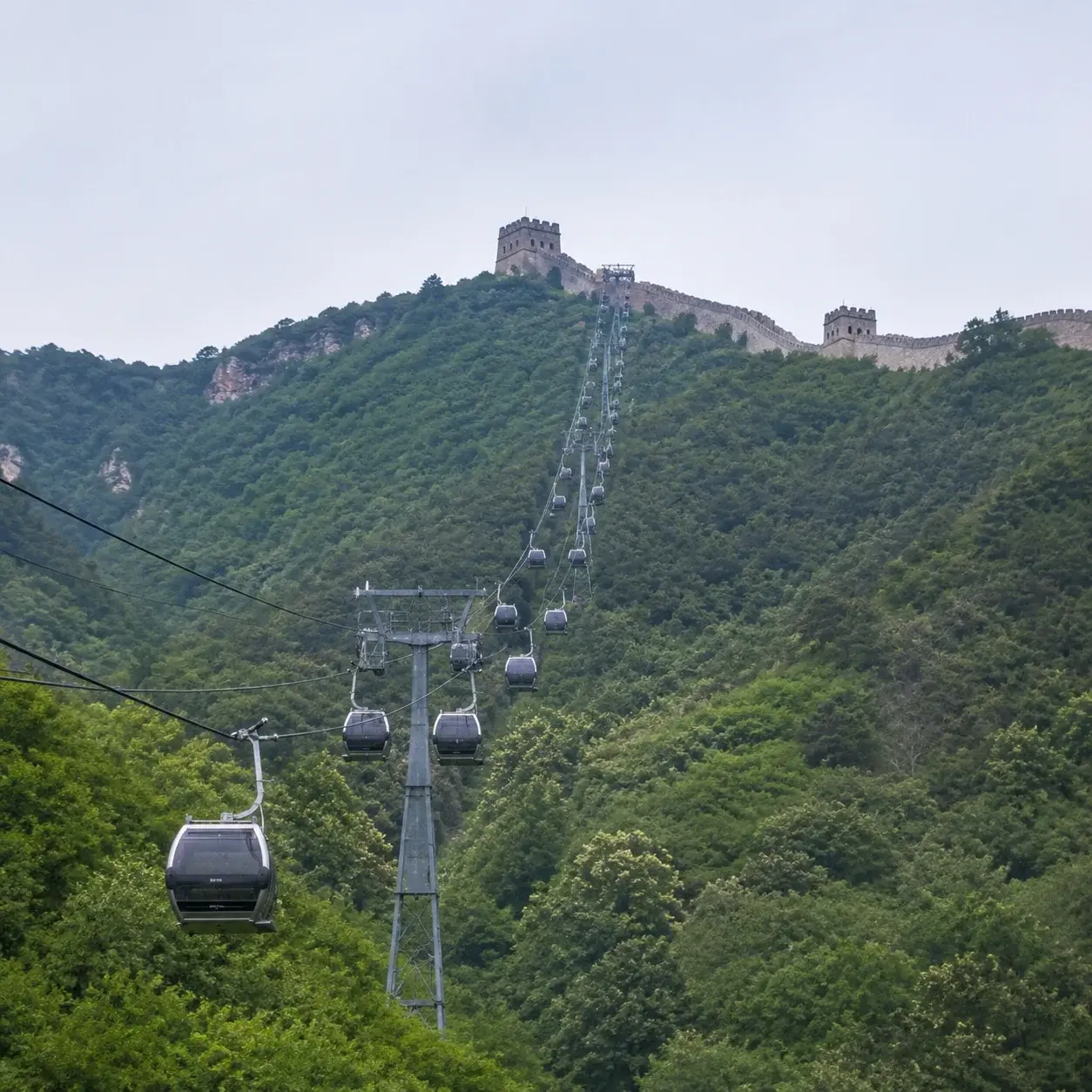
Cable car up and cable car down is the safe default. Chairlift up and toboggan down is the fun one. The stairs are free but steep. The one combination to avoid is planning the toboggan as your only way down without first checking that it is running that day.
Mutianyu has two separate lift systems, not one, and they are not interchangeable — the toboggan runs from the chairlift side, so if you ride the enclosed cable car up you cannot simply switch to the slide on the way down. Decide the pair before you buy, not at the top.
The separation is commercial, not just geographic — and this is the strongest evidence on the page that one Mutianyu ticket is really five products. The scenic area's own visitor notice, read on 2026-08-13, states that the cable car company is a different company from the ropeway and slide operator, and that their tickets are not interchangeable. It adds that a round-trip cable-car ticket must be returned by the same route. Read that as a warning rather than a footnote: it means a reader who buys a cable-car round trip at the counter, rides up, and then decides at the top that the toboggan looks more fun is holding a ticket from the wrong company, on the wrong side of the hill, with no way to convert it. It is a minute's decision at a window that cannot be undone afterwards. If there is any chance you want the slide, buy the chairlift-and-toboggan side, not the cable car.
| Option | What it is | Indicative RMB | Time / effort | Best for | Watch out |
|---|---|---|---|---|---|
| Cable car (enclosed) | Gondola cabin to the upper towers | ≈ 120 round trip / 100 one way | Fastest, no effort | First-timers, families, seniors, anyone short on time | Queues at peak hours and on Chinese public holidays. A round trip must be returned by the same route, and the ticket is not valid on the chairlift or slide |
| Chairlift (open) | Open seat lift, pairs with the toboggan | ≈ 120 round trip / 100 one way | Fast, exposed to the weather | Anyone planning the toboggan descent | Open-air, so weather-dependent |
| Toboggan (down only) | Metal-track slide with a hand brake | Included in the chairlift + toboggan fare | The highlight of many visits | Kids old enough for the rules, thrill-seekers | Age/height rules and weather closures — verify on the day |
| Stairs / walk-up trail | Free hiking trail up to the wall | Free (entry only) | Steep and sweaty, allow 40+ minutes | Fit hikers and budget travellers | Not viable in summer heat, rain, or with luggage |
The cable car is the boring right answer for most people. It is enclosed, it is quick, the queue is the only real cost, and it puts you on the wall with your legs intact for the walking you actually came to do.
The chairlift is an open seat with a bar — pleasant in good weather, less so in wind or rain. Its real function is that it is the toboggan's partner: you ride it up so you can slide down.
The toboggan gets its own section below, because it is the most-searched Mutianyu experience by a distance and nobody answers the actual questions about it.
The stairs deserve more respect than they usually get. Untold Wanderlust notes that the hiking trails up to the wall are free if you skip the transport entirely — a genuinely useful fact for budget travellers, and one almost no page mentions. The honest cost is 40-plus minutes of steep climbing before you have walked a single metre of wall, and then the walking on the wall itself is also stairs.
One accessibility warning, stated plainly. The China Guide states that Mutianyu is not suitable for wheelchair users, because there are stairs after the cable car. Mutianyu has a reputation as "the easy one", and for most visitors it is — but the cable car does not deliver you onto flat ground. If step-free access is a requirement rather than a preference, do not book Mutianyu on the assumption the lift solves it.
Is the Great Wall Toboggan Worth It (and Can Kids Ride)?
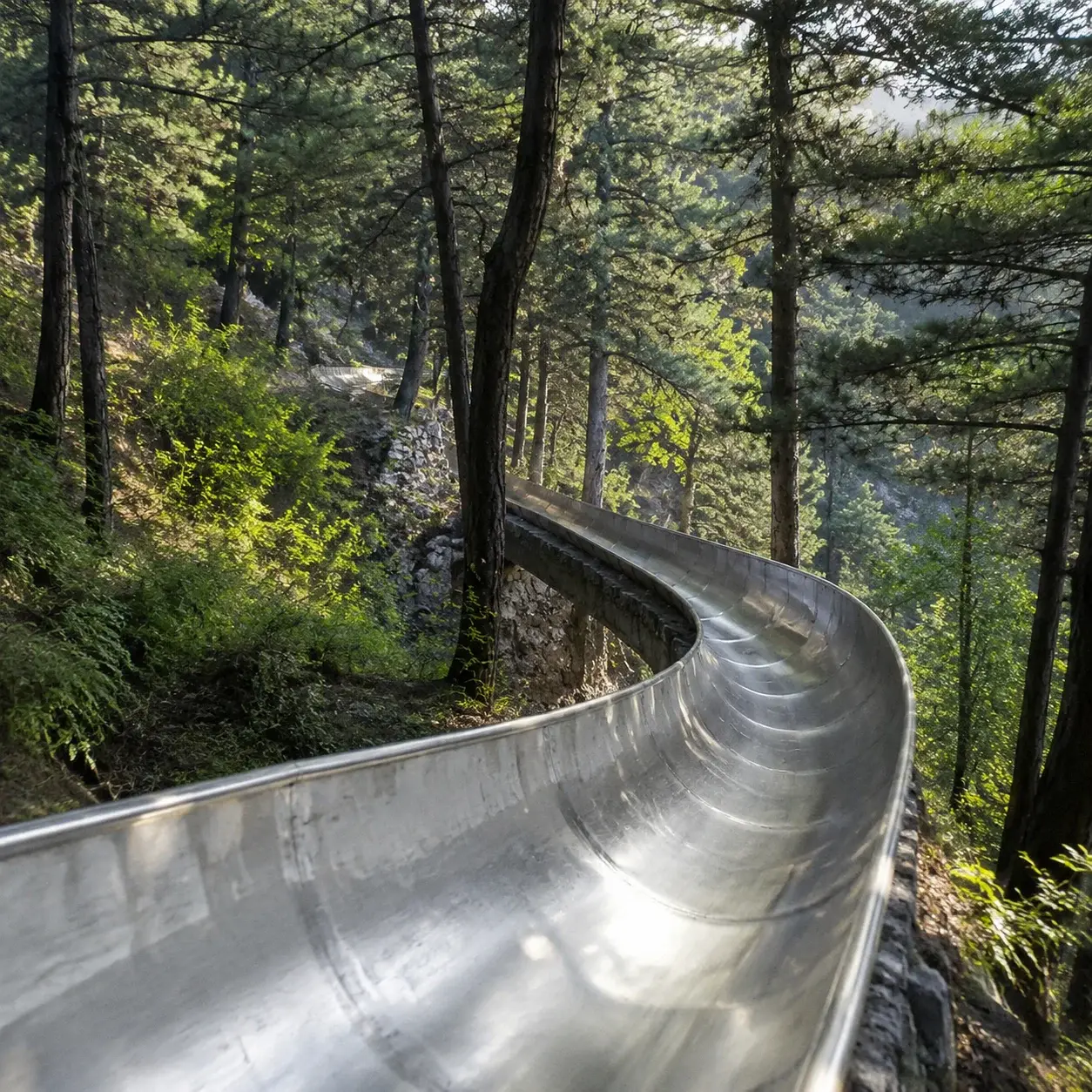
For most visitors with kids or a sense of humour: yes. The Great Wall of China toboggan is the single thing people remember from Mutianyu, and it costs no more than the chairlift you would otherwise be riding back down — so the marginal price of the fun is effectively zero. The exceptions are nervous riders and anyone with a bad back.
It is a stainless-steel channel that runs down the hillside from the wall, and you ride it in a small wheeled cart with a lever between your knees: push forward to go faster, pull back to brake. There is nothing to steer. Staff will run you through it and will shout at you if you tailgate.
The realistic complaint is not danger, it is pacing. You go exactly as slowly as the person in front of you, and one cautious rider braking the whole way turns a fast descent into a crawl. Leave a real gap at the top if you want speed.
Practical points to plan around, all of which need confirming on the day rather than in advance:
- Kids can ride, but there are age and height rules and they are the part most likely to have changed since any English page was written. Check at the chairlift base before you buy the ticket, not after.
- Rain closes it. It is an open metal track; wet track means the slide stops running, and it can stop mid-visit. This is exactly why you should not treat the toboggan as your only planned route down.
- If it is shut, the chairlift takes you back down on the same ticket. You lose the fun, not the fare.
- Skip it if you dislike being in a moving thing you do not fully control, or if your back objects to a low seated position with a rigid frame.
How Do You Get to Mutianyu From Beijing — and How Do You Get Back?
Allow roughly 1.5 hours each way from central Beijing. A private car or an organised day trip is the simple option; public transport is possible but multi-leg, and the return is where independent visitors get caught. Mutianyu sits in Huairou District, well north of the city, with no direct metro.
Outbound, in order of how much thinking each option requires:
- Private car or driver — the least friction. One vehicle, one price, waits for you, and removes the return problem entirely.
- Organised day trip — usually bundles transport with the ticket, which also sidesteps the booking and payment friction covered below.
- Public transport — genuinely doable and much cheaper, but it is a bus-plus-transfer journey rather than a single ride, and the last connection back to the city is earlier than most people expect.
Indicative opening hours are 07:30–18:00 (April–October) and 08:00–17:00 (November–March), per The China Guide as checked in August 2026. Treat those as the outer envelope of the day, not as your plan.
One current operating detail worth knowing before you set your expectations for the walk: the scenic area's visitor notice, read on 2026-08-13, states that only watchtowers 1 to 20 are open at present. That is an operating status, not a permanent feature — restored sections at Mutianyu open and close for maintenance — so it may well have changed by the time you go. Check the notice again the week you travel, particularly if you were planning to walk to a specific tower you read about somewhere.
Now the part almost every guide skips: getting back. We are not going to publish a last-shuttle or last-cable-car time, because we cannot verify one remotely and a wrong time here is the difference between a good day and being stranded on a hillside at dusk. What we can give you is the rule that always works:
Work backwards from the last cable car, not from the closing time. The scenic area's closing hour is not the moment the lifts stop. Ask a staff member for the day's last cable car (and last shuttle) the moment you arrive, write it on your phone, and set an alarm 30 minutes before it.
Two more habits that make the return safe: do not plan your descent solely around the toboggan, since weather can close it, and have your ride home arranged before you go up, because phone signal and taxi availability at a mountain car park in the evening are not things to discover on the day. If you are fitting this half-day into a wider Beijing plan, our Beijing travel guide covers where to base yourself and what pairs well with a wall morning.
How Do You Book Mutianyu Tickets From Abroad — Passport, Payment and the 15-Day Window?
Book on the official English site, en.mutianyugreatwall.com, expect to enter your passport number on the form, and expect the payment step to be the hard part. The booking flow itself is short; the friction is in the details that Western guides usually omit.
The flow, as documented by The Roaming Renegades from an actual booking (checked 2026-08):
1. Choose your ticket combination and date. 2. Enter name, passport number, country and phone number. 3. Pay by card. 4. Receive a QR code by email — that is your ticket.
Five Mutianyu-specific things to get right:
Your passport number is part of the booking. The form asks for it because Chinese scenic-area tickets are issued against a real identity document. The name and number you type must match your passport exactly, including the order of your given names, and you must carry the physical passport on the day — the QR code alone is not a substitute for the document it was issued against.
The advance window is 15 days — and that is now the operator's own rule, not a blogger's estimate. We previously carried the figure as indicative, from a booking walkthrough published in May 2026. The scenic area's visitor notice, read on 2026-08-13, publishes it as policy. Two conditions travel with it, and both catch people out. First, each identification document is limited to one ticket per day — a Chinese ID card, a foreigner's permanent-residence ID, or a passport — so you cannot buy the family's tickets on your own passport, and each traveller's document has to appear on its own booking. Second, there is no ticket exchange: you do not swap a booking for a paper ticket at a window, you enter by having the original document verified at the gate. Practically: outside Chinese public holidays, booking a few days ahead is usually enough; during national holidays, book the moment the system opens the date you want. Confirm the window on the official site before you travel, because published rules change without announcement.
The real-name mechanics, and the one thing the notice does not settle. Per the same notice, booking requires a real mobile phone number, a name and an ID number, and each phone number registers one user — so one phone number cannot quietly carry a whole travelling party's accounts. What the notice does not say is whether that mobile number has to be a mainland Chinese one. It says "real mobile phone number" and stops there. We are not going to fill that gap in either direction: whether a foreign number is accepted at registration is unverified, and it is one of the very few things only a real booking attempt can settle. If you have access to a mainland number, use it and the question disappears. If you do not, attempt the registration early enough in your planning that a failure is an inconvenience rather than a crisis on the morning you meant to be on the wall.
Refunds and changes — the part almost no English page mentions. The notice states that a booked ticket that has not been checked in can be refunded or changed on the ticketing platform before 24:00 on the day of the reservation. After that it cannot be processed, and the ticket will not admit you. Refunds reach the paying account within 7 working days, and the notice publishes an enquiry line: 400-632-9662. In plain terms, there is no grace period the next morning — if the weather turns or your day slips, deal with it before midnight on the booked date.
Payment is where foreign visitors stall. WeChat Pay, Alipay and UnionPay dominate Chinese ticketing, and international cards behave inconsistently — sometimes they go through, sometimes they fail with no useful error. Test your card well before travel day so a failure is an inconvenience rather than a crisis, carry cash as an on-site fallback, and buy from the official domain rather than third-party resellers, which quote inflated bundles for the same five products broken down above.
The rule that saves the most time: check what a site will accept as payment before you invest time in registering. It is the sign-up form travellers brace for, and it is usually not where the wall is. At the Forbidden City — a different attraction, documented in detail — a China Daily government-channel question-and-answer published in August 2025 states that registration takes only an email address and a passport number, no phone number, while the checkout accepts only Alipay, WeChat Pay or a Chinese bank card. Work out the payment question first and you find out in a minute what an account would have told you in twenty. Note that the two sites differ even here: the Forbidden City's registration asks for no phone number, while Mutianyu's does — one more reason to check the site you are actually booking rather than generalise from the one you read about. It is also worth asking at the Mutianyu ticket window whether cards are taken at the counter, because at some Chinese attractions the physical window accepts what the online channel will not — we have not verified that at Mutianyu, so ask rather than assume, which is the other reason the cash fallback above is worth taking seriously.
Which Mutianyu Plan Fits You?

Match your ticket, your lifts and your time budget to who you are travelling as — the right combination for a solo photographer is the wrong one for a family with a grandparent. Four common cases:
| You are… | Ticket to buy | Way up / down | Time to allow | The one thing to know |
|---|---|---|---|---|
| First-timer with one day in Beijing | Combined package ≈ 180–200 | Cable car up, cable car down | Half a day | Book the day before, and do not try to add a second wall section |
| Travelling with kids and seniors | Combined package, plus concession tickets (≈ 20 child/senior; free under 1.2 m) — but concessions are entry only: above 1.2 m, every rider pays full fare on the shuttle and cable car | Cable car up; toboggan down only if the kids meet the current rules | Half a day, unhurried | ⚠️ Mutianyu is not suitable for wheelchair users — there are stairs after the cable car (source: The China Guide) |
| Photographer | Entry + shuttle, or the full package | Chairlift or cable car up early, walk the ridge, walk or toboggan down | Most of a day | Aim for the first cable car — the light and the emptiness are both at the start |
| No guide, no Chinese | Whatever you can reliably pay for | Cable car — simplest signage, shortest decision | Half a day plus buffer | Pre-book on the official English site with your passport, and carry cash for the payment wall |
The pattern across all four rows is the same: buy the transport you will actually use, and buy it before you are standing at a window trying to negotiate five products in a language you do not read.
One more thing for families, because it is the clearest proof that concession rules do not transfer between attractions. Mutianyu's own visitor notice, read on 2026-08-13, offers a discounted ticket to foreign minors aged over 6 and up to 18. The Forbidden City's free entry for under-18s, by contrast, applies only to Chinese citizens — so the same foreign child pays full price there. Two Beijing attractions, one family, two different answers on the same morning, and neither rule tells you anything about the other. The practical instruction is simply this: check each site's own concession page for the ages and documents it wants, and never carry a threshold you learned at one attraction to the next. The same notice adds that holders of a Beijing Tong elderly or disabled care card enter Mutianyu free — but that an accompanying carer must buy a ticket, which is the kind of detail that quietly breaks a budget built on "the grandparent goes free".
A gap between the published policy and the booking form, reported by a traveller. The concession above is Mutianyu's own written rule and it stays exactly as stated: foreign minors aged over 6 and up to 18 are eligible for a discounted ticket. Set beside it, a parent travelling with a foreign-passport child, in a post dated 29 June 2026 (Xiaohongshu, read 2026-08-13), reports that at Mutianyu they ended up buying the child a student ticket, because the minor concession as presented to them required a Chinese ID number, which a foreign child does not have. Both of those can be true at once, and the gap between them is the useful part: the notice grants the concession, while the form reportedly asks for a number a foreign child cannot supply, and the parent lands on a different ticket instead. This is one traveller's workaround, not the rule — do not plan on it and do not read it as a change of policy. What it does justify is a minute of your time at the ticket window: concession documents are checked there anyway, so ask a member of staff which ticket a foreign minor should hold before you buy online.
Mutianyu vs Badaling — What's the Short Answer?
Mutianyu is the calmer, greener, more family-friendly restored section, with a cable car, a chairlift and the toboggan; Badaling is closer to Beijing, easier and cheaper to reach on public transport, and considerably busier. If you value space over convenience, Mutianyu; if you value the simplest possible journey, Badaling. That is the honest short version of the "mutianyu vs badaling" question — the full section-by-section decision, including Jinshanling, Simatai and the unrestored stretches, lives on our hub: which Great Wall section should you visit.
Frequently Asked Questions
Cable car, chairlift or the stairs — which should I buy? Cable car up and down is the safe default and the one most first-timers should buy. Take the chairlift only if you want the toboggan descent it pairs with. The stairs are free but steep, and add roughly forty minutes of climbing.
Is the Great Wall toboggan worth it, and can kids ride? For most visitors, yes — it costs the same as the chairlift you would otherwise ride down, and it is the part people remember. Children can ride, but age and height rules and the day's operating status vary; confirm both at the chairlift base before you buy.
When are the last shuttle and the last cable car? We will not invent a time — published last-service hours for Mutianyu are not something we can verify remotely, and they shift by season. Use the rule instead: ask staff for the day's last cable car when you arrive, and work your whole afternoon backwards from it.
Can I pay by card, or is it WeChat and Alipay only? Assume mobile payment first. WeChat Pay, Alipay and UnionPay dominate at Chinese scenic areas, and foreign cards behave inconsistently both online and at the window. Carry cash as a fallback, and try your card on the official booking site well before travel day, not on it. Check the accepted payment methods before you spend time registering — that is where the wall usually sits, not at the sign-up form. Asking at the ticket window whether cards are taken at the counter is also worth a minute, though we have not verified that at Mutianyu.
How far in advance can I book Mutianyu Great Wall tickets? Fifteen days — that is the scenic area's own published rule, per its visitor notice read on 2026-08-13. Two conditions come with it: each identification document (Chinese ID card, foreigner's permanent-residence ID, or passport) is limited to one ticket per day, and there is no ticket exchange, so you enter by having the original document verified rather than swapping the booking for a paper ticket. Booking a few days ahead is usually enough outside Chinese public holidays, when demand spikes and you should book as early as the system allows. Confirm on the official site the week you travel.
Can I cancel or change a Mutianyu ticket? Yes, if you act in time. Per the scenic area's visitor notice read on 2026-08-13, a booked ticket that has not been checked in can be refunded or changed on the ticketing platform before 24:00 on the day of the reservation; after that it cannot be processed and the ticket will not admit you. Refunds reach the paying account within 7 working days, and the notice publishes an enquiry line, 400-632-9662.
Do I need a Chinese phone number to book? We do not know, and we are not going to guess. The visitor notice says booking requires a real mobile phone number, a name and an ID number, and that each phone number registers one user — but it does not say whether the number must be a mainland Chinese one. That is unverified, and only a real booking attempt settles it. Try the registration early rather than on travel day, and if you have access to a mainland number, use it.
Is Mutianyu Great Wall wheelchair accessible? No. The China Guide states plainly that Mutianyu is not suitable for wheelchair users, because there are stairs between the cable car station and the wall itself. If step-free access is essential, do not book Mutianyu on the assumption the cable car solves it.
The Short Version
Two decisions settle a Mutianyu day. Buy the combined package — indicatively CNY 180–200, bundling entry, shuttle and round-trip cable car — unless you are genuinely planning to hike up the free trail, in which case entry alone at CNY 40 — or 45 for the postcard version of the same ticket — is all you need. Then decide your pair of lifts before you buy: cable car both ways for simplicity, or chairlift up and toboggan down if the kids meet the rules and the weather is dry.
Treat every figure on this page as a range checked in August 2026, and confirm it on en.mutianyugreatwall.com the week you travel rather than the month before. If you are still choosing between sections, go back up to which Great Wall section should you visit; if Mutianyu is settled and you are building the rest of the trip around it, our Beijing travel guide picks up from there. And if the passport-and-payment wall is the part you would rather not deal with, LyrikTrip can arrange a private English-speaking driver with tickets already booked, so the only decision left is cable car or toboggan.