




 18 days China, End to End Beijing → Xi'an → Chuanzhusi → Jiuzhaigou → Chengdu → Zhangjiajie → Guilin → Yangshuo → Shenzhen From $6,360 View route
  3 days 4-Day Tour of Siguniang Mountain, Biepa Gou, and Dagu Glacier Chengdu → Lixian → Heishui County From $1,599 View route
  5 days Above the Pillars, Then Below Zhangjiajie From $1,430 View route
  3 days After the Last Booth Guangzhou From $840 View route
  13 days All the Way West Xi'an → Dunhuang → Turpan → Kashgar → Shanghai From $3,500 View route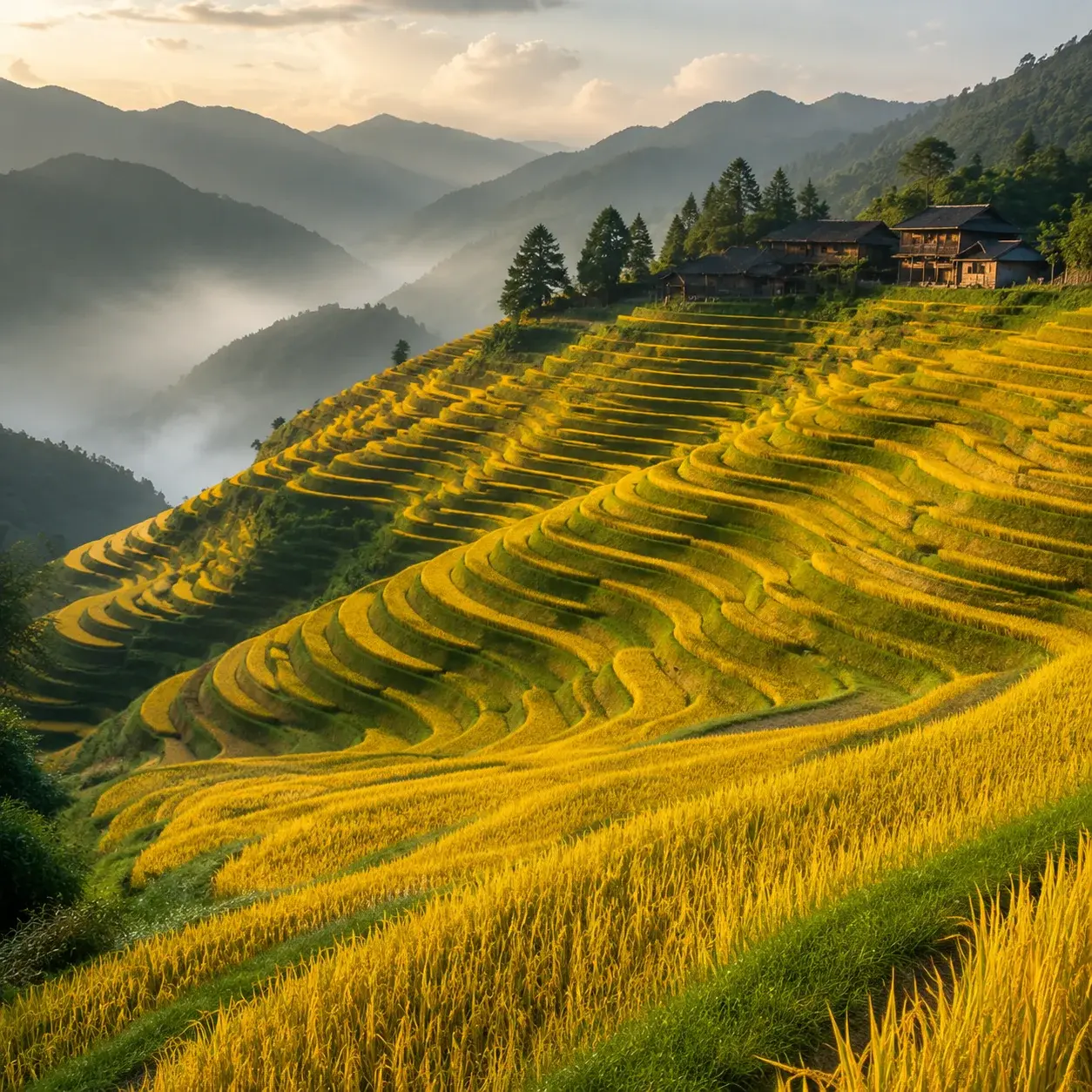
Longji Rice Terraces: Which Village to Visit, and When It's Worth the Trip
The Longji rice terraces sit two to three hours from Guilin, cost ¥100 for a single ticket covering three separate terrace areas, and look completely different depending on the month. Ping'an suits a half day or travellers with limited stamina; Dazhai's Jinkeng terraces suit photographers willing to stay overnight. Between late October and April the fields are bare brown earth, and most people should not make the trip then.
That last sentence is the one that matters, and it is the one you will rarely find on pages selling day tours here. At LyrikTrip we send travellers up this mountain most weeks of the season, and the complaint we hear is almost never about the wrong village — it is from someone who came in the wrong month and photographed an empty hillside.
Key Takeaways
- One ¥100 ticket covers all three terrace areas, with separate checkpoints at each. Keep the ticket — it is checked repeatedly.
- Children are priced by height, not age: ¥100 from 140 cm, ¥60 between 120 and 140 cm, free under 120 cm. This catches out most foreign families.
- Ping'an or Dazhai: Ping'an for half a day, young children or older parents; Dazhai's Jinkeng terraces for the biggest, most layered views, a cable car, and an overnight stay.
- Two good windows: mid-May to early June for mirror-flooded fields, and late September to mid-October for gold, with the harvest usually around 10-25 October.
- The mirror window has a cost. Mid-May to early June is the wettest part of the Guilin year, and it is also when Li River sailings are most likely to be suspended.
- This is not a "stop by on the way" sight. Give it a full day, stay a night, or leave it off the itinerary.
Prices and operating rules below are indicative, cross-checked against multiple operators in August 2026, and should be re-confirmed against the signage on site.
Should you go at all? Four questions
Ask these in order. If the first one fails, the rest do not matter — and that is a genuine outcome, not a rhetorical device.
- In the month you are coming, what colour are the fields? From late October to April they are bare brown, with a chance of snow from December to February. If the answer is "bare," stop here.
- Do you have a full day? A half day gets you as far as the first tier above the car park, which is not what you came for.
- Can everyone in your group manage one to two hours of steps? Paths here are stone stairs, not ramps, and they are slick after rain.
- Are you here to photograph it? If yes, plan on Dazhai and a night on the mountain. If no, Ping'an in half a day is enough.
Pass all four and the terraces are among the most rewarding half-days in southern China. Fail the first and you will have spent five hours in a vehicle to look at mud.
What are the Longji terraces — and why are there three of them?
Longji, meaning "dragon's backbone," is a terraced landscape in Longsheng county, north of Guilin, carved into the hillsides over centuries and still farmed. What is sold as a single attraction is in practice three distinct areas inside one scenic zone, each with its own entrance and its own character.
- Ping'an — the compact, best-known area, with the Seven Stars Around the Moon and Nine Dragons and Five Tigers viewpoints reachable on foot from the village.
- Jinkeng, reached through Dazhai — the largest and most layered, home to the Golden Buddha Peak and West Hill Music viewpoints, and the only area with a cable car.
- Longji Ancient Zhuang Village — the smallest and quietest, where the draw is the village architecture as much as the fields.
The villages are Zhuang and Yao communities, and the terraces are working farmland rather than a landscaped park. What you see in any given week depends on the farming calendar, not on a maintenance schedule.
Ping'an or Dazhai — which one should you go to?
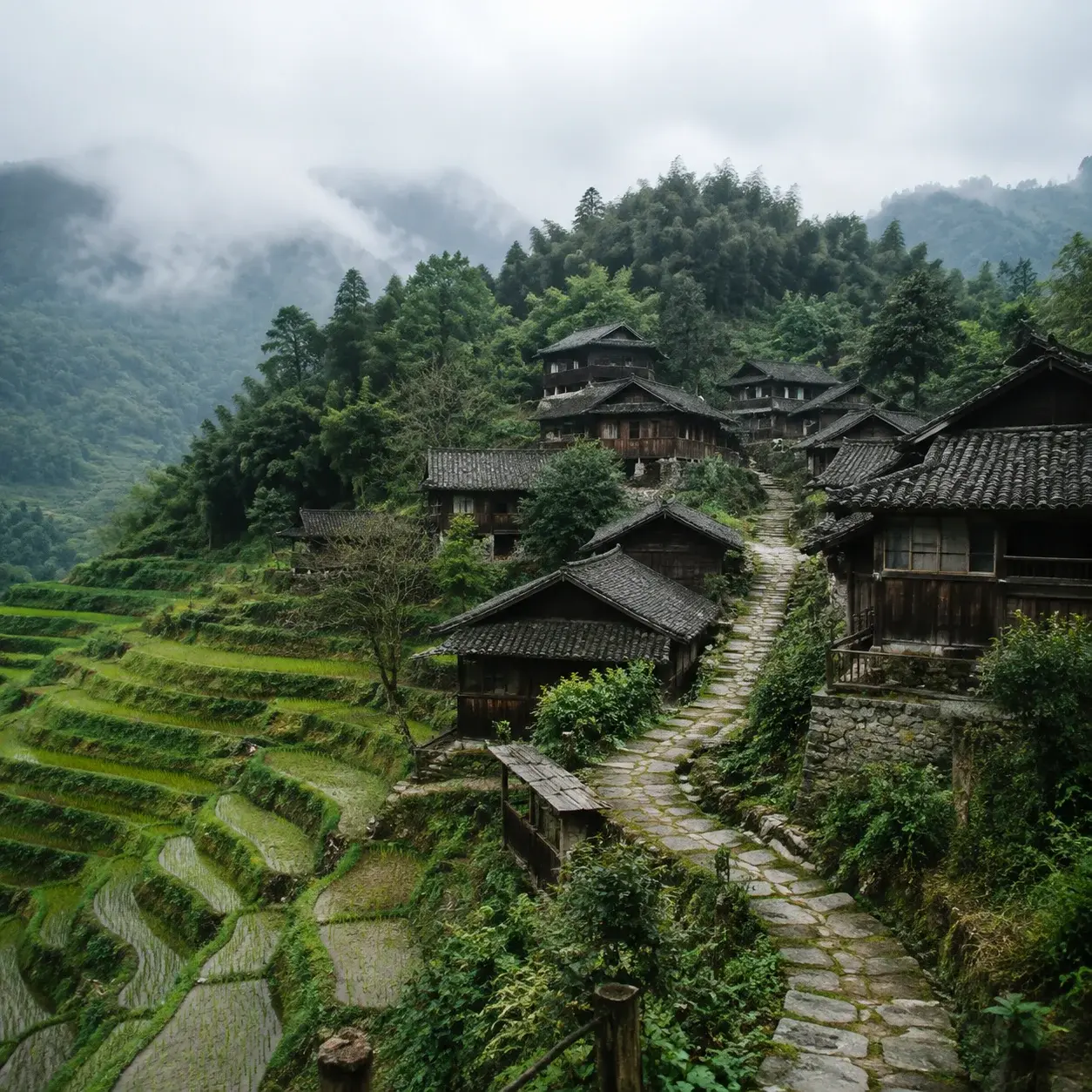
Ping'an if you have half a day or are travelling with young children or older parents; Dazhai's Jinkeng terraces if you are here to photograph and can give it a night.
| Ping'an | Jinkeng · Dazhai | Longji Ancient Zhuang Village | |
|---|---|---|---|
| Signature views | Seven Stars Around the Moon; Nine Dragons and Five Tigers | Golden Buddha Peak; West Hill Music | The village itself |
| Scale | Smaller, concentrated | Largest, most layered | Smallest |
| Effort | Gentle — main views walkable from the village | High — real climbing to the upper platforms | Moderate |
| Cable car | No | Yes | No |
| Accommodation | Plentiful | Moderate | Sparse |
| Crowds | Highest | Moderate | Lowest |
And matched against who is actually travelling:
| Ping'an | Jinkeng · Dazhai | Ancient Zhuang Village | |
|---|---|---|---|
| First visit, tight schedule | ✅ best choice | ⚠️ needs a full day | ❌ |
| With children aged 6-12 | ✅ | ⚠️ workable with the cable car | ❌ |
| With parents over 70 | ✅ on the gentler paths | ⚠️ cable-car section only | ❌ |
| Photography | ⚠️ fewer layers | ✅ best choice | ⚠️ |
| Avoiding crowds, seeing village life | ❌ busiest | ⚠️ | ✅ |
If you can only visit one and are not photographing seriously, Ping'an is the right answer for most travellers. The view is genuinely excellent, and the walk is the difference between an enjoyable morning and a forced march.
When should you go? The terraces have four completely different faces
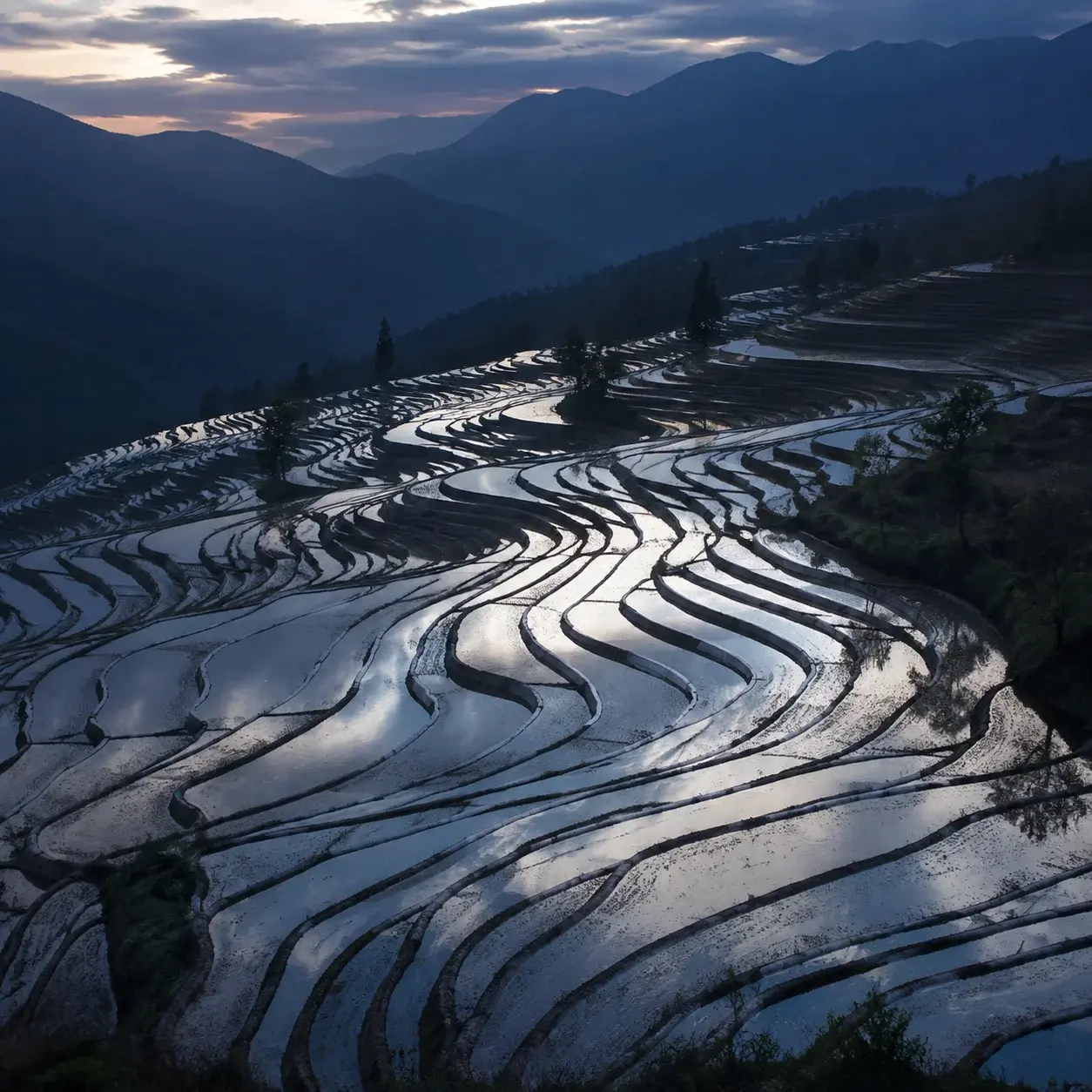
Mid-May to early June for mirror-flooded fields, and late September to mid-October for gold. Between late October and April there is nothing to see but bare earth.
| Window | What the fields look like | Who should come | Who should avoid it |
|---|---|---|---|
| Mid-May to early June | Flooded before planting, mirroring the sky | Photographers — the most striking window | Anyone who dislikes rain |
| Mid-June to mid-September | Solid green | Travellers wanting settled weather and greenery | Anyone after mirrors or gold |
| Late September to mid-October | Gold, harvested roughly 10-25 October | Most visitors — the strongest colour | Anyone avoiding crowds; early October is a national holiday |
| Late October to April | Bare brown; possible snow December to February | Only those coming for snow or solitude | Almost everyone else |
The seasonal sequence follows China Highlights (2026). The harvest dates move year to year with the weather, and the photographer Fabio Nodari, who has documented these terraces extensively, recommends asking your guesthouse directly rather than trusting a published date — advice we endorse. Ask one to two weeks before you travel, and ask two properties rather than one.
There is a trade buried in that table that no single-attraction guide will tell you, because it involves a different attraction entirely. The mirror window in mid-May to early June coincides with the wettest weeks of the Guilin year — using 1991-2020 climate normals published by Climates to Travel, May averages about 325 mm of rain and June about 395 mm, against about 80 mm in September and 65 mm in October. Those same high-water weeks are when Li River sailings are most likely to be suspended.
So if both the terraces and the river are on your list, September and October are the only weeks when both cooperate. Coming in late May buys the mirrors at the cost of the rain and the river. We cover the river side of that decision in our  Li River cruise guide.
How do you actually get there from Guilin?
Two to three hours each way, by public bus with a transfer, by private car, or on an organised day trip. The bus is cheapest and the least forgiving of a tight schedule.
| Option | Roughly | What it involves | Best for |
|---|---|---|---|
| Public bus | About ¥35 to Longsheng | From Guilin's Qintan coach station, roughly an hour, then a further transfer — the drop point sits about 7 km short of the scenic area | Budget travellers with a whole day and no fixed return |
| Private car | Highest | Door to door, waits for you, and lets you leave before or after the tour crowds | Families, older travellers, photographers chasing light |
| Organised day trip | Middle | Fixed timings, transport and ticket handled | First-time visitors who want it simple |
Bus routing and the approximate ¥35 fare follow Travel China Guide (2026) and VisitGuilin (2026); the 7 km gap between the bus drop and the terraces is the detail most itineraries omit, and it is what turns a "one-hour bus ride" into a half-day approach.
Coming by rail, note that Guilin has three stations — Guilin, Guilin North and Guilin West — and they are in different places. Which one you use changes your transfer time before you have even started up the mountain; we cover that in the Guilin travel guide.
What does it cost — tickets, cable car and shuttles?
Entry to the whole scenic area is ¥100 for adults, with children priced by height. Inside, the cable car and shuttles are extra.
| Item | Price | Notes |
|---|---|---|
| Adult entry (from 140 cm) | ¥100 | Covers all three terrace areas |
| Child, 120-140 cm | ¥60 | Measured, not asked |
| Child under 120 cm | Free | |
| Cable car at Jinkeng, one way | ¥60-70 | Sources disagree — see below |
| Cable car at Jinkeng, return | ¥110-120 | Sources disagree — see below |
| Internal shuttle minibuses | Extra | Charged separately from entry |
Three things to know that the price table alone does not convey.
One ticket, three checkpoints. The ¥100 admission covers all three areas, but each has its own checkpoint, and your ticket is inspected again at each one and at internal shuttles. Do not throw it away after the first gate.
Children are measured, not asked their age. The 120 cm and 140 cm thresholds are height lines at the gate. This is standard practice at Chinese attractions and routinely surprises foreign families, who expect to state an age.
The cable-car price is genuinely disputed. VisitGuilin lists ¥60 one way and ¥110 return; China Discovery lists ¥70 and ¥120 for the same lift. We have not been able to resolve which is current, so we publish both and tell you to trust the sign at the cable-car station over any website, including this one. Where guides differ on a number, the honest move is to show you the disagreement rather than pick one and sound confident.
Should you stay overnight in the village?
Stay if you are photographing, and go up and back in a day if you are not. Sunrise and the hour before the day-trip buses arrive are the two things an overnight buys, and they are worth a lot to a photographer and very little to anyone else.
The costs are real. Guesthouses sit above the road, so you either carry your luggage up a stone staircase or put it on a shuttle with limited space — which is why travelling light here is not a slogan but a practical instruction. Food options are limited to guesthouse kitchens and a handful of village restaurants, and after dark there is nothing to do but look at the hillside, which is either the point or a problem depending on why you came.
For most itineraries, a full day from Guilin is the right shape. For a photographer in the mirror or gold windows, one night in Dazhai is the difference between the pictures you came for and the pictures everyone else took at 11 a.m.
How hard is the walking — with kids or older parents?
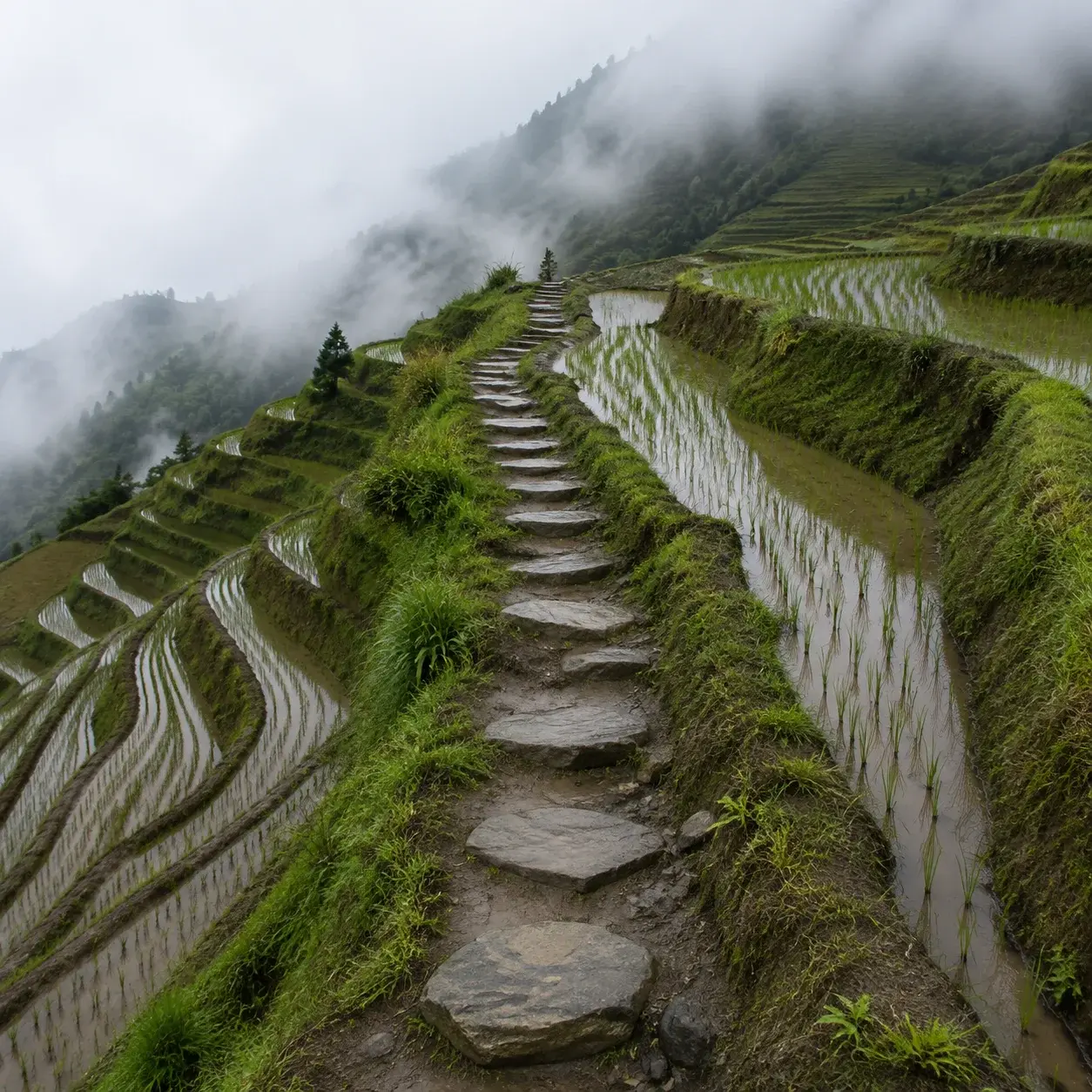
Harder than the photographs suggest. The paths are stone steps rather than graded trails, sections have no railing, and after rain they are slippery. Plan by your slowest walker.
- Ping'an — the principal viewpoints are reachable on a gentle climb from the village, making it the realistic choice for older parents and for children who still need carrying part of the time.
- Jinkeng, via Dazhai — the upper platforms involve sustained climbing. The cable car removes the hardest ascent but not the walking at the top.
- After rain — assume everything takes longer, and that stone steps in the wet are the main hazard here, more than altitude or distance.
Bring shoes with grip, not fashion trainers, and treat the cable car as a legitimate tool rather than a shortcut to feel bad about — it is what makes Jinkeng viable for a mixed-age group. Families planning around stamina across a whole China trip will find the wider framework in our China family itinerary.
Is a guided tour worth it here?
It is worth it for tight schedules, mixed-age groups and photographers chasing specific light; it is not necessary for a fit, flexible traveller with a full day. Going independently is entirely achievable.
What a tour genuinely removes is the transfer risk: the coach station, the ¥35 bus, the 7 km gap at the far end, and the return timing that decides whether you make dinner in Guilin. What it costs you is the freedom to stay for the light.
Interest in this is rising sharply. Searches for guided visits to these terraces grew by more than 130% year on year to August 2026, with about two-thirds of that demand coming from the United States — which suggests a lot of independent travellers are looking at the logistics and deciding not to do it themselves. If that is you, our private China tours cover this route with a driver who knows when the light is right.
Frequently asked questions
Is one day enough for the Longji rice terraces? One full day is enough for Ping'an, including the two to three hours of travel each way. Jinkeng at Dazhai deserves an overnight, because the upper viewpoints plus the climb do not fit comfortably around a return drive to Guilin.
Are the terraces worth visiting out of season? Rarely. From late October to April the fields are bare brown earth. Come then only if you specifically want snow on the terraces in December to February, or solitude, and go in expecting landscape rather than colour.
Can you visit the terraces and the Li River on the same day? Not sensibly. The terraces are two to three hours north of Guilin and the cruise piers are 25 to 28 km south of it, and the cruise runs mornings only. Give each its own day.
What happens if it rains? The terraces stay open and mist between the ridges can be beautiful, but stone steps become slippery and the long views close in. Build a spare day into any three-day Guilin plan — Guilin averages around 172 rain days a year.
Do you need to book tickets in advance? Entry tickets are bought at the gate and do not usually sell out. What is worth booking ahead is accommodation in the mirror and gold windows, when village guesthouses fill early.
Which village has better views, Ping'an or Dazhai? Dazhai's Jinkeng terraces are larger and more layered, which is why photographers favour them. Ping'an's views are excellent and far easier to reach, which is why most first-time visitors are happier there.
The verdict
Longji rewards people who give it a proper day and come in the right month, and punishes everyone else. Check the calendar first, pick Ping'an unless you are photographing, keep your ticket for the checkpoints, and trust the sign at the cable car over any price you read online.
If the months do not line up with your trip, leave it out without regret. There is more than enough in the river valleys to fill your time.
Next, read our Guilin travel guide to decide where to base yourself and how many nights to allow, and our Li River cruise guide before committing to a sailing date. If mountains are the theme of your trip, our China mountains guide covers the wider picture.