



 18 days China, End to End Beijing → Xi'an → Chuanzhusi → Jiuzhaigou → Chengdu → Zhangjiajie → Guilin → Yangshuo → Shenzhen From $6,360 View route
  3 days 3-Day Tour: Mount Siguniang, Bipenggou & Dagu Glacier Chengdu → Lixian → Heishui County From $1,599 View route
  5 days Above the Pillars, Then Below Zhangjiajie From $1,430 View route
  3 days After the Last Booth Guangzhou From $840 View route
  13 days All the Way West Xi'an → Dunhuang → Turpan → Kashgar → Shanghai From $3,500 View route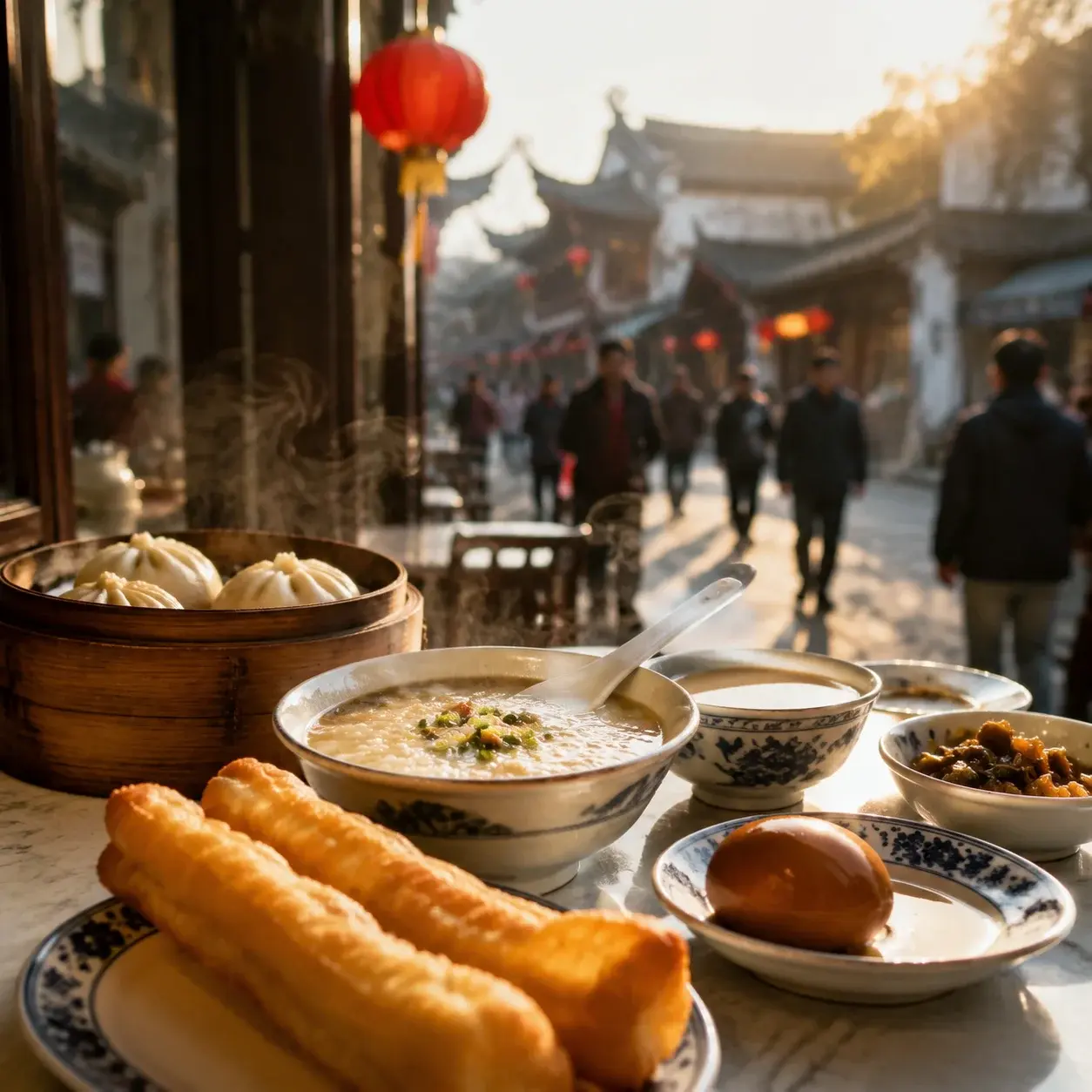
What Do Chinese People Eat for Breakfast? (And How to Order It Without Speaking Mandarin)
Chinese breakfast is bought, not made. Almost nobody cooks it at home — it comes from a street cart or a small shop on the way to work, and that single fact is what turns it from a food question into a travel question. It is savoury rather than sweet, it is hot, and it is grain-led: in the north, wheat in the form of steamed buns, pancakes, noodles and fried dough sticks; in the south, rice in the form of porridge and rice noodles. In Cantonese cities it is not a breakfast at all but morning tea, a sit-down social meal that runs for hours. And it has a hard window: the stalls open very early and are usually gone by mid-morning.
That last part is the part travellers get wrong. Most visitors sleep through the window, eat the hotel buffet they have already paid for, and leave China without having eaten a single Chinese breakfast. This guide is about the morning as you will actually meet it — what time to be standing outside, what kind of counter to walk up to, how to complete the transaction with no Mandarin, roughly what a normal person pays, and where to head in six cities. It sits inside a wider look at  what Chinese daily life actually looks like, because "breakfast porridge" is one of the daily habits that conversation keeps naming, and this is that habit examined at street level. If what you want instead is what each dish is and which regional cuisine it comes from, that is a different page and it already covers it properly — this one is about getting one into your hands.
LyrikTrip plans private, family-friendly trips through China from inside the country, which means our guides and guests are standing at breakfast carts in the dark before the queues form, and the framework at the centre of this page — The LyrikTrip Morning Coordinate — is built out of that hour rather than out of a dish list.
Two honesty notes, because they change how you should read what follows. First, this page carries no price figures at all. Every competitor on this topic gives none either, but the reason they are missing here is deliberate: the field pass that collects real paid prices has not happened yet, and a plausible-looking number is worse than no number. Where money comes up, you get comparative language and a promise that a verified band will replace it. Second, everything to do with stall opening and closing times, stall density, and exactly which lanes to walk is marked indicative and needs local verification — those things drift, and the review date at the top of this page is the honest limit of what has been checked.
Key Takeaways
- It is bought, not cooked. Breakfast in China is a street transaction, not a home meal. That is the whole reason it belongs in a travel guide rather than a recipe collection.
- The window is real and it closes. Industry sources put the national peak at roughly 6:30–9:00. Street breakfast does not taper off — the whole operation packs up and leaves.
- North is wheat, south is rice, Guangdong is a different meal entirely. Where you woke up determines what is in front of you more than what you feel like eating.
- Use The LyrikTrip Morning Coordinate. Answer four questions — Half, Hour, Counter, Comfort — and you get a specific order, a specific place to stand, and a specific way to pay.
- The Graceful Degradation Ladder means nobody goes hungry. No Mandarin, no cash and no mobile wallet still ends with breakfast, one rung further down.
- Ordering is physical, not verbal. The display is the menu. Quantity on your fingers and one word for "to go" are the only two things you genuinely need to communicate.
- It is cheap enough that pricing is not the risk. Missing the window is the risk.
What Do Chinese People Actually Eat for Breakfast?
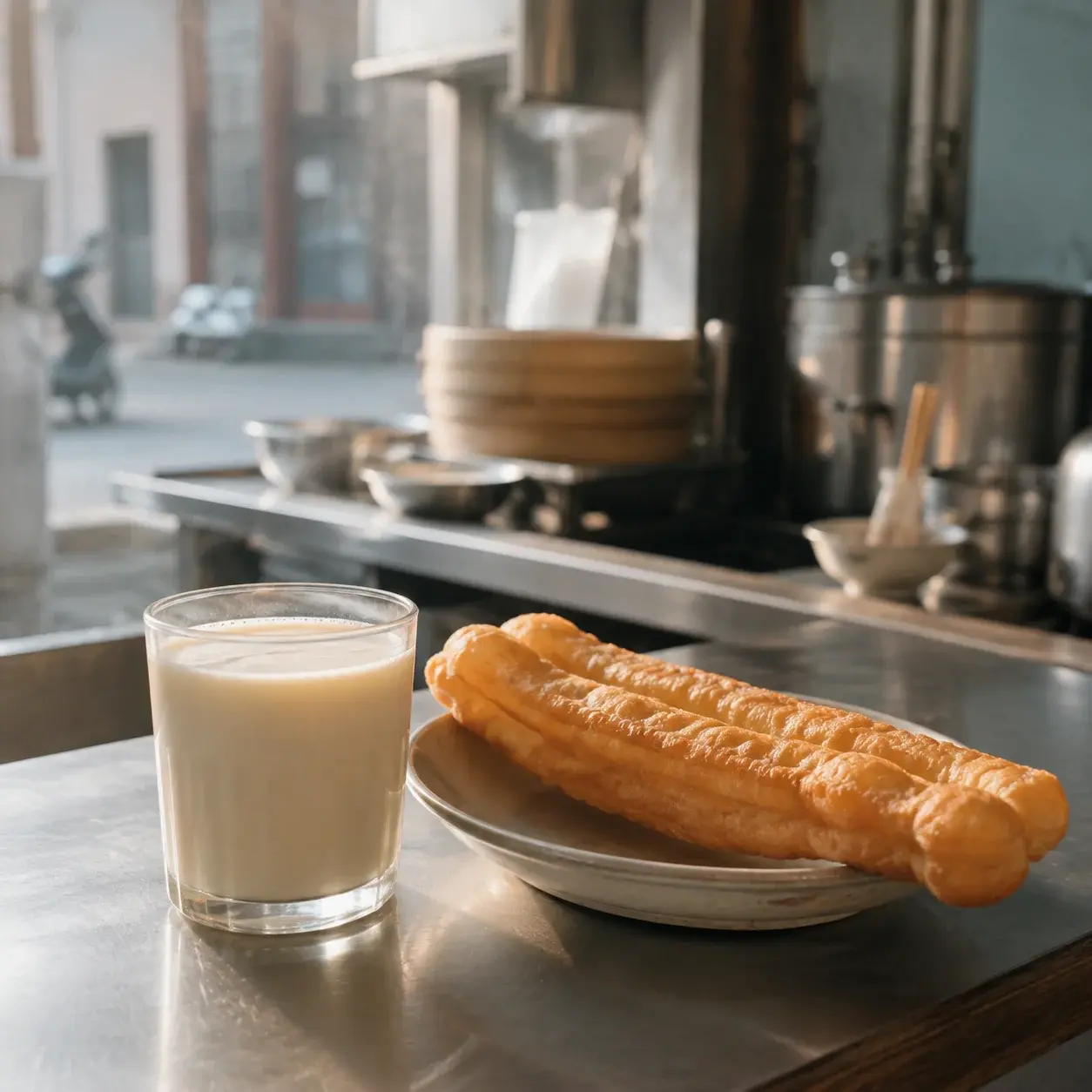
Savory, hot, grain-led, and handed to you on the way somewhere. There is no cereal-and-pastry default here — the thing that surprises most Western visitors is not any single dish, it is that the whole meal sits on the savory side of the line, and that it arrives hot.
The pairing you will see most widely across the country is soy milk with fried dough sticks (youtiao), a combination that food and travel sources consistently name as the closest thing China has to a national breakfast default, and one particularly associated with Shanghai — more on that in the guide to what to eat in Shanghai. Around it sit steamed buns (baozi), rice porridge (congee), noodles in broth, and savory pancakes (jianbing). Each of those is one thing you can point at; none of them requires you to know its name.
What travels with the food matters almost as much. The drink is usually hot — soy milk, thin porridge, or plain hot water — which is worth knowing before you go hunting for iced anything at 7am, and is its own small cultural story in why Chinese people drink hot water.
China Highlights' 2021 roundup, and the Chinese-food authorities that rank alongside it, all describe the same underlying regional split — north wheat, south rice, Cantonese morning tea as its own category. Everybody names it. Almost nobody uses it. The rest of this page uses it as the spine.
Editor's note. Buying rather than cooking is not a detail, it is the premise. Once you accept that breakfast here is a transaction completed on a street, the question stops being what is this and becomes how do I get one — and only someone who was standing there can answer the second one.
North vs South — Why Breakfast Changes Depending on Where You Wake Up
One line: the north eats wheat, the south eats rice, and Guangdong eats a different meal on a different clock. This is the single most useful navigational fact on the page, because it tells you what to expect before you have seen a single stall.
| North (Beijing, Xi'an, Harbin) | South (Shanghai, Chengdu, Changsha) | Cantonese (Guangzhou, Hong Kong) | |
|---|---|---|---|
| Base grain | Wheat | Rice | Rice + everything |
| Typical form | Steamed buns, savoury pancakes, fried dough sticks, wheat noodles | Rice porridge, rice noodles, soy milk pairings | Dim sum, small plates, tea |
| How it's eaten | Grab-and-go, standing or walking | Grab-and-go or a quick sit-down | Sit-down, social, hours long |
| Time posture | Early and fast | Early and fast | Late-morning and unhurried |
| What surprises visitors | How savoury and how hot | Porridge as a main event | That breakfast is a whole outing |
The split is agricultural before it is cultural. The north grows wheat and the south grows rice, and a breakfast built centuries ago out of whatever was in the fields nearby has stayed put long after supply chains stopped caring. So it is not a preference you can argue with by ordering differently — in a wheat city, the mainstream forms really are wheat. Practically, the further south you go, the longer breakfast takes: a northern morning is measured in minutes, a Cantonese one in hours. Beijing's morning is the clearest version of the northern pattern, and the Beijing street food guide covers where that overlaps with the rest of the city's eating.
The boundary is a belt, not a line. In the transition cities — roughly the Zhengzhou, Nanjing and Hefei band — wheat and rice sit on the same street, sometimes at the same stall, and the map stops helping. The working rule there is simple: read the Half axis off the cart three meters away, not off the latitude. What is steaming in front of you is a better guide than any regional generalisation, including this one.
The honest version. This is the one place where a map actively misleads you. What determines your breakfast is what the cart in front of you is selling, not which side of a river you woke up on.
The LyrikTrip Morning Coordinate — Tell Us Four Things, Get Your Order
The LyrikTrip Morning Coordinate is a four-axis decision tool: answer Half, Hour, Counter and Comfort, and you get a specific order, a specific place to stand, and a specific way to pay. It is designed to be mechanical, repeatable and — the part that matters most — degradable. Someone with no Mandarin, no cash and no mobile wallet can still run all four axes and walk away holding breakfast.
The Four Axes
| Axis | The question you answer | Codes | Full detail lives in |
|---|---|---|---|
| Half | Which half of the country am I in? | N north · S south · C Cantonese | North vs South, above |
| Hour | What time am I standing here? | H1 opening · H2 commute peak · H3 wind-down · H4 missed · C-band Cantonese exception | What Time Is Breakfast, below |
| Counter | What kind of counter is in front of me? | K1–K6 | Where Do Locals Actually Buy Breakfast, below |
| Comfort | What are my non-negotiables? | C-A adventurous · C-B cautious · C-V vegetarian · C-H halal · C-W no wheat · C-K with kids · C-T catching a train | Different Travelers, Different Mornings, below |
The override rules are what make this a decision tool rather than a taxonomy. C-B (cautious) forces Counter up to K3 and Hour to H2 — you want the standardised counter at the busiest moment, because a long queue is a working queue. C-W (avoiding wheat) forces Half to S or C, and in a northern city that means accepting a narrower morning rather than pretending the choice is wide. C-T (catching a train) ignores Half and Hour entirely and keeps only Counter: when time is the hard constraint, geography and authenticity both stop mattering.
The Graceful Degradation Ladder
Each rung down trades a little authenticity for a lot of certainty. The design promise is that every reader can stop at some rung and still actually eat — there is no rung where the answer is "bad luck."
| Rung | What you have | What you do | What it costs you |
|---|---|---|---|
| L0 | Pointing + mobile payment + inside the window | K1/K4 street stall; join the longest local queue | Nothing |
| L1 | Pointing + cash only | Switch to K2/K3; carry small notes and expect change to be a live question | Fewer stalls available |
| L2 | Neither mobile payment nor cash | K3 chain counter with a picture menu, or a K6 convenience-store hot cabinet — the two counter types most likely to have a card terminal | You lose the street-stall experience |
| L3 | No appetite for negotiation, small children, or an early train | The hotel buffet's porridge-and-buns station — already paid for, zero language risk | You lose this particular meal |
| L4 | Window already closed and you're in a Cantonese city | Go straight to a teahouse (K5) | It becomes a two-hour meal, not a breakfast |
L1 and L2 both rest on payment facts that change month to month — whether a given cart takes cash, whether change exists, whether a foreign card behind a wallet actually clears. Both rungs are indicative, pending on-the-ground verification; the payment section below sets out what is genuinely known and what is not.
Worth saying plainly. The ladder is the honest version of "just be brave." Nobody needs courage; they need to know which rung they are standing on and what the next one down actually costs.
What Time Is Breakfast in China? (The Window You Will Miss)
Industry sources broadly agree that the national breakfast peak runs from roughly 6:30 to 9:00 — treat that as approximate, not as a schedule. The important part is not when it starts but how it ends, and it ends abruptly.
The Breakfast Window
Times below are staged rather than clocked, because the real boundaries shift by city, by season and by street. Every band here is indicative and pending on-the-ground verification.
| Stage | What you can see | When (indicative) | What to do about it |
|---|---|---|---|
| Ignition | The first carts light up; pans go on; boards come out | Before full daylight — varies by city and season | The only band where you get the "first pan" scene |
| Full range | Every category is out and hot | Shortly after ignition | Best entry point if you want to see the whole spread |
| Commute peak | Longest queues, fastest turnover | Inside the commute flow — the roughly 6:30–9:00 window | The default target. Follow the queue; don't deliberate |
| Signature sells out | The best-selling item goes first | The back half of the peak | Arrive late and the signature item is simply not there |
| Teardown | Not a slow fade — the whole stall leaves | Mid-morning; varies widely, verify locally | This is what "missing breakfast" actually means |
| Cantonese exception | Teahouses open early and never pack up | All morning, into lunch service | The one place oversleeping is survivable |
Which Hour Band Did You Walk Into?
The window table tells you when. The Hour axis of The LyrikTrip Morning Coordinate tells you what to order instead.
At H1, the range is at its widest but not everything is hot yet — this is the band for anything made in front of you. At H2, the commute peak, you do not need to choose at all: join the longest queue of work uniforms and school bags and order whatever they are ordering. At H3, the signature item is gone; the correct move is to switch to whatever still has steam coming off it rather than waiting at a cold pan for something that is not coming back. At H4 the stalls are physically absent and you take the Degradation Ladder. C-band, the Cantonese morning, never packs up and runs straight into lunch.
Three things follow from that, and they are the part worth remembering:
- Chinese street breakfast does not taper — the whole operation leaves, pans, boards and price signs together.
- So "missing breakfast" in China is not eating late; the meal has physically ceased to exist, and the same street two hours later shows no sign it ever happened.
- The only exception is the Cantonese morning, which is measured in hours and runs into lunch.
If you are already awake at that hour, the street is not the only thing happening: the parks fill at the same time, and the same early-morning hour in the park and the breakfast stall afterwards are one continuous scene rather than two separate outings.
A note for the jet-lagged. This is the one meal that rewards the side of jet lag that wakes you early rather than the side that lets you sleep in. On your first morning, don't fight it back to sleep — that is the easiest real scene you will get all trip.
Where Do Locals Actually Buy Breakfast?
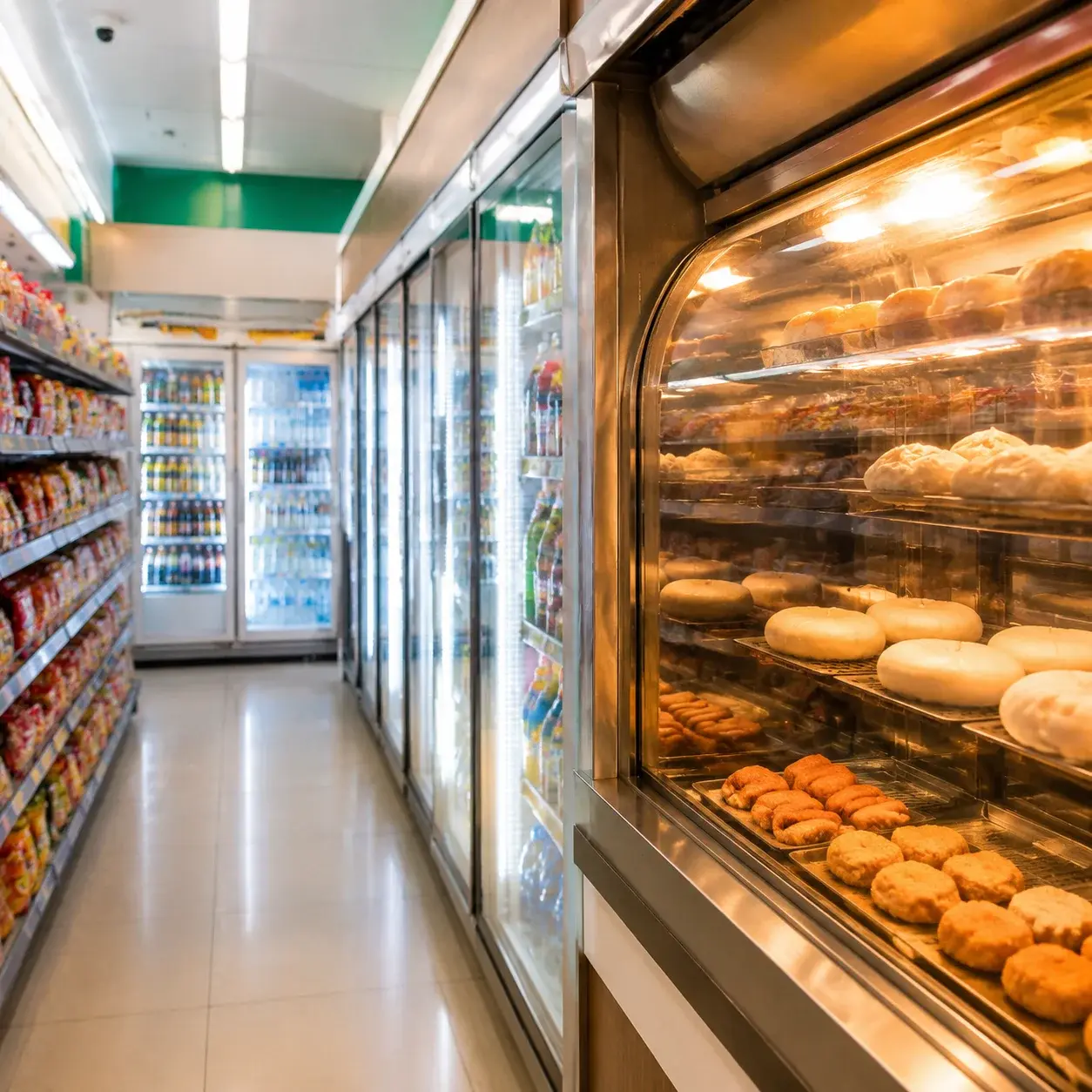
Chinese breakfast street food is sold from six recognizable kinds of counter, and choosing the right one matters more than choosing the right dish. Each has its own speed, its own place to stand, and its own moment when money changes hands — and standing in the wrong place at the wrong moment is the single most common source of traveller awkwardness. For the wider picture of street food across China, the sibling guide covers the rest of the day.
The Six Counter Types (K1–K6)
| Code | What it is | Speed | Where you stand | When you pay | Difficulty |
|---|---|---|---|---|---|
| K1 Street cart | One pan, one board, no seats | Fastest | Queue → take it → step aside immediately | Usually on handover | Medium (no menu; you read the display) |
| K2 Breakfast shop (早餐店) | A room with plastic stools | Fast | You may sit; read the counter before you sit | Usually prepay | Low |
| K3 Chain counter | Standardized, often a picture menu | Fast | Queue, point at the picture, collect | Prepay | Lowest — best first attempt |
| K4 Market edge / lane | Highest density, least English | Medium | Walk and look; read the queues | Varies by stall | High (best experience) |
| K5 Teahouse (Cantonese) | Sit down, tea first | Slow, by the hour | Take a seat, wait to order | Settle at the end | Medium (different process) |
| K6 Hotel buffet / convenience hot cabinet | The fallback | Immediate | — | Included / at the register | Lowest |
The Stall Read — A Five-Point Scorecard
Your real question is not "where is the best breakfast in this city." It is "is the stall in front of me any good." Score it out of ten, two points per row, and stand in the queue at 7 or above.
| Check | 0 points | 1 point | 2 points |
|---|---|---|---|
| Queue composition | Tourists only, or nobody | Mixed | Commuters, students, older regulars |
| Turnover | Things sitting still | Occasional handovers | The pan never stops; the queue never breaks |
| Price board | No board; priced by eye | A board, but incomplete | Posted openly on the front |
| Range of items | Sells everything | Three to five things | Makes one or two things only |
| Distance from the tourist street | On the main tourist street | Within a block | Two streets in or further |
The underrated part. Range is the row everyone reads backwards. A stall that sells one thing means enough people buy that one thing every single day — its narrowness is evidence of demand density. The stall with everything laid out is almost always built for someone who doesn't know what they want, and that person is usually a tourist.
One line worth quoting. The tourist street is usually the worst place in the city to eat breakfast — not because it is expensive, but because breakfast there isn't made for people in a hurry, and every technique at a real stall is optimized for people in a hurry.
Stall density genuinely varies by location type — metro exits, office blocks, school gates and market edges behave differently from each other, and all four behave differently from the main tourist street. Until that has been counted properly on the ground it stays a direction rather than a rule: indicative, pending on-the-ground verification. What can be said now without a count is the shape of it — clusters form where people are funneled past on a fixed schedule, which is why exits and gates outperform open plazas.
Hotel Breakfast or Street Breakfast?
The buffet has already won, and that is the problem. It is paid for, it is downstairs, it carries no language risk, and it is why a large share of visitors leave China without eating one Chinese breakfast. But the answer is not a reflexive "go outside" — on some mornings the buffet is genuinely the right call.
| Situation | The call | Why |
|---|---|---|
| First full morning in each city | Go outside | The window opens once a day and you have a finite number of mornings here |
| Early train or early flight | Stay at the buffet | See C-T: time is the hard constraint; don't spend it on an unfamiliar process |
| Traveling with small children | Buffet first, street as a second breakfast | Temperature, seating, handwashing, predictability |
| Firm dietary restriction, hard to communicate locally | Buffet first | A buffet lets you see everything; a stall does not |
| Day after arrival, awake early from jet lag | Go outside | The one time jet lag is doing you a favour |
| Already slept past the window | Cantonese city → teahouse; everywhere else → buffet | See The Breakfast Window |
Editor's note. Plenty of hotel buffets run a porridge-and-buns station of their own. Treat it as a dress rehearsal — learn what those things look like with zero language pressure, and tomorrow morning your hesitation at the stall is half as long. That is more useful than being told to be brave.
How to Order Chinese Breakfast Without Speaking Mandarin
You complete the transaction physically, not verbally — by looking, pointing, holding up fingers, and knowing when the money moves. This is the part no other guide on this topic covers, and it is the part that actually causes anxiety.
The Point-and-Pay Sequence
Seven beats, fixed order, one job each.
| Beat | What you do | How | Why it sits here |
|---|---|---|---|
| 1. Look before you queue | Find the menu | The display is the menu — steamers, fryer, porridge pot, griddle. Walk one lap and work out what the categories are | Deciding once you are already in the queue jams the queue and panics you |
| 2. Read the queue, then pick | Choose the stall | Use The Stall Read. The one-line version: follow the queue of work uniforms and school bags | A local queue is the only free quality signal there is |
| 3. Set the quantity | Use your fingers | Point at the tray and hold up fingers. Chinese hand counting matches Western counting for one through five and diverges above that, so never go above five — split it into two asks instead | Quantity is the only thing you must communicate |
| 4. Work out when you pay | Before or on handover | K1 carts usually take payment on handover; K2 and K3 usually prepay; K5 teahouses settle at the end | Standing in the wrong place at the wrong moment is the most common source of awkwardness |
| 5. Pay | Mobile first | Either you scan a code, or you present one and get scanned. Cash and foreign cards are the uncertain part — see below | The highest-anxiety beat, and the one that decays fastest |
| 6. Say "to go" or "eat here" | One word | See the phrase table below. It decides your packaging: a bag, or a bowl and a stool | It determines where you stand for the next ten minutes |
| 7. Take it and step aside | Move | At a cart, move the instant it is in your hand and eat a few paces away. Sitting is what shops are for | Blocking the handover point is the only mistake that genuinely annoys anyone |
The Six Phrases That Change the Outcome
| Situation | English | 中文 | Pinyin |
|---|---|---|---|
| Choosing | this one | 这个 | zhè ge |
| Quantity | two | 两个 | liǎng ge |
| Price | how much | 多少钱 | duō shao qián |
| Heat | not spicy | 不要辣 | bú yào là |
| Packaging | to go | 打包 | dǎ bāo |
| Diet | no meat | 我不吃肉 | wǒ bù chī ròu |
Editor's note. Don't memorise dish names. A dish name does nothing for the transaction — anything you can point at doesn't need naming, and anything you can't point at won't appear because you named it. Spend the entire memory budget on quantity and on "to go"; those are the only two sentences that change what ends up in your hand.
Paying — What Actually Works
This is the fastest-decaying fact on the page, which is exactly why a four-year-old article structurally cannot answer it.
What is documented: as of 2024 reporting on China's payment reforms, overseas visitors can bind foreign bank cards to Alipay and WeChat Pay; UnionPay is interoperable with close to 200 overseas wallets; single-transaction limits for foreign users were raised to US$5,000 with an annual ceiling of US$50,000; and WeChat Pay waives its 3% service fee on transactions under ¥200 — which covers essentially every breakfast you will ever buy.
What is not documented, and where we have deliberately stopped short: policy coverage is not the same as the reader on a given cart. A national interoperability agreement says nothing about whether the one-pan operation at a metro exit has a working code, takes cash, or has change at 7am. Small street stalls specifically are where the gap between "supported" and "works" is widest, and that gap has not been field-tested for this page. Treat the payment picture as indicative, pending on-the-ground verification, and treat the 2024 date as load-bearing — this area moves fast enough that a year-old answer is a guess.
Practically, that is what rungs L1 and L2 of The Graceful Degradation Ladder are for. If your wallet doesn't clear, you move to a chain counter or a convenience-store hot cabinet, and you still eat.
What Does Breakfast Cost in China?
Cheap — cheap enough that price is not the thing to worry about. A cart item costs less than a coffee does at home, and even a sit-down bowl doesn't move the needle on a day's budget. That is the honest shape of it, and it is deliberately all you get here, because the field pass that collects real paid prices has not run yet and a fabricated figure would be worse than none.
Indicative, pending on-the-ground verification — this table carries no figures by design. What it gives you is the ordering, which is the part that lets you tell a normal price from a tourist price even without knowing either number.
| Scenario | Where it sits | Note |
|---|---|---|
| Street cart · one item | The floor | The cheapest way to eat in China, full stop |
| Street cart · full breakfast (item + drink) | A small step up from the floor | The page's anchor case — this is the "less than a coffee at home" comparison |
| Breakfast shop · a hot bowl, sitting down | Modestly above the cart | You are paying for the seat |
| Chain counter · a set | Above the breakfast shop | A predictability premium, and often worth it on day one |
| Cantonese morning tea · per head | A different order of magnitude | Because it is a morning, not a breakfast |
| Convenience-store hot cabinet | Near the top of this list | The fallback ceiling, and still not expensive |
The honest version. Breakfast is too cheap to be worth scamming you over — it is not a con target. But tourist-district pricing is real: the same thing costs differently on the main street and two blocks off it, and the gap isn't really money, it's who the price was set for. You, or the person who comes every day.
Dim Sum Breakfast: The Cantonese Morning Is a Different Meal
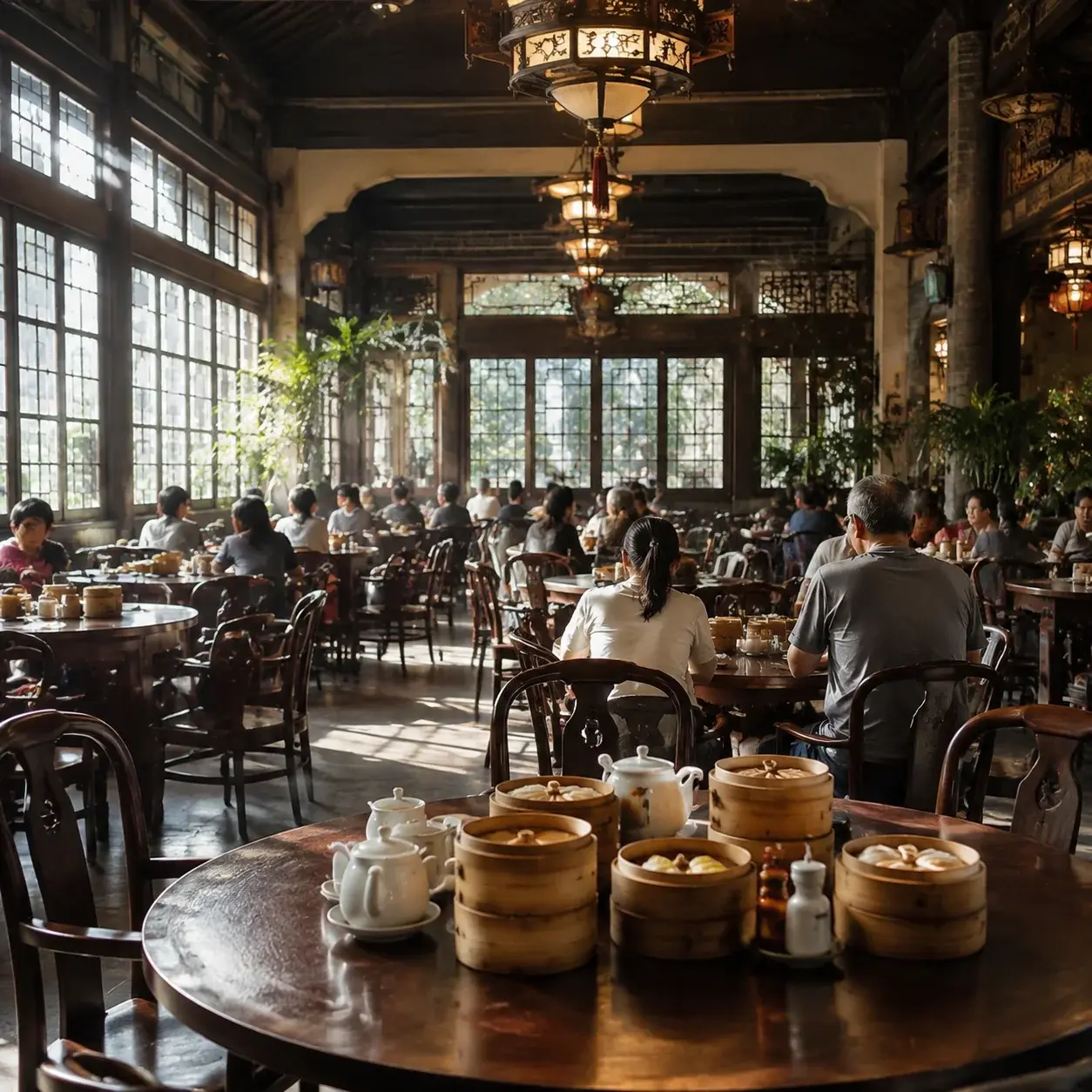
In Guangzhou, Hong Kong and the cities around them, the morning meal is yum cha — morning tea — and it is a leisurely, social, sit-down occasion rather than anything you grab on the way somewhere. Treating it as a breakfast is the mistake, because it is not one; it is a morning.
The mechanics are genuinely different from every other counter type on this page. Tea comes first and you choose it. Small plates arrive in rounds rather than as a single order, either from a trolley or against a paper slip that gets marked as things land on your table. Rooms are loud and full of retirees and multi-generation families, which is its own reason to go. And critically, you settle at the end — K5 is the only counter type here where payment comes last, which catches out anyone conditioned by the prepay counters up north.
Two mechanical facts make this the page's escape hatch. Teahouses open early but never tear down, and service runs continuously into lunch. That makes a Cantonese city the only place where someone who slept through the window can still sit down to a real morning meal — rung L4 on The Graceful Degradation Ladder, C-band on the Hour axis. If you have exactly one morning to oversleep on your whole trip, spend it in Guangzhou.
Exactly how the tea order is taken, how the slip is handled, and how long a table realistically sits are all indicative, pending on-the-ground verification; they vary between teahouses and between cities, and they have not yet been observed for this page across a large enough sample to state as a range.
Worth budgeting for. A Cantonese morning is not a breakfast, it is a morning. Allow a breakfast's worth of time for it and you will get the arithmetic wrong by hours.
Different Travelers, Different Mornings
Six readers, one morning, six different correct answers. Each row below is a Morning Coordinate override — which is the real proof that the framework works rather than just decorating the page.
| Reader | Coordinate override | What to do | Read next |
|---|---|---|---|
| Vegetarian (C-V) | Prioritise the steamed and soy categories | Ask; don't judge by appearance — plenty of things that look meat-free aren't. Say "no meat" before you say "to go," which is far more graceful than picking things out afterwards | — |
| Halal (C-H) | Look for the 清真 sign; bias Half toward northwestern cities | In cities with a long-established Hui presence, breakfast is the easiest meal of the day to solve | halal food in China |
| With kids (C-K) | Counter forced up to K2/K3 | You need seats, controllable temperature, and the option to abandon halfway. Make the street stall the second breakfast, not the only one | China food with kids |
| Avoiding wheat (C-W), in a wheat city | Half forced to S or C | Northern mornings are the hard case — the mainstream forms are nearly all wheat. The honest answer is to drop to porridge and rice forms, or take Ladder rung L2. Not to pretend the choice is wide | — |
| Catching a train, ≤40 min (C-T) | Ignore Half and Hour; keep only Counter | K3 chain counter or a station counter. "To go" is the only sentence that matters here. Don't make your first street-stall attempt inside a 40-minute margin | — |
| Not feeling adventurous (C-B) | Counter to K3, Hour locked to H2 | Picture menu, prepay, join the queue — the lowest-language path that exists. Win once, then go one lane deeper tomorrow | — |
Editor's note. Designing an easy first attempt beats telling people to be brave. The real use of The LyrikTrip Morning Coordinate isn't producing one optimal answer — it's letting a reader move the Counter axis down one notch the next morning. Anyone who moves down two notches over a trip has eaten a genuine Chinese morning.
Where to Eat Breakfast in Six Cities
Everything in this table is street-and-district level on purpose. Individual shops close, move, and get redeveloped, and naming one is the fastest way to make a page wrong — so no single stall or shop is named here, and every "head for" is indicative and needs local verification before you build a morning around it.
| City | The local morning | Where to head | Read next |
|---|---|---|---|
| Beijing | Wheat-led; steamed buns and savoury pancakes | Hutong lanes a block or two off the main drags, and the clusters that form around metro exits — which lanes specifically varies, verify locally | Beijing street food |
| Shanghai | Soy milk with fried dough sticks — the pairing the country most associates with this city | Older residential lanes rather than the Bund waterfront | what to eat in Shanghai |
| Guangzhou | Morning tea, measured in hours | Old-city teahouse districts rather than the new business towers | — |
| Xi'an | Wheat and noodles, plus the Muslim Quarter's own distinct morning | The streets in and around the Muslim Quarter, early | halal food in China |
| Chengdu | Rice noodles, and a breakfast register that carries chilli where other cities' don't | Neighbourhood shop rows, not the restored tourist alleys | street food across China |
| Hong Kong | Dim sum, plus the cha chaan teng hybrid | Old-neighbourhood teahouses away from the harbourfront | — |
The pattern underneath the table is more portable than the table itself: in every one of these cities, the good morning is one or two streets off whatever the visitor route is, and it is over before the visitor route wakes up.
Chinese Breakfast FAQ
What time do Chinese people eat breakfast?
Early. Industry sources put the national peak at roughly 6:30 to 9:00, which is when queues are longest and turnover fastest. Treat that as approximate rather than a schedule — the real boundaries shift by city and season, and stalls pack up entirely by mid-morning.
Where do locals eat breakfast in China?
At street carts, small breakfast shops, chain counters and market lanes — bought on the way to work rather than cooked at home. The highest concentration is where people are funnelled past on a fixed schedule: metro exits, office blocks, school gates and market edges, typically a street or two off the tourist route.
How do you order Chinese breakfast if you don't speak Chinese?
Physically. Walk one lap to see what the display offers, join a queue of local commuters, point at what you want and hold up fingers for quantity, then work out whether that counter takes payment before or on handover. Quantity and "to go" are the only two things you must communicate.
Is Chinese breakfast savoury or sweet?
Savoury, overwhelmingly, and hot. There is no cereal-and-pastry default. Expect steamed buns, savoury pancakes, noodles, fried dough sticks and rice porridge, usually with a hot drink alongside. Sweet items exist but are the exception rather than the shape of the meal.
How much does breakfast cost in China?
Very little — a cart item costs less than a coffee does at home, and a sit-down bowl is only modestly more. This page deliberately carries no figures until real prices have been collected on the ground; a verified band will replace this answer rather than a plausible-looking guess.
What's the difference between breakfast in north and south China?
Grain. The north is wheat-based — steamed buns, pancakes, noodles, fried dough sticks — and the south is rice-based, with porridge and rice noodles. Cantonese cities do neither: morning tea there is a sit-down social meal running for hours rather than a grab-and-go.
The Bottom Line
Chinese breakfast is bought, not made, and that is the whole reason it belongs on a travel itinerary rather than in a cookbook. Missing it isn't eating late — the meal physically leaves, stalls and boards and price signs together, and the street two hours later shows no trace. The hotel buffet isn't the enemy either; it is the rehearsal room and the correct answer on early-train mornings. So: set an alarm, walk two streets off the tourist route, use The Stall Read on whatever is in front of you, and point. The Point-and-Pay Sequence handles the rest, and The Graceful Degradation Ladder is there for the mornings when your wallet, your Mandarin or your patience isn't.
Take The LyrikTrip Morning Coordinate with you — Half, Hour, Counter, Comfort — and the goal for the trip is modest: move the Counter axis down one notch each morning. If you'd rather have the window, the neighbourhood and the ordering handled for you, that's the kind of morning we build into a trip. In the meantime, read on into Chinese daily life beyond the meme, street food across China, and what each dish is and where it comes from.