




 18 days China, End to End Beijing → Xi'an → Chuanzhusi → Jiuzhaigou → Chengdu → Zhangjiajie → Guilin → Yangshuo → Shenzhen From $6,360 View route
  3 days 3-Day Tour: Mount Siguniang, Bipenggou & Dagu Glacier Chengdu → Lixian → Heishui County From $1,599 View route
  5 days Above the Pillars, Then Below Zhangjiajie From $1,430 View route
  3 days After the Last Booth Guangzhou From $840 View route
  13 days All the Way West Xi'an → Dunhuang → Turpan → Kashgar → Shanghai From $3,500 View route
Chengdu Panda Base: Which One Should You Visit, and When Should You Arrive?
For a first visit, go to the Chengdu Research Base and be at the gate when it opens: the early-morning feeding window decides your morning more than which base you choose. Tickets are ¥55 for adults with a passport-tied online reservation. The Dujiangyan Base has been closed since 23 April 2026 — but the separate Dujiangyan Panda Valley, which most guides merge with it, is open.
There are four headline panda bases around Chengdu and, right now, only three of them you can enter — plus a fifth site at Dujiangyan that shares the town's name with the closed base and is open for business. This page settles the three decisions in the order you actually face them: which base, what time to arrive, and how a foreign passport holder gets through the gate. The natural history sits near the bottom, deliberately — you can more or less guarantee a sighting in Sichuan, so what you can get wrong is the timing and the base.
At LyrikTrip we handle the ticketing and transfer side of this morning for foreign travellers, and every fact below carries a verification date — because panda information goes stale faster than travel sites update it, as the Dujiangyan section shows.
Key Takeaways
- Go to the Chengdu Research Base unless you have a specific reason not to: most pandas, biggest nursery, shortest journey, and the only one you can do properly in half a morning.
- Timing beats base choice. Arrive inside The LyrikTrip Panda Activity Window — roughly 07:30–10:00 — when pandas are being fed and the park is coolest. Above about 26 °C they retreat indoors.
- Check which season you are booking. The gate opens 07:30 March–October but 08:00 November–February (confirmed 2026-08-13), so "be there at 07:30" is impossible in the cool months. Aim for opening, whenever opening is.
- 🔴 Two different places are called Dujiangyan, and only one is closed. The Dujiangyan Base (都江堰基地 / 中华大熊猫苑), run by the China Conservation and Research centre for the Giant Panda, has been closed since 23 April 2026 for facility upgrades with no reopening date announced (reported by Xinhua, 15 April 2026; no reopening notice found as of 13 August 2026). Dujiangyan Panda Valley (都江堰熊猫谷), a field-release research centre belonging to the Chengdu base, is a separate site and is open, ticket ¥55. Several otherwise-reputable travel sources, including panda.org.cn, still describe the closed base as open.
- Tickets are ¥55 adult, ¥27 student, reserved online against the passport you will enter with — and if you hold a passport, start on the base's own official platform. The authorised resale platforms (Meituan, Ctrip, Douyin, Tongcheng) are reported not to offer a document-type field a passport can go into, so the booking cannot be completed there (recorded April 2023; confirm before you rely on it). You cannot pay to hold a panda anywhere in Sichuan — a 2018 provincial ban ended it.
Which Chengdu panda base should you visit?

For a first visit with limited time, choose the Chengdu Research Base — it has the most pandas, the biggest nursery, and the shortest journey from the city. For most itineraries it is simply the best place to see pandas in China. Choose Wolong or Bifengxia instead only if you specifically want a near-wild setting, low crowds, or a volunteer day. The Dujiangyan Base is not an option right now — though the separate Dujiangyan Panda Valley still is.
Most guides just list the bases, and merge the two at Dujiangyan while they are at it. The better question is which one fits you:
| Base | From Chengdu | Character | Crowds | Best for |
|---|---|---|---|---|
| Chengdu Research Base (成都大熊猫繁育研究基地) | ~10 km, ~40 min | Largest collection, big nursery, most cubs | Highest | First-timers, families, short on time — you'll see the most pandas fastest |
| Wolong / Shenshuping (卧龙·神树坪) | ~2–2.5 hours (~130 km) | Highest altitude, closest to natural habitat; runs a volunteer program | Lowest | Enthusiasts and photographers wanting a near-wild setting |
| Bifengxia, Ya'an (碧峰峡) | ~2–2.5 hours | Semi-wild forested valley, 60-plus pandas; runs a volunteer program | Low | A wilder feel without the altitude, plus keeper-for-a-day |
| Dujiangyan Base (都江堰基地 / 中华大熊猫苑) | ~1–1.5 hours | The "panda hospital" and retirement base, run by the CCRCGP — closed since 23 April 2026 | — | Nothing for now; check for a reopening announcement |
| Dujiangyan Panda Valley (都江堰熊猫谷) | ~1–1.5 hours | A different site: the Chengdu base's field-release research centre, wooded and quiet — open, ¥55 | Low | Anyone who wanted "Dujiangyan" and can still have a calm panda morning there, minus the hospital and the retirees |
Our honest take after guiding families here: timing matters more than which base you pick. The in-city base at 7:30 a.m. beats the far bases at noon, every time. If you only take one thing from this page, take that.
Which base fits your constraint?
The table above compares bases. This one routes people — start from the constraint you actually have, not from which base sounds best.
| Your real constraint | Go to | Why | Watch out for |
|---|---|---|---|
| Half a morning only | Chengdu Research Base | The only base you can finish in half a day, and the early slot sits inside the window | You must be at the gate at opening |
| A full day, want it to look wild | Bifengxia (Ya'an) | Forest enclosures, thin crowds, completely different photographs | Don't schedule anything else in Chengdu that day |
| A full day, want real high-altitude habitat | Wolong / Shenshuping | Near-wild setting at altitude — a day out, not a morning | Longest transfer; one entry per day, so bring food |
| Want a keeper or volunteer day | Bifengxia or Wolong | Not the Dujiangyan Base, which is closed — and do not assume the separate Panda Valley substitutes for it, as we have not confirmed a programme there. Book ahead and allow a whole day | Whether foreign passports are accepted is unconfirmed |
| Red pandas matter to you | Chengdu Research Base | Red pandas are there in a hillside free-range area, no second journey needed | — |
| Travelling with children | Chengdu Research Base | Shortest transfer, flattest walking, finished before a child runs out | Don't stack a long transfer on top of a dawn start |
| Pandas are the point of the trip | Bifengxia or Wolong, sleeping nearby | Sleeping close means you enter inside the morning window instead of losing it on the road | Accommodation options unverified |
"Which base is best" is the wrong question. "How many hours do I have, and how long a transfer will I tolerate" is the real variable — and in most itineraries it converges on the Chengdu base. That convergence is the answer, not a fudge.
Chengdu Research Base — the default, and usually the right one
About 10 km north of downtown, this is the base with the most animals, the nursery where cubs are raised, and the easiest logistics. It is also the busiest, which is exactly why the opening-time rule matters most here. It keeps red pandas too, in a hillside free-range area that opened on 9 February 2026 — so you can see both animals in one morning without a second trip. Tickets, hours and transport are below.
Wolong / Shenshuping — the near-wild option
Higher, quieter, and set in the mountains that are actual panda habitat. This is the base for people who want photographs that don't look like a zoo, and who don't mind a half-day of driving. If the mountains are as much of the draw as the animals, our guide to  China's mountain destinations covers where else that instinct leads. Reported operating details, worth confirming before you commit:
- Hours: around 09:00–17:00, with ticketing and entry stopping about 16:30. Note this is later than the Chengdu base — the activity window below is a Chengdu-base rule, and Wolong's own best viewing is reported as roughly 09:00–11:00 and 15:00–17:00.
- One entry per day — if you leave at lunchtime you may not be readmitted, so bring food and water.
- Getting there: a scenic-area shuttle runs from central Chengdu (Chunxi Road area), typically departing around 07:00 and returning mid-afternoon; self-driving is via the Dujiangyan–Wenchuan expressway. Allow 2–3 hours on site.
Bifengxia (Ya'an) — quiet, forested, and a volunteer base
A semi-wild valley with sixty-plus pandas spread through forest enclosures, plus a keeper-for-a-day program. Lower and warmer than Wolong, so it is the easier of the two "wilder" options. Getting there usually means a long-distance bus from Chengdu (Xinnanmen or Shiyangchang stations) to Ya'an, then a short local connection — budget most of a day round trip.
Dujiangyan — two sites, one name, and only one of them is closed
If you searched for the Dujiangyan panda base, you may mean either of two facilities an hour or so from Chengdu, and most of what is written about them merges the pair. They are not the same place and they are not run by the same organisation.
| Which one | Who runs it | Status |
|---|---|---|
| Dujiangyan Base (都江堰基地 / 中华大熊猫苑) | China Conservation and Research centre for the Giant Panda (CCRCGP) | 🔴 Closed since 23 April 2026 for facility upgrades, reopening date to be announced — reported by Xinhua, 15 April 2026; no reopening notice found as of 13 August 2026 |
| Dujiangyan Panda Valley (都江堰熊猫谷) | A field-release research centre belonging to the Chengdu panda base | ✅ Open, ticket ¥55 |
Dujiangyan Base is the rescue, disease-control and elderly-panda base — home to the world's only "panda retirement home." Its popular volunteer programme is paused with it. Dujiangyan Panda Valley is a different proposition: a quieter, wooded site where pandas are prepared for release into the wild, and it belongs to the Chengdu base rather than to the CCRCGP. That the two are genuinely separate is easy to check from the Chengdu base's own annual-pass notice, which states that the pass applies only to the Chengdu base and does not include Dujiangyan Panda Valley.
So the practical answer depends on which one you meant. If you wanted the panda hospital and the retirees, it is shut, and you should substitute by motive rather than distance: for convenience, the Chengdu base; for the quiet forest you were probably picturing, Bifengxia. If you simply wanted a calmer panda morning out at Dujiangyan, Panda Valley is open and does exactly that.
This one deserves a moment of your scepticism, and not only about us. Four sources still high in search results — sichuantravelguide, moganddogtravels, trip.com and the official panda.org.cn itself — continue to describe the closed Dujiangyan Base as open, and several still advertise its keeper programme as bookable. They are out of date, and the closure is attributed to the operating centre and to Xinhua, the state news agency, not to us. The habit worth taking away is not "trust LyrikTrip" but check the date on any panda advice, including this page — which is why every fact here carries one. If an operator is still selling a Dujiangyan Base visit or volunteer day, that is a red flag about how current their information is. Everything in this section is a check of published sources made on 13 August 2026, not a visit; a reopening could be announced the week after you read it.
When are pandas actually active? The LyrikTrip Panda Activity Window

Arrive between 07:30 and 10:00. Pandas are most active in the early morning — it is the coolest part of the day and it is when they are being fed. After about 10:00 the crowds build and rising heat drives the animals indoors, so a midday visit often means watching pandas sleep. This is an indicative window, not a schedule: activity is never guaranteed.
Two sources converge on it — our own page has long given a 7:30–9:30 a.m. feeding window, and trip.com's Chengdu panda guide (checked 2026-08) gives 07:30–10:00 — on top of the underlying feeding-and-temperature mechanism, which is not in dispute. That is why we publish a range and not a timetable. If you can only manage one hour of it, make it the first.
| Arrival | What you realistically see | Crowds | Verdict |
|---|---|---|---|
| Opening–09:00 | Around feeding: animals outdoors, eating, climbing | Lowest | Best. Worth the early alarm |
| 09:00–10:00 | Still outdoors, activity easing; queues forming | Rising | Still inside the window |
| 10:00–12:00 | Warmth plus tour groups; some animals retreat indoors | High | Window closed — partial activity |
| 12:00–15:00 | Mostly asleep; viewing shifts to the indoor houses | Heaviest | The "I saw a pile of fur" visit |
| 15:00–closing | A modest late-afternoon rebound; crowds thinning | Moderate | Second-best window |
Only the opening rows have external sourcing; the rest is derived from the same mechanism and should be read as a shape, not a timetable.
And "indoors" does not mean invisible, which nobody bothers to explain. Pandas prefer temperatures below about 26 °C; above that they retreat to air-conditioned indoor dens, and that means three specific things. You are looking through glass at a longer distance, so photographs come out reflective and flat. The indoor houses are the funnel where the longest queues form. And what you are watching is a sleeping animal rather than a moving one. Knowing that in advance is the difference between a disappointing morning and a realistic one.
Does the window change by season?
Yes — and so does the gate, which is the part most advice gets wrong. Temperature drives the window, not the clock, but you cannot arrive before the base opens:
| Season | Gate opens (Chengdu base) | What happens to the window | What to do |
|---|---|---|---|
| March–October | Entry 07:30–17:00, park clears 18:00 | Summer heat compresses it: the retreat indoors can begin before 10:00 | Be there at 07:30; make the base the day's first stop |
| November–February | Entry 08:00–16:30, park clears 17:30 | Cool air widens it: outdoor activity lasts noticeably longer | 07:30 is impossible — the gate does not open until 08:00 (confirmed 2026-08-13). Target 08:00, and you lose nothing by it |
Spring and autumn are the sweet spot: the gate still opens at 07:30 and the heat has not yet started closing the window early. We are not publishing season-specific hour ranges beyond this, because we do not have the seasonal observations to support that precision — and inventing it would be exactly the false confidence this page exists to correct.
You arrived late — now what?
Plenty of readers land at 11:00 because of a flight, traffic, or a previous stop that overran. In order:
- Do the indoor houses first and save the outdoor enclosures for last. Walk against the flow — most people rush the nearest outdoor enclosure on arrival, when it is hottest and busiest — and be back outside after 15:00 for the late rebound.
- Prioritise the youngest animals. Cubs and juveniles are less governed by the "too warm, go to sleep" rule.
- Lower your expectations out loud. Midday is sleeping-panda photography, not behaviour watching.
- Come back tomorrow morning if the itinerary allows. At ¥55 a second early ticket is better value than three hours in the afternoon heat.
- Don't switch to a more distant base to chase activity — further away means arriving later still. And do not switch to the Dujiangyan Base; it is closed. Dujiangyan Panda Valley is open, but it is an hour away and the clock problem only gets worse.
When can you see cubs?

Cubs run on a different clock from the Activity Window: the window decides what time you arrive, cub season decides which month you book. Most cubs are born over the summer, spend their first months in the nursery, then appear in public — often as a group debut staged around Chinese New Year. On 12 February 2026, for example, the Chengdu Research Base presented 12 cubs born the previous summer ahead of the new-year holiday (People's Daily). Individual cubs become visible earlier, through late autumn and winter, as they grow steady enough for display.
So if a squirming, fuzzy cub is the dream: plan for late autumn through winter — which is conveniently the same half of the year when the daily window is at its widest — and know the biggest single reveal tends to land near Chinese New Year, one of China's busiest travel weeks. Book early, and treat cub visibility as a reason to prefer certain months rather than a guarantee on any given day.
How do you get tickets, and how do you get there?
Tickets are ¥55 for adults, reserved online in advance against the passport you will enter with. Advance booking is not a time-saving trick here — it is a precondition of entry, and turning up expecting to buy at a window is the standard failure. There is an on-site window, but only for as long as tickets are left — what it is and is not is set out below. Details for 2026:
- Tickets: ¥55 full price — the base's own ticketing page defines the full-price band as ages 18 (exclusive) to 59 (inclusive), so 18 sits outside it and 59 sits inside it; ¥27 student (6–18); free for children under 6 or under 1.3 m, and for visitors 60+, though that concession is keyed to a Chinese ID card and does not reach a foreign passport (see below). The ¥55 / ¥27 pair is confirmed by the Chengdu municipal government's April 2026 page and the base's own notices, checked 2026-08-13.
- Booking horizon and daily cap: tickets are bookable up to seven days ahead, counting the current day, against a daily cap of 60,000 — 30,000 for the morning session and 30,000 for the afternoon. That comes from a base announcement relayed by a Chengdu city-information service in April 2023 and re-read 2026-08-13; caps of this kind get adjusted, so treat the number as the scale of the thing rather than a guarantee.
- Hours (seasonal), same sources: in the summer schedule (March–October; in 2026 it ran 16 March – 31 October) the morning ticket admits 07:30–12:00 and the afternoon ticket 12:00–17:00, with the park cleared from 18:00. In the winter schedule (November–February) the morning ticket admits 08:00–12:00 and the afternoon ticket 12:00–16:30, cleared from 17:30. Note the morning/afternoon split: an afternoon ticket will not get you in at 09:00, which is the half of the day you actually want.
- There is no booking QR code any more. The base cancelled QR-code issuance: Chinese ID holders simply scan the original card at the gate. Passport, Taiwan-permit and Hong Kong/Macau-permit holders book by entering the document number and then show the original document for verification at entry — that is a different lane from the ID scanners, and it is the detail that strands people who queue at a scanner which cannot read a booklet. Same April 2023 announcement plus the base's own ticketing page, checked 2026-08-13.
- Getting there: Metro Line 3 to Panda Avenue (Xiongmao Dadao), then the free shuttle; or a taxi for roughly ¥30–50.
✅ The on-site window, resolved: it is a remainder window. This page previously carried a flat contradiction — one source saying there is no ticket window at all, the Chengdu municipal government saying you can buy on site. A third source turns it from a disagreement into a timeline, and both statements were true about different things. From 23 April 2023 the base moved to fully online real-name booking and cancelled routine on-site selling, which is exactly what the "no window" account describes. What exists now is narrower. A Sichuan provincial news notice of April 2024 states that while tickets remain, the on-site window sells using cash and domestic or foreign bank cards (原文「境内外银行卡」) or deals with ticketing problems, and that it closes once the day's tickets have sold out. The Chengdu municipal government's page (April 2026) says the same thing from the other end: visitors who genuinely cannot pay online may buy at an on-site window while tickets remain. So: open only if stock is left, shut the moment it is not, cash and bank cards only. What was cancelled in 2023 was routine walk-up selling; what survives is a remainder counter. 🔑 The part that matters if your phone is the problem: it takes foreign bank cards. The official wording is "domestic and foreign bank cards", which makes this counter the one point in the whole chain that does not need a Chinese payment app. It is still not a plan — book online before you fly, because the window is gone the moment the day sells out — but it is a better fallback than hope. These are published official statements, read on 13 August 2026; neither we nor anyone we can cite has tested the counter on the day.
Why that window would matter so much to a foreign visitor: the step that stops people is usually payment rather than registration — a China Daily government Q&A published in August 2025 describes the Palace Museum's official site in Beijing as registering you on an email address and a passport number with no phone number required, while accepting only Alipay, WeChat Pay or a Chinese bank card, international cards not listed. That is Beijing detail rather than Chengdu policy, but it is the mechanism behind the phrase "cannot pay online", so check what this base accepts as payment before you invest time in registering — and if the answer is a Chinese wallet you do not have, a physical counter is the only thing that rescues the morning.
Three things the booking pages don't spell out for foreign visitors. The name on your reservation must match your passport exactly, including the order of your given names — a mismatch is a refusal at the gate, not a shrug. The passport itself is the entry document, so carry the physical booklet, not a photo, even if you qualify for free or discounted admission. And some Chinese booking systems reject foreign documents without a clear error message; if that happens, don't keep retrying — the workable fallback is a staff-assisted booking through your hotel or your operator. Book early for Chinese public holidays and weekends.
Booking with a passport: use the base's own platform, not an OTA
If you hold a passport, start on the base's own official ticketing platform. The Chengdu municipal government (April 2026) names Meituan, Ctrip, Douyin and Tongcheng as authorised sales platforms alongside the base's official WeChat account and mini-programme, and on any other topic that list would be good news. The catch is a narrower one than it first appears. A Chengdu city-information article from April 2023 advises buying on the base's own platform because, it says, the other platforms do not let you choose a document type — and if a visitor form only accepts a mainland ID card, a passport holder cannot finish it. We have not tested those four platforms ourselves, and the official channel list says nothing about their document fields, so treat this as a reason to start with the official platform rather than as a proven fact about the others. If you do try an OTA, get as far as the visitor-details screen before you commit to it.
The steps that article records, 🔴 as recorded in April 2023 — confirm the interface still looks like this before you rely on it:
- Open the base's official ticketing platform.
- Choose the full-price ticket.
- Tap add visitor.
- Tap the arrow beside the ID-card field to change the document type. This one control is the whole trick, and it is the thing that reportedly exists only on the official platform.
- Choose Passport, enter the passport number, and confirm the visitor.
- Pick your date, select the visitor you just saved, and complete the booking.
We have not run this flow ourselves. It is a published account of a screen from three years ago, and Chinese booking mini-programmes get redesigned often, so read it as the shape of the task rather than as a script: what you are hunting for is a document-type selector, wherever it has moved to. If you cannot find one, that is the signal to switch to a staff-assisted booking rather than to keep retrying.
And this is why "just book through an OTA" can never be general advice in China. At the Forbidden City in Beijing, a China Daily government question-and-answer of August 2025 recommends Trip.com and Klook to English speakers, precisely because those platforms take international cards. Here the reported obstacle is different in kind: not whether the platform takes your card, but whether its form has a passport field at all. Same country, same month, two different questions to ask. The rule that survives both is: answer the booking question attraction by attraction, never platform by platform. Anyone who tells you which website to use for China, rather than for a specific gate, is guessing.
And read that free-entry line as local, not national — then check whether it reaches you at all. The Chengdu municipal government's April 2026 wording is that visitors over 60, and children under 6 or under 1.3 m, may enter without a reservation by scanning an original Chinese ID card. That mechanism is also the catch: a foreign senior or a foreign child has no Chinese ID card to scan, so the concession as written does not cover them. Budget for a ticket, and ask at the counter rather than assume. It is the same shape of problem as the OTA flow above — a rule that is genuinely free, genuinely official, and genuinely keyed to a document you do not hold. Beyond this base, age thresholds, height cut-offs and supervision rules are set attraction by attraction across China, so a foreign family should not assume another site's "children free" wording covers their child either. Check the specific site's own notice rather than carrying these numbers with you.
A panda morning pairs naturally with the rest of the city — our Chengdu travel guide covers what to do with the afternoon, and Chengdu street food is the obvious lunch once you are back in town. If the pandas are the anchor of a family trip, our China with kids guide covers pacing the rest of it around a 07:30 start.
Can you hold a panda in China? The honest answer
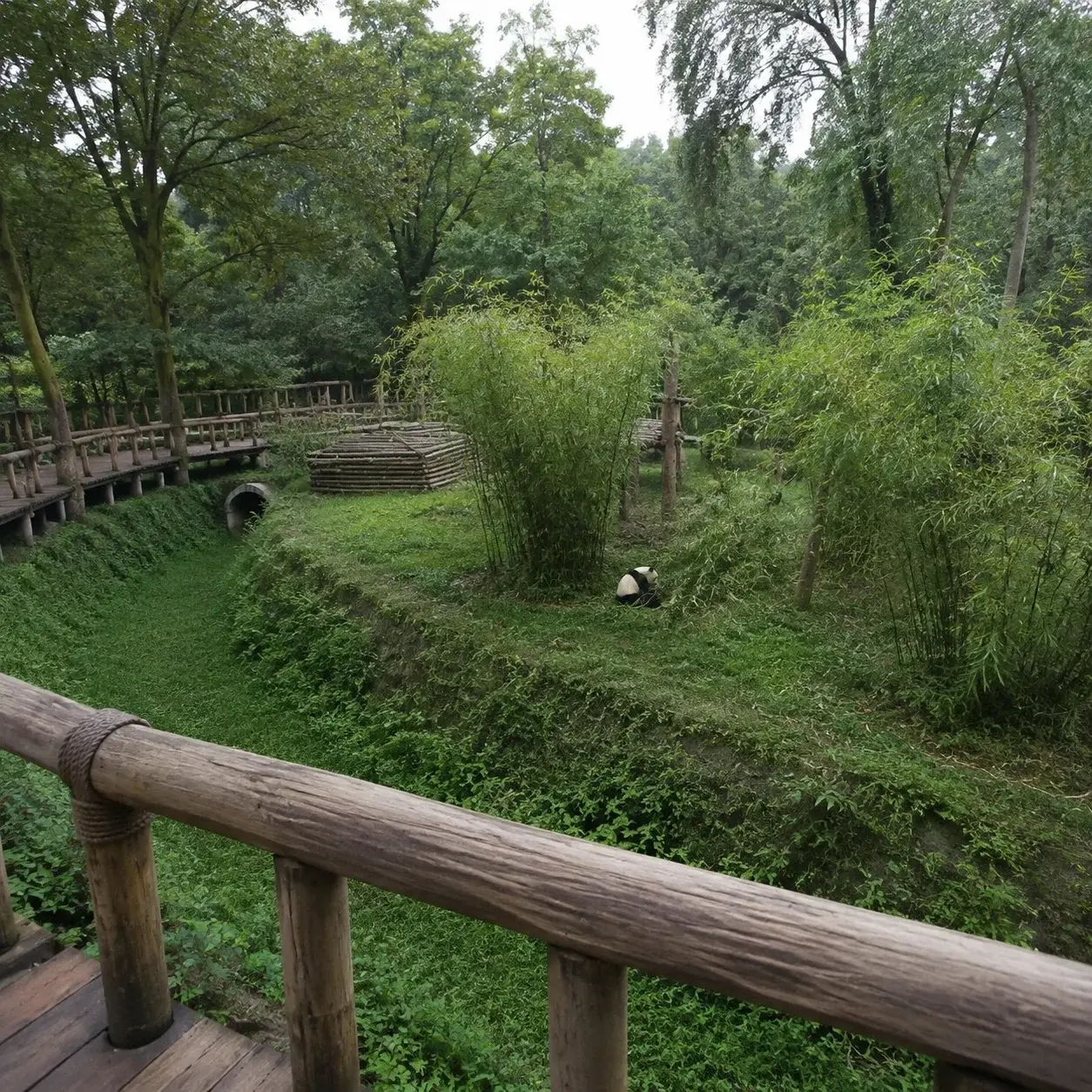
No — you can no longer pay to hold, hug, or pose with a panda anywhere in Sichuan. In October 2018 the Sichuan provincial forestry authority issued a notice banning commercial close contact with captive giant pandas, explicitly including paying to feed them or have photos taken with them (reported by China Daily). It protects the pandas: handling stresses them and risks transmitting human illness. This is not bad luck, and not a product you failed to book.
One detail matters more than travellers realise. That same 2018 notice also barred using the "volunteer" label as cover for paid close contact. So a listing that promises hands-on cuddling dressed up as a volunteer experience is not a clever workaround — it is describing something the rules prohibit. If an agent is still promising a panda hug in any form, treat it as outdated information or a scam, not as a rare channel you were lucky to find. Ask them to name the base and the official programme name; if they can't, there is no programme.
What you can do is genuinely better: join a panda volunteer (keeper-for-a-day) program, where you spend a day preparing food, cleaning enclosures, and observing pandas up close under keeper supervision — not holding them. As of 2026, Wolong and Bifengxia are running; the Dujiangyan Base's programme is paused while that base is closed. Programs are usually limited to roughly ages 8–70, cap daily places in the low tens, require ID and a basic health declaration, and cost in the region of several hundred to about a thousand yuan per person. Limits, prices and whether foreign passports are accepted differ by base and change — verify directly with the base or a licensed operator rather than trusting a figure on a blog, including this one.
Pandas, briefly — what are you actually looking at?

Where they live: wild giant pandas live in the temperate bamboo forests of central China — chiefly Sichuan, with smaller populations in Shaanxi and Gansu, at elevations of roughly 1,200–3,500 m. The wild population is split into 33 separate groups, many too small to be self-sustaining, which is exactly why breeding bases and habitat corridors exist. It is also why every place you can reliably see a panda is in or near Sichuan, and why Wolong, high in that habitat, feels different from a city base.
What they eat, and why it sets your alarm clock: roughly 99% of a giant panda's diet is bamboo, and because bamboo is so low in nutrition a panda eats 12–38 kg (26–84 lb) a day, spending 10 to 16 hours eating (World Wildlife Fund). They still have the digestive system of a carnivore, so they compensate by eating constantly and resting hard in between. That cycle — eat for several hours, sleep for a few, repeat — is the whole reason the morning window exists. It isn't a rule of the park; it's a rule of the animal.
Red panda or giant panda: despite the shared name, homeland and bamboo habit, a red panda is not a bear and not a close relative. They belong to their own family (Ailuridae), are about the size of a house cat with a long ringed tail, and are russet-and-cream rather than black-and-white. The Chengdu base keeps both, so you don't need a second trip.
Not going to Sichuan — can you still see pandas?
Yes. Beijing Zoo has giant pandas, and if Sichuan genuinely will not fit your itinerary, go — it is a real panda, half a morning, inside a city you are already in. But be clear about what it is not. A zoo enclosure is not a breeding base: fewer animals, no nursery, none of the scale, and nothing of the sense of a research institution at work. It is a substitute, not an equivalent. The morning logic still applies, because it is the same temperature mechanism: go early. If your route can be bent to fit two nights in Chengdu, bend it. If it truly cannot, Beijing is a fair second-best rather than a consolation prize.
FAQ
Which Chengdu panda base is best? The Chengdu Research Base for a first visit — most pandas, biggest nursery, closest to the city. Choose Wolong or Bifengxia for a near-wild setting, low crowds, or a volunteer day. The Dujiangyan Base has been closed since April 2026; the separate Dujiangyan Panda Valley is open.
What time of day are pandas most active at the Chengdu panda base? Right at opening, roughly 07:30–10:00, when pandas are being fed and the park is coolest. They sleep through late morning and retreat indoors above about 26 °C. In November–February the gate opens at 08:00, so target that instead.
Is Dujiangyan panda base open? That depends which one you mean, because there are two. The Dujiangyan Base (都江堰基地 / 中华大熊猫苑), run by the China Conservation and Research centre for the Giant Panda, has been closed since 23 April 2026 for facility upgrades with no reopening date — reported by Xinhua on 15 April 2026, and we found no reopening notice as of 13 August 2026. Dujiangyan Panda Valley (都江堰熊猫谷), which belongs to the Chengdu base and sits nearby, is a separate site and is open, ¥55. Several otherwise-reputable sources, including panda.org.cn, still describe the closed base as open — check the date on any panda advice, including ours.
How much are Chengdu panda base tickets, and do I need my passport? ¥55 full price — the base defines that band as ages 18 (exclusive) to 59 (inclusive) — ¥27 for students, and free for under-6s and visitors 60+ on a scan of an original Chinese ID card, which means the free-entry line does not reach a foreign senior or a foreign child (Chengdu municipal government, April 2026; checked 2026-08-13). Reserve online in advance with real-name registration, and bring the original passport you booked with: the name must match exactly, no booking QR code is issued any more, and passport holders are verified against the original document at entry rather than through the ID scanners.
How does a foreign passport holder book Chengdu panda base tickets? Start on the base's own official ticketing platform. A Chengdu city-information article from April 2023 reports that the other authorised platforms — Meituan, Ctrip, Douyin and Tongcheng — do not let you choose a document type, which would leave a passport holder unable to finish; we have not verified that ourselves, so treat it as a reason to start official rather than a settled fact. On the official platform you add a visitor, tap the arrow beside the ID-card field to switch document type, choose Passport and enter the number, then pick your date. That too is a 2023 account of the interface, so confirm it still matches before relying on it. Tickets are bookable up to seven days ahead including the current day, capped at 60,000 a day (30,000 morning, 30,000 afternoon).
Can I buy a Chengdu panda base ticket on the day? Only if tickets are left. The base moved to fully online real-name booking on 23 April 2023 and cancelled routine on-site selling; what remains is a remainder window, which per a Sichuan provincial notice of April 2024 sells while tickets remain using cash and domestic or foreign bank cards, or handles ticketing problems, and closes once the day has sold out — the same position the Chengdu municipal government's April 2026 page takes. So book online before you fly and treat the window as a fallback rather than a plan. The useful detail if you are stuck: that counter takes foreign bank cards, which the app routes generally do not. These are published official statements read on 13 August 2026, not something tested by us at the gate.
Can you hold a panda in China? No. A 2018 Sichuan provincial ban ended paid holding and posed photos, and also barred using the "volunteer" label as cover for paid contact. Anyone still selling a panda cuddle is offering something the rules prohibit — treat it as a red flag.
Can I still do a panda keeper or volunteer programme? Wolong and Bifengxia are running as of 2026; the Dujiangyan Base's programme is paused while that base is closed. Expect roughly ages 8–70, a few dozen places a day, and several hundred to about a thousand yuan. Confirm with the base directly, including whether foreign passports are accepted.
How many giant pandas are left, and are they still endangered? Around 1,900 in the wild by China's more recent official estimates — the widely quoted 1,864 comes from the 2011–2014 census — plus 808 in breeding centres at the end of 2025. The IUCN downgraded them from "Endangered" to "Vulnerable" in 2016.
Is a giant panda really a bear? Yes — a true bear (Ailuropoda melanoleuca), just the strangest one on Earth: a carnivore that lives almost entirely on grass. It even evolved a "pseudo-thumb," an enlarged wrist bone for gripping bamboo. The red panda, despite the name, is unrelated.
Planning the visit
Three decisions, in order. Go to the Chengdu panda base unless you have a specific reason — a free day, a volunteer booking, a wish for real habitat — to choose Bifengxia or Wolong. Be at the gate when it opens, 07:30 from March to October and 08:00 from November to February, because that is the difference between watching pandas and watching pandas sleep. And book with your passport before you fly, because the reservation is an entry condition rather than a convenience. Everything else is refinement: spring or autumn over summer, late autumn to winter if you want cubs, and a volunteer day rather than the panda hug that no longer exists.
We have not visited all five sites. What we do have is a page that knows the Dujiangyan Base is closed while the official site still says otherwise — and that the separate Dujiangyan Panda Valley is not closed, which most pages get wrong in the other direction — plus a date stamped next to every fact so you can check us. This one was last reviewed on 13 August 2026 against published sources rather than on the ground, and the Dujiangyan Base was still closed with no reopening notice as of that date.
If you'd rather have the morning window, the reservation, the transport and any volunteer booking handled so you can just enjoy it, we can arrange exactly that as part of a Chengdu itinerary.