




 18 days China, End to End Beijing → Xi'an → Chuanzhusi → Jiuzhaigou → Chengdu → Zhangjiajie → Guilin → Yangshuo → Shenzhen From $6,360 View route
  3 days 3-Day Tour: Mount Siguniang, Bipenggou & Dagu Glacier Chengdu → Lixian → Heishui County From $1,599 View route
  5 days Above the Pillars, Then Below Zhangjiajie From $1,430 View route
  3 days After the Last Booth Guangzhou From $840 View route
  13 days All the Way West Xi'an → Dunhuang → Turpan → Kashgar → Shanghai From $3,500 View route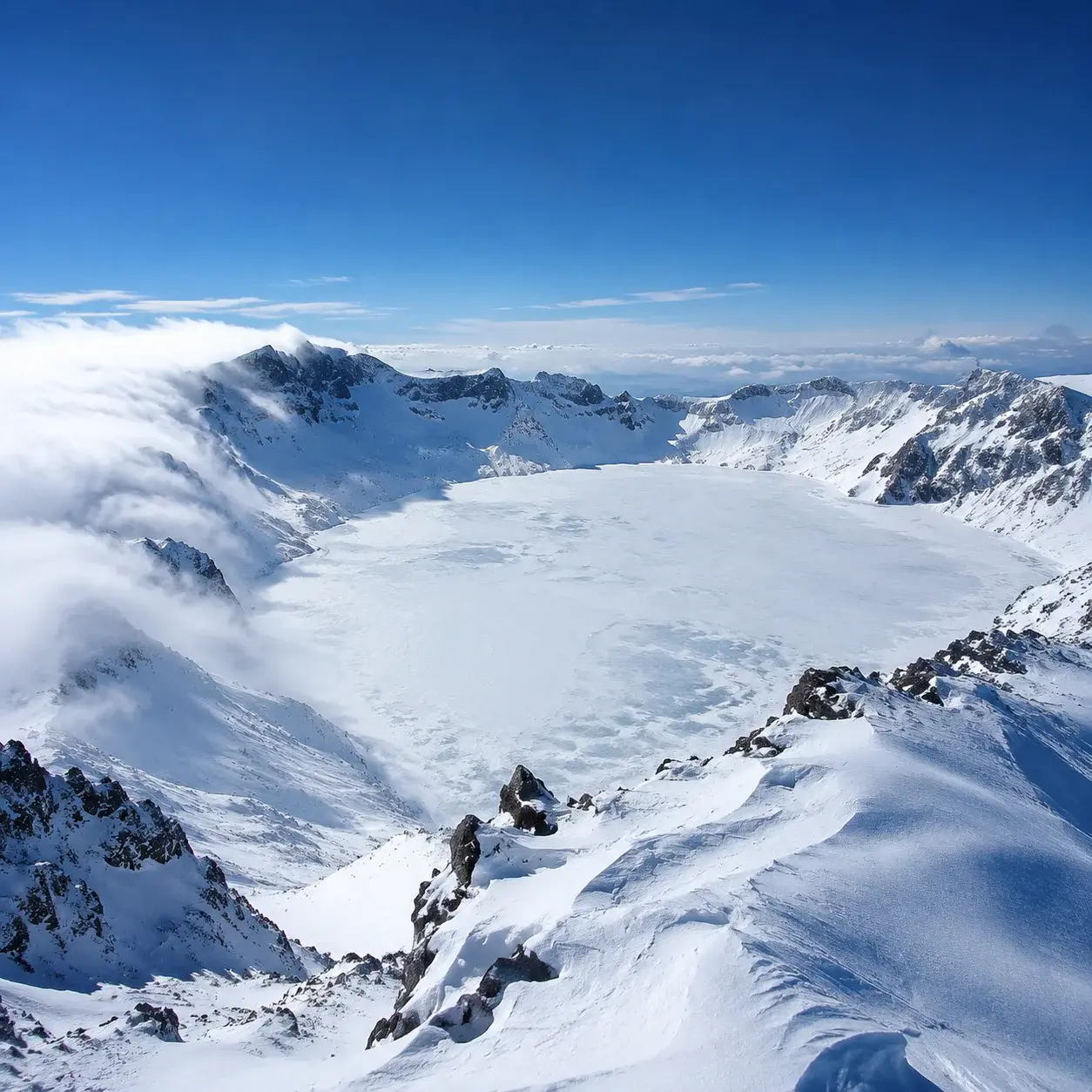
Changbai Mountain & China Snow Town: Which to Add to a Winter China Trip?
Both are worth it, but most 5–7 day northeast itineraries can only fit one: Changbai Mountain needs 2–3 days and a lucky break on Heaven Lake, while China Snow Town needs 2 days built around one overnight stay.
Changbai Mountain (also written Changbaishan) is a dormant volcano on the Chinese–North Korean border whose crater lake, Heaven Lake (Tianchi), sits at the centre of three separately ticketed slope areas. China Snow Town (Xuexiang) is a forest-farm village in Heilongjiang whose snow-laden wooden roofs make it one of the most photographed snow villages in China. At LyrikTrip, we have spent winter seasons mapping how first-time visitors actually move between Harbin, Changbai Mountain, and China Snow Town.
Key Takeaways
- Heaven Lake is not seasonally closed. It operates on a daily announcement system driven by summit wind plus snow and ice on roads and boardwalks, so the only reliable check is the official "Changbaishan" WeChat account notice on the morning of travel. - Changbai Mountain sells three separate slope areas with separate reservations. The north slope suits elders, small children, and short schedules; the west slope gives the fullest lake panorama at the price of 1,442 steps; the south slope is normally summer-only. - Reaching the summit means stacking up to three tickets, not one, and booking is real-name, timed-entry, and online-only with no ordinary ticket window on site. - From Harbin, China Snow Town is about 280 km and 5–6 hours each way, longer after snowfall. A same-day return trades 10–12 hours on the road for a few daylight hours and misses the lit-up village at night, so one overnight stay is the recommended form. - Ticket figures disagree across sources and vintages. This guide places the competing figures side by side and selects none of them; every grounded price, hour, and policy below carries verify before you travel (checked 2026-09).
Which traveller are you? Start here
| Traveller | What matters most on this page | Jump to |
|---|---|---|
| Families and three-generation groups weighing cold, walking, and driving | North slope only for Changbai Mountain; Snow Town only as an overnight trip with a private driver, because fixed ticket costs beat volatile village prices for a group budget | Travelling with older parents or young kids? |
| First-time winter visitors deciding between the two places | With 5 days, pick one; with 6–7 days, both only by giving something up; with 8 or more days, put Changbai Mountain first for a second chance at the lake | Changbai Mountain or Snow Town — or both? |
| Photographers chasing snow-mushroom roofs and night lights | The village after dark is the entire point, so only an overnight trip delivers the value; day-trippers pay the same road cost and miss the core scene | Should you stay overnight or do it as a day trip? |
| Travellers entering on a Philippine passport | Visa lead time is the first constraint and must be settled before any timed-entry ticket is booked | How do you get there — and does it change by passport? |
| Travellers entering on a Hong Kong Home Return Permit | The permit, not a passport plus visa, is the document for entry and for the real-name mountain reservation | How do you get there — and does it change by passport? |
| Travellers flying from Australia in December–February | This is reverse-season snow inside the Australian school-holiday peak, when flights and lodging cost the most | How do you get there — and does it change by passport? |
| Travellers from Singapore and Malaysia who have never seen snow | Zero winter gear is the default assumption, so rentable layers and grip aids decide the packing list | What to pack and what to book first |
What is Changbai Mountain — and what does winter change?
Changbai Mountain is a dormant volcano and a border mountain whose crater holds Heaven Lake, surrounded by waterfalls, hot-spring clusters, crater forests, and deep valleys. The practical root of every decision on this page is that the north, west, and south slope areas sell separate tickets, run separate shuttles, use separate entrances, and require separate reservations.
Winter changes three things. Some boardwalks and side paths close, the chance of reaching Heaven Lake drops because summit weather turns faster, and snow scenery coexists with hot springs. For the ice festival itself, see the companion Harbin guide at Harbin winter guide; this page covers what to add beyond Harbin, not whether the ice festival is worth it.
North, West or South slope — which gate should you book?
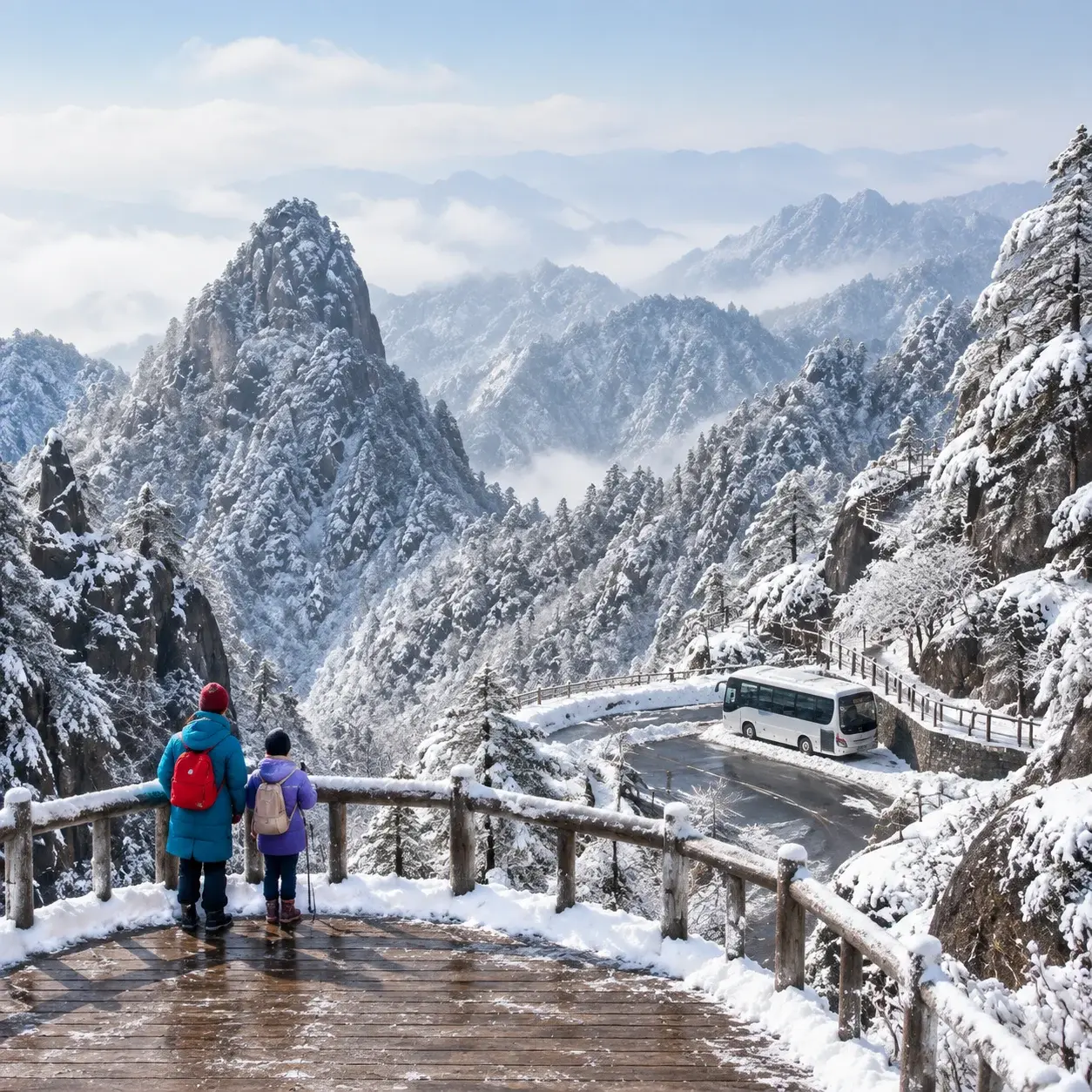
Through the LyrikTrip Slope Picker: every Changbai Mountain visitor books one of three separate gate areas, and the choice is made by constraints, not by the photos. North slope if elders, small children, or less than a full day are in play; west slope if the full bowl of Heaven Lake is the point and 1,442 steps (or an icy winter snowmobile transfer) are acceptable; south slope only in summer, when it is the rawest of the three and the lake sits closest to the viewing platform.
| Your constraint | Book this gate | Why |
|---|---|---|
| Travelling with travellers aged 65 and above | North slope | Shuttle buses reach the main viewpoints with the least walking, and the facilities for lodging, food and shopping are the best |
| Travelling with children under 6 | North slope | Boardwalks are gentle with easy turn-back points; the west slope's 1,442 steps are unsuitable for small children |
| The lake is the point, and a closure is acceptable | West slope for the full panorama, north slope for the lowest-effort attempt | The west slope shows the complete bowl; north slope views are partly obstructed, which is a known trade-off |
| Only one day, arriving and leaving the same day | North slope | Closest to the Changbaishan high-speed rail station and Erdaobaihe town, with the shortest shuttle-plus-summit loop |
| Waterfalls, forests and hot-spring clusters | North slope | Changbai Waterfall, Julong Hot Springs, Green Deep Pool and the valley forest all sit on the north side |
| Short walking and short queues matter most | North slope in the off season; west slope on public holidays | On holidays the north slope draws the heaviest crowds, the longest queues and the tightest tickets, so the west slope feels calmer; in the quiet season the north slope is the most comfortable |
| Summer only, seeking the rawest side | South slope | The only gate where a hired private vehicle can reach the summit directly, with about 1,000 tickets per day |
| Landing at Changbaishan Airport or staying at the Wanda–Luneng resort cluster | West slope | The west slope sits near Songjianghe town, the airport and the resort base |
| Off-season trip seeking the easiest day | North slope | Recorded in the eastchinatrip guide of 30 July 2026 as the most comfortable off-season choice, verify before you travel (checked 2026-09) |
The constraint table rests on the following hard limits, each verify before you travel (checked 2026-09):
| North slope | West slope | South slope | |
|---|---|---|---|
| Base town and gateway | Erdaobaihe town, closest to the Changbaishan rail station | Songjianghe town, near the Wanda–Luneng resorts and Changbaishan Airport | The Changbai county area, distant from both, requiring pre-arranged road transport |
| Lake view | Partly obstructed | Best full panorama | Closest to the lake, overlooking the whole basin |
| Way up | Shuttle bus to the main sights with the least walking; summit transfer by the Tianchi shuttle bus at 80 CNY per person round trip, about 20 minutes each way | 1,442 stone steps in summer and autumn; in winter and spring the steps ice over and a paid snowmobile transfer becomes effectively required | The only gate where a hired private vehicle can drive to the summit |
| Cable car to the main peak | None to this day; shuttle bus or foot only, confirmed 19 September 2026 | None; steps or snowmobile only | None |
| Open in winter | Yes, year-round | Yes, year-round | No, normally summer into mid-October only; opened for 2026 on 25 May |
| Daily ticket volume | Tightest in peak season and hardest to secure | Not published as a fixed figure; no figure is stated here | About 1,000 per day |
| Facilities | Strongest | More limited, with basic support in Songjianghe | Most limited |
| Reservation | Each slope booked separately | Each slope booked separately | Each slope booked separately |
One line to carry away: travellers with elders or small children go north; travellers chasing the complete lake go west; travellers seeking the rawest side in summer go south. On holidays reverse the instinct and choose west; in the quiet season choose north. Actual walking distances and step-climbing times per slope have no qualified published source, so no distance or duration figure is stated here.
Is Tianchi open in winter?
Heaven Lake (Tianchi) is more likely to be closed in winter, but it is not seasonally closed — it runs on a daily announcement system. The trigger is wind at the summit plus snow and ice on the roads and boardwalks, not the month. Only the Tianchi viewpoint closes on the north slope; the rest of the north slope stays open.
Under the LyrikTrip Tianchi Notice Rule, the mechanism has three parts, and all three matter. First, the trigger is weather, not the calendar: the official "Changbaishan" WeChat account notice of 5 May 2025, relayed by the Guancha news report of the same date, closed the north-slope Tianchi viewpoint because summit wind was strong and roads and boardwalks carried snow and ice, leaving safe operation impossible. Second, summer closures happen too: that notice was issued on 5 May, not in winter, and a matching 5 May 2024 notice closed the north and west Tianchi viewpoints for summit snowfall with the same wording, so "frozen in winter" descriptions found in competing guides misstate the system. Third, a lake closure is partial: the same notice states that other north-slope sights remain open subject to weather, while a same-day west or south slope closure shuts that slope for the day — a lake closure and a slope closure are different events.
The only same-day action is to check the official "Changbaishan" WeChat account announcement on the morning of travel. The summit shuttle runs only as weather allows and can stop at short notice in fog or high wind, and no sightseeing cable car serves the main peak to this day, so the shuttle bus or foot are the only ways up (status confirmed 19 September 2026, verify before you travel (checked 2026-09)). One further mechanism is reported by a single source: if weather keeps Tianchi shut for the day, the summit ticket is refunded, according to the eastchinatrip guide of 30 July 2026, with no second source found in official channels, so that refund is treated as indicative until confirmed on site.
A closed lake does not empty the day, and the official notice says exactly which sights survive it. The park's own closure announcement of 4 April 2026 (North Slope), published by Jilin City Evening News, reads in full: the north-slope Tianchi viewpoint is closed because the summit carries cloud and light snow at −8 to −6°C with gusts around force 10 above 2,000 m, blowing snow and low visibility; and then, in the same paragraph, "the waterfall, hot springs, Small Tianchi, Lüyuan Pool and the valley forest remain open, subject to weather." The same notice closes the west-slope lake viewpoint for 8–9-force south-westerly winds and ice on roads above 1,700 m, while noting that the west slope's Jinjiang Grand Canyon is being cleared of snow and is expected to open at 08:30.
That one announcement answers the question this page previously left to field measurement. A closed lake does not mean a closed park: the north slope's five non-summit sights stay open on the same day, and they are the waterfall, the hot-spring cluster, Small Tianchi, Lüyuan Pool and the valley forest. What the notice does not give is a walking duration, so we still do not invent one — but a north-slope visit itself is documented as a six-to-seven-hour proposition with the most sights of the three slopes and shuttle buses that reach the main viewpoints.
How often this happens is worth knowing before you book. One Chinese report, citing park notices as of 8 September 2026, puts the winter closure probability for Tianchi at roughly 30–40% for November to February, and notes that even in the June-to-September window only about half the days give good visibility. A single source, but it matches the closure mechanism rather than contradicting it.
One live status note for the coming season: as of September 2026 the north slope's Tianchi Line A viewing route was suspended for infrastructure repair, with Line B operating normally, and the south slope's Jinjiang Grand Canyon was also closed for repair. If you are going up for the lake, that detail changes which path you walk.
How much does Changbai Mountain actually cost?
Getting to the top of Changbai Mountain means stacking up to three separate tickets, not one: the scenic-area gate ticket (105 CNY), the mandatory in-park shuttle (85 CNY), and — only if you want the summit — the Tianchi shuttle on the north slope (80 CNY round trip, about 20 minutes each way), which adds up to roughly 270 CNY on the north slope. Booking is real-name, timed-entry and online-only through the official "Changbaishan" WeChat mini-program, with no ordinary ticket window on site — do not assume tickets can be bought on arrival.
Through the LyrikTrip Ticket Stack, the stack separates as follows, each verify before you travel (checked 2026-09):
| Ticket | Price | Required? | Key constraint | Source |
|---|---|---|---|---|
| Scenic-area gate ticket, same price at all three slopes | 105 CNY per person | Yes | Each slope sells separately; buy the slope being entered | sina.cn travel desk, 6 September 2026 |
| In-park shuttle bus | 85 CNY per person | Yes, the only transport between sights inside the park | Last departures around 17:00 in summer and around 16:00 in winter | sina.cn travel desk, 6 September 2026 |
| Tianchi summit shuttle, north slope | 80 CNY per person round trip, about 20 minutes each way | Only when heading for the main peak | Runs only as weather allows; fog or high wind can suspend it; no cable car serves the peak | k.sina.com.cn status check, 19 September 2026 |
| Snowmobile, west slope | Set by the same-day on-site system | Effectively required for the west-slope lake in winter and spring while steps are iced | Described by the eastchinatrip guide as faster with greater risk | eastchinatrip guide, 30 July 2026 |
| South slope combined | 105 plus 85, or 190 | As a slope entry | Normally summer into mid-October only, about 1,000 tickets per day | eastchinatrip guide, 30 July 2026 |
| Concession bands | Half price for full-time undergraduate-and-below students, ages 7 to under 18, and ages 60–64; concession tickets for 65 and above with documents | — | Select the matching ticket type in the official mini-program and carry documents | eastchinatrip guide, 30 July 2026 |
Two pricing calibres coexist and are not a contradiction. The itemised calibre from the sina.cn travel desk of 6 September 2026, with the k.sina.com.cn check of 19 September 2026, gives gate 105 plus shuttle 85 plus north-slope summit shuttle 80, totalling about 270, a total the latter source states outright. The combined calibre from the eastchinatrip guide of 30 July 2026 gives north slope 215, west slope 209, and south slope 190 CNY, where north slope 215 equals gate 105 plus a 25 visitor-line segment plus shuttle 85, before adding 80 for the summit. The two calibres describe itemised parts versus a bundled gate-plus-transport figure, and any self-calculated total on this page is the sum of the itemised parts above, not an official package price. Discount wording also differs: one source phrases student and exam-taker treatment as free-or-half while the other states half price, so the two wordings are placed side by side, with free treatment normally covering only the gate and on-park transport billed separately, subject to the current year's document rules.
On the passport question the official FAQ is now explicit, and it is the opposite of what most English guides imply. The park's own ticketing help text — carried by The Paper and by Sina Finance's reprint of 21 July 2026 — answers "how do I exchange my ticket?" with: "no exchange is needed; enter by scanning your ID card, passport, or Hong Kong/Macau/Taiwan travel permit", with passport and permit holders using the electronic QR code bearing their booking document number. So a passport is a recognised travel document at the gate. The step that remains genuinely unstated is the one before it: whether the mini-programme's registration accepts a foreign passport, since the booking flow is real-name and the notice describes it as "only the person named on the document may enter". Two further official details change how you plan: booking opened to 7 days ahead from 26 June 2026 (previously 15), and online and on-site inventory are the same pool — in the park's own words, "if there are no tickets online, there are no tickets on site", so arriving to buy at the gate is not a fallback. The only official channels are the "Changbaishan" WeChat account and the "Changbaishan" / "Changbaishan One-Stop" mini-programmes; the hotline is 400-000-6789, 07:00–19:00. Note also that 65+ is a discounted combination ticket, not free entry — free admission covers only children under seven or under 1.2 m.
Opening hours also come in two calibres; verify before you travel (checked 2026-09). The official-side calibre relayed by the sina.cn travel desk of 6 September 2026 gives high season, May–October, 7:30–16:00 with last entry 15:30, and low season, November–April, 8:30–15:00 with last entry 14:30, with the south area normally summer-only. The OTA-and-guide calibre from the trip.com attraction page and the eastchinatrip guide gives all three slopes 6:30–15:00 with entry cutoff around 14:00, south slope 8:00–15:00, shorter hours from December–February, and temporary closure in heavy snow or wind. Both are stated and neither is selected. The recorded visitor hotline is +86-433-5742286 as listed on the trip.com attraction page.
Is there a ski resort here?
Yes, a ski resort sits on the west-slope side of Changbai Mountain with a season running mid-November into April, among the longest in China. For which resort to choose across China, a companion guide to skiing in China is being prepared in the same publishing run and is not yet a clickable page, so this page states the existence of the slopes and stops there.
What is China Snow Town — and is it worth the 5–6 hour drive?
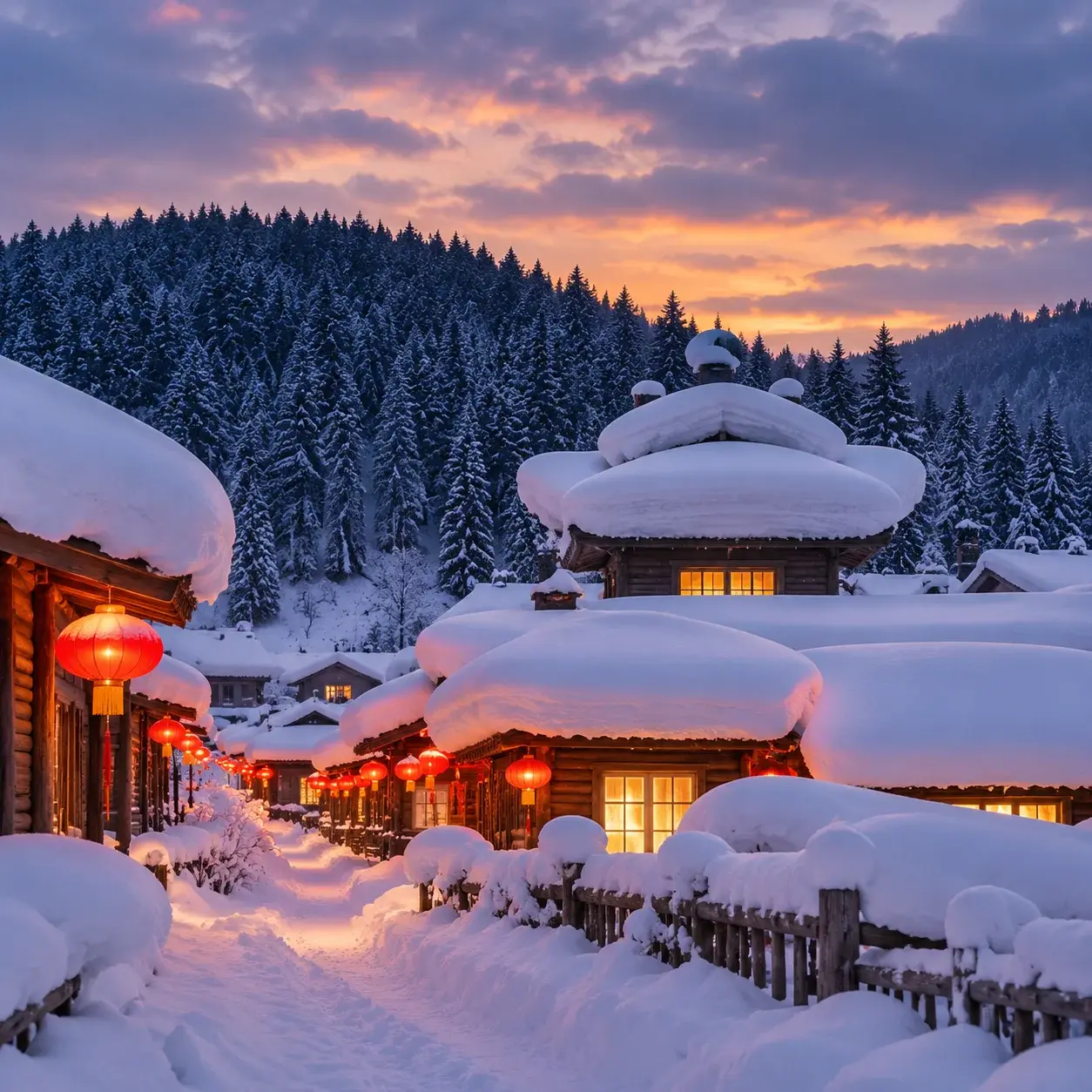
China Snow Town is worth the drive only as an overnight trip: from Harbin it is about 280 km and a 5–6 hour drive each way, longer after snowfall, so the village pays off across one lit evening plus one quiet morning rather than a daylight dash. The village sits at Shuangfeng Forest Farm under the Dahailin forestry bureau in Hailin, Mudanjiang, Heilongjiang, and its loaded "snow mushroom" rooftops make it one of the most photogenic snow villages in China.
Through the LyrikTrip Honest No-Go List, the honest framing comes first: Tianchi cannot be guaranteed, Snow Town cannot be done without the long road, and neither place behaves like a fixed-date attraction. Readers who need a guaranteed lake view, cannot accept extreme cold, or hold only 3–4 days for Harbin plus both destinations will find the trip turning into continuous driving, and are better served by choosing differently.
The core sights, drawn from a 2026 Chinese self-media guide treated as indicative, verify before you travel (checked 2026-09):
| Sight | Time | What it is |
|---|---|---|
| Xueyun Avenue | 1.5–2 hours | The main street of wooden houses, snow mushrooms, and red lanterns, at its best after dark, suited to every fitness level |
| Dream Home | About 1 hour | The classic snow-mushroom photo stop with the highest picture yield |
| Yangcao Mountain sunrise | About 2.5 hours round trip | A snowmobile or foot climb for sunrise over a sea of clouds, suited to stronger walkers |
| Snow Town ski field | Half a day | A beginner-friendly slope suited to families and first-timers, stated here without any resort comparison |
| Yaxue Highway and Ten-Mile Gallery | 1 hour | Rime and snow-draped trees along the approach road, best taken slowly with a hired car or an independent group |
| Local-style alternatives | Flexible | Morning smoke over Erlong River, the Xuegu–Dongsheng forestry traverse, and the raw forest-and-snowfield country around Yong'an village, all with lower visitor density for travellers seeking quiet snow |
Lodging divides three ways: inside the scenic area, convenient for first visits and night photography but expensive; Erlong River and Yong'an village, better value and suited to multi-night stays; Changting town, cheapest but with a costly commute. Ticket figures for Snow Town coexist in several vintages and currencies and are placed side by side with no selection: the Mudanjiang Development and Reform Commission price notice (documents Price 2024-4 and 2024-5), relayed by the Harbin Local Treasure report of 17 November 2025, sets the current seasonal gate at 140 CNY per person in high season, 1 November–30 April, and 70 CNY in low season, 1 May–31 October, with a 15 CNY round-trip sightseeing-vehicle fare on a voluntary basis and concessions for children, students, seniors, active military, disabled travellers, and police; the Qunar attraction page records an older 95 CNY gate valid two days from purchase; the Wing On Travel Hong Kong storefront lists HKD 643 and above; a Wing On traveller review of 25 December 2025 writes an entry-plus-transport payment of $155 with the currency unstated, suspected Hong Kong dollars; and a trip.com Moments traveller post states about 120 RMB per person without clarifying what is included. No conversion is performed and no single figure is adopted.
Indicative per-person budget bands from the same 2026 Chinese self-media guide, verify before you travel (checked 2026-09), read as reference bands rather than quotes with large peak-season swings: transport by shared hired car from Harbin about 400–800 CNY; two nights of lodging about 400–1,200 CNY; tickets and in-park activities about 300–600 CNY; food about 300–500 CNY; an independent 3-day, 2-night group including car, lodging, tickets, and some meals 1,500–2,800 CNY per person; a fully self-arranged trip about 2,000–3,500 CNY per person, rising across the Spring Festival peak. The source does not state whether gear rental and long-haul access are included.
On peak-season room rates inside the village, the two calibres in circulation disagree by an order of magnitude, so both are printed here and neither is adopted. The self-media calibre — a 2026 Chinese guide syndicated on Sina Finance — gives 100–200 CNY a night for a farmhouse kang room, 200–300 for a budget hotel, 300–800 for a boutique guesthouse and 800–1,200 for the top hotel, rising 30–50% around Spring Festival. The reporting calibre is a different animal: the Shanghai news outlet Upper News, working inside Ctrip's app on 30 December 2023, found rooms near the scenic area at 3,370 / 2,968 and 1,790 CNY for that night — the 3,370 one being a 10-square-metre room with a double and a small bed for three people — with the same room type quoted at 1,686 CNY for 1 January and 3,519 CNY for the second day of Spring Festival. China.com's reporters found the same pattern in early January 2024: most listed hotels above 800 CNY a night, and hotels on Xueyun Avenue above 3,000 CNY. A Ctrip guest who booked early, for contrast, records paying just over 600 CNY on a Singles' Day pre-sale for a room selling at 1,700 CNY on the day. Guests writing on the same listings describe 1,710 CNY and 2,900 CNY nights. Outside the village proper, and further from it, the same reporters found 593 CNY for a triple at Erlong River, forty-odd kilometres away, and 311 CNY for a 20-square-metre room at Xuegu, a little under 10 km out.
Read the four vintages honestly. The self-media bands and the reporter's Ctrip queries describe peak-adjacent nights three seasons apart, and both are now old: what this page will not do is hand you a number for the coming season, because nobody publishes one. Roughly half of all Ctrip bookings for the Snow Town area are made for the national forest park itself (49.2%), with "China Snow Town" at 26% and Xueyun Avenue at 14.8% — which is why the inside-the-scenic-area figure carries the premium it does. Book early, prefer a rate you can cancel, and treat any single number — including ours — as a snapshot of a specific night rather than a price list.
The commercialization question is handled with one concrete observation rather than a blanket verdict. Negative commentary on Chinese and Hong Kong platforms concentrates on commercial atmosphere and peak-season lodging prices, represented by one review among 1,360 on the Wing On Travel listing, dated 25 December 2025, which calls the village too commercial, notes scheduled performances at 15:30 and 19:30 with heavy holiday crowds, and adds that mid-December prices at the start of high season still felt reasonable while peak-season village lodging would not be considered at all for its high prices. Check the current season's reviews before travelling and keep cancellation flexibility.
Should you stay overnight or do it as a day trip?
Through the LyrikTrip Snow Town Overnight Test: from Harbin, China Snow Town is a 5–6 hour drive each way (about 280 km), so a "day trip" means 10–12 hours on the road for a few daylight hours — and it misses the reason people come, which is the village lit up after dark. That last point is not an opinion, it is a clock reading: the village lights come on around 16:30 in midwinter, and the one-day tour products sold by operators run from about 09:00 to about 17:00. A day trip therefore ends roughly half an hour after the lights do their thing, while the return buses from Snow Town leave at 08:00 and 13:00. If starting in Harbin, stay one night; the only form of same-day return that makes sense is the high-speed-rail version (a private one-day tour by rail is sold, with the standard departure around 09:00 and the finish around 17:00, flexible on request), not the road version — and neither one buys you the lit evening.
| Same-day return | One overnight stay | |
|---|---|---|
| One-way drive | 5–6 hours over about 280 km, longer after snowfall | Same |
| Total road time | 10–12 hours on the road | 10–12 hours split across two days |
| Actual sightseeing time | A few daylight hours | One lit evening plus one early morning |
| What is seen | Daytime snow mushrooms and the main street | The village lit after dark along Xueyun Avenue at its best, plus the quiet village before day visitors arrive |
| What is missed | The lit night atmosphere, which is the core experience | — |
| Transport cost | A direct through-bus at about 120 RMB single, verify before you travel (checked 2026-09) | Same doubled, or a hired car |
| Gate and entry payment | Competing figures placed side by side: about 120 RMB per person in a traveller post; $155 for entry plus transport in a Hong Kong review with currency unstated | Same competing figures |
| Lodging cost | Lodging saved, no bag moves | Lodging added. Published rates inside the village range from a self-media 100–200 CNY farmhouse band to reporter-verified 1,790–3,370 CNY peak nights — a spread wide enough that the decision rests on your dates, not on the average |
| Verdict | Viable only when already staying nearby such as Yabuli or Mudanjiang; from Harbin it exchanges 10–12 hours of driving for a few daylight hours | Recommended |
The market itself points the same way without stating it: the standard commercial form is a 2-day product, including the tour-beijing 2-day Harbin–Snow Town tour and a 4-day Harbin–Yabuli–Snow Town combination, and no seller offers a genuine same-day return from Harbin, which reads as side evidence that the same-day form barely works in physical terms.
Changbai Mountain or Snow Town — or both?
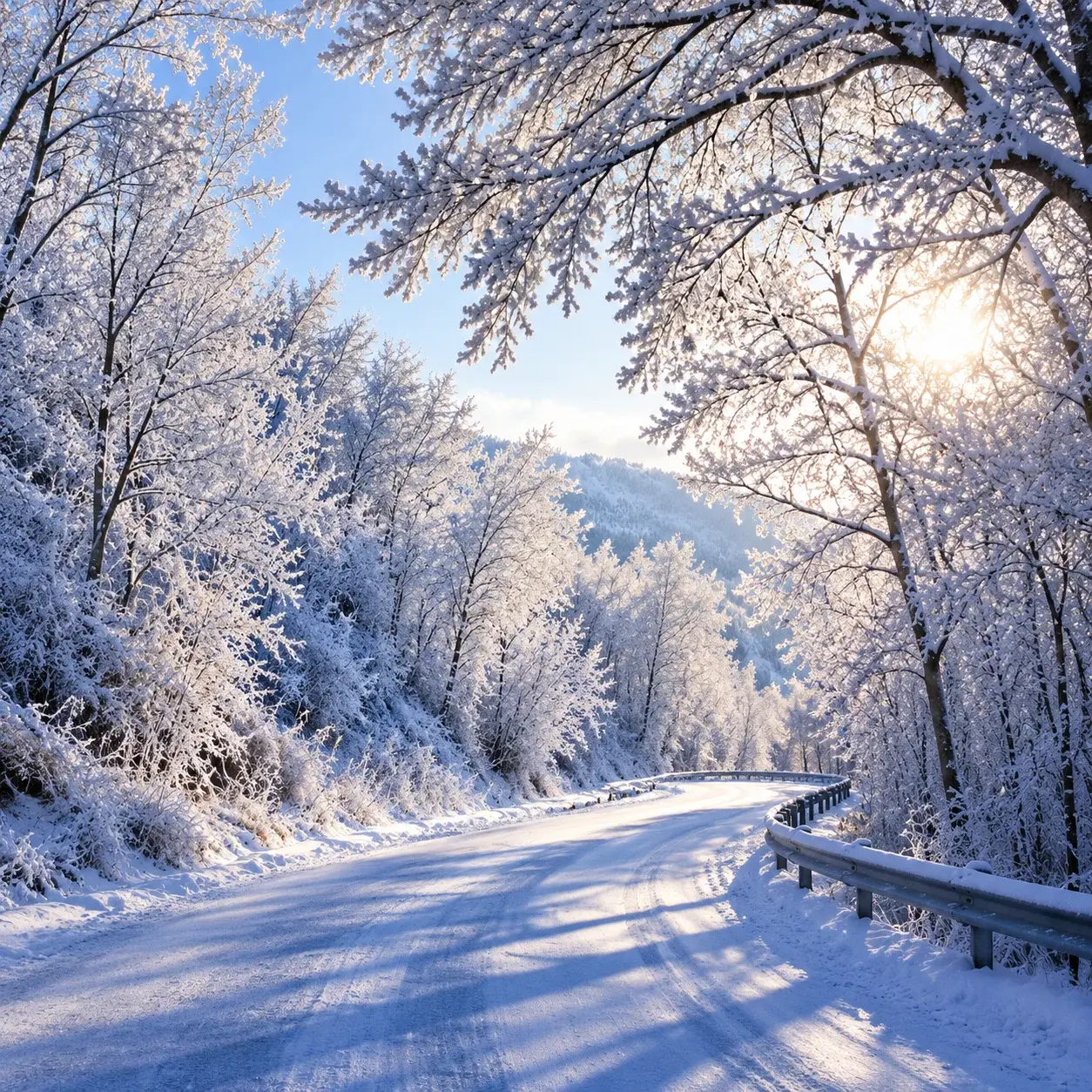
Using the LyrikTrip Northeast Days Budget: with 5 days in the northeast, pick one of Changbai Mountain or China Snow Town, not both — going to both burns 4–5 days on the two ends of the region. With 6–7 days, both are possible if something is given up. With 8 or more days, both fit comfortably, but put Changbai Mountain first because Tianchi is a weather gamble and an early slot leaves a second chance.
| Northeast window | Recommendation |
|---|---|
| 5 days | Choose one. Visiting both consumes at least 4–5 days moving between the two ends of the region, leaving no real itinerary. |
| 6–7 days | Both are possible only by dropping one end: either one Changbai Mountain slope, or the second Snow Town night. |
| 8 or more days | Both fit smoothly, but still schedule Changbai Mountain in the first half so a failed lake attempt can be retried. |
The single-choice test is direct:
| What is wanted | Choose | Allow |
|---|---|---|
| Heaven Lake plus volcanic landforms plus hot springs, with tolerance for a weather gamble | Changbai Mountain | 2–3 days, keeping one day as a backup for a failed lake attempt |
| Photography plus snow-village atmosphere plus snow mushrooms, with tolerance for a 5–6 hour drive | China Snow Town | One overnight night |
| Both depend on luck | — | The mountain gambles on the lake opening; the village gambles on snow conditions and peak-season prices, which are risks of the same kind |
One honest note on an existing route: the 7-day Harbin winter route at 7-day Harbin winter route runs Shenyang, Changchun, Erdaobaihe, and Harbin, and it contains no Snow Town, no ski field, and no Yabuli, so readers adding the village need a separate arrangement rather than assuming the route covers it.
How do you get there — and does it change by passport?
The short answer is that the skeleton is fixed but four passport-and-hemisphere facts change the plan: Philippine passports need a mainland visa; Hong Kong and Macao residents travel on a Home Return Permit; the Australian December–February window is a summer holiday; and most travelers from Singapore and Malaysia own no winter gear. The LyrikTrip Market Reality Check therefore keeps the four markets in separate sections below, since each one changes the conclusion.
The transport skeleton, each verify before you travel (checked 2026-09): the nearest airport is Changbaishan Airport near the west slope with limited public transport, plus a recorded 30-minute airport shuttle; the Changchun–Changbaishan high-speed rail runs about 2 hours 25 minutes at 128 CNY, then riders change at Changbaishan station to bus 1 or 3 for the north-slope visitor centre, or take a taxi of about 15 minutes at 24 CNY; the west slope runs on the Jilin scenic shuttle account with departures at 8:00 and 14:00 taking about 4 hours at 60 CNY; from Harbin to the Changbai Mountain area is a long inter-provincial journey recorded at 7 hours of driving in the chinahighlights comparison table, which is not merged with an unrelated 177 km figure attached to Harbin on a trip.com page because the two describe different objects; from Harbin to Snow Town the consistent record is about 280 km in 5–6 hours, longer after snowfall, from both the 2026 Chinese self-media guide and traveller posts.
Travellers on Philippine passports face the steepest demand curve on this topic, with Changbai Mountain searches up 238.5 per cent, the highest year-on-year rise across every term and market in this cluster. A Philippine passport requires a visa for mainland China rather than visa-free entry, so the visa timetable becomes the first planning constraint and must be settled before timed-entry mountain tickets are booked.
Travellers from Hong Kong, where searches for Changbai Mountain rose by 84.6 per cent, enter and leave the mainland on the Home Return Permit for Hong Kong and Macao residents, not on a passport plus visa. The same permit must be used to complete the mountain's real-name timed-entry registration, and the official terms do not say how permit numbers are validated within the mini-program, so that step needs confirming before travel.
Travellers from Australia, where searches rose by 128.6 per cent, face a flipped calendar: December–February is the Australian summer school holiday, so for Australian readers this is reverse-season snow rather than winter snow. January travel coincides with Australian school holidays, when airfares and lodging peak together.
Travellers from Singapore, where searches rose 83.3 per cent, and Malaysia, where they rose 125.6 per cent, overwhelmingly come from tropical climates, have mostly never seen snow, and own no winter layers, so never assume down jackets and snow boots are already owned. The north-slope visitor centre is reported to rent winter gear, verify before you travel (checked 2026-09); Snow Town involves long stretches on foot where grip aids for shoes prove practical; and families with children or elders adapt better with a hired car or an independent group in winter. One extra signal for Malaysian readers: Changbai Mountain demand there outruns Harbin ice-festival demand, which fell 18.1 per cent, suggesting Malaysian interest sits with snow mountains rather than ice viewing.
What to pack and what to book first
Book the timed-entry mountain tickets first, then lodging, then transport last, because the timed reservation is the scarcest slot and everything else can flex around it. Pack for two different cold spots: Snow Town from January–February can fall to minus 35 degrees Celsius, while the Changbai Mountain summit in winter can fall below minus 25 degrees, and the two figures describe two places rather than one range.
Cold safety follows the US National Weather Service wind-chill chart, which divides exposed-skin frostbite time into three bands of 30 minutes, 10 minutes, and 5 minutes; conditions near minus 20 degrees sit in the 30-minute band and slide toward the 10-minute band with wind, and no separate time windows are invented here. Travellers with underlying conditions, and anyone bringing small children or elders, are advised to consult a doctor before travel. After snowfall the roads ice over and self-driving is not advised for drivers unfamiliar with the area; inside Snow Town walking dominates, so grip aids for shoes prove practical. For general cold-weather layering systems, see family packing list.
Travelling with older parents or young kids?
The north slope is the only recommended gate for elders and small children, because shuttle buses reach the viewpoints with the least walking and the strongest facilities. The west slope's 1,442 steps plus a winter snowmobile transfer over iced steps are unsuitable for elders and small children, and Snow Town combines long walks, extreme cold, and roads where self-driving is not advised for unfamiliar drivers.
Concretely: keep Changbai Mountain to the north slope's short shuttle-based loop with short outdoor spells and an early turnaround before the winter afternoon last departures; keep Snow Town to one overnight night inside the scenic area where possible, with a hired car throughout and warm-up breaks built in.
What a night in a Snow Town kang room is actually like — the honest version, including the complaints. The kang is not a wood-fired bed you have to manage: the village has 138 family-run guesthouses and the kangs have all been converted to electric or water heating for safety (Beijing News, quoting the scenic area), with fire masks and the usual hotel safety fittings in each room. Measured indoor temperatures in guest reviews run to about 25°C, with underfloor heating in the newer boutique properties. But the experience is not uniform, and the negative reviews are as specific as the positive ones. The three complaints that recur are dryness (the kang runs hot and the air dries out), noise (guesthouse soundproofing scores far lower than heating does) and unstable hot water, with one guest reporting intermittent water and no working shower at all. Rooms are simple: more than one guest records no table, no stool, and toiletries you supply yourself. And the price does not guarantee the comfort — a guest paying over 1,700 CNY for a night described it as the most expensive and poorest-equipped room they had ever stayed in.
So, plainly: heat is not the risk. Dryness, noise, hot water and sparse furnishing are. If you are travelling with older parents or small children, that reorders the packing list — a humidifier matters more than an extra layer, and earplugs more than a spare scarf.
For the general constraints of cold-weather senior travel see China travel guide for seniors, and for cold-weather family mechanics see China with kids guide and China family itinerary.
FAQ
How do I get to Changbai Mountain from Harbin?
Take the high-speed rail via Changchun to Changbaishan station in about 2 hours 25 minutes, then bus 1 or 3 or a short taxi ride to the north-slope visitor centre. Direct driving from Harbin is a long inter-provincial journey recorded at 7 hours, so rail plus local transfer is the calmer routing.
Is Changbai Mountain worth visiting in winter?
Yes, when the trip is bought as volcano landforms, snow scenery, and hot springs with the lake as a bonus rather than a promise. Winter lowers the odds of reaching Heaven Lake and shortens the sightseeing window, so allow 2–3 days with one backup day.
Is Tianchi open in winter?
Heaven Lake (Tianchi) is more likely to be closed in winter, but it is not seasonally closed — it operates on a daily announcement system. Summit winds plus snow and ice on the roads and boardwalks are assessed each morning, so check the official WeChat notice that day.
Should China Snow Town be an overnight trip or a day trip?
Stay one night when starting from Harbin, because the 5–6 hour single drive turns a same-day return into 10–12 hours of driving for a few daylight hours. An overnight stay captures the lit village at night plus the quiet village before day visitors arrive.
Changbai Mountain or Snow Town — which one?
With 5 days, pick one; with 6–7 days, both only by dropping one end; with 8 or more days, do both with the mountain first. Choose the mountain for the lake, volcanic landforms and hot springs, or the village for photography and snow-mushroom atmosphere.
How many days does Changbai Mountain need?
Allow 2–3 days with one held as a backup for a failed lake attempt. One day forces a single slope and a single weather draw, while the backup day gives Tianchi a second chance without wrecking the rest of the itinerary.
How far is China Snow Town from Harbin?
About 280 km, normally 5–6 hours each way and longer after snowfall. Treat the road as a full travel half-day in each direction, which is why the village works as a 2-day, 1-night block rather than a day excursion.
Conclusion
Changbai Mountain rewards travellers who accept a weather gamble and plan around it; China Snow Town rewards travellers who accept a long drive and stay the night. Most winter itineraries should buy one of the two rather than both, and the deciding variables are window length, tolerance for cold and driving, and whether the lake or the lit village matters more. For a route that holds these pieces together without overselling either gamble, a private China trip planner at private China trip planner is the natural next step.