




 18 days China, End to End Beijing → Xi'an → Chuanzhusi → Jiuzhaigou → Chengdu → Zhangjiajie → Guilin → Yangshuo → Shenzhen From $6,360 View route
  3 days 4-Day Tour of Siguniang Mountain, Biepa Gou, and Dagu Glacier Chengdu → Lixian → Heishui County From $1,599 View route
  5 days Above the Pillars, Then Below Zhangjiajie From $1,430 View route
  3 days After the Last Booth Guangzhou From $840 View route
  13 days All the Way West Xi'an → Dunhuang → Turpan → Kashgar → Shanghai From $3,500 View route
 Terracotta Warriors: How Do You Get There, What Does the Ticket Cover, and Which Pit Should You See First?
Getting to the Terracotta Warriors from Xi'an takes roughly an hour by taxi, which is the right answer for two or more people; the metro-and-bus chain is cheapest and slowest. One ticket — CNY 120 full price, CNY 60 student — covers all three pits and the Qin Shihuang Mausoleum. Walk the pits backwards: 3, then 2, then 1.
This page settles four things and deliberately nothing else: how you get there from Xi'an, what your ticket actually buys, what order to walk the pits in, and whether you need a guide. It is not a Qin dynasty history lesson, and it is not a Xi'an city guide — for the rest of your time in the city, see planning the rest of your time in Xi'an.
One thing worth knowing before you read: in Google's keyword data (checked 2026-08), searches for "terracotta warriors pit 1" have more than doubled year on year. Travellers have stopped asking whether to go and started asking how to walk it. That is a better question, and almost nobody answers it.
Key Takeaways
- Getting there: four realistic routes. Taxi (~1 hour, indicatively CNY 120–200) wins from two people upwards; the metro-and-bus chain is the cheapest and the highest-friction; an organised tour removes every transfer; a same-day return from Beijing is possible and rarely sensible.
- The ticket: CNY 120 full price, CNY 60 student, flat all year — there is no peak-season price (confirmed against the museum's published information, August 2026). What changes with the season is the opening hours, not the fee. It covers Pits 1, 2 and 3, the exhibition halls and the Qin Shihuang Mausoleum at Lishan Garden, reached by a free shuttle. The common mistake here is not overpaying — it is under-using what you already bought. Two vehicles get confused in the write-ups: the shuttle between the two sites is free, while the sightseeing buggy inside Lishan Garden is optional and separately charged — a traveller posting on 17 July 2026 puts it at CNY 15 per person.
- The order: walk Pit 3 → Pit 2 → Pit 1, so the visit builds instead of peaking in minute four. One exception: if you are through the gate at opening, take Pit 1 while it is empty.
- Timing: aim to be inside Pit 1 before 09:30. This rests on one traveller's account, not a crowd measurement — treat it as a direction, not a deadline.
- A guide: the audio guide is right for more people than the industry admits, and a private guide for fewer — but for families with children and travellers with limited mobility it changes the whole visit. - Apart from the entry price, every price and travel time below is indicative, sourced by name and last verified 2026-08. Confirm before you travel.
How Do You Get to the Terracotta Warriors From Xi'an?
There are four routes from Xi'an: a metro-and-bus chain (cheapest, most friction), a taxi or ride-hail (about an hour, indicatively CNY 120–200, usually the right answer for two or more people), an organised tour (costs more, removes every transfer, includes commentary), and a same-day bullet-train return from Beijing (possible, rarely sensible). Nobody in the search results compares them side by side, so here is the comparison.
| Route | Door-to-door time | Indicative cost | Friction / language load | Who it suits |
|---|---|---|---|---|
| ① Metro + bus chain — Line 4 to Wulukou, Line 1 to Fangzhicheng, Line 9 to Huaqing Pool (exit C), then Lintong bus 602 or tourist bus 613 | Longest of the four — budget most of a morning, both ways | Lowest — a few yuan per leg | High. Three metro legs plus a bus; at the bus end the signage is mostly Chinese and station names are in characters | Solo and budget travellers, confident metro users, anyone not on a clock |
| ② Taxi / ride-hail | ~1 hour (travelchinaguide, checked 2026-08) | ~CNY 120–200 (travelchinaguide, checked 2026-08) | Low. Door to door; agree the meter or the app fare before you set off | Families, groups of two to four (the cost splits down to near-bus levels), early starts, anyone with kids or older parents |
| ③ Organised tour (half or full day) | A full day, usually bundled with Huaqing Pool or the city wall | Varies by operator — not comparable to a ticket price | Lowest. No transfers, no ticket mechanics, commentary included | Travellers who want commentary, non-Chinese speakers who dislike improvising, anyone who also wants the mausoleum explained |
| ④ Same-day return from Beijing by bullet train | A whole day: two intercity legs, two local legs, plus your actual time on site | High — two rail tickets plus local transport | Medium. The stations are not the hard part; the time arithmetic is | Almost nobody — see the verdict below |
The metro-and-bus chain, exactly
Four legs, in order: Line 4 to Wulukou, change to Line 1 to Fangzhicheng, change to Line 9 to Huaqing Pool station, leave by exit C, then take Lintong bus 602 or tourist bus 613 to the site. Travelchinaguide (checked 2026-08) is the only source in our research that gives the chain in full, which tells you how rarely it is written down.
Two honest qualifications. First, both bus numbers are named here on purpose: which one is running is the variable most likely to have changed since that source was written, and we have not yet stood at that stop ourselves. The same applies to exit C. Second, the traveller behind markusmarkusmuller records (2026-08) that the metro made this route far easier than the old bus-only approach — it genuinely improved, and it is still the highest-friction of the four. Expect most of a morning in each direction rather than a number, because the real end-to-end timing of this chain is one of the things we have not verified.
Taxi and ride-hail
At an indicative CNY 120–200 for roughly an hour (travelchinaguide, checked 2026-08), the taxi stops being a luxury the moment there are two of you: split two or three ways it approaches the cost of the bus chain and hands back half a morning. Agree the fare or confirm the meter before you start, and treat the drivers who approach you at the site exit as what they are — an unofficial market with an unofficial price. Book the return through the same ride-hail app you arrived with, or ask your driver to wait.
When a tour is the right call
A tour is worth it when you value the absence of decisions: no transfers, no ticket mechanics, no working out which bus is running, and commentary included. That is a real product for travellers who dislike improvising in a language they do not read, and for anyone trying to fit the warriors, the mausoleum and Huaqing Pool into a single day. Whether you need commentary specifically is a different question, and it gets its own section below.
Can You Visit the Terracotta Warriors From Beijing in a Day?
You can — the bullet train connects Beijing and Xi'an directly — but as a same-day return it is a very long day of travel for a short visit, and most travellers are better off buying one night in Xi'an. Every other source stops at "the high-speed train goes there," which is a fact, not an answer.
Look at the structure rather than the timetable. The site sits roughly an hour outside Xi'an on top of the rail journey, in each direction. So a same-day return has to absorb two intercity legs, two local legs and your actual time in the pits — and the first and last trains of the day put a hard ceiling on the whole thing, which no amount of efficiency negotiates away. The usual result is ten-plus hours of movement bought with about two hours in front of the warriors.
The verdict: worth it only if Xi'an is otherwise unreachable in your itinerary and you genuinely accept a two-hour visit. Not worth it whenever a single overnight is possible. An overnight also unlocks the city wall, planning the rest of your time in Xi'an as an actual day rather than a corridor, and where to eat in Xi'an — and you stand in front of Pit 1 in a completely different state than you do after five hours on trains.
What Does the Terracotta Warriors Ticket Actually Include?
One ticket — CNY 120 full price, CNY 60 student — covers all three excavation pits, the exhibition halls, and the Qin Shihuang Mausoleum at Lishan Garden, which a shuttle reported as free reaches in about ten minutes. Most visitors never use that last part, which is the most common way to waste money here.
That is the inversion worth naming. At most large Chinese attractions a single "ticket" quietly fragments into entry plus shuttle plus cable car plus combo, and your risk is overpaying. The Terracotta Warriors is the counter-example: one ticket bundles more than people expect, so the failure mode is not overpaying — it is not using what you already paid for.
What the single ticket covers (three independent sources agree — hittheroadket, feastographyblog and markusmarkusmuller, all checked 2026-08):
| Included | What it is |
|---|---|
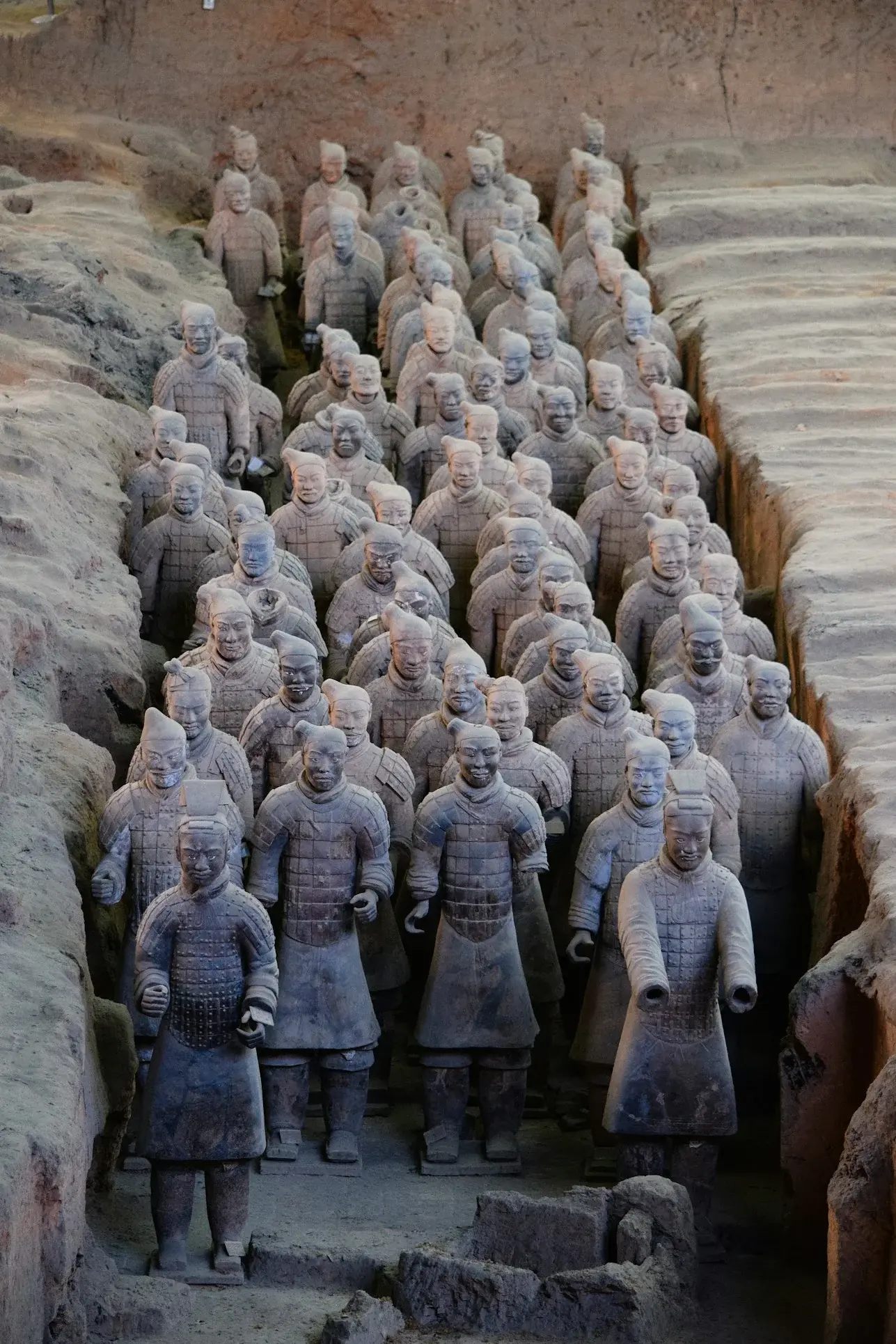
| Pit 1 | The main army hall — the image on every poster |
| Pit 2 | The partially excavated pit: cavalry and kneeling archers, some still half in the earth |
| Pit 3 | The smallest pit — the command post |
| The exhibition halls | Including the bronze chariots |
| Qin Shihuang Mausoleum / Lishan Garden | A separate site, reached by a shuttle that travel sources describe as free and about ten minutes — we found no museum announcement confirming the fare or the frequency, so ask at the north gate. Do not confuse that free shuttle with the paid sightseeing buggy that runs inside Lishan Garden, which is a different vehicle and a separate, optional charge — see below |
On the price, stated honestly. Entry is confirmed against the museum's published information, August 2026: CNY 120 full price and CNY 60 student, flat — there is no peak-season price. You will see a peak figure of 150 quoted on travel blogs; it is not supported by the museum's own information. Entry is free for visitors aged over 65, for under-16s, for military personnel, for active firefighters and for disabled visitors. What genuinely does change with the season is the opening hours: peak season runs 16 March – 15 November (ticket office from 08:30, last admission 17:00, site closes 18:30) and off-peak 16 November – 15 March (ticket office from 08:30, last admission 16:30, closes 18:00). Be clear about what this is, though: a check against published official information, not a receipt from a window we have stood at. Museums change prices, hours and concession rules quietly — confirm before you travel.
"The Museum" is not the same thing as the pits
The umbrella site is the Emperor Qinshihuang's Mausoleum Site Museum. The excavation pits are one component of it; the mausoleum mound at Lishan Garden is another. Feastographyblog (checked 2026-08) is the only source in our research that clears this up, and the confusion is not trivia — it is a mistake that happens on the day. People holding a ticket labelled "Museum" either hunt for a museum building that does not exist as a separate thing, or assume the mausoleum needs a second ticket and skip the part they already own.
Is the mausoleum worth the shuttle?
Sometimes, and you should know what you are going to see: the mound is a large vegetated earth hill, not a spectacle. Its value is scale and concept — the quiet realisation that the army you just walked past was drawn up to face this. So decide by the clock:
- An hour or more left, and you want the visit to close properly → go. The shuttle round trip is the cheapest hour of the day.
- Tight enough that it is the mausoleum or more time in Pit 1 → stay in Pit 1. Do not trade the reason you came for a conceptual footnote.
- Either way, put the shuttle round trip in your time budget. That omission is precisely why "how long do I need here" gets answered wrong so often.
The free shuttle and the paid buggy are two different vehicles
This is the part of the ticket the write-ups disagree about, and a detailed traveller post on Xiaohongshu dated 17 July 2026, read by us on 13 August 2026, explains why they disagree: there are two vehicles here, and writers describing different ones both sound right.
- The free shuttle connects the two visitor areas — the Terracotta Army site and Lishan Garden. That traveller reports it as free, which is what the travel sources say too.
- The Lishan Garden sightseeing buggy runs only inside Lishan Garden, is entirely optional, and is reported at CNY 15 per person. The garden involves a lot of walking, so the same traveller rates it worth taking with elderly visitors or children, or when your time is short.
Their own one-line summary is the shape to carry in your head: one ticket, two sites, a free shuttle between them, and a paid buggy inside the garden. Which is this page's recurring pattern arriving one level deeper. A single "ticket" at a large Chinese site is really several products — and here, unusually, the extra product is not in front of the thing you came for but inside the part you already own.
Be clear about what has and has not changed. This is one traveller's account, not an announcement, and we still have no museum announcement confirming the shuttle's fare or its frequency. What it does is raise the confidence that the shuttle really is free and explain where the CNY 15 circulating online actually attaches. Confirm both at the north gate on the day.
Walking Lishan Garden: a route, and how long it takes
The same traveller (17 July 2026) gives a route through Lishan Garden that the signage does not: pit K9901, the acrobat figures → the Bronze Chariot Museum → pit K0006, the civil-official figures → exit, at about 1.5 hours including waiting and transfers. That is the first end-to-end figure we have seen for this half of the ticket, and it is a traveller's timing rather than one we have taken ourselves.
Which site first. A first-time visitor arriving in the morning should do the Terracotta Army first and Lishan Garden second — the order least likely to run you into the day's ticket-check cut-off. The crowd-avoiding alternative from the same account runs the other way: reach Lishan Garden at about 14:30, spend roughly 1.5 hours there, take the free shuttle across, and be at the north gate before about 16:40. Anyone going in that reverse order has to check the day's last-admission time first, which can be extended on holidays — it is the thing that ends the visit, and it is why the reverse order is the riskier one.
Time budgets, also from that traveller:
| Time you have on site | What to do |
|---|---|
| About 2 hours | Pits 1, 2 and 3 plus the exhibition hall, and skip Lishan Garden. You will not do it justice and the cut-off is unforgiving |
| 3–4 hours | Both sites, using the buggy inside Lishan Garden to save your legs for the pits |
Booking, your passport, and where you actually pay
Three points, and this page deliberately stops there — the general mechanics of real-name booking in China, and what to do without a mainland phone number, are covered properly in our Forbidden City guide rather than repeated here.
1. Your passport is the entry document. Book in the name exactly as printed on your passport, and carry that same physical passport on the day. The Marriott activities listing for this site describes its cheapest option as "entrance only, show passport/ID at the gate" (checked 2026-08), which corroborates the practice for this attraction specifically. 2. Channel changed the price for one traveller. Markusmarkusmuller reports paying CNY 120 per person via WeChat and says the OTA platforms wanted "a lot more" (2026-08). That is one traveller, one visit, one attraction — report it as we do, and hold the balancing truth alongside it: an OTA that accepts a foreign card behind an English interface is worth real money to anyone who cannot complete a WeChat payment at all. This is an observation about this site, not a rule about booking channels. The reason to hold it that loosely is that the OTA question has no single answer across China, and the official side is not even internally consistent: the Palace Museum states it has no third-party sales channel and warns about fraud, while a China Daily government-channel question-and-answer published in August 2025 recommends Trip.com and Klook to English speakers precisely because they accept international cards. So judge it attraction by attraction — never pay a large premium, treat a seller guaranteeing a sold-out date as the fraud warning in action, and remember that for a traveller who cannot complete a mainland payment at all, an OTA is the answer rather than the trap. 3. The evening show is not included. A "Legend of Qin"-style performance runs indicatively CNY 268 for about 70 minutes (chinahighlights, 2026-04). Mentioned once so you are not surprised, not because you need it.
The LyrikTrip Reverse-Pit Route: Which Pit Should You See First?
Walk it Pit 3 → Pit 2 → Pit 1, so the visit accumulates towards the image you came for instead of peaking in minute four. We call this the LyrikTrip Reverse-Pit Route, and after years of building Xi'an days for first-time China travellers it is the single change that most often turns "impressive" into "unforgettable." The one exception: if you are through the gate at opening, take Pit 1 first while it is still empty.
The argument is not aesthetic preference. It comes out of what each pit actually contains.
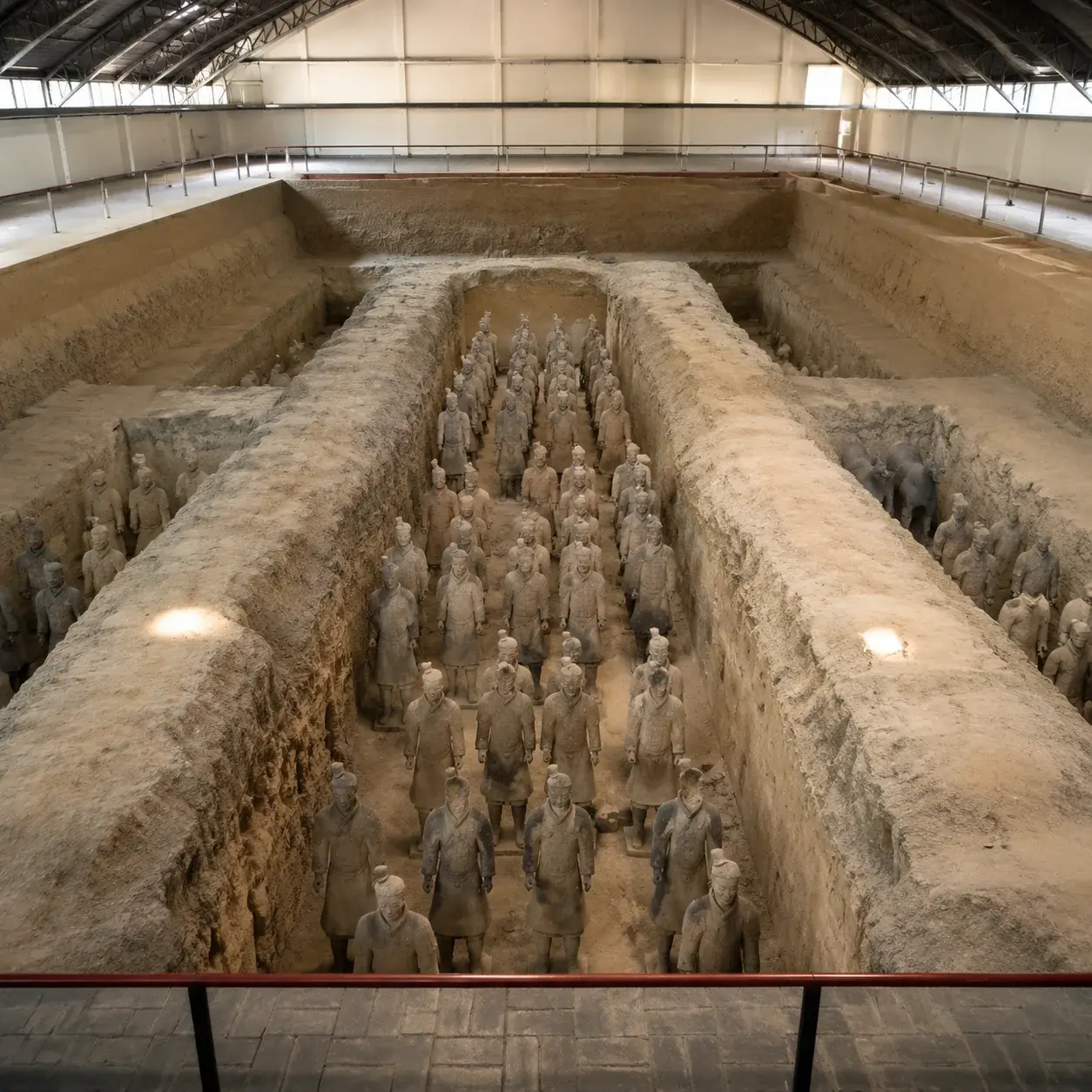
1. Pit 1 is the photograph you have already seen. It is the main army hall, and it is the shot on every poster, documentary and textbook you have ever encountered. Entering it first spends your visual peak in minute four — after which Pits 2 and 3, smaller and emptier, read as leftovers. That is a sequencing problem, not a quality problem. The same two halls become build-up rather than remainder purely by moving them.
2. Pit 3 is the command post, and it answers "what was this for." It is the smallest and quietest of the three, and you can read it in well under ten minutes, so it costs almost nothing as an opener. What it hands you is a frame: this is an army that was organised, and someone was commanding it — rather than "wow, a lot of statues."
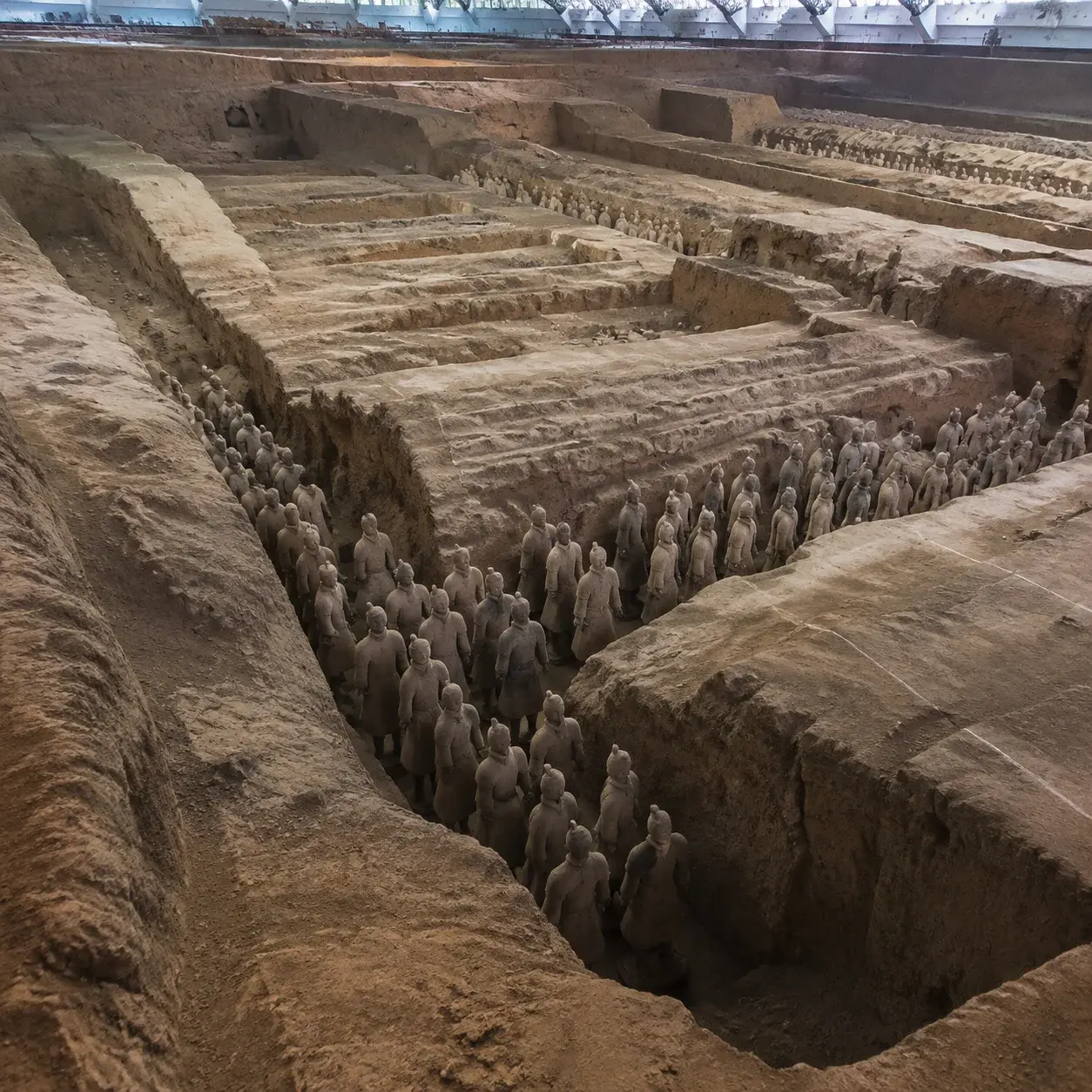
3. Pit 2 is the only place you see the archaeology itself. It is partly unexcavated, with cavalry and kneeling archers still half in the original earth. It is the only hall that shows you how any of this was found, not just what was found. See that half-buried state first and Pit 1 stops being "rows of figures" and becomes "two thousand of them, dug out of that." Which means Pit 2 is essential before Pit 1 and nearly worthless after it.
4. Pit 1 then lands as the payoff. You know who was commanding and what state it came out of the ground in, so the scale means something instead of merely being big. Same hall, different order, different visit.
There is a second reason the route works, and it is crowd-shaped. The site's own signage funnels everyone into Pit 1 first — which means the hour when Pit 1 is fullest is the hour Pits 3 and 2 are emptiest. Walking backwards is also walking against the flow.
Pit 1, in its own right
Nothing above is an argument for deprioritising Pit 1 — the Reverse-Pit Route changes when you see it, never whether. Pit 1 is the main army hall and the only place where the sheer count registers physically: rank after rank in the excavation trenches, most of them repaired, the restoration work visible in the back half of the hall. It is worth a long stop at the railing, and it is worth going back to it a second time if your ticket day allows. Plan the visit so you arrive there with something in your head, and then stay.
What time should you arrive?
Aim to be inside Pit 1 before 09:30 — inside the hall, not arriving at the car park. This comes from one traveller's account: hittheroadket records arriving at 09:30 to find Pit 1 still clear, and watching it fill within about an hour (checked 2026-08).
The gate side of that is settled. The ticket office opens at 08:30 all year; what moves with the season is the far end of the day — last admission 17:00 and closing 18:30 in peak season (16 March – 15 November), last admission 16:30 and closing 18:00 off-peak (16 November – 15 March), per the museum's published information, checked August 2026. Confirm before you travel.
Be clear about what that is. It is one report from one visit, not a crowd measurement, and we have not yet counted heads by the hour ourselves. It gives you a target to aim past, not a deadline you fail at 09:31. We keep it because it is more useful than the standard advice: "go early" is not advice, whereas "be inside the main hall before about half nine, because that is roughly when one traveller watched it fill" is something you can actually act on. One upward note: timed-entry booking does not solve Golden Week — Xi'an's Terracotta Warriors is named among the worst-hit sites in that period (dionfest, 2026-08). If those dates are unavoidable, arrive earlier than this rule, and walk backwards harder.
| Your arrival | Order to walk | Why |
|---|---|---|
| In the first group through the gate (early enough that Pit 1 is still empty) | Pit 1 → Pit 3 → Pit 2 → back into Pit 1 | An empty Pit 1 is rarer than a perfectly paced visit. Take the scarce thing first, rebuild the context in 3 and 2, then return — the second look is for detail, not scale. |
| Mid-morning onwards (Pit 1 already busy) | Pit 3 → Pit 2 → Pit 1 — the standard Reverse-Pit Route | You gain nothing by joining the crush. Spend the quiet pits while the crowd is jammed into the main hall, then arrive with context and usually a slightly thinner room. |
| Afternoon arrival, or only 90 minutes | Pit 3 → Pit 1, with Pit 2 only if time survives | Protect the fastest pit and the unmissable one. What you are giving up is explicit: the archaeology-in-progress layer. |
So how long do you need? Budget the three pits and the exhibition halls, and then add the mausoleum shuttle round trip on top if you intend to use it — one traveller puts Lishan Garden itself at about 1.5 hours including waits and transfers (17 July 2026). That last piece is exactly the amount by which people underestimate this site — and why so many of them skip the part they already paid for. Under about two hours on site, take the pits and the exhibition hall and leave the garden for another trip.
Do You Need a Guide at the Terracotta Warriors?
With no commentary at all you will see the army without understanding it — this is one of the few sites where "no narration" really does mean "you did not see it." But "a guide" is four different products, and three of them are free or cheap.
Here is the real argument, because it is specific to this attraction. The Terracotta Warriors is a site where the objects are visually repetitive and the meaning lives almost entirely in the narration. That is not a criticism; it is the nature of the thing. You are looking at thousands of figures that closely resemble one another, so past about minute three the visual information stops increasing, and "overwhelming" quietly becomes "seen it." Meanwhile everything genuinely interesting is invisible: how the formation is organised by troop type, what hairstyles and armour differences say about rank, why Pit 2 is deliberately left half-dug, where the original paint went, how the "museum" relates to the pits. None of it is written on the statues. Without narration you are looking at a warehouse.
That is the honest case for commentary — which is precisely what earns us the standing to tell half of you not to buy any.
| Option | What you actually get | Roughly what it costs | Best for | Skip it if |
|---|---|---|---|---|
| ① Nothing | Three pits and the halls, entirely at your own pace | Free | Independent travellers who genuinely read up beforehand; people who came for the scale of Pit 1 and know that is what they want | You want to know why any of it looks the way it does — here "nothing" wastes the trip |
| ② Audio guide | Self-paced, stop-by-stop commentary you can pause | Low, rented on site (fee and language list unverified) | Most first-timers; anyone on a variable schedule; families who may need to bail at any moment | You are already with a guide — you would be paying twice |
| ③ On-site shared guide | A live guide joined at the entrance, with a group of strangers | Mid (unverified) | Travellers who want live Q&A without private-guide money; solo visitors | You cannot stand walking at a group's pace |
| ④ Private guide (with or without transfers) | Your own guide, your own pace, door-to-door transport if bundled | Highest | Families with children — the largest difference a guide makes anywhere on this site; travellers with limited mobility; anyone fitting the warriors, the mausoleum and Huaqing Pool into one day | You are two adults on a budget who mainly want to look at Pit 1 quietly — take the audio guide and put the difference into the taxi |
When not hiring a guide is the right answer
- You already read up. This page plus a documentary means what you need on site is prompts, not a lecture from zero. The audio guide is enough.
- You came to photograph, or to linger. Some people want to stand at the Pit 1 railing for a long time. A guide talks continuously and will destroy that.
- You have a small child who could melt down at any moment. A group's pace is someone else's pace; an audio guide pauses.
- You have under 90 minutes. Commentary will eat viewing time you already do not have.
The honest summary: the audio guide is the right answer for more people than the industry admits, and the private guide is the right answer for fewer people than the industry admits — but for those few it changes the whole visit, not just the comfort. If you are in that group, we can arrange private English-speaking guides in Xi'an. That is availability, not a recommendation.
What Else Do People Ask About Visiting the Terracotta Warriors?
Short answers to the questions that come up most often — all prices and times indicative, last verified 2026-08.
Should I see Pit 1 first or last? Last, in almost every case. Walk Pit 3, then Pit 2, then Pit 1, so the command post and the half-excavated hall give you context before the main army arrives as the payoff. The single exception: if you are through the gate at opening, take an empty Pit 1 first and come back.
What time should I arrive at the Terracotta Warriors? Aim to be inside Pit 1 before about 09:30. That target comes from one traveller's account — arriving at 09:30 to find the hall clear and watching it fill within roughly an hour (hittheroadket, 2026-08) — so treat it as a direction to aim past rather than a measured threshold.
Is a guide worth it, or is the audio guide enough? For most first-time visitors the audio guide is enough, and it is our default recommendation. A private guide earns its cost mainly for families with children, travellers with limited mobility, and anyone combining the warriors, the mausoleum and Huaqing Pool into one day.
Can I do the Terracotta Warriors as a day trip? From Xi'an, comfortably — it is a half-day for most people, or a full day if you add the mausoleum and Huaqing Pool. From Beijing it is technically possible by bullet train but rarely sensible, because the site sits about an hour beyond Xi'an in each direction.
Is the Qin Shihuang Mausoleum included, and is it worth the shuttle? Yes — three independent sources agree the standard ticket covers it, via a free shuttle taking about ten minutes as of 2026-08. Worth it if you have an hour spare and want the visit to close; skip it if the choice is between the mound and more time in Pit 1. One ticket, two sites, a free shuttle between them — and a paid sightseeing buggy inside Lishan Garden, a different vehicle reported at CNY 15 per person by a traveller writing on 17 July 2026, optional and worth it mainly with elderly visitors, children, or a tight clock.
Can I visit the Terracotta Warriors from Beijing in one day? Possible, rarely sensible. A same-day return absorbs two intercity rail legs, two local legs and a first-and-last-train ceiling, which typically buys about two hours on site with ten-plus hours of movement. One night in Xi'an fixes it and unlocks the city as well.
How long should I spend at the Terracotta Warriors? Budget the three pits and the exhibition halls, then add the mausoleum shuttle round trip if you plan to use it. The shuttle is what people leave out of the estimate, which is why so many arrive with just enough time to skip the part of the ticket they already bought. A traveller writing on 17 July 2026 splits it cleanly: with about 2 hours, do pits 1, 2 and 3 plus the exhibition hall and skip Lishan Garden; with 3–4 hours, do both, and take the buggy inside the garden to save your legs.
So What Should You Actually Do?
Four decisions, one line each. Take the taxi if there are two or more of you — it costs an indicative CNY 120–200 and buys back half a morning. Assume your ticket covers more than you think: three pits, the halls, and a mausoleum most visitors never claim. Walk the Reverse-Pit Route, 3 → 2 → 1, unless you are through the gate at opening, in which case take the empty Pit 1 and come back to it. And take the audio guide unless you are travelling with children or limited mobility, where a private guide genuinely changes the day.
One last thing, said plainly: the entry price and the opening hours above are confirmed against the museum's published information as of August 2026, but several other numbers on this page — the shuttle interval, the real end-to-end time on the metro chain, the audio-guide fee, and the CNY 15 buggy fare and 1.5-hour Lishan Garden timing that come from one traveller writing on 17 July 2026 — are carried on named sources, and we have flagged each one as awaiting our own check on the ground. Verify prices and times before you travel. If you would rather not assemble the day yourself, we can build a Xi'an day around this site instead of through it — with the pits in the right order, and time left over for where to eat in Xi'an.