




 18 days China, End to End Beijing → Xi'an → Chuanzhusi → Jiuzhaigou → Chengdu → Zhangjiajie → Guilin → Yangshuo → Shenzhen From $6,360 View route
  3 days 3-Day Tour: Mount Siguniang, Bipenggou & Dagu Glacier Chengdu → Lixian → Heishui County From $1,599 View route
  5 days Above the Pillars, Then Below Zhangjiajie From $1,430 View route
  3 days After the Last Booth Guangzhou From $840 View route
  13 days All the Way West Xi'an → Dunhuang → Turpan → Kashgar → Shanghai From $3,500 View route
 China Visa Guide 2026: Types, Application Process & Requirements
Introduction: What Most Travellers Need to Know Before Applying
If you are planning your first trip to China, the visa question usually arises long before you can book your flights with confidence. I hear the same concerns time and again from travellers: Do I need a visa for China? Which type should I apply for? How early should I start? It can feel confusing at first, especially when different websites mention different rules, processing times, and exceptions.
The good news is that the process becomes much easier once you understand the basics. In most cases, foreign travellers entering mainland China need a valid China visa before departure. The right visa depends on the purpose of your trip, your nationality, your passport type, and sometimes even the city where you submit your application.
In this guide, I will walk through who needs a China visa, the main visa types, how the China visa application process works, what documents you will usually need, how long processing takes, what fees to expect, and when visa-free transit may be an easier option. Because rules can vary by nationality and by the Chinese embassy, consulate, or visa center handling your case, always confirm the latest requirements before you submit anything.
Do I Need a Visa for China?
For most travellers, the general rule is simple: if you are visiting mainland China on a foreign passport, you will usually need a visa before arrival. This applies to many tourists, business visitors, students, and travellers joining organised trips.
That said, there are important exceptions. A small number of nationalities may be eligible for temporary visa-free entry policies, limited short-stay exemptions, or regional entry schemes. These policies change from time to time, so the exact answer depends on your citizenship, passport type, trip length, and route.
It is also important to distinguish between a foreign passport and a Chinese passport. Travelers holding a Chinese passport or who are considered Chinese nationals follow different entry rules from foreign tourists. If you have dual-nationality questions, previous Chinese nationality, or a recently renewed Chinese passport, you should check directly with the relevant authorities before making travel plans.
Several exceptions come up often in trip planning:
- Hainan visa-free entry for eligible travellers from approved countries, usually for tourism and for a limited stay period
- Temporary visa-free policies for selected countries, often limited by trip length and purpose
- 144-hour transit visa-free policy in cities such as Shanghai, Beijing, and others, for travellers transiting onward to a third destination
If you are considering a transit visa for Shanghai or another transit-based entry route, pay close attention to the routing rule. In most cases, you must arrive from one country or region and depart to a different third country or region. A round trip such as country A → China → country A usually does not qualify.
China Visa Types: Which One Fits Your Trip?
China offers several visa categories, but for most overseas travellers, a few types are especially relevant.
Tourist Visa (L Visa) — Most Common
The Tourist (L) visa is the standard choice for leisure trips, family sightseeing, and general tourism. If your plan is to visit Beijing, Shanghai, Xi'an, Guilin, Chengdu, or other major destinations as a holiday traveller, this is usually the visa you need.
Tourist visas may be issued as:
- Single-entry
- Double-entry
- Multiple-entry
Typical permitted stays are 30 to 60 days per visit, although the exact duration depends on what is granted on your visa sticker. Validity can also vary. In some cases, long-validity visas may be available, including multi-year options for certain nationalities.
Business Visa (M Visa)
The M visa is for commercial and trade activities, such as attending meetings, business negotiations, visiting suppliers, or participating in exhibitions. Applicants often need an invitation letter from a Chinese company or trade partner.
Student Visa (X Visa)
The X visa is for international students enrolled in educational programmes in China. There are different subtypes depending on the length of study. Admission documents from a Chinese school or university are usually required.
Work Visa (Z Visa)
The Z visa is for travellers taking up legal employment in China. This category typically requires a valid work permit notice or related government-approved documentation before the visa application can proceed.
Transit Visa (G Visa)
The G visa applies to travellers transiting through China when they do not qualify for visa-free transit. It is less common for ordinary tourists but still useful in specific routing situations.
10-Year and Long-Validity Visas
Some US and Canadian travellers may be eligible for longer-validity visas under current bilateral arrangements. These remain purpose-specific visas, not open-ended entry permissions, and each stay is still subject to the conditions stated on the visa.
One more point often causes confusion: many people search for a China e visa or assume there is a universal online tourist visa. In practice, China does not generally offer a fully digital e-visa system for ordinary tourist entry in the same way some countries do. You may complete the application form online, but that does not automatically mean you are receiving an e-visa. Always check whether you are using an official application platform or a third-party visa service.
How to Apply for a China Tourist Visa Step by Step
Applying for a China tourist visa is manageable if you prepare carefully and start early. I usually recommend beginning several weeks before departure, especially during busy travel periods.
Step 1: Prepare Core Documents
Start with your passport. In most cases, it should be valid for at least six months beyond your planned entry date and contain blank visa pages.
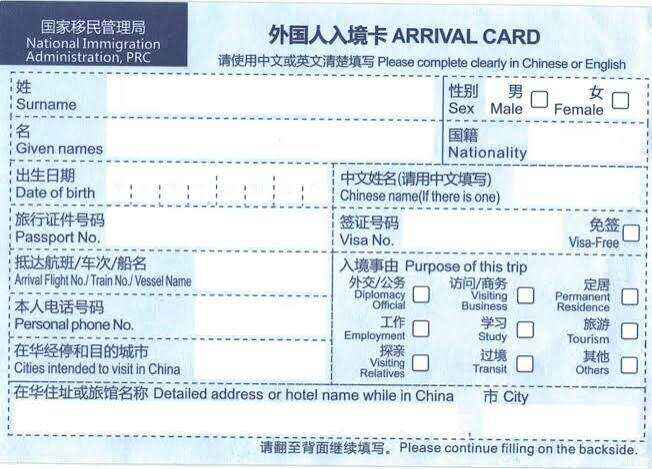
You will also need a completed China visa application form, which is often submitted through the official online system before printing or confirming the appointment. Some travellers search for the Chinese visa application form or even terms like 中國 簽證 申請 表; regardless of the language used, the key is to use the correct official form required by your local mission.
A standard tourist application usually includes:
- Passport with sufficient validity
- Completed online visa application form
- Recent passport photo meeting size and background requirements
- Round-trip or onward flight reservations
- Hotel bookings for the trip
- A simple day-by-day or city-by-city itinerary
In some cases, additional documents may be requested, especially if you are staying with friends or family, have previously held Chinese nationality, or have a complicated travel history.
Step 2: Submit the Application
The next step is to submit through the correct channel. Depending on the country, this may be:
- A Chinese embassy
- A Chinese consulate
- A Chinese Visa Application Service Center
This part of the Chinese consulate visa application process varies more than many people expect. In some locations, applicants must appear in person. In others, biometric collection, appointment booking, or document pre-check procedures may apply. Rules can also differ depending on whether you are applying in your home country or from a country where you are legally residing as a foreign national.
If you are handling your own American visa application for China, or applying from the UK, Canada, Mexico, France, or elsewhere, always check the local mission website, as submission rules are not completely standardised worldwide.
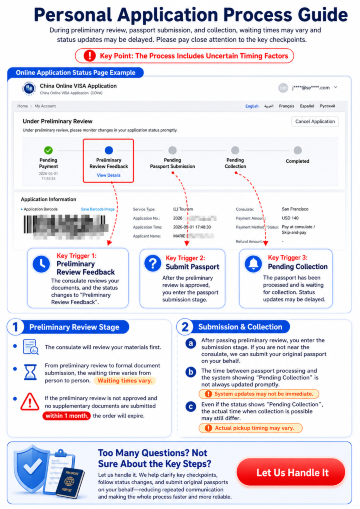
Step 3: Pay the Visa Fee and Await Processing
After submission, you will pay the applicable visa fee. The amount depends on nationality, visa type, number of entries, and where the application is lodged. As a rough example, fees may be around:
- Around USD 140 for many US applicants
- Around GBP 151 for some UK-based applications
- Different rates apply for Canadian, Mexican, and other nationalities
If you are looking into a Chinese visa for Canadians, the tourist visa process for China from the UK, Chinese visa requirements for Mexicans, or even searching in French for visa pour la Chine, the overall process structure is similar, though fees and submission details may vary.
Standard processing often takes 4 to 5 working days, while expedited options may reduce that to 2 to 3 working days where available. During holidays or peak seasons, timelines may stretch, so do not leave the application until the last minute.
Step 4: Collect Your Passport and Check the Visa Carefully
Once your passport is returned, do not just slip it into your bag and assume everything is fine. Open it and review the visa sticker carefully.
Check:
- Your full name
- Passport number
- Visa type
- Number of entries
- Validity period
- Maximum duration of each stay
If anything is incorrect, contact the issuing office immediately before travel. Fixing a problem after arrival at the airport is much harder than catching it early.
Should You Use a China Visa Service?
For straightforward trips, many travelers can apply on their own. But in real life, not every itinerary is simple. Tight timelines, unusual travel histories, invitation letter questions, and uncertainty about local submission rules are all reasons people consider a Chinese visa application service.
A good visa service can help with:
- Reviewing documents before submission
- Flagging common errors in the form
- Advising on photo standards and supporting paperwork
- Helping schedule appointments
- Explaining local embassy or visa center procedures
Popular international providers may include agencies such as CIBT or VisaHQ, depending on your location. The trade-off is straightforward: you pay a service fee on top of the official visa fee. That extra cost buys convenience and reduced paperwork stress, but it does not guarantee approval.
This is precisely where an experienced China travel agency can be genuinely useful without turning the process into a hard sell. For travellers who need an invitation letter, coordinated hotel bookings, a realistic route plan, or pre-arrival guidance, agency support can save time and reduce mistakes. In our experience, many first-time visitors feel much more confident once their itinerary, accommodation confirmations, and day-to-day plan all clearly match the visa application.
What Does a China Visa Look Like?
A China visa is usually a full-page sticker placed inside your passport. If you have ever searched what does a China visa look like or what does a Chinese visa look like, the answer is that it resembles a formal visa label with security features, printed text, and a clearly structured information layout.
Key details shown on the visa typically include:
- Your name
- Date of birth
- Passport number
- Visa category
- Number of entries
- Issue date
- Enter-before date
- Duration of each stay
Before traveling, compare those details against your passport and itinerary. A single wrong digit in the passport number or a mistaken entry count can create serious trouble at check-in or immigration.
144-Hour Transit Visa-Free Entry — The Easiest Option for Some Travelers
For the right itinerary, the 144-hour transit visa-free policy can be one of the easiest ways to visit China briefly without applying for a standard visa in advance. This option is especially popular with travellers planning a stopover in cities such as Shanghai, Beijing, Guangzhou, Chengdu, or Xi'an.
The basic idea is simple: you enter China while transiting to a third destination. For example, a route such as Seoul → Shanghai → Tokyo may qualify, while Seoul → Shanghai → Seoul generally does not.
Eligibility depends on:
- Your nationality
- Your exact arrival and departure cities
- The airport or port of entry
- Whether your onward destination counts as a different third country or region
If you are looking specifically for a transit visa for Shanghai, verify not only that your passport is eligible, but also that your ticketed route meets the policy rules. This transit arrangement is convenient, but it is highly technical. The smallest routing mistake can mean you need a regular visa instead. If that's your situation, start with  Visa & Entry Guide 2026.
China Visa-Free Policies (2026 Update)
China’s visa-free policies have grown more dynamic in recent years, making this a vital area where travellers should be particularly cautious about relying on outdated information. Some passport holders may qualify for short, visa-free visits under temporary bilateral or unilateral arrangements, while others may still require a standard visa even for a short holiday.
There are also region-specific programmes, such as:
- Hainan visa-free entry for eligible nationalities on approved tourism terms
- Short-stay visa exemptions for selected countries
- Transit visa-free entry in designated cities and regions
Because these policies can expand, pause, or change in duration, always confirm the latest 2026 update through official sources before relying on visa-free travel.
Common Reasons for Visa Rejection
Most China visa refusals are not dramatic; they are often caused by preventable mistakes.
Common reasons include:
- Errors or inconsistencies in the application form
- Insufficient passport validity
- Passport photos that do not meet official standards
- Missing flight, hotel, or itinerary information
- Unclear purpose of travel
- Incomplete supporting documents
The safest approach is to make sure every detail matches across your passport, application form, bookings, and supporting materials. Even small discrepancies can trigger delays or requests for additional documentation.
China Travel Tips for First-Time Visitors
Once your visa is approved, trip planning becomes much more enjoyable. For any tourist in China, I always recommend preparing beyond the visa itself. Save hotel addresses in both English and Chinese, confirm whether your payment apps and bank cards will work, and keep digital and printed copies of your passport, visa, and travel reservations.
It is also beneficial to read destination-specific guides before arriving. Transport, train reservations, mobile payments, and local etiquette may feel unfamiliar at first, but a little preparation makes the experience much smoother. If you are planning a longer itinerary, practical support with hotels, transport timing, and a realistic sightseeing pace can make a big difference.
FAQ
1. How long does it take to get a China visa?
Standard processing usually takes about 4 to 5 working days, though this varies by location and season. Expedited options may be available in some countries for an additional fee.
2. Can I get a China visa on arrival?
In most cases, ordinary tourists should not expect a visa on arrival for mainland China. Most travelers need to obtain a visa before departure unless they qualify for a visa-free or transit policy.
3. How much does a China tourist visa cost?
The cost depends on your nationality, number of entries, and where you apply. U.S. applicants often pay around USD 140, but fees for UK, Canadian, Mexican, and other applicants may differ.
4. Can I extend my China visa while in China?
In some situations, yes. Extensions may be possible through the local public security authorities, but approval is not guaranteed. Apply before your current permitted stay expires.
5. What happens if I overstay my China visa?
Overstaying can lead to fines, administrative penalties, travel disruption, or difficulties with future visa applications. If you think you may overstay, seek official guidance immediately rather than waiting.
Final Thoughts
A China visa may seem daunting at first, but the process is usually straightforward once you identify the right category for your trip and prepare your documents carefully. For many travellers, the key is not to rush: check your eligibility, confirm whether a standard visa or a transit option is more suitable, and review every document before submission.
If you are planning a more complex trip, our support team can help. Our professional travel specialists can assist with invitation letters, itinerary design, hotel coordination, and practical pre-arrival advice, ensuring your application materials tell a clear and consistent story. If you are getting ready to explore China, save this guide, share it with your travel partner, and check your itinerary against the latest official regulations before applying.
Ready to explore China? Let LyrikTrip help with your visa invitation letter and complete trip planning. Start your China adventure.