




 18 days China, End to End Beijing → Xi'an → Chuanzhusi → Jiuzhaigou → Chengdu → Zhangjiajie → Guilin → Yangshuo → Shenzhen From $6,360 View route
  3 days 4-Day Tour of Siguniang Mountain, Biepa Gou, and Dagu Glacier Chengdu → Lixian → Heishui County From $1,599 View route
  5 days Above the Pillars, Then Below Zhangjiajie From $1,430 View route
  3 days After the Last Booth Guangzhou From $840 View route
  13 days All the Way West Xi'an → Dunhuang → Turpan → Kashgar → Shanghai From $3,500 View route
How Do You Climb Mount Tai China? Steps, Sunrise, and the Cable Car, Explained
You climb Mount Tai China by choosing one of four ways up: walk the classic East (Imperial) Route — roughly 6,000 stone steps, 4–6 hours, genuinely hard — or skip most of it with a sightseeing bus to Midway Gate plus a cable car to South Heaven Gate, which puts kids, older travelers, or anyone short on time on the sacred summit with almost no climbing. The single most useful decision you'll make isn't which trail — it's whether you're here to climb Mount Tai (walk the stairs as a 3,000-year-old pilgrimage) or simply to reach the top for its legendary sunrise over a sea of clouds. Both are valid; they need different plans.
A note on who's telling you this. LyrikTrip is a travel company, not a ticket reseller — we don't earn a commission on cable-car fares or summit hotels, so we'll happily tell you when the cable car beats the climb and when a clear-sky forecast matters more than any itinerary. Mount Tai (Tài Shān 泰山), in Shandong province, is the foremost of China's  Five Great Mountains and its summit, Jade Emperor Peak, sits at about 1,532.7 m / 5,029 ft (Britannica, Mount Tai, reviewed 2026-07-04). Here's how to plan your climb, your sunrise, and your trip in.
Key Takeaways
- Four ways up, one decision: full walk (East/Imperial Route, ~6,000 steps, 4–6 h), afternoon climb + sleep on the summit, bus + cable car, or cable car both ways. Pick by fitness and goal, not by trail name.
- Steps, honestly: the classic route is about 6,293 official steps to the top — roughly 7,200 if you count every temple and side stair — gaining ~1,300 m (Wikipedia, Mount Tai, reviewed 2026-07-04). The steep crux is the Eighteen Bends (1,827 steps).
- The sunrise is the reason to come — but it's a gamble. Sleeping on the summit is more comfortable than the traditional midnight night-hike, and clear autumn mornings give the best odds of a sea of clouds.
- Yes, families and grandparents can do it — bus to Midway Gate, cable car to South Heaven Gate, gentle walk to the summit temples. No 7,000-step ordeal required.
- Getting there is easy: Tai'an is a high-speed-rail stop on the Beijing–Shanghai line (roughly ~2 h from Beijing, ~20 min from Jinan — verify current timetables).
- Every price, time, and fare below is an indicative range flagged _verify locally (2026)_. The step counts, elevation, Eighteen Bends, 72 emperors, and UNESCO 1987 listing are sourced and citable.
How Do You Climb Mount Tai? (Routes, Steps & Cable Car Compared)
The classic climb is the East (Imperial) Route — about 6,000 stone steps, 4–6 hours, moderately hard — but you can skip most of it with a sightseeing bus to Midway Gate (Zhongtianmen) plus a cable car to South Heaven Gate, which makes the summit reachable for kids, older travelers, or anyone short on time. The mistake most guides make is listing the East Route, West Route, cable car, and buses as separate options and leaving you to assemble your own plan. Instead, match one of four ascent methods to who you are and what you want.
| Ascent method | Best for | Steps on foot _verify_ | Time _verify_ | Difficulty | Where you sleep |
|---|---|---|---|---|---|
| ① Night hike to sunrise | Fit travelers who want the "rite of passage" and to save a night's lodging | Full route, ~6,000 official (up to ~7,200 with temple steps) | Start ~midnight; 4–6 h up in the dark, reach the top before dawn | Hard — the Eighteen Bends is near-vertical, in the cold and dark | No sleep, or a few rough hours up top |
| ② Afternoon climb + sleep on summit | Most people who want the sunrise without pulling an all-nighter | ~6,000 up, cable car down | Climb by day (4–6 h), sunrise next morning | Hard up, easy down (cable car spares the knees) | A summit hotel near South Heaven Gate |
| ③ Bus → cable car → short walk | Families with kids, older travelers, the time-crunched | ~0–1,000 (short walk up top) | ~1–1.5 h all in | Easy | Back down in Tai'an, or a summit hotel |
| ④ Cable car both ways | Reaching the summit with the least possible effort | Minimal | ~1 h | Easiest | Tai'an town |
All step counts and times above are indicative and competitor-sourced — treat as a range and verify locally (2026).
Four one-line read-outs an itinerary can hang on:
- Here for the challenge / the pilgrimage → ① walk the full East (Imperial) Route, ~6,000 steps, 4–6 hours, and earn the Eighteen Bends.
- Want the sunrise, not the all-nighter → ② climb by afternoon and sleep on the summit; cable car down after dawn.
- Family with kids or grandparents → ③ sightseeing bus to Midway Gate, cable car to South Heaven Gate, gentle stroll along Heaven Street.
- Short on time → ④ cable car both ways; you're on top in about an hour.
The iron rule underneath the whole table: "climbing Mount Tai" and "getting up Mount Tai" are two different trips. If you want the 3,000-year pilgrimage, walk every stair. If you want to stand on the sacred summit for the sunrise, there is nothing shameful about the cable car — and your knees will thank you on the way down. For how Mount Tai stacks up against China's other great peaks, see the China mountains guide; for the specific "Mount Tai vs Huangshan" decision, jump to our Huangshan travel guide.
How Many Steps Is Mount Tai — and How Hard Is the Climb, Really?
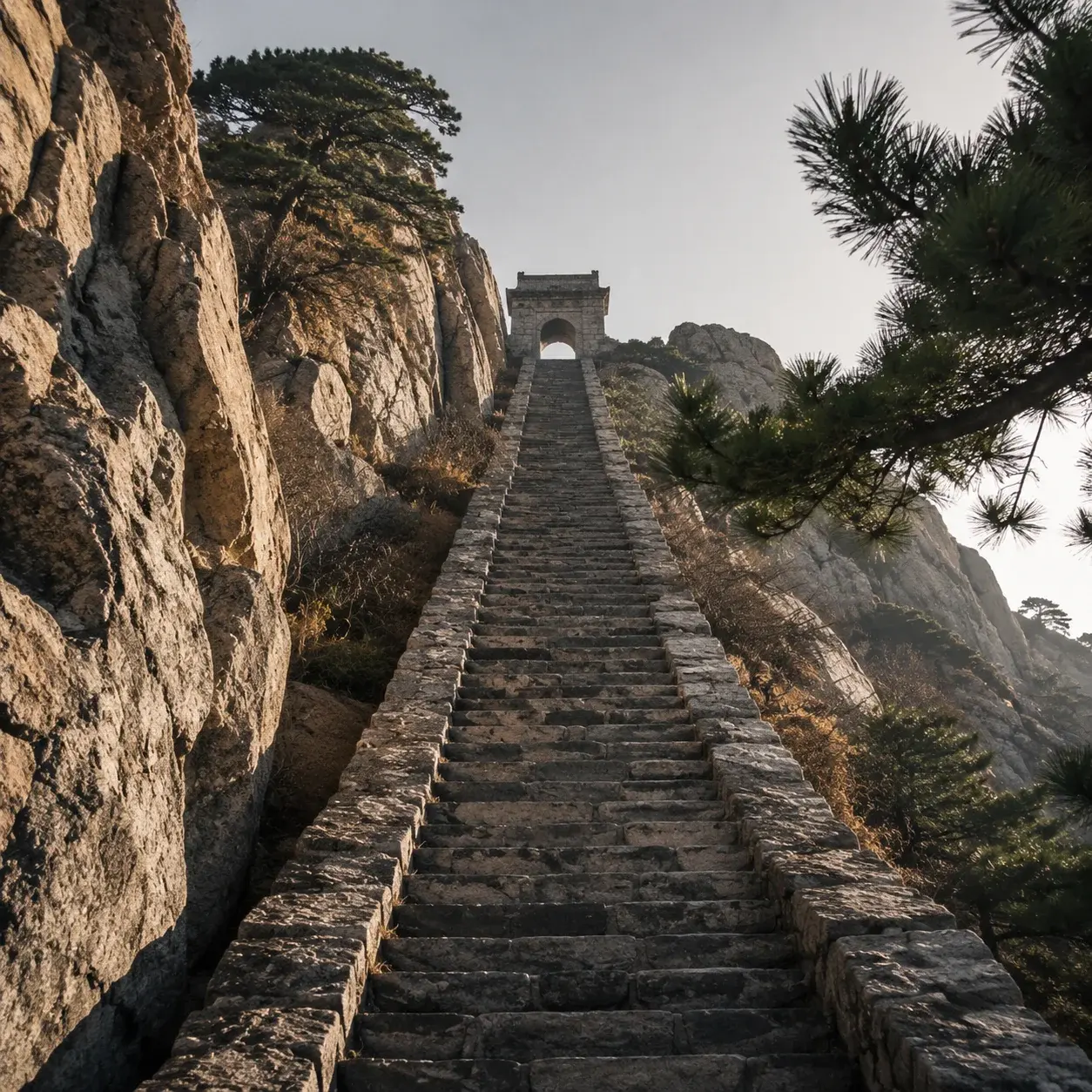
The classic East/Imperial Route is about 6,293 official stone steps to the summit — roughly 7,200 if you count every temple and side stair — climbing about 1,300 m, and it takes a typical hiker 4–6 hours up and around 3 hours down. You'll see wildly different numbers online (6,000-plus, 6,293, 6,660, "over 7,000 brutal steps") because people count differently: the mountain walkway itself is about 6,293 steps, while the full tally including inner temple stairs reaches roughly 7,200 (Wikipedia, Mount Tai, reviewed 2026-07-04). Any single figure you're quoted is an approximation — treat exact counts as indicative and verify on site.
The crux is the Eighteen Bends (Shibapan 十八盘) — 1,827 stone steps rising almost vertically to South Heaven Gate, split into the "slow eighteen," "tight eighteen," and "neither-slow-nor-tight eighteen" (Wikipedia, Mount Tai, reviewed 2026-07-04). Honestly: this is a serious leg workout, not a technical climb — no ropes, no exposure, just relentless stairs. What wrecks people isn't the way up; it's the way down, which pounds the knees far harder. Our standing advice: almost everyone should take the cable car down. Conquer the Eighteen Bends once on foot; you don't need to pay for them again in the other direction.
Is the Mount Tai Sunrise Worth It? (Night Hike vs. Sleeping on the Summit)
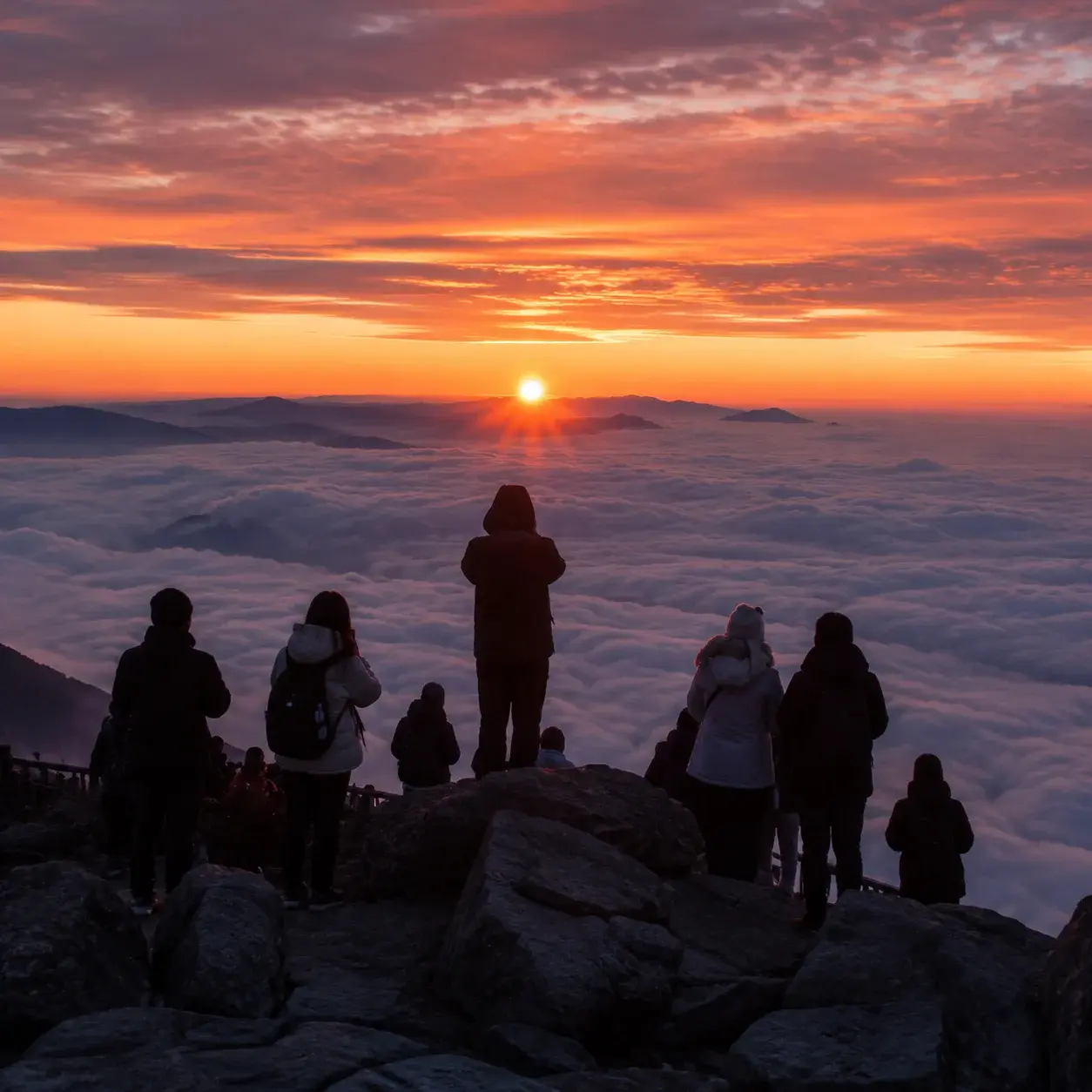
The sunrise over the sea of clouds is the reason most people climb Mount Tai — and it's worth it, but it's a probability, not a guarantee. There are two ways to be on the summit for dawn, and for most travelers the second is the better call. (1) The traditional night hike: leave the base around midnight, climb by headlamp, and reach the top before first light — a genuine Mount Tai rite of passage, but cold, tiring, and you'll still need an afternoon nap. (2) Climb by afternoon and sleep on the summit: far more comfortable, and the plan we'd recommend to most people — you're rested, close to the viewpoint, and you cable-car down afterward.
Where you sleep decides how brutal your morning is:
| Where you sleep | Walk to the viewpoint _verify_ | Suggested wake-up _verify_ | Cold / tired | Best for |
|---|---|---|---|---|
| Summit hotel (near South Heaven Gate / Heaven Street) | ~10–20 min to Sun-Viewing Peak | ~40–60 min before sunrise (roughly 04:00–04:30 in summer) | Slept in a bed — most comfortable | Most people: rested, close to the view, cable car down |
| Midway (Zhongtianmen area) | Still 2–3 h of climbing to the top | Set out in the middle of the night to hike the upper section | Little sleep + a dark second climb | Only if summit rooms are sold out and you're set on sunrise |
| No sleep — night hike from Red Gate | Reach the top as dawn breaks | Depart ~midnight | Coldest, most tiring | Younger, fit travelers chasing the ritual and saving a night's lodging |
Three sunrise rules worth lifting:
- Where to stand: the viewing spots cluster around Jade Emperor Peak and Sun-Viewing Peak (Riguan Feng), east along Heaven Street.
- What to wear: the summit is high (~1,532.7 m) and pre-dawn is bitterly cold; vendors rent the famous padded army coats — rent one rather than tough it out, and bring a hat and gloves.
- Whether you'll even see it: this is the most honest line in this guide — the sunrise and sea of clouds are a weather lottery, not something an itinerary can promise. Overcast, foggy, or post-rain mornings often deliver nothing. Give yourself an extra night, pick a clear-weather window, and treat the climb (or the Qufu culture loop below) as the main event so a grey dawn doesn't sink the whole trip.
On the summit-sleep reality: hotels such as Shenqi, Nantianmen, and Yunchao near South Heaven Gate run roughly ¥500–1,200 in peak season (nearer ¥500–600 off-peak), rooms are basic, and they book out fast — reserve well ahead; a rented tent runs about ¥100 (all indicative, competitor-sourced — verify locally, 2026).
Can Families, Kids or Older Travelers Climb Mount Tai?
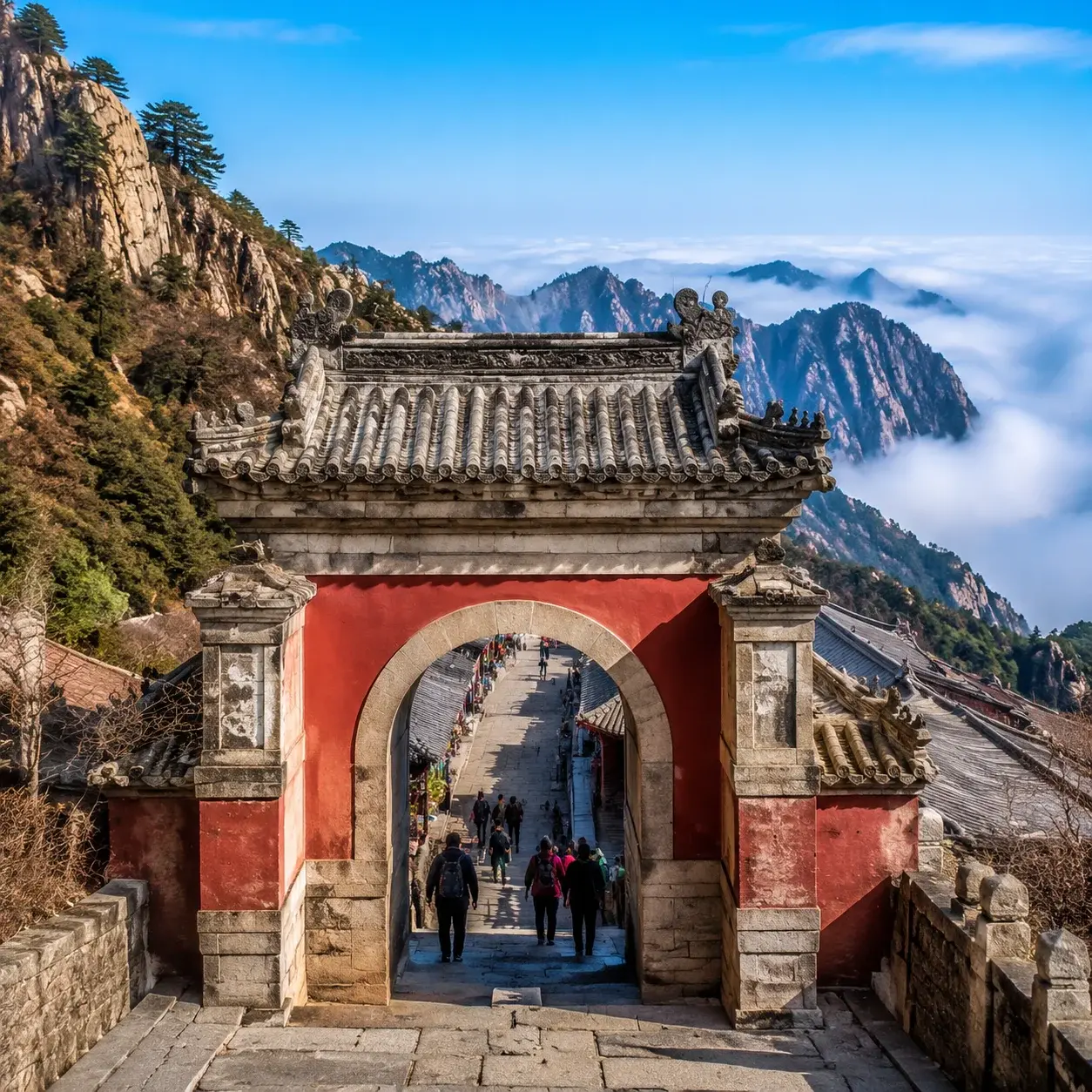
Yes — you do not have to walk 7,000 steps to stand on the sacred summit. Mount Tai isn't a knife-edge peak like Hua Shan; a bus-and-cable-car combination will carry almost anyone to the top. Here is the easy path, in order:
- From the Tianwaicun (West Route) entrance, take the sightseeing bus to Midway Gate (Zhongtianmen).
- Transfer to the cable car up to South Heaven Gate (Nantianmen).
- Walk the gentle, mostly level Heaven Street (Tian Jie) to the summit temples, Jade Emperor Peak, and the sunrise viewpoints.
That puts kids and grandparents on the summit with only a short walk. A few honest caveats: strollers are a losing battle against the steps and crowds up top, so bring a baby carrier instead; age and child-height ticket discounts exist but the exact thresholds change — verify locally (2026); and the summit is high, cold, and busy, so pack real layers and pick a clear day. For multi-generational trips into China more broadly, our China mountains guide flags which peaks are easiest.
Why Is Mount Tai Sacred? The Five Great Mountains (五岳) Explained
Mount Tai is the foremost of the Wuyue (五岳), China's Five Great Mountains — five peaks arranged by the cardinal directions and revered for millennia as links between heaven and earth. As the eastern mountain, Tai is tied to sunrise, birth, and renewal, which is why emperors came here above all others.
| Mountain | Direction | Province _verify_ |
|---|---|---|
| Tai Shan (泰山) — the foremost | East | Shandong |
| Hua Shan (华山) | West | Shaanxi |
| Heng Shan (恒山) | North | Shanxi |
| Heng Shan (衡山) | South | Hunan |
| Song Shan (嵩山) | Center | Henan |
Note the two "Heng Shan": the northern one (恒山) is in Shanxi, the southern one (衡山) in Hunan — easy to confuse.
Why does Tai lead the five? A recorded 72 emperors made the pilgrimage here to perform the imperial fengshan rites — sacrifices to Heaven on the summit and to Earth at its foot — a tradition of worship stretching back some 3,000 years; Confucius famously climbed it, and later poets followed (Wikipedia, Sacred Mountains of China, reviewed 2026-07-04). That unbroken cultural weight, paired with its natural drama, earned Mount Taishan inscription as a UNESCO World Heritage Site in 1987 — China's first mixed cultural-and-natural property (UNESCO / Wikipedia, reviewed 2026-07-04). To understand where Tai sits among China's sacred mountains and how the other four compare, head up to the mountains pillar.
How Do You Get to Mount Tai? (Tai'an & the Bullet Train)
Mount Tai rises just north of Tai'an in Shandong, and the easy way in is the high-speed train: Tai'an sits on the Beijing–Shanghai line, roughly ~2 hours from Beijing, ~1.5–2 hours from Shanghai, and about ~20 minutes from Jinan (all indicative — verify current timetables, 2026). You'll arrive at Tai'an (Taishan) Railway Station, a short taxi, DiDi, or bus ride from the trailheads: Red Gate (Hongmen) for the East Route walk, and Tianwaicun for the bus-plus-cable-car route.
Flying in? There's no major international airport at Tai'an itself — the nearest is Jinan Yaoqiang, or you can land at a big hub and connect by rail. If you're still deciding your China gateway, our guide to which airport to fly into walks through the trade-offs, and the same high-speed network that reaches Tai'an connects most major cities, so taking the bullet train to Tai'an from Beijing or Shanghai is usually simpler than any flight. Final-leg taxi and bus fares are short and cheap — verify locally (2026).
Should You Combine Mount Tai With Qufu — Confucius's Hometown?
Yes — the classic Shandong pairing is Mount Tai plus Qufu, two UNESCO sites about an hour apart: the sacred mountain and Confucius's hometown, home to the Temple, Mansion, and Cemetery of the sage. It makes a tidy, high-value 1.5–2 day culture loop that almost no travel guide bothers to build.
| Day | Plan | Transport _verify_ |
|---|---|---|
| Day 1 | Tai'an — climb or cable-car up Mount Tai (method ①/②/③); sunset or sea-of-clouds on the summit; overnight up top or back in Tai'an | High-speed rail to Tai'an (Taishan) Station → taxi/bus to the trailhead |
| Day 2 | Sunrise on the summit → descend → high-speed train ~30–40 min to Qufu East → the Confucius sites → onward | Tai'an ↔ Qufu high-speed rail, ~30–40 min _verify_ |
The neat symmetry: Mount Tai is about heaven — ascent, pilgrimage, the dawn — while Qufu is about humanity — Confucius, ritual, a family line two thousand years deep. One mountain, one sage; together they're the most compact, high-value culture circuit in Shandong. Don't climb Tai and leave — half a day in Qufu lifts the whole trip.
Frequently Asked Questions
How many steps is Mount Tai? The classic East/Imperial Route is about 6,293 official stone steps to the summit, or roughly 7,200 if you count every temple and side stair, gaining about 1,300 m (Wikipedia, Mount Tai, reviewed 2026-07-04). Any exact figure is indicative — verify on site.
How long does it take to climb Mount Tai? Budget 4–6 hours up the East Route on foot and about 3 hours back down, depending on fitness and crowds. Taking the cable car down cuts the descent to roughly an hour and spares your knees. Times are indicative — verify locally (2026).
Is there a cable car on Mount Tai, and how much is it? Yes. A cable car runs from the Midway Gate (Zhongtianmen) area up to near South Heaven Gate. Competitor-sourced pricing suggests around ¥100 one-way, with no peak-season discount and long queues — treat as an indicative range and verify locally (2026).
Is the Mount Tai sunrise worth it, and what time is sunrise? For most people, yes — but it's a weather lottery, not a guarantee. Summer sunrise falls roughly 04:30–05:00; sleep on the summit and wake 40–60 minutes before. Clear autumn mornings give the best odds. Exact times vary by season — verify locally.
Can you sleep on top of Mount Tai? Yes — summit hotels near South Heaven Gate (Shenqi, Nantianmen, Yunchao) let you catch the sunrise without a midnight hike. Rooms are basic, run roughly ¥500–1,200 in peak season, and sell out fast, so book ahead. Rates are indicative — verify locally (2026).
Mount Tai vs Huangshan — which should I climb? Choose Mount Tai for the culture and the sacred sunrise; choose Huangshan for otherworldly granite peaks and pine-and-cloud scenery. Tai is a pilgrimage of stairs; Huangshan is a landscape spectacle. See our Huangshan travel guide for the full comparison.
What are the five sacred mountains of China? The Wuyue (五岳) are Tai Shan (East, Shandong), Hua Shan (West, Shaanxi), Heng Shan 恒山 (North, Shanxi), Heng Shan 衡山 (South, Hunan), and Song Shan (Center, Henan). Mount Tai is the foremost (Wikipedia, Sacred Mountains of China, reviewed 2026-07-04).
How do I get to Mount Tai from Beijing or Shanghai? Take the high-speed train to Tai'an (Taishan) Station — roughly ~2 hours from Beijing and ~1.5–2 hours from Shanghai — then a short taxi or bus to the trailhead. It's faster and simpler than flying. Verify current timetables (2026).
Bottom Line: Three Decisions and You're Set
Climbing Mount Tai China comes down to three choices: how you go up (walk the ~6,000-step East Route for the pilgrimage, or take the bus-and-cable-car for the summit without the ordeal), how you catch the sunrise (the midnight night-hike for the ritual, or — better for most — climb by afternoon and sleep on the summit), and how you get in (the high-speed train to Tai'an). Families and older travelers, take heart: the cable car makes the sacred summit reachable for almost anyone — just bring layers and pick a clear day.
If you'd rather have the Mount Tai sunrise, the summit hotel, the Qufu pairing, and every transfer handled end-to-end by an English-speaking team, that's what LyrikTrip plans. Either way, go for the mountain and treat the sea of clouds as a gift — that's the honest way to climb the emperors' mountain.