





 18 jours La Chine, d'un bout à l'autre Pékin → Xi'an → Chuanzhusi → Jiuzhaigou → Chengdu → Zhangjiajie → Guilin → Yangshuo → Shenzhen À partir de $6,360 Voir le circuit
  18 jours Air raréfié, puis niveau de la mer Pékin → Xi'an → Chengdu → Lhassa → Tchong-King → Yichang → Shanghaï À partir de $4,900 Voir le circuit
  3 jours Après le dernier stand Canton À partir de $840 Voir le circuit
  5 jours Au-dessus des piliers, puis en dessous Zhangjiajie À partir de $1,430 Voir le circuit
  10 jours Banquet de retour au pays Canton → Shantou → Jieyang → Chaozhou → Quanzhou → Zhangzhou → Xiamen À partir de $4,000 Voir le circuit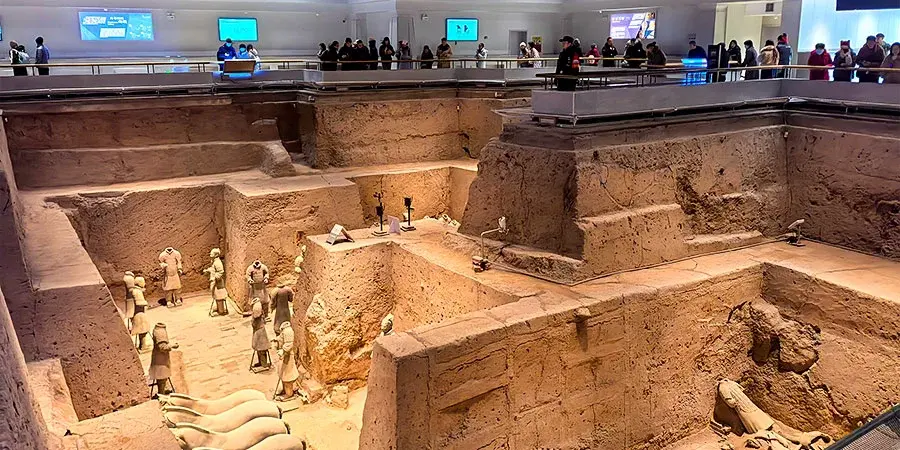
Quelles sont les meilleures choses à faire à Xi'an ? Des Guerriers en terre cuite aux Murs de la ville
Les meilleures choses à faire à Xi'an sont de visiter les Guerriers en terre cuite, de faire du vélo sur l'intégralité des 14 km des murs de la ville de la dynastie Ming, de déguster la cuisine du Quartier Musulman et de passer une soirée parmi les pagodes de la dynastie Tang — idéalement sur deux ou trois jours. Xi'an a été la capitale de 13 dynasties chinoises et le point de départ oriental de la Route de la soie ; son charme réside dans une densité rare d'histoire marchable et de classe mondiale, superposée à l'une des grandes villes culinaires de Chine.
Ceci est un guide honnête et indépendant pour vous aider à décider ce qu'il faut prioriser, comment voir la célèbre Armée sans perdre une journée, et si Xi'an mérite plus qu'un arrêt rapide. Xi'an récompense les voyageurs qui viennent pour l'histoire et restent pour la nourriture — et peut décevoir ceux qui s'attendent au polish anglophone de Shanghai ou à un voyage axé sur le paysage.
Points clés
- Les Guerriers en terre cuite sont l'attraction phare, mais cela ne représente qu'une demi-journée, pas un voyage complet. Environ 8 000 figures à taille réelle se situent à environ 1 à 1,5 heures de la ville ; planifiez votre visite intelligemment (voir le tableau de décision ci-dessous) et réservez le reste de votre temps pour les murailles et la nourriture.
- La muraille de la cité, longue de 14 km, est une valeur cachée. Louez un vélo à la Porte du Sud et faites le tour complet en environ 2 à 3 heures — peu de villes chinoises permettent de faire le tour de leur ancienne ville ainsi.
- Xi'an est l'une des meilleures villes culinaires en Chine. Les nouilles Biang Biang, le roujiamo, le yangrou paomo et les brochettes d'agneur au cumin se concentrent dans le Quartier Musulmain et ses ruelles secondaires.
- De trois jours est le point idéal. Une journée est trop rapide ; plus de quatre jours n'a de sens que si vous ajoutez une excursion (mont Hua) ou si vous utilisez Xi'an comme point de départ pour la Route de la Soie.
- Venez au printemps (avril-mai) ou en automne (septembre-octobre). L'atteint régulièrement 35–40 °C et transforme les excursions en corvée.
- Restez à l'intérieur des murailles près de la Tour de la Cloche pour votre première visite — central, piétonnier, à deux pas de la nourriture.
Visiter Xi'an vaut-il la peine — et plus de deux jours ?
Oui, Xi'en vaut la visite : elle détient certaines des richesses historiques les plus concentrées en Chine, et seule l'Armée de terre cuite justifie le voyage pour la plupart des premiers visiteurs. Si elle vaut plus que deux jours dépend de la valeur que vous accordez à l'histoire et à la nourriture par rapport aux paysages et à la vie nocturne.
Xi'an est là où l'histoire impériale chinoise prend réellement naissance. Elle a été le point d'extrémité orientale de la Route de la soie pendant plus d'un millier d'années et la capitale de la dynastie Tang, l'une des civilisations les plus cosmopolites du monde médiéval. La ville affiche ouvertement ce passé — de l'armée enfouie du premier empereur aux pagodes de la dynastie Tang jusqu'à la muraille complète de l'époque Ming sur laquelle on peut toujours faire du vélo.
Mais elle n'est pas qu'un musée. La cuisine de la Route de la soie de Xi'an — nouilles de blé, agneau, cumin et pains plats — est sans pareille dans le pays, et la vieille ville est particulièrement praticable pour une mégaville chinoise, car elle reste enfermée dans un rectangle de murs.
Le contre-argument honnête : Xi'an est avant tout historique. Si vous n'êtes pas attiré par les musées, les dynasties et l'archéologie, et que vous préférez plutôt des panoramas, des montagnes ou une vie nocturne, une visite plus courte est raisonnable — certains voyageurs expérimentés trouvent la ville elle-même moins mémorable que ses sites individuels, et certaines parties sont mal desservies par le métro, vous reliant alors à DiDi. Si votre voyage en Chine ne dure qu'une semaine, Pékin et Shanghai remportent généralement les deux places ; ajoutez Xi'an lorsque vous avez plus de 10 jours. Mais si vous aimez la nourriture et l'histoire, deux jours semblent serrés et trois jours sont véritablement gratifiants.
Quel voyageur à Xi'an êtes-vous ? (Choisissez votre itinéraire)
Xi'an récompense un voyage concentré plutôt qu'une liste de contrôle. Servez-vous-en pour choisir l'ossature de vos journées, puis adaptez le reste selon votre énergie et la chaleur.
| Vous êtes un… | Priorisez | Votre base idéale | Évitez de |
|---|---|---|---|
| Amateur d'histoire | Guerriers en terre cuite (privés avec guide), Musée de l'histoire du Shaanxi, Forêt des stèles, la muraille de la ville | À l'intérieur des murs, près de la Tour de la cloche | Trop charger les soirées — les sites de journée sont assez denses |
| Gourmand | Ruelles du quartier musulman, rue alimentaire Yongxingfang, une recherche de nouilles Biang Biang | Tour de la cloche / Tour du tambour | La principale rue alimentaire touristique ; allez dans la rue à côté |
| Famille avec enfants | Faire le tour de la muraille en vélo, Tang Paradise la nuit, un spectacle culturel, s'habiller en hanfu | À l'intérieur des murs (piétonnier, espace) | Longues journées au musée ; les guerriers peuvent être visités rapidement avec un guide |
| Première visite (court séjour) | Demi-journée aux Guerriers en terre cuite + une section de la muraille + un dîner au quartier musulman | Près de la Tour de la cloche ou de la gare du nord de Xi'an | Essayer aussi de faire des excursions d'une journée ; réservez-les pour un prochain voyage |
Quelles sont les meilleures choses à faire à Xi'an ?
Les expériences essentielles de Xi'an gravitent autour de l'histoire impériale, de la muraille de la ville et de la nourriture. Voici celles qui valent votre temps limité — avec les Guerriers en terre cuite, en tant que vedette, ayant leur propre section ci-dessous.
Parcourez la Muraille de la Ville Ancienne (西安城墙)

<!– img : unsplash / 政 闫 / query=Xian ancient city wall –>
Une rempart complète de la dynastie Ming de 14 km qui entoure toute la vieille ville — assez large pour y faire du vélo, et le meilleur moyen de ressentir l'échelle de la ville. Vous pouvez louer un vélo à la Porte du Sud (Yongningmen) et faire le tour complet en environ 2 à 3 heures, ou simplement marcher une partie au coucher du soleil. L'entrée du mur coûte 54 ¥ par personne ; la location de vélo coûte environ 45 ¥ pour un seul ou 90 ¥ pour un tandem (environ 2 heures), et l'entrée est gratuite pour les enfants de moins de 120 cm (2025). C'est le site que les premiers visiteurs sous-estiment le plus et que les visiteurs de retour classent en première place.
Manger dans le quartier musulman (回民街)

<!– img: tavily / / query=Xian Muslim Quarter street food night –>
Le quartier Hui historique et le meilleur endroit à Xi'an pour manger — un dédale de ruelles où l'on vend des brochettes d'agneau, des ragoûts de pain déchiré à la main et du jus de grenade. Évitez l'axe principal encombré et trop touristique, et suivez les petites ruelles où les gens font la queue. C'est aussi là que se trouve la Grande Mosquée, un complexe paisible de style cour chinoise, facile à manquer derrière les étals de nourriture.
Passer une soirée au Tang Paradise et à la Grande Pagode de l'Oie Sauvage (大雁塔)

<!– img: tavily / / query=Big Wild Goose Pagoda Xian Tang –>
Le Parc Tang Paradise est un vaste parc de style Tang qui est vraiment beau la nuit ; la célèbre Grande Pagode du Goélier Sauvage, située à proximité, domine un temple de l'époque Tang avec un spectacle de fontaine gratuit le soir. Les rues piétonnes autour de la pagode sont parmi les plus agréables de la ville pour se promener la nuit, et le secteur est très apprécié des familles et des photographes.
Découvrez la Tour de la Cloche et la Tour du Tambour (钟楼 / 鼓楼)
Les deux tours de l'époque Ming qui marquent le centre historique — illuminées et photogéniques la nuit. La Tour de la Cloche se trouve sur un carrefour au cœur de la vieille ville, à quelques pas du Quartier Musulman et de la plupart des hôtels situés derrière les murs. Une visite rapide, mais un point d'orientation utile pour tout le reste.
Explorez le Musée d'Histoire du Shaanxi et la Forêt de Stèles
Pour les amateurs d'histoire, ces deux lieux fournissent un contexte que les Guerriers seuls ne peuvent vous procurer — bronzes, or Tang et l'une des plus grandes collections de stèles en pierre sculptée de Chine. Le Musée d'Histoire du Shaanxi est très populaire et nécessite souvent une réservation préalable, alors réservez votre créneau avant d'y aller.
Comment Visiter les Guerriers en Terre Cuite — La Bonne Façon ?
<!– img: tavily / / query=Terracotta Army warriors Xian pit –>
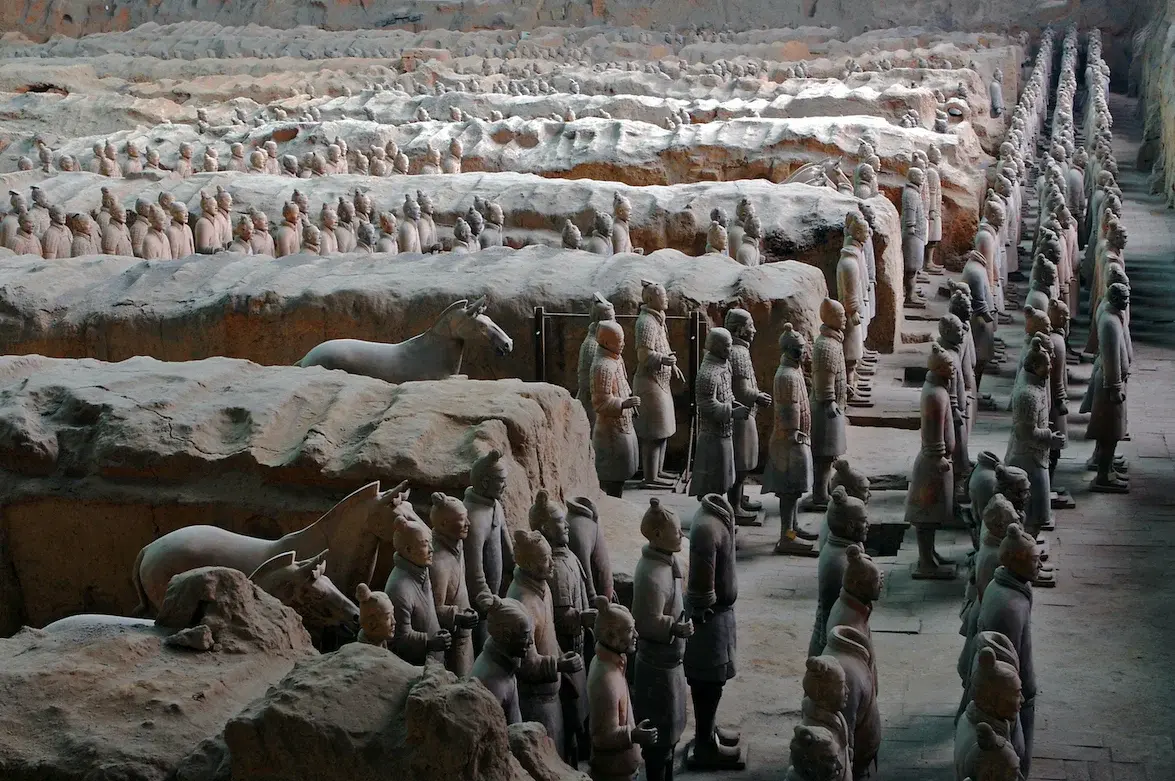
L'armée de terre cuite est une formation souterraine d'environ 8 000 soldats, chevaux et chars en terre cuite à taille réelle, conçue pour protéger le tombeau de Qin Shi Huang, premier empereur de Chine. Elle a été découverte par des agriculteurs creusant un puits en 1974 et inscrite au patrimoine mondial de l'UNESCO en 1987 (UNESCO, 1987). Le site se situe à environ 1 à 1,5 heures du centre de Xi'an et s'étend sur trois fosses d'extraction, la Fosse 1 — vaste hall regroupant l'infanterie — étant l'attraction principale.
Puisqu'il est la première raison pour laquelle la plupart des personnes volent jusqu'à Xi'an, c'est aussi là que les voyageurs gèrent souvent mal leur temps : arrivant en milieu de matinée au moment des plus fortes affluences, ou payant un tour dont ils n'avaient pas besoin. Le site est accessible en autonomie, mais un guide compétent transforme les rangées de statues en histoire que vous garderez en mémoire. Décidez avec intention.
Comment visiter intelligemment — choisissez le format et le moment qui vous conviennent :
| Option | Signification | Idéal pour | Compromis |
|---|---|---|---|
| Indépendant (métro/bus + DIY) | Se rendre sur le site en transports publics et visiter les fosses vous-même, éventuellement avec un guide audio | Voyageurs à petit budget, navigateurs expérimentés, visiteurs de retour | Les rangées de figures ont peu de sens sans contexte ; vous devrez faire la queue et gérer vous-même |
| Excursion en groupe | Excursion en autocar réservée, généralement avec un guide et parfois un déjeuner | Premiers visitants qui veulent zéro logistique et un coût partagé | Rythme fixe ; certaines excursions incluent une visite de jade ou de souvenirs |
| Guidé privé | Votre propre guide et voiture, selon votre horaire | Familles, amateurs d'histoire, personnes pressées | Coût le plus élevé ; réservez auprès d'un opérateur réputé |
| Matin vs après-midi | Ouverture tôt ; affluence accrue en fin de matinée | Arriver à l'ouverture ou à partir de 14h30 | Le midi est le moment le plus chargé et le plus chaud |
Guide pratique : réservez votre entrée en ligne à l'avance, visez l'ouverture (ou après ~14h30), et visitez les fosses dans l'ordre inverse — commencez par la Fosse 3 et la Fosse 2, puis terminez par l'impressionnante Fosse 1 pour qu'elle soit la dernière. Un guide (en personne ou un bon guide audio) est la plus grande amélioration possible de l'expérience. L'entrée coûte 120 ¥ par personne toute l'année (2025) ; réservez votre créneau environ 7 jours à l'avance, car les billets du même jour peuvent se vendre rapidement.
Note honnête : certains voyageurs trouvent les Guerriers une attraction à voir une fois — véritablement étonnant, mais nécessitant une visite de deux à trois heures plutôt qu'une journée entière. Organisez le reste de votre temps à Xi'an autour des murailles et de la nourriture, et l'Armée deviendra l'apogée d'un voyage équilibré plutôt que son seul objectif.
Que manger à Xi'an ?
La cuisine de Xi'an est celle de la Route de la Sable — riche en blé, en agneau, en cumin et en piment — et elle est abordable et célèbre pour être adaptée aux enfants. Vous avez plus besoin d'une liste courte de plats à découvrir en flânant que d'une liste de restaurants. Suivez les files d'attente dans la Quarter Musulman et la rue alimentaire Yongxingfang.
| Plat | Description | Où le trouver |
|---|---|---|
| Nouilles Biang Biang (biángbiáng面) | Nouilles larges, tirées à la main, en forme de ceinture, dans une sauce soja-piment | Partout dans la ville ; le seul caractère est un spectacle |
| Roujiamo (肉夹馍) » Le « hamburger chinois » original — viande braisée dans un pain croustillant | Étales du Quarter Musulman et magasins spécialisés | |
| Yangrou paomo (羊肉泡馍) | Ragoût d'agneau que vous achèvez en déchirant vous-même le pain dans le bol | Situations près du Quarter Musulman |
| Liangpi (凉皮) | Nouilles « froides-froides » dans une sauce acidulée et ailée | Étals de rue ; un excellent plat par beau temps |
| Brochettes d'agneau au cumin (孜然羊肉串) | Brochettes grillées au bois, très aromatisées au cumin | Partout où vous sentez la fumée |
Où séjourner à Xi'an ?
Restez à l'intérieur des remparts, près de la Tour de la Cloche ou de la Tour du Tambour, pour votre première visite — c'est central, à pied dans le Quarter Musulman, et bien desservi par le métro. Choisissez une base différente uniquement si vous avez une priorité spécifique.
| Quartier | Idéal pour | Compromis |
|---|---|---|
| Tour de la Cloche / Tour du Tambour (à l'intérieur des remparts) | Premiers visiteurs, accès à la nourriture, praticité | Central et animé ; peut être très vivant la nuit |
| Port Sud / Yongningmen (à l'intérieur des remparts) | Cyclistes sur les murailles, base un peu plus calme | Un peu plus loin de l'ambiance du Quarter Musulman |
| Grande Pagode de l'Oie Sauvage / Qujiang | Rues piétonnes en soirée, Paradis Tang, familles | En dehors du cœur historique ; dépendent du métro |
| Près de la gare du Nord de Xi'an | Escales d'une nuit avant un train de bonne heure | Pratique mais peu d'atmosphère |
Les noms d'hôtels, types de chambres et tarifs actuels changent constamment — vérifiez au moment de la réservation. Pour une analyse détaillée quartier par quartier à tous les niveaux de budget, consultez le guide « Où séjourner à Xi'an ».
Quand est le meilleur moment pour visiter Xi'an ?
Visitez au printemps (avril–mai) ou en automne (septembre–octobre), lorsque les températures sont douces et les ciels dégagés. Évitez l'été intense, où Xi'an atteint régulièrement 35–40 °C. La ville connaît quatre saisons distinctes, et le moment choisi change toute l'ambiance du voyage.
| Saison | Conditions | Verdict |
|---|---|---|
| Printemps (mars–mai) | Doux ~12–25°C, sec, fleurs dans les parcs | ✅ Meilleur ensemble — ciblez avril/début mai |
| Été (juin–août) | Chaud et sec, souvent 35–40°C ; foule importante aux Guerriers | ❌ Épuisante — uniquement tôt le matin ou en soirée |
| Automne (sept.–oct.) | Ciel dégagé, confortable ~15–25°C, meilleure photo | ✅ Excellent — juste derrière |
| Hiver (déc.–fév.) | Froid et sec, environ -5 à 5°C, calme et pas cher | ➖ Acceptable si vous vous coupez bien ; neige occasionnelle sur les murs |
Allez quand vous voulez, mais évitez le « Golden Week » du 1er au 7 octobre (Fête nationale) et le Nouvel An chinois (fin janvier–février), lorsque la circulation intérieure explose et que les Guerriers sont les plus encombrés.
Comment y aller et se déplacer ?
Volez à l’aéroport international Xi’an Xianyang (XIY) ou arrivez en train à grande vitesse, puis comptez sur le métro, la marche et DiDi. L’aéroport se trouve à environ 40 km au nord-ouest du centre ; le lien le plus rapide est l’Express Aéroport Ligne de métro 14 (ouverte en 2024), qui relie la gare du Nord de Xi’an en environ 30 minutes avant un transfert vers la Tour de la Cloche. Les taxis et DiDi mettent entre 45 et 60 minutes selon le trafic.
En train à grande vitesse, Xi’an est l’une des villes les mieux connectées de Chine : Pékin ~4,5 heures, Chengdu ~3,5 heures, Chongqing ~5 heures et Luoyang ~1,5 heure (les durées varient selon le service — consultez les horaires actuels). Presque tous les trains à grande vitesse utilisent Xi’an North (西安北), qui se relie au vieux quartier via la Ligne 2 du métro.
Pour se déplacer, le métro (lignes 1, 2, 3, 5, 6 et 14) dessert les principaux sites, et vous payez en scannant un code QR dans Alipay ou WeChat. À l'intérieur des remparts, marcher est vraiment la meilleure option — la Tour de la Cloche, la Tour du Tambour, la Quartier Musulman et les portes des remparts se situent tous dans un rayon d'environ 20 minutes. Pour tout ce qui est hors ligne de métro, DiDi est le plus simple ; mettez-le en place avant votre arrivée.
Combien de jours faut-il à Xi'an ?
Prévoyez deux à trois jours pour une première visite satisfaisante ; ajoutez un quatrième jour seulement pour une excursion ou pour entamer un voyage sur la Route de la Soie vers l'ouest. Voici une structure viable.
| Jours | Ce que vous pourrez visiter |
|---|---|
| 1 jour | Vieux quartier seulement — Tour de la Cloche, Quartier Musulman, une section des remparts, une soirée autour de la Grande Pagode du Cygne Sauvage |
| 2 jours | Ce qui précède, plus les Guerriers en terre cuite ou un spectacle culturel — serré mais faisable |
| 3 jours | La ville entière — Guerriers, boucle des remparts, Quartier Musulman, Musée historique du Shaanxi, Paradis Tang — le rythme que nous recommandons |
| 4+ jours | Ajoutez une excursion (Mont Hua, Tombe Hanyang ou Temple Famen), ou dirigez-vous vers l'ouest sur la Route de la Soie |
Ajustement familial : gardez la visite des Guerriers courte et guidée, laissez le vélo sur les remparts et le port hanfu porter l'amusement, et prévoyez une soirée au Paradis Tang pour que la visite ne soit pas uniquement des musées.
Questions fréquemment posées
Xi'an vaut-il le détour ?
Oui — même au-delà des Guerriers en terre cuite. Xi'an détient l'une des richesses historiques les plus accessibles à pied de Chine, depuis la ville murale de l'époque Ming jusqu'aux pagodes de la dynastie Tang, sans oublier l'une des meilleures scènes de rue de la ville. Située à l'est de la Route de la Soie, elle est aussi la porte d'entrée naturelle pour tout voyage vers l'ouest.
Comment se rendre aux Guerriers en terre cuite depuis Xi'an ?
Le site se trouve à environ 1 à 1,5 heures du centre de Xi'an, accessible en transports publics ou via un groupe ou un tour privé. Réservez votre entrée à l'avance, arrivez à l'ouverture ou en milieu d'après-midi pour éviter les foules, et envisagez un guide ou un audioguide — les rangées de figures prennent bien plus de sens avec un contexte.
Combien de jours faut-il à Xi'an ?
Deux à trois jours sont idéals. Une journée suffit pour le vieux centre ; deux jours ajoutent les Guerriers en terre cuite ou un spectacle ; trois jours permettent de profiter des Guerriers, de faire un tour en vélo sur la muraille, de déguster la cuisine du quartier musulman, et de visiter le musée historique du Shaanxi et le Paradis Tang à un rythme confortable.
Quelle est la meilleure période pour visiter Xi'an ?
Avril–mai et septembre–octobre sont idéaux — températures douces, temps sec et ciel dégagé. Évitez juin–août, où la chaleur atteint régulièrement 35–40 °C, et sautez la semaine d'or du 1er au 7 octobre et le Nouvel An chinois, lorsque les foules locales atteignent leur sommet dans tous les grands sites.
Préférer Xi'an ou Pékin pour un voyage ?
Ils se complètent plutôt que de se concurrencer. Pékin est la capitale impériale — Cité Interdite, Grande Muraille — tandis que Xi'an est l'ancienne capitale et point de départ de la Route de la Soie, avec une couche historique plus ancienne. La plupart des premiers visiteurs visitent les deux villes ; le train à grande vitesse entre elles dure environ 4,5 heures.
Peut-on visiter Xi'an sans parler chinois ?
Oui, bien que l'anglais soit moins courant qu'à Pékin ou Shanghai. Les principaux sites et stations de métro portent des inscriptions en anglais, et une application de traduction gère les menus et les taxis. Configurer DiDi et une application de paiement mobile avant votre arrivée élimine la plupart des tracas quotidiens.
Planifier votre voyage à Xi'an
Xi'an est l'une des villes les plus gratifiantes de Chine pour les voyageurs qui aiment l'histoire et la cuisine. Prévoyez deux à trois jours, installez-vous dans les murs près de la Tour de l'Horloge, venez au printemps ou en automne, visitez sagement les Guerriers en terre cuite, et réservez du temps pour faire du vélo sur les murailles et explorer la Quartier Musulman. Elle s'associe naturellement à Pékin pour l'itinéraire classique des premiers visiteurs, et c'est la base de départ pour un voyage plus approfondi vers l'Ouest sur la Route de la Soie.
Pour une vue d'ensemble, commencez par le  guide de voyage en Chine, puis lisez le guide de voyage à Pékin pour planifier l'association, et le guide de voyage à Chengdu pour un contraste plus lent, avec pandas et maisons de thé, situé à seulement 3,5 heures au sud par rail.