



 4d $970 Beijing in Depth — Great Wall & Forbidden City, Made Easy
  18d $5,840 Classic China & Yunnan: 18 Days from Beijing to Shangri-La and Shanghai
  12d $3,120 Real China: 12-Day Small-Group Adventure
  10d $4,160 Silk Road Highlights: 10 Days from Xi'an to Kashgar
  13d $3,640 Ancient Culture Tour: 13 Days from Beijing to Shanghai via the Silk Road
 Public Transportation in China 2026: Metro, Bus & Getting Around Chinese Cities
Arriving in a major Chinese city for the first time can feel intense for about five minutes. You step out of the airport or railway station expecting confusion, crowds, and a language barrier—then you notice the signs are clearer than you expected, the metro is spotless, the fare is surprisingly cheap, and within half an hour you are already moving through the city with confidence. That is the experience many overseas travelers have when they discover how efficient urban travel can be here.
For most visitors, public transportation in China is one of the easiest parts of independent travel once you understand the basics. In the country’s biggest cities, metro systems, buses, airport links, taxis, ride-hailing apps, and bike-sharing networks work together to make getting around fast and affordable. Whether you are traveling between famous landmarks in Beijing, heading from a Shanghai airport to downtown, or exploring neighborhoods in Chengdu, you usually have multiple good options.
This guide explains what first-time visitors need to know about metro systems, buses, payment methods, transportation in Beijing, and practical tips that can make daily travel in Chinese cities much smoother.
Why Public Transportation in China Is So Convenient for Travelers
One of the biggest advantages of urban travel in China is scale. The country has invested heavily in city transport, and today more than 50 Chinese cities operate metro systems, with new lines continuing to open regularly. In large and mid-sized cities, public transportation is not an afterthought—it is a central part of everyday life.
For travelers, that creates several immediate benefits.
First, it is affordable. Compared with transport costs in many major cities around the world, metro and bus fares in China are remarkably low. A short metro ride may cost only a few RMB, and city buses can be even cheaper.
Second, coverage is broad. In cities such as Beijing, Shanghai, Guangzhou, Shenzhen, and Chengdu, rail lines connect airports, high-speed rail stations, business districts, shopping areas, universities, and major sightseeing zones. This means travelers can often move between hotels and attractions without needing a taxi.
Third, service is frequent and reliable. In major cities, trains often arrive every few minutes, especially during the day. Even when stations are busy, the system itself is usually predictable.
Fourth, signage is much better than many visitors expect. In the biggest tourist and business destinations, station names, line maps, transfer signs, and announcements are commonly shown in both Chinese and English. The level of English support can vary by city, but in China’s main travel hubs, navigating the system is usually manageable even if you do not speak Chinese.
This guide mainly focuses on public transportation in large and mid-sized Chinese cities, because that is where most international visitors spend their time. Rural and remote areas can be very different, but in urban China, getting around is often straightforward.
China’s Metro Systems: The Fastest Way to Get Around Major Cities
If you ask me to choose the single most useful form of public transportation in China for overseas visitors, the answer is easy: the metro. In most major cities, it is the fastest, most predictable, and least stressful way to move around—especially during busy daytime hours when road traffic can slow everything else down.
Chinese metro systems are generally modern, clean, air-conditioned, and built for high passenger volume. Stations often connect directly to underground malls, office towers, railway hubs, and airport lines. In practical terms, that means you can land in a city, take the airport metro or express line toward downtown, transfer once or twice, and arrive close to your hotel without much trouble.
Metro fares are also budget-friendly. In most cities, a typical ride costs around 2-10 RMB, depending on distance and local pricing rules. Short urban trips are usually at the low end of that range, while longer rides—especially airport routes or cross-city journeys—cost more.
For entry, travelers usually have three common options:
- Transport QR codes in Alipay or WeChat
- Local transit cards
- Single-journey tickets bought from station machines or service counters
For short trips, single-journey tickets can work fine. But if you plan to use city transport often, mobile payment or a local transit card is usually more convenient.
Another reason metros work so well for visitors is consistency. Security checks are standard, platforms are clearly marked, and interchange stations are well organized. Once you understand the line colors and final station directions, the system becomes intuitive surprisingly quickly.
Major Metro Systems at a Glance
Shanghai has around 20 metro lines and one of the world’s longest urban rail networks. It is extensive, efficient, and excellent for travelers staying in central areas or moving between airports, railway stations, and famous districts such as People’s Square, Lujiazui, and Xujiahui. Base fare typically starts at 3 RMB.
Beijing operates around 27 lines, making it one of the most comprehensive city rail systems in the country. It offers strong access to historic sights, business districts, residential areas, and major transport hubs. Base fare also typically starts at 3 RMB.
Guangzhou has a large, well-connected metro system that is easy to use for both business and leisure travel. Fares usually start at 2 RMB.
Shenzhen and Chengdu both have modern, fast-growing metro networks with good city coverage, low base fares, and a user-friendly experience for international visitors.
Buses, Airport Links, and Other Affordable Ways to Travel Within Chinese Cities
While the metro is usually the easiest option, it is not the only one. City buses remain one of the cheapest forms of transportation in China, with fares often starting from 1 RMB. In some cities, buses are extremely useful for short local trips or neighborhoods not directly served by metro lines.
That said, buses can be more difficult for first-time visitors. Route maps may be less intuitive, stop names can move by quickly, and English support is often weaker than on the metro. If you are comfortable using map apps and matching your location carefully, buses can save money. If not, they are best treated as a secondary option.
Airport transport is another area where Chinese cities perform well. Many major airports have dedicated airport express metro lines, direct metro connections, airport buses, or shuttle services to central districts. These are especially useful if you are arriving with luggage but still want to avoid the higher cost of a taxi. In cities with heavy traffic, the airport rail option is often the most time-efficient choice as well.
Beyond buses and metro, most travelers will also use at least one of these options:
- Official taxis for direct point-to-point travel
- Didi for ride-hailing convenience
- Shared bikes for very short distances or neighborhood exploration
Each mode has its strengths. The metro is best for speed and predictability. Buses are best for strict budgets. Taxis and ride-hailing are best when you have luggage, are traveling late, or want door-to-door convenience. Shared bikes are ideal for the final kilometer between a station and a café, park, or hotel.
In practice, the smartest travelers mix all four depending on the day’s route.
Getting Around Beijing: Metro, Bus, Bikes, and Ride-Hailing
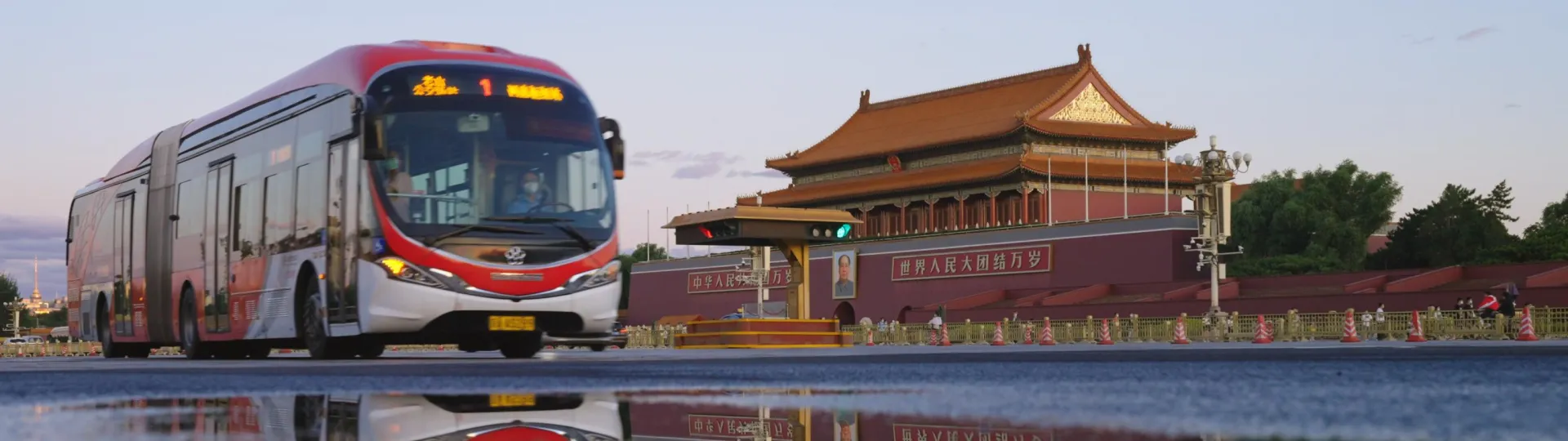
For visitors planning their first trip to the capital, understanding transportation in Beijing makes a huge difference. Beijing is vast, busy, and spread out, but it also has one of the strongest urban transit systems in the country. If you use it well, transportation in Beijing China becomes much easier than the city’s size might suggest.
The Beijing Metro is the backbone of city transportation in Beijing China. With around 27 lines, it covers major tourist areas, commercial districts, railway stations, and airport connections. Popular visitor destinations such as Wangfujing, Tiananmen area access points, Sanlitun, the Summer Palace region, and many museum or shopping zones are all tied into the network. For most daytime sightseeing, the metro is the practical first choice.
Payment has become simpler in recent years. Many travelers can use Alipay transport QR codes to enter stations directly, which removes the need to queue for tickets every time. Single tickets are still available, and local transport cards remain useful for visitors who prefer a physical option.
Beijing buses are even cheaper, often starting at around 1 RMB, and they reach areas the metro does not always serve directly. However, because the city is so large and bus routes can be complex, many international visitors use them only occasionally.
For shorter distances, bike-sharing is incredibly useful. Services such as Mobike and Hellobike are common in many parts of the city, and cycling can be a pleasant way to move between hutong areas, local food streets, or parks when the weather is good.
When convenience matters more than price, Didi is often the easiest option. It is especially helpful early in the morning, late at night, or when you are traveling with children, heavy luggage, or tired feet after a long day of sightseeing.
If you are building a city itinerary, it is worth checking a full Beijing Travel Guide alongside your transport planning so you can group attractions by metro line and reduce unnecessary cross-city travel.
How to Pay for Public Transport in China
For many overseas travelers, payment is the part that feels uncertain before arrival—but in reality, it is usually easier once you are set up properly. If you plan to move around cities independently, I strongly recommend reviewing a dedicated Mobile Payment Guide before your trip, because mobile tools now play a major role in daily travel.
The most common option is Alipay. In many cities, you can activate a local or national transport QR code inside the app and scan it at the metro gate or on supported buses. This is one of the smoothest ways to use public transportation in China because it eliminates the need to buy paper tickets again and again.
WeChat is another widely used option. In some cities, transport access works through a Mini Program, allowing you to generate a transit code for metro or bus use. The exact setup can vary slightly depending on the city.
A third option is the traditional transport card. These local cards can usually be purchased at metro service counters, and some require a refundable deposit of around 20 RMB. They are simple, reliable, and still useful for travelers who want a backup in case mobile access fails.
Finally, there are single-journey tickets, which remain available in most metro systems through ticket machines or station staff. They are fine for occasional use, but not the most efficient solution if you will be traveling every day.
If you are staying in China for more than a few days, setting up mobile payment or using a stored-value transit card will save time and make daily travel much less stressful.
Tips for Using Public Transport in China
A few simple habits can make your experience dramatically smoother.
Avoid rush hour when possible. In major cities, the busiest periods are typically 7:30-9:00 AM and 5:30-7:00 PM. Trains still run efficiently, but stations and carriages can become very crowded.
Expect security checks. In most metro systems, all passengers and bags pass through a security screening area before entering. This is routine, but it does add a little time, especially at large interchange stations.
Download a transit-friendly app. Many travelers find apps such as MetroMan useful for line maps, route planning, and transfer logic. Pairing a metro app with a reliable map service can make navigation much easier.
Travel light when possible. Chinese public transit is efficient, but stairs, transfers, and crowded platforms are easier to manage with compact luggage or a daypack rather than oversized bags.
Check the final station name. On Chinese metro systems, trains are identified by their direction toward the line’s terminal stop. Before boarding, make sure you are heading toward the correct end of the line.
Frequently Asked Questions
Is public transportation in China safe?
Yes, in major cities it is generally very safe. Metro systems are heavily used, well monitored, and professionally managed. Standard travel awareness still matters—watch your belongings in crowded stations and stay alert during rush hour—but for most visitors, public transit in Chinese cities feels secure and orderly.
Can I use public transport without speaking Chinese?
Usually, yes—especially in major cities such as Beijing, Shanghai, Guangzhou, Shenzhen, and Chengdu. Bilingual signs and announcements are common in key transport systems, and route-planning apps help a lot. You may face more challenges on local buses or in smaller cities, but metro travel is often manageable without Chinese language skills.
How much does public transport cost in China?
It is generally inexpensive. Metro rides often cost around 2-10 RMB, depending on city and distance. Buses commonly start from 1 RMB. Airport links, taxis, and ride-hailing cost more, but compared with many global cities, urban transport in China is still very affordable.
Can I use Apple Pay for Chinese metro?
In most cases, not directly as a universal solution for metro entry. What travelers usually need is a supported transit QR code inside Alipay or WeChat, or a local transit card. Some phone wallets may work in limited scenarios, but for dependable access, local mobile payment tools are the better choice.
Final Thoughts: Urban Travel in China Is Easier Than Many Visitors Expect
One of the most pleasant surprises for first-time visitors is that public transportation in China often removes stress rather than adding it. In the country’s major cities, metros are fast, buses are cheap, bike-sharing is convenient, and ride-hailing fills the gaps when you need flexibility. Once you understand payment methods and peak-hour patterns, daily travel becomes routine very quickly.
If you are planning a multi-city trip, it helps to organize your routes in advance, especially when you are balancing airport transfers, train arrivals, and sightseeing schedules. That is also where a travel agency with strong on-the-ground China experience can be genuinely useful—not by replacing independent travel, but by helping you make it smoother. We often help travelers build realistic city itineraries, choose hotels with better metro access, and avoid common transport mistakes that waste time.
If you are still planning your route, browse our city tour packages for ideas, save this guide for later, and compare notes with other travelers. The better you understand the system before arrival, the more confidently you will move through China’s cities when the trip begins.
FAQ
Is public transportation in China easy for first-time travelers?
Yes, in most major Chinese cities public transportation is efficient, affordable, and well integrated. Clear signage, extensive metro networks, and multiple transit options make it manageable for first-time visitors.
What types of public transportation are common in Chinese cities?
Travelers can usually choose from metro systems, city buses, airport express lines, taxis, ride-hailing apps, and bike-sharing services. Large cities like Beijing, Shanghai, and Chengdu often offer all of these options.
Is public transportation in China affordable?
Yes, metro and bus fares in China are generally low compared with many major cities worldwide. Short metro rides often cost only a few RMB, while buses can be even cheaper.
Which Chinese cities have the best public transportation for tourists?
Major cities such as Beijing, Shanghai, Guangzhou, Shenzhen, and Chengdu are especially convenient for tourists. Their transport networks connect airports, rail stations, hotels, shopping districts, and popular attractions.