



 18 days China, End to End Beijing → Xi'an → Chuanzhusi → Jiuzhaigou → Chengdu → Zhangjiajie → Guilin → Yangshuo → Shenzhen From $6,360 View route
  3 days 4-Day Tour of Siguniang Mountain, Biepa Gou, and Dagu Glacier Chengdu → Lixian → Heishui County From $1,599 View route
  5 days Above the Pillars, Then Below Zhangjiajie From $1,430 View route
  3 days After the Last Booth Guangzhou From $840 View route
  13 days All the Way West Xi'an → Dunhuang → Turpan → Kashgar → Shanghai From $3,500 View route
 TL;DR
Beijing received 5.48 million inbound tourism trips in 2025—up 39% year-on-year—generating ¥50.56 billion ($7.21 billion) in inbound tourism spending, a 44.7% increase (Beijing Municipal Bureau of Culture and Tourism, January 2026). The city offers 30-day visa-free entry for citizens of 50 countries (including Canada and the UK from February 17, 2026), the world's longest subway network at 879 kilometers with 27 lines and 400+ stations, and 7 UNESCO World Heritage Sites within city limits.
For a first trip: 4–5 days, $1,600–3,500 for two people excluding international flights, in April–May or September–November—October 8–31 is the best window of all.
Quick Reference: Beijing Trip at a Glance
| Factor | Detail |
|---|---|
| Recommended length | 4–5 days (comfortable pace, all key attractions) |
| Budget (2 people, 4 days) | \$1,600–3,500 mid-range including accommodation, excl. flights |
| Daily independent budget | \$60–100 (budget) / \$100–170 (mid-range) / \$200–400 (luxury) |
| Best seasons | Apr–May ⭐ and Sep–Nov ⭐ (Oct 8–31 ideal) |
| Visa | 30-day visa-free for 50 countries; 240-hour transit for 55 countries |
| Subway | 27 lines, 400+ stations, ¥3–9/trip, English signage throughout |
| Safety | Very safe; low violent crime; watch for tourist scams |
| Essential app | Alipay (link international card; handles 90%+ payments) |
What are the best things to do in Beijing?
The essential short list is the Great Wall, the Forbidden City, and the hutongs. Around them: the Temple of Heaven at dawn, the Summer Palace, Tiananmen Square, Jingshan Park, the Lama Temple, 798 Art District, and the Olympic Park—plus one Peking duck dinner. Beijing is rare among world capitals because 3,000 years of civilization are woven into daily life rather than preserved behind glass.
Tiananmen Square: The world's largest public square (440,000 square meters) and the gateway to the Forbidden City. 30–60 minutes.
Jingshan Park: The hill behind the Forbidden City gives the best panorama of the palace complex; the climb takes 15 minutes, and Wanchun Pavilion is the photograph that defines Beijing. ¥2.
Lama Temple (Yonghe Temple): Beijing's most beautiful Buddhist temple and an active place of worship, with an 18-meter-tall sandalwood Buddha carved from a single tree. 1–1.5 hours.
798 Art District: Contemporary galleries in a decommissioned military electronics factory complex; best for art enthusiasts and younger travelers. 2–3 hours.
Beijing Olympic Park: The Bird's Nest and Water Cube (now Ice Cube), best in the evening when both are lit. 1–2 hours.
Which Great Wall section should you choose from Beijing?
Choose Mutianyu for a first visit, Jinshanling if you hike or photograph seriously, and skip Badaling unless you need wheelchair access. The wall stretches over 21,196 kilometers across northern China, and the sections near Beijing are the most accessible and dramatic—so the real decision is which one.
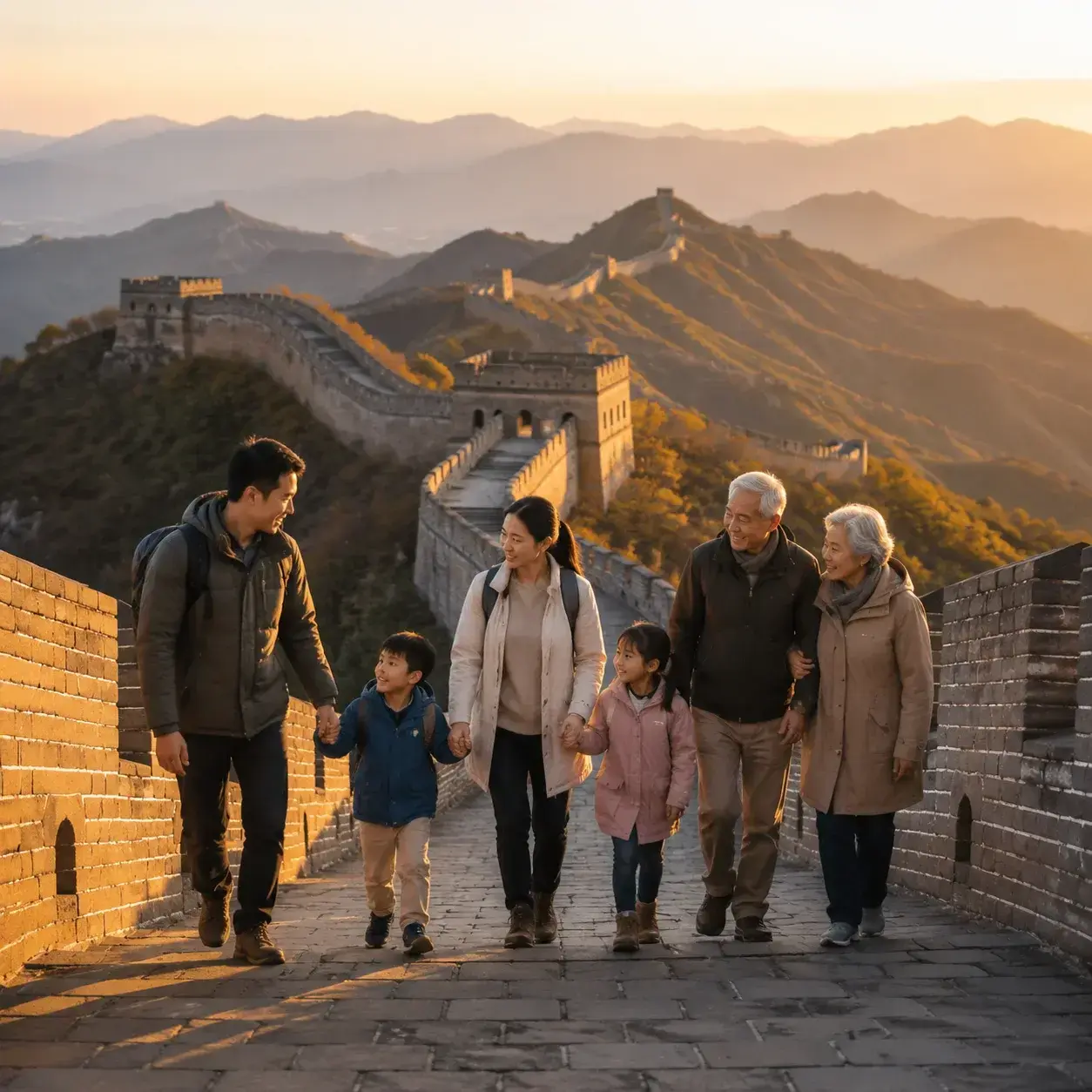
Mutianyu ⭐ most recommended for first-timers: 73 kilometers northeast of central Beijing (1.5 hours by car), restored but still monumental, with 23 watchtowers along a 2.5-kilometer stretch. A cable car skips the steep initial climb that defeats many visitors at other sections, and the toboggan down is genuinely fun for children. Autumn (September–October) sets the forested ridges ablaze, crowds are moderate (significantly less than Badaling), and restrooms, restaurants, and shops are well maintained. Entrance ¥40/adult (¥20 children/seniors); combo packages including shuttle bus + cable car round-trip or chairlift up + toboggan down approximately ¥250. Allow 3–4 hours including travel.
Jinshanling — for hikers and photographers: 130 kilometers northeast (2.5 hours by car), partially restored—some sections pristine, others crumbling romantically—with virtually no crowds in your photographs. The hiking is moderate to challenging (uneven steps, 4–6 hours including travel), and sunset hikes and overnight camping can be arranged.
Badaling — not recommended: The most famous and most crowded section; on peak days the wall becomes a slow-moving queue of humanity. Choose it only for wheelchair accessibility (ramp access and a flat, paved area at Juyong Pass) or extremely limited time.
Insider tips: Arrive at opening (7:00–8:00 AM) or late afternoon (4:00–5:00 PM) to avoid the midday crush. The toboggan at Mutianyu often has 1–3 hour queues on weekends; the cable car round-trip is faster.
Why should every visitor explore the Forbidden City?
Because nowhere else packs this much imperial history into one walkable complex: 492 years (1420–1912), 24 emperors, 980 buildings across 72 hectares, over 1.8 million artifacts, and its 100th anniversary as a public museum in 2025. In late October–early November the golden ginkgo trees in the inner courtyards become Beijing's most iconic seasonal image.
Before you go, our  Forbidden City route map and tickets covers the seven-day booking window, the passport rule at the gate and how long the walk actually takes.
Critical booking information: There are no on-site ticket windows. Book online via the official website (bookingticket.dpm.org.cn, English version available) or WeChat Mini-Program. Tickets go on sale exactly 7 days in advance at 8:00 PM Beijing time, and in peak seasons (April–May, July–August, October) they frequently sell out within minutes. Each ticket is linked to your passport number under a strict real-name system, and your passport is scanned at the Meridian Gate for entry. Visitors under 18 enter free but still require a reservation.
Practical information: Hours 8:30 AM – 5:00 PM (April–October), 8:30 AM – 4:30 PM (November–March); closed Mondays. Entrance ¥60 (April–October), ¥40 (November–March); the Treasure Gallery and Clock Exhibition Hall cost extra. Allow 2–3 hours for the standard central axis walk, 3–4 hours with side halls and the Hanfu costume photo experience—rental shops cluster near the east and west gates, ¥100–300 for costume and basic photography. Enter through the Meridian Gate (south), exit through the Gate of Divine Might (north); the route is one-directional.
How can visitors experience authentic Beijing hutongs?
Hutongs reveal the soul of Beijing: alleyways (the word derives from Mongolian for "water well") that have wound through the residential fabric since the Yuan Dynasty (1271–1368), connecting courtyard homes (siheyuan) in a grid that has survived 700+ years of dynastic change and modernization. Elderly residents still play chess in courtyards their families have occupied for generations.
Three ways to experience them: A rickshaw tour (1–2 hours) covers the lanes with a guide—best for first-timers and families; ¥100–200 per person. A walking tour (2–3 hours) goes deeper. A local family visit—courtyard home, tea, calligraphy or paper cutting—consistently ranks highest in post-trip surveys.
Best hutong areas: Nanluoguxiang (南锣鼓巷) is the most famous and most touristy, crowded on weekends; Wudaoying Hutong (五道营胡同) has trendy cafés and a younger creative energy; Mao'er Hutong (帽儿胡同) is more residential, with historical mansions and genuine neighborhood life.
Why are the Temple of Heaven and Summer Palace worth your time?
These two are imperial-scale landscapes rather than single buildings, and together they bookend the city—one about cosmology, the other about pleasure.
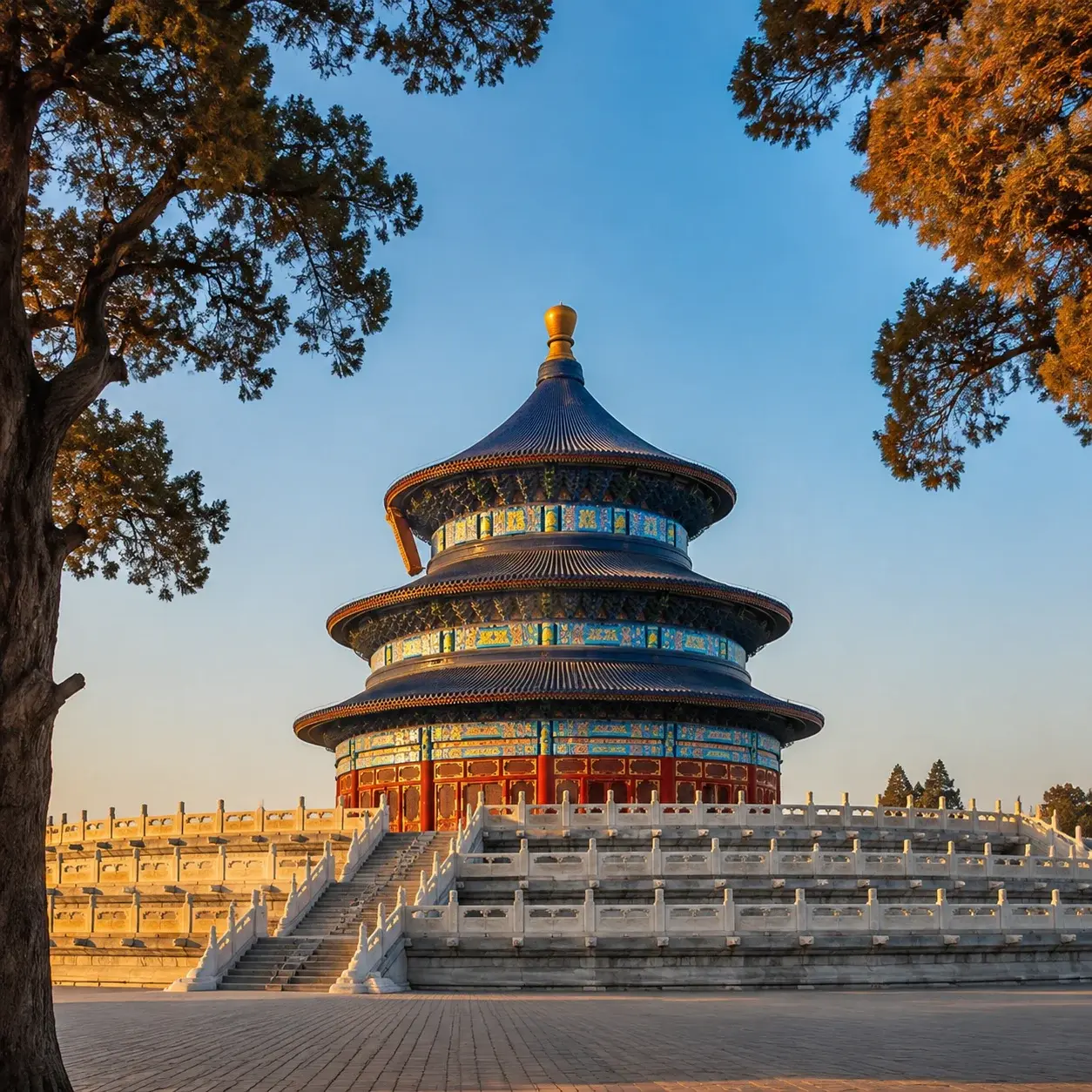
Temple of Heaven (天坛): Built in 1420, this is where Ming and Qing emperors prayed to Heaven for good harvests—a political act that maintained the emperor's "Mandate of Heaven." The Hall of Prayer for Good Harvests uses no nails and represents heaven through its circular form, while the surrounding square walls represent earth. Arrive at 6:00–8:00 AM to see locals doing tai chi, playing erhu, singing Peking Opera. Park entrance ¥15; combo ticket (park + all historical buildings) ¥34, with discounts for seniors (60+) and children under 1.2m; park opens 6:00 AM, buildings 8:00 AM; allow 1.5–2 hours; Line 5 (Tiantan Dongmen station).
Summer Palace (颐和园): The Qing emperors' retreat from the Forbidden City's formality, where Kunming Lake dominates 75% of the 290-hectare site and Longevity Hill rises in a cascade of temples, pavilions, and covered walkways. The 728-meter Long Corridor, decorated with 14,000 painted scenes, and the Marble Boat—commissioned by Empress Dowager Cixi with funds intended for the Chinese navy—are the set pieces. ¥30 (April–October), ¥20 (November–March), plus fees for the Tower of Buddhist Incense and Suzhou Street; 15 km northwest via Line 4 (Beigongmen station); allow 2–3 hours, entering through the North Palace Gate and coming late afternoon when tour groups have gone.
What should you eat in Beijing, and where?
Start with the duck, then eat your way through the city's imperial and street-food traditions.
Beijing roast duck (北京烤鸭) is a 600-year-old tradition from the imperial kitchens of the Ming Dynasty: ducks are air-dried, glazed with maltose syrup, and roasted in wood-fired ovens until the skin is lacquered and crisp. It is carved tableside (a skilled carver produces 100+ uniform slices) and served with thin pancakes, scallion brushes, cucumber strips, and sweet bean sauce.
| Restaurant | Style | Price per Duck | Best For |
|---|---|---|---|
| Siji Minfu (四季民福) | Traditional, local favorite | ¥200–300 | Best quality-to-price ratio; expect queues |
| Da Dong (大董) | Modern innovation | ¥400–500 | Less oily, crispier skin; reservations essential |
| Quanjude (全聚德) | Historic (est. 1864) | ¥300–400 | Ceremonial carving show; most famous name |
| Bianyifang (便宜坊) | Traditional (est. 1416) | ¥200–350 | Oldest duck restaurant in Beijing; closed-oven technique |
One whole duck serves 2–3 people. Place a slice on a pancake, add scallion and cucumber, brush with sweet bean sauce, fold, and eat in one or two bites.
Also worth eating: Zhajiangmian (炸酱面), hand-pulled noodles with fermented soybean paste, ¥15–30. Jiaozi (饺子), ¥30–50. Mongolian hotpot (涮羊肉), a copper pot of simmering broth with paper-thin lamb you cook yourself—¥80–150 per person, Donglaishun the most famous chain. Jianbing (煎饼), the breakfast crepe sold near every subway station from 6:00–10:00 AM, ¥8–15.
Skip Wangfujing Snack Street's scorpions and seahorses—a tourist spectacle, not Beijing food.
Dining tips: Order family-style, with rice and noodles separate from mains. Alipay and WeChat Pay dominate and credit cards work only at upscale restaurants, so keep ¥500–1,000 cash as backup. Tipping is not customary.
How many days do you need in Beijing—and what should each day look like?
Four to five days is the sweet spot for a first visit. Three days covers the essential sights but leaves no room for spontaneity or rest. Four to five days allows comfortable pacing, unhurried meals, a full day in the hutongs, and the flexibility buffer that turns a good trip into a great one. Six to seven days unlocks Prince Gong's Mansion, Fragrant Hills Park (red maple foliage mid-October through early November), a tea ceremony, a dumpling cooking class, and day trips to Tianjin (30 minutes by high-speed rail) or the preserved Ming/Qing village of Cuandixia (3 hours by car).
4-Day Beijing Itinerary
Day 1 — Imperial Beijing: 8:30 AM Tiananmen Square (30 minutes, security check required); 9:00 AM Forbidden City (3–4 hours; Meridian Gate, central axis, Treasure Gallery, optional Hanfu experience); 1:00 PM Peking duck lunch at Siji Minfu; 2:30 PM Jingshan Park (30–45 minutes); 3:30 PM Beihai Park (1–1.5 hours); 6:00 PM Wangfujing Street.
Day 2 — The Great Wall: 7:30 AM depart for Mutianyu (private car or MuBus); 9:30 AM cable car up; 10:00 AM – 1:00 PM explore the wall between watchtowers; 1:00 PM lunch near the wall; 2:00 PM toboggan or cable car down; 4:00 PM return; 7:00 PM dinner and rest.
Day 3 — Cultural immersion: 6:30 AM Temple of Heaven park (tai chi, instruments, Peking Opera); 8:00 AM the buildings open—Hall of Prayer for Good Harvests, Echo Wall, Circular Mound Altar; 10:00 AM hutong rickshaw tour (1.5 hours); 11:30 AM local family visit with a calligraphy or dumpling-making class; 1:00 PM lunch in a hutong restaurant; 3:00 PM Nanluoguxiang or Wudaoying Hutong; 7:30 PM acrobatics show at Chaoyang Theatre (optional).
Day 4 — Imperial garden and departure: 8:30 AM Summer Palace via the North Palace Gate (2.5–3 hours); 12:00 PM lunch; 1:30 PM 798 Art District (2 hours) or shopping at Sanlitun; 4:00 PM airport transfer—allow 2 hours for Capital Airport, 2.5 hours for Daxing.
6-Day Beijing Itinerary
Days 1–3: Same as the 4-day itinerary above.
Day 4 — Alternative Great Wall plus evening: Full day hiking Jinshanling (more challenging, more photogenic, fewer crowds); evening Mongolian hotpot at Donglaishun.
Day 5 — Temples, mansions, and tea: Morning Lama Temple → Confucius Temple → Guozijian (Imperial Academy); afternoon Prince Gong's Mansion; evening traditional tea ceremony.
Day 6 — Modern Beijing and departure: Morning Olympic Park; afternoon Sanlitun shopping and cafés; evening departure.
When is the best time to visit Beijing?
April–May and September–November. Autumn is the better of the two, and within it October 8–31 is the ideal window.
Spring (April–June) ⭐ excellent: 11–26°C, blossoms in the parks, comfortable hiking on the Great Wall, moderate crowds outside the May 1–5 Labor Day holiday. Avoid May 1–7 entirely: massive crowds and 50–100% price increases.
Autumn (September–November) ⭐ best overall: 10–26°C, the clearest skies of the year, the lowest rainfall, golden ginkgo filling Forbidden City courtyards (late October–early November), red maple blanketing Fragrant Hills Park (mid-October–early November). Avoid October 1–7 (National Day Golden Week—extreme crowds, doubled prices); October 8–31 is our team's favorite time to visit Beijing.
Summer (July–August) ⚠️ hot and crowded: 24–33°C and often higher, high humidity, monsoon thunderstorms, peak domestic tourism. If summer is your only option, sightsee early morning (7:00–10:00 AM) and evening (5:00–9:00 PM) and keep midday for indoor attractions.
Winter (December–February) 💰 budget option: -10°C to 5°C—cold but dry, with 30–50% lower prices and dramatically fewer crowds. The Great Wall dusted in snow is hauntingly beautiful, and Kunming Lake freezes over for ice skating.
| Period | Impact |
|---|---|
| May 1–7 (Labor Day) | Massive crowds, prices +50–100%, transportation fully booked |
| October 1–7 (National Day) | Biggest holiday; extreme crowds, prices +50–100%, hotels booked months ahead |
| Chinese New Year (late Jan/early Feb) | Transportation overwhelmed, businesses closed, prices spike |
Where should you stay in Beijing?
Stay in Dongcheng unless you have a reason not to: Beijing's historical heart, containing the Forbidden City, Tiananmen Square, the Lama Temple, and the most atmospheric hutongs—walking distance to the major sights and several subway lines at your doorstep. Best pockets are near the Forbidden City, Wangfujing, or Nanluoguxiang: luxury $200–500+/night, mid-range $80–165/night, boutique hutong courtyard hotels $70–140/night.
Chaoyang is the modern, international face—CBD skyline, Sanlitun's bars and restaurants, the 798 Art District, the highest concentration of English-speaking hotel staff—20–40 minutes by subway from the historical core ($200–500+/night luxury, $80–165/night mid-range, $30–55/night budget). Xicheng is a more residential old Beijing around Shichahai's lakes and Beihai Park (courtyard hotels $70–140/night, mid-range chains $55–110/night, guesthouses $21–48/night).
Booking strategy: Book 2–3 months ahead for peak season (April–May, September–October), 3–4 months for holiday periods (May 1–7, October 1–7), 2–4 weeks off-season. Critically, not all hotels in Beijing are licensed to accommodate foreign passport holders—verify before booking; international chains always are, smaller local hotels may not be.
How do you get to and around Beijing?
Fly into PEK or PKX, use the subway for everything central, and hire a private car and driver for the Great Wall.
Arriving by air: Beijing Capital International Airport (PEK) is 26 km northeast of the center, Terminal 3 handling most international flights; the Airport Express train is ¥25 and takes 20–30 minutes to Dongzhimen (fastest and most reliable), a taxi ¥80–120 and 30–60 minutes. Beijing Daxing International Airport (PKX) is 46 km south: Daxing Airport Express ¥35 and 20 minutes, taxi ¥100–150 and 45–75 minutes.
Arriving by high-speed rail: Beijing South handles bullet trains to Shanghai (4.5 hours, ¥550–1,750), Tianjin (30 minutes, ¥55–175), and Nanjing. Beijing West serves Xi'an (4.5 hours, ¥515–1,750), Chengdu, and Hong Kong—it is the station that serves Hong Kong by high-speed rail. Beijing Chaoyang Station (opened with the new Line 3 in December 2025) is becoming an increasingly important hub.
Subway — the primary recommendation: The world's longest metro network at 879 kilometers, with 27 lines and over 400 stations as of the December 2025 expansion (which added Line 18 and extensions of Lines 6 and 17). It is clean, efficient, and affordable (¥3–9 per trip), runs every 2–5 minutes, and has English signage throughout. As of January 2025 you can tap contactless international credit cards at fare gates, though a transit card or Alipay QR code is more convenient. Key lines: Line 1 (Tiananmen Square, Wangfujing), Line 4 (Summer Palace), Line 5 (Temple of Heaven). The drawbacks: crowded rush hours and security checks at every station entrance that add 2–5 minutes.
DiDi and taxis: The dominant ride-hailing platform works like Uber—English app, payment via Alipay, GPS tracking, transparent pricing—at roughly taxi cost (¥13 base fare, ¥2.3/km). Traditional taxis are abundant, but most drivers speak limited English and some refuse the meter. Private vehicle and driver: The most convenient option for the Great Wall (essential for Mutianyu and Jinshanling, which have no direct subway access), for families or elderly companions, and for maximizing limited time. Full-day hire ¥800–1,500 ($110–210); Great Wall day trip ¥1,000–1,800 ($140–250).
How much does a trip to Beijing cost?
A comfortable 4–5 day trip costs $1,600–3,500 for two people excluding international flights. Ground costs for 4 days, by tier:
| Tier | Accommodation | Meals | Transport | Attractions | Total |
|---|---|---|---|---|---|
| Budget (per person) | ¥800–1,200 (\$110–165) hostels/budget hotels | ¥500–800 (\$70–110) | ¥200–400 (\$28–55) subway + occasional taxi | ¥300–500 (\$40–70) | ¥1,800–2,900 (\$250–400) + flights |
| Mid-range (2 people) | ¥3,200–6,400 (\$440–880) 3–4 star hotels | ¥2,000–4,000 (\$275–550) | ¥1,500–3,000 (\$210–410) subway + DiDi + Great Wall car | ¥600–1,000 (\$80–140) | ¥7,300–14,400 (\$1,000–1,980) + flights |
| Luxury (2 people) | ¥8,000–16,000 (\$1,100–2,200) 5-star hotels | ¥4,000–8,000 (\$550–1,100) fine dining | ¥6,000–12,000 (\$825–1,650) private vehicle + guide | ¥1,500–3,000 (\$210–410) premium experiences | ¥19,500–39,000 (\$2,680–5,360) + flights |
International flights:
| Origin | Economy Round-Trip |
|---|---|
| US West Coast (LAX, SFO) | \$800–1,800 |
| US East Coast (JFK, EWR) | \$1,200–2,500 |
| Europe (direct) | \$800–1,800 |
| Europe (one-stop) | \$500–1,200 |
| Southeast Asia | \$300–800 |
| Japan/Korea | \$400–900 |
Book 2–3 months in advance; Tuesday and Wednesday departures are often cheaper, and Chinese carriers are frequently 20–30% cheaper than Western airlines. PEK generally has more international options and competitive pricing than Daxing.
Money-saving strategies, ranked by impact: travel off-season in November–February (30–50% savings); avoid the May 1–7 and October 1–7 holidays (eliminating a 50–100% premium); use the subway rather than taxis (¥20–40/day versus ¥100–200/day); and eat lunch rather than dinner at the same restaurants, where menus are identical.
What should first-timers know before visiting Beijing?
Eight things decide whether your first Beijing trip feels easy or exhausting: visa, language, payment, internet, air, safety, etiquette, and accessibility.
Visa, free: As of February 2026, citizens of 50 countries enjoy 30-day visa-free entry for tourism, business, and family visits, valid through December 31, 2026—including all EU/Schengen nations, the UK, Canada, Australia, Japan, South Korea, and Singapore. For Americans and citizens of 55 countries total, the 240-hour (10-day) visa-free transit policy allows entry without a visa if you hold an onward ticket to a third country or region (Hong Kong, Macau, and Taiwan qualify as "third regions").
Language: English proficiency is limited outside international hotels and major attractions. Download Google Translate with offline Chinese before arrival, have your hotel address written in Chinese characters, and learn five phrases that cover most daily interactions: 你好 (nǐ hǎo—hello), 谢谢 (xiè xie—thank you), 多少钱 (duō shao qián—how much?), 这个 (zhè ge—this one, while pointing), and 不要 (bú yào—don't want/no thanks).
Mobile payment: 90%+ of transactions use Alipay or WeChat Pay. Link an international credit or debit card to Alipay; setup takes about 10 minutes, and it then covers restaurants, subway fares, convenience stores, and street vendors. Keep ¥500–1,000 in cash as backup.
Internet access: Google, Facebook, Instagram, WhatsApp, and YouTube are blocked by the Great Firewall. Download and configure a VPN before arriving (it cannot be downloaded from within China), use international roaming or a travel eSIM (which bypasses the firewall through roaming—no VPN needed), or rent a pocket Wi-Fi device with built-in VPN. Buy your eSIM before arrival, since provider websites are blocked within China.
Air quality: Variable, especially in winter heating season. Check the AQI daily via the AirVisual app: below 100, normal activities; above 150, consider indoor activities.
Safety: Beijing is very safe—violent crime against foreigners is extremely rare—so the risks are petty. Watch for pickpocketing in crowded subway stations and tourist areas, and for the "tea ceremony" scam (friendly English-speaking strangers invite you for tea, then present an enormous bill), the "art student" (an invitation to an exhibition that becomes a high-pressure sales pitch), and the "massage" (touts whose services lead to inflated charges). Emergency numbers: police 110, ambulance 120, fire 119.
Etiquette: Remove shoes when entering homes. Use both hands when giving or receiving business cards, gifts, or payments. Try offered food (refusing entirely is impolite). Don't stick chopsticks upright in rice (funeral symbolism), and don't point with a single finger. Tipping is not customary—guides and drivers are the exception.
Accessibility: The Forbidden City, Temple of Heaven, and Summer Palace all have accessible central routes, though some side halls and hilltop areas do not. Most Great Wall sections are too steep for wheelchair access—Juyongguan is the exception, with a flat, paved area and ramp access. For mobility-limited travelers, the answer is a private car and driver: door-to-door service and no stairs or crowds.
FAQ
How many days do I need in Beijing?
First-time visitors should plan three to four full days. This allows the Forbidden City, Great Wall, hutongs, Temple of Heaven, Summer Palace, and food without rushing.
Which Great Wall section is best from Beijing?
Mutianyu is best for most first-timers. Jinshanling is better for hikers and photographers, while Badaling is usually the most crowded.
How hard is it to book Forbidden City tickets?
Tickets can sell out quickly, especially in peak seasons and holidays. Book as soon as the window opens and have passport details ready.
Where should first-time visitors stay in Beijing?
Stay central, with good access to the subway, restaurants, and major sights. Avoid saving money by staying far outside the city core.
What Beijing food should I not miss?
Peking duck is the headline dish, but travelers should also try hutong snacks, noodles, dumplings, breakfast foods, and regional restaurants.
What is the biggest mistake in planning Beijing?
The biggest mistake is underestimating distances and walking. Beijing is huge, and a single major sight can take half a day with transfers and security.