




 18 days China, End to End Beijing → Xi'an → Chuanzhusi → Jiuzhaigou → Chengdu → Zhangjiajie → Guilin → Yangshuo → Shenzhen From $6,360 View route
  3 days 4-Day Tour of Siguniang Mountain, Biepa Gou, and Dagu Glacier Chengdu → Lixian → Heishui County From $1,599 View route
  5 days Above the Pillars, Then Below Zhangjiajie From $1,430 View route
  3 days After the Last Booth Guangzhou From $840 View route
  13 days All the Way West Xi'an → Dunhuang → Turpan → Kashgar → Shanghai From $3,500 View route
 TL;DR
China is one of the world's most accessible destinations, but its cashless economy and internet restrictions require preparation no other country demands. In 2025, China recorded over 150 million inbound visits — a 17% year-on-year increase — with visa-free entries by foreigners exceeding 30 million.
Three things will make or break your trip: set up mobile payments (Alipay or WeChat Pay) before arrival, download a VPN while still outside China, and carry your passport everywhere. Without them, even buying a bottle of water or messaging your family becomes a challenge.
Do You Need a Visa for China in 2026?
Most Western travelers no longer need a visa. As of March 2026, citizens of 50+ countries — including France, Germany, the UK, Canada, Australia, Japan, South Korea, and New Zealand — can enter China visa-free for up to 30 days with nothing more than a valid passport and a return ticket. In 2025, 30.08 million foreign visitors entered under visa-free schemes, a 49.5% year-on-year increase, according to National Bureau of Statistics data.
US citizens are not in the 30-day visa-free list but qualify for 240-hour (10-day) visa-free transit through 65 designated ports across 24 provinces with an onward ticket to a third country or region. Hong Kong, Macau, and Taiwan all count as "third countries," so a New York → Beijing → Hong Kong itinerary is a valid transit.
Everyone else needs a standard L (tourist) visa: apply through the COVA online system, upload documents digitally, and visit the visa center once for biometrics. Processing takes 4–7 business days and costs approximately $140–185 depending on nationality.
What essential apps should you download before departure?
Download everything before you board your flight — several critical apps cannot be installed once you're inside China. This is the single most common mistake first-time travelers make.
Must-have apps (download and set up before departure):
| App | Why It's Essential | Setup Notes |
|---|---|---|
| VPN (ExpressVPN, NordVPN, or Surfshark) | Google, Gmail, WhatsApp, Instagram, YouTube — all blocked in China | Install and test before entering China; provider sites are blocked inside. $8–13/month |
| Alipay | Mobile payment — accepted virtually everywhere | Register with international number, link Visa/Mastercard, verify with passport |
| Messaging + payment + mini-programs (China's super-app) | Register, verify identity, enable WeChat Pay. Essential for hotels, guides, locals | |
| Amap (高德地图) | Navigation — Google Maps is blocked and inaccurate in China | Some English support. Download offline maps for your cities |
| Trip.com | Trains, flights, hotels with English interface | Accepts international cards. Best English booking platform for China |
| Microsoft Translator | Real-time voice and camera translation | Download Chinese offline pack; Google Translate needs VPN |
| DiDi | Ride-hailing (China's Uber) | Register with international number, link Alipay/WeChat Pay |
Inbound tourists' mobile payment transactions reached approximately 80 billion yuan ($11 billion) in 2025, and among visitors from countries such as Kazakhstan and Malaysia, more than 80% now use mobile payment services.
What should you pack for China?
Beyond normal travel items, China requires a few specific preparations that most travelers overlook.
Documents (keep physical AND digital copies): passport with 6+ months validity · visa documents or visa-free entry proof · travel insurance documents (minimum $50,000 medical coverage recommended) · hotel confirmations with Chinese-language addresses · emergency contact list including your country's embassy in China.
China-specific essentials: portable charger (your phone is your wallet, map, translator, and communication device) · universal power adapter, since China uses Type A, C, and I plugs at 220V · toilet paper/tissues, because most public restrooms do not provide toilet paper · face masks for air quality days and crowded public transport · prescription medications in original containers with documentation, since some common Western medications are restricted in China.
How Do Mobile Payments Work in China for Foreigners?
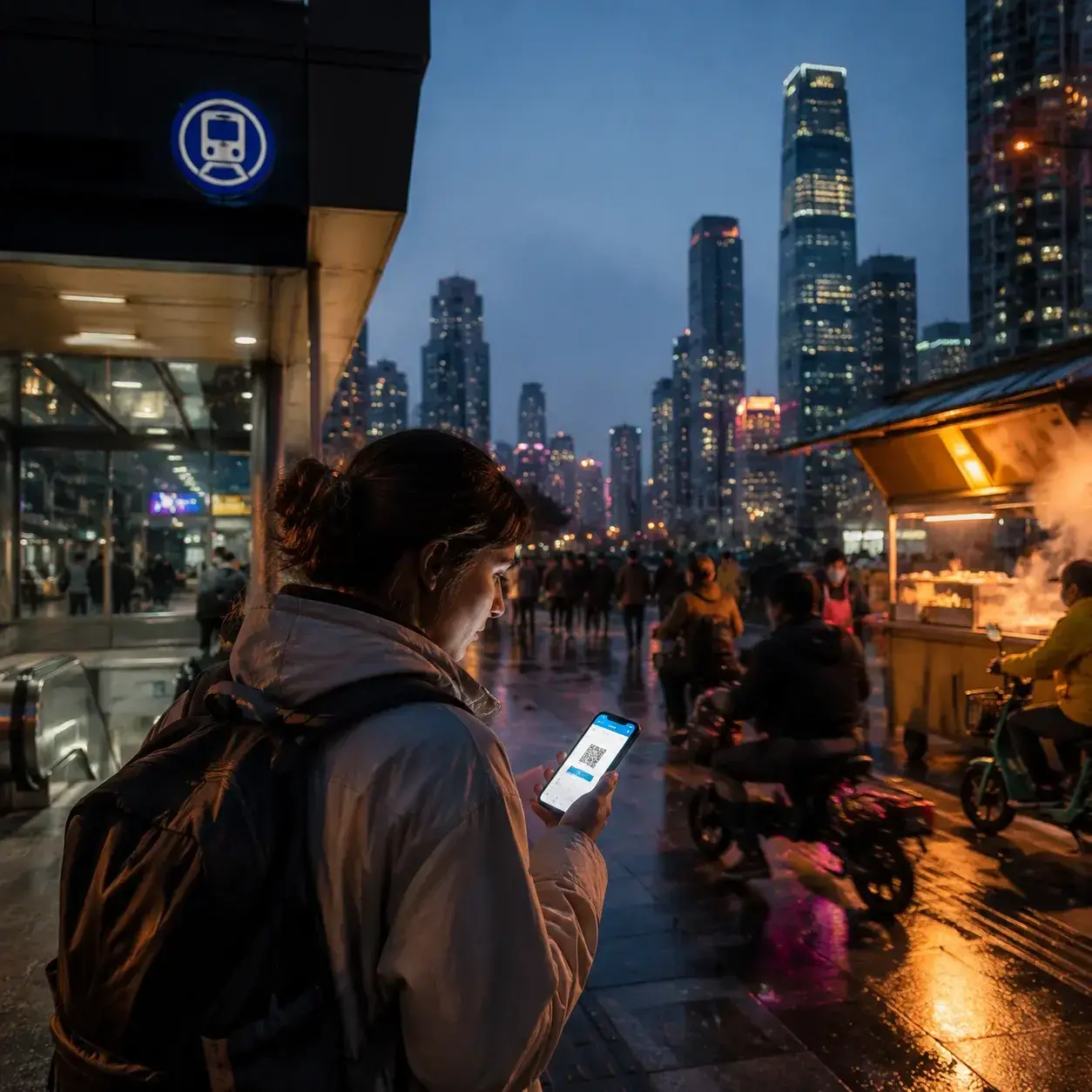
Yes — China really is cashless. Approximately 90% of online payment users in China rely on Alipay or WeChat Pay, and many vendors, restaurants, and even street food stalls no longer accept cash or credit cards.
How to set up Alipay as a foreign tourist (the most widely accepted and foreigner-friendly option):
- Download Alipay from the App Store or Google Play (do this before entering China)
- Register with your international phone number
- Verify your identity by scanning your passport
- Link an international credit card (Visa, Mastercard, JCB, Diners Club, or Discover are supported)
- Start paying — scan the merchant's QR code or show your payment QR code
Key details for foreign card users: approximately 3% service fee per transaction; daily spending limit typically ¥2,000–5,000 ($280–700); annual limit ¥50,000 ($7,000) without additional verification, up to ¥200,000 ($28,000) with enhanced verification.
When do you still need cash? Cash is your backup, not your primary payment method — carry ¥500–1,000 ($70–140) for rural vendors, older taxi drivers who don't use mobile payment, temple donation boxes, and moments when your phone battery dies.
Where to get cash: airport ATMs on arrival (most convenient), Bank of China branches (best exchange rates), or any ATM displaying Visa/Mastercard/UnionPay logos. Daily ATM withdrawal limit: ¥2,500–3,000 ($350–420), plus ¥15–30 per transaction and your home bank's fee.
Credit cards are NOT widely accepted. They work at international hotel chains, high-end restaurants in major cities, airport shops, and some large department stores — but not at local restaurants, street vendors, taxis, public transportation, or most attractions.
How Do You Access the Internet in China?
China operates the world's most extensive internet censorship system, known as the Great Firewall (防火长城), which blocks most Western websites and apps. A VPN is essential for any traveler who needs Gmail, Google Maps, WhatsApp, or social media.
Blocked (will not work without VPN): ❌ Google (Search, Gmail, Maps, Drive, Photos, YouTube) · ❌ Facebook, Instagram, WhatsApp, Messenger · ❌ Twitter/X, Telegram, Signal · ❌ BBC, NYT, Reuters · ❌ ChatGPT, Claude, and most AI assistants · ❌ Dropbox, Notion, Slack
Works without VPN: ✅ WeChat · ✅ Bing (Microsoft search) · ✅ Apple iMessage, FaceTime · ✅ LinkedIn · ✅ Microsoft Outlook, Teams · ✅ Most banking apps
Critical rules for VPN use in China:
- Download and install it before entering China. VPN provider websites are blocked inside China — arrive without one and you cannot easily get one
- Install two different providers, because the Great Firewall periodically blocks specific protocols. ExpressVPN and NordVPN are the most consistently reliable options based on 2025–2026 testing from Beijing, Shanghai, and Shenzhen
- Test it before relying on it, and expect imperfect performance — switch servers or protocols when speeds drop
In practice, enforcement targets VPN providers and political activists, not individual foreign travelers checking Gmail.
What is the best way to get mobile data in China? An eSIM is the best option for most travelers — fastest to set up, keeps your home number active, and needs no physical SIM swap.
| Option | Cost | Pros | Cons |
|---|---|---|---|
| eSIM (Recommended) | $4.50–99 for 1GB–unlimited data, 5–90 days | Activate before departure, keep home number | Phone must support eSIM (iPhone XS+, Pixel 3+, Samsung S20+) |
| Physical SIM | ¥50–150 ($7–21) for 7–30 days | Cheap, any unlocked phone | Buy at airport or shop, needs passport and setup |
| Pocket WiFi | $5–10/day rental | Share with companions | Extra device to carry and charge, costly for solo travelers |
eSIM providers: Airalo ($4.50–37 for 1GB–20GB), Holafly ($19–99 for unlimited data, 5–90 days), Nomad ($8–50 for 1GB–10GB).
LyrikTrip Tip: Most eSIM and local SIM plans provide Chinese internet access but do NOT bypass the Great Firewall — you still need a separate VPN. Some premium providers (like Holafly) include VPN-like routing that bypasses the firewall; check before purchasing.
What Is the Best Way to Get Around China?
For distances under 1,000 km, China's high-speed rail is faster, cheaper, and more convenient than flying. Trains reach 300–350 km/h and connect virtually every major city center-to-center with no airport security hassle.
Cost comparison (Beijing → Shanghai, 1,318 km): high-speed train ¥553 ($77) second class, 4.5 hours, city center to city center; flight ¥600–1,200 ($84–168) plus 2 hours airport time each end, effectively 6–7 hours total. Train wins on price, convenience, and often total travel time.
How to book train tickets: Trip.com (English interface, international cards, small fee of ~¥20–40) or the official 12306 app (cheapest, but Chinese interface and passport verification can be tricky for foreigners). Book popular routes 7–10 days ahead; Chinese holidays 15–30 days ahead.
Ticket classes: second class is standard and comfortable, comparable to European business class; first class is roomier, 30–50% more expensive; business class adds lie-flat seats and meals at 2–3x the price of second class.
How do you get around within Chinese cities? The metro is the fastest and cheapest way around any major Chinese city — a ride costs ¥2–10 ($0.30–1.40) by distance, paid by scanning your Alipay or WeChat Pay QR code at the gate.
For taxis and ride-hailing, DiDi (China's Uber) is the most convenient option: set your destination as a map pin to avoid language issues, and the driver arrives. Street taxis charge ¥10–14 starting fare plus ¥2–3 per km.
Essential tip: always have your destination address written in Chinese characters and show it to the driver — even DiDi drivers may call to confirm pickup.
When to fly: for distances over 1,000 km or remote regions (Tibet, Xinjiang, Inner Mongolia), book domestic flights 2–4 weeks ahead, arrive 2 hours early, and bring your passport (required on all domestic flights in China).
How Do You Communicate Without Speaking Chinese?
English is not widely spoken outside international hotels and major airports — plan to rely on technology rather than conversation. You'll find English-speaking staff at 5-star international chains, major airport information desks, and some attractions in Beijing and Shanghai; at restaurants, train stations, taxis, shops, and with most Chinese people, English will not work.
1. Translation apps (your most important tool):
- Microsoft Translator: download the Chinese offline pack before your trip. Camera mode translates signs and menus in real time; voice mode handles conversations
- Google Translate: equally powerful but requires a VPN in China — download the offline pack as backup
- Pleco: the best Chinese dictionary app, with handwriting recognition and camera OCR
2. The "screenshot method" (foolproof for taxis): save destination addresses in Chinese characters as screenshots. Show one to your driver — this works 100% of the time, needs no internet, and eliminates pronunciation issues.
3. Essential Chinese phrases (effort is deeply appreciated):
| English | Chinese | Pinyin | When to Use |
|---|---|---|---|
| Hello | 你好 | nǐ hǎo | Greeting anyone |
| Thank you | 谢谢 | xiè xie | After any interaction |
| How much? | 多少钱? | duō shao qián? | Shopping, restaurants |
| I want this | 我要这个 | wǒ yào zhè ge | Pointing at menu items |
| Bill please | 买单 | mǎi dān | At restaurants |
| Where is...? | ......在哪里? | ...zài nǎ lǐ? | Asking directions |
| I don't understand | 我不懂 | wǒ bù dǒng | When confused |
| Use the meter | 打表 | dǎ biǎo | In taxis |
How Do You Order Food Without Knowing Chinese?
You don't need to speak Chinese to eat well in China — but you do need the right strategies. Regional variation is dramatic: you'll encounter entirely different flavors in Sichuan, Guangdong, Shaanxi, and Shanghai.
- Strategy 1: Point at pictures. Most Chinese restaurants have picture menus, printed or on wall screens — this works in roughly 80% of dining situations
- Strategy 2: Use your translation app's camera mode on text-only menus for an instant translation overlay
- Strategy 3: Follow the crowd. See what other tables are eating, then point at a dish and say "我要这个" (wǒ yào zhè ge — "I want this")
- Strategy 4: Order via apps. Many restaurants use QR code ordering — scan the table code, browse the picture menu, pay via Alipay or WeChat Pay
Is food safe in China? Cooked food is generally safe; tap water is not. Never drink tap water and avoid ice in drinks (often made from tap water). Hotels provide free bottled water daily, and boiled water (开水, kāi shuǐ) is safe — every room has an electric kettle.
Safe to eat: hot, freshly cooked food from busy restaurants, peeled fruits, sealed bottled water, and street food cooked in front of you at popular stalls. Exercise caution with raw vegetables and salads, unpeeled fruit, street food from vendors with few customers, and dairy products from small vendors.
Dietary restrictions — key phrases to carry:
- Vegetarian: 我吃素 (wǒ chī sù) — many "vegetable" dishes use meat stock or oyster sauce, so Buddhist vegetarian restaurants (素食餐厅) are the safest option
- Peanut allergy: 我对花生过敏 (wǒ duì huā shēng guò mǐn)
- Shellfish allergy: 我对海鲜过敏 (wǒ duì hǎi xiān guò mǐn)
- Halal food: look for 清真 (qīng zhēn) signs. Xi'an's Muslim Quarter and Lanzhou-style restaurants are widely available nationwide
LyrikTrip Tip: Carry a printed allergy card in Chinese with your dietary restrictions and show it to staff before ordering — we provide these cards to all our clients, and they've prevented countless issues.
What Should You Know About Hotels in China?
No — not all hotels can accept foreign guests, and this catches many travelers off guard. Under China's Exit and Entry Administration Law (Article 39), hotels must register foreign guests with local police within 24 hours of check-in, but not all have the license to process foreign passports.
Hotels that reliably accept foreigners: international chains (Marriott, Hilton, Hyatt, IHG, Shangri-La, Accor), most 4-star and 5-star Chinese hotels, and hotels marked "foreign guest friendly" on booking platforms.
Hotels that may refuse you at check-in: budget chains under ¥150/night ($21), small local hotels and guesthouses, and some hostels, especially in smaller cities.
How to avoid problems: book through Trip.com (which indicates foreign guest acceptance) or contact the hotel directly to confirm. Arriving at midnight to discover your hotel can't check you in is a real scenario that happens to unprepared travelers.
Check-in process: present your original passport (not a copy). The hotel scans it, completes a registration form, and submits your information to local police — a legal requirement, not optional. Keep the hotel's business card with its Chinese-language address for taxi returns.
In March 2026, the National Immigration Administration launched a pilot online accommodation registration service for foreigners in non-hotel lodgings (homestays, short-term rentals, rural villas).
What Cultural Etiquette Should You Follow in China?
Chinese culture places enormous value on "face" (面子, miànzi) — social reputation and dignity — and most etiquette rules flow from this concept.
Do:
- ✅ Remove shoes when entering someone's home — universal and non-negotiable
- ✅ Use both hands when giving or receiving anything — business cards, gifts, money, even a cup of tea
- ✅ Try local food when offered — declining is impolite; even a small taste shows respect
- ✅ Learn and use basic Chinese phrases — even a clumsy "谢谢" (thank you) earns disproportionate goodwill
- ✅ Bring a small gift when visiting someone's home — fruit, tea, or treats from your home country
Don't:
- ❌ Tip — tipping is not part of Chinese culture and may cause confusion or be declined, including at restaurants, taxis, and hotels
- ❌ Stick chopsticks upright in rice — this resembles incense offerings at funerals and is considered deeply inauspicious
- ❌ Get visibly angry in public — causing someone to "lose face" is one of the most serious social offenses. Stay calm, resolve issues privately
- ❌ Discuss sensitive political topics — Taiwan, Tibet, Xinjiang, and historical political events are topics to avoid with people you don't know well
- ❌ Point with one finger — use your whole hand or an open palm
Dining etiquette essentials: wait for the host or eldest person to begin eating; dishes are shared from the center of the table; slurping noodles is acceptable; leaving a little food on your plate signals you've been well-fed. When toasting, "干杯" (gān bēi) means "bottoms up," but "随意" (suí yì — "drink as you like") sets a more relaxed pace.
How Safe Is China for Tourists?
China is one of the safest countries in the world for tourists. Violent crime is rare compared to most Western countries, and major cities like Beijing, Shanghai, and Guangzhou have extensive public security systems including widespread surveillance and a strong police presence — walking alone at night is safer than in comparable Western cities.
Real safety concerns (minor but worth knowing): pickpocketing is possible in crowded tourist areas (the Bund in Shanghai, Tiananmen Square, busy metro stations). Keep valuables in front pockets or a cross-body bag.
Common scams to recognize:
- Tea ceremony scam: friendly English-speaking locals invite you for "tea" or "to practice English," then present a bill for hundreds of dollars at a tea house. Rule: never follow strangers to a restaurant or tea house
- Art student scam: "students" invite you to view their "exhibition," then pressure you to buy overpriced art
- Taxi scams: refusing to use the meter or taking unnecessarily long routes. Solution: use DiDi instead — the price is fixed before you ride
- Fake monks: people dressed as monks asking for "donations" near temples. Real monks do not solicit money from tourists on the street
Emergency numbers: police 110 · ambulance 120 · fire 119
Medical care: international hospitals with English-speaking staff exist in Beijing, Shanghai, Guangzhou, Shenzhen, and Chengdu, where consultations cost ¥100–500 ($14–70); public hospitals are cheaper but have limited English. Travel insurance with minimum $50,000 medical coverage and medical evacuation is strongly recommended.
Air quality: northern cities (Beijing, Xi'an) can have poor air quality in winter — download the AirVisual app, check the AQI daily, and carry N95 masks when AQI exceeds 150. Southern and coastal cities (Guilin, Kunming, Xiamen, Sanya) generally have excellent air quality year-round.
What Common Challenges Will You Face in China?
Every traveler encounters a few "culture shock" moments in China — knowing about them in advance transforms frustration into amusement.
Toilets: public restrooms frequently use squat toilets and most do not provide toilet paper. Solution: carry tissues everywhere. Western-style toilets are standard in hotels, malls, international restaurants, and airports.
Crowds: popular attractions get extraordinarily crowded, especially during Chinese national holidays (May 1–7 and October 1–7) and weekends. Solution: visit major attractions at opening time (7–9 AM), avoid weekends, and absolutely avoid the first week of May and October. Off-season travel (November–March) offers dramatically fewer crowds at a significant discount.
Personal space: people stand closer in lines, pushing in crowds is normal behavior (not rude), and strangers may stare at foreigners out of curiosity rather than hostility. Solution: be patient and don't take it personally — in smaller cities and rural areas this is almost always friendly curiosity.
Noise and smoking: restaurants, markets, and public spaces are louder than Western equivalents, with animated conversation and phone calls on speaker. Indoor smoking bans exist in major cities (Beijing, Shanghai, Shenzhen) but enforcement varies, and smoking remains common among older men. Solution: embrace the atmosphere, choose non-smoking sections when available, and retreat to international hotel restaurants and cafés when you need quiet.
Pre-Departure Checklist
Before you leave home: verify visa requirements (or confirm visa-free eligibility) · download and set up VPN (two providers recommended) · download and configure Alipay — link international credit card, complete identity verification · download WeChat and enable WeChat Pay · download Amap, Trip.com, DiDi, Microsoft Translator · download the Chinese offline language pack · purchase travel insurance (minimum $50,000 medical coverage) · notify your bank of travel dates to prevent card blocks · photocopy your passport and store the copy separately · save hotel addresses in Chinese characters as phone screenshots · purchase an eSIM or arrange mobile data.
Upon arrival in China: activate your eSIM or buy a local SIM · test the VPN · withdraw ¥500–1,000 cash from an airport ATM · download offline maps for your first city in Amap · confirm your hotel accepts foreign guests (if not pre-verified) · collect the hotel business card at check-in (Chinese address for taxis) · obtain the "Registration Form of Temporary Residence" from the front desk.
Daily essentials: carry your passport (required for train stations, some attractions, hotel check-ins) · keep your phone charged · carry tissues · drink bottled water only · check the AQI before outdoor activities · keep a hotel-address screenshot ready for taxi returns.
Disclaimer: Information accurate as of March 2026. Policies, prices, and conditions may change. Always verify current visa requirements through official channels (visaforchina.cn) before travel.
FAQ
What should every first-time visitor set up before China?
Set up mobile payment, internet access, translation, maps, train or ticket tools, and copies of hotel addresses before leaving home.
Can I rely on cash in China?
No. Cash still exists, but many everyday situations are built around QR payments. Alipay and WeChat Pay are the practical default for travelers.
Do I need a VPN or eSIM in China?
If you need Google, Gmail, WhatsApp, Instagram, or similar services, prepare an eSIM, roaming plan, or VPN before arrival because setup can be harder inside China.
What should I know about food and allergies?
Carry allergy information in Chinese, expect limited English in local restaurants, and use translation tools or a guide for serious dietary restrictions.
How should I plan transport for a first trip?
Use high-speed rail for efficient city pairs, book popular routes ahead, and leave time for station security, large terminals, and traffic to the station.
What first-timer mistake causes the most stress?
Arriving without working data and payments creates the most friction because maps, taxis, tickets, restaurants, and messaging all depend on a connected phone.