



 18 days China, End to End Beijing → Xi'an → Chuanzhusi → Jiuzhaigou → Chengdu → Zhangjiajie → Guilin → Yangshuo → Shenzhen From $6,360 View route
  3 days 3-Day Tour: Mount Siguniang, Bipenggou & Dagu Glacier Chengdu → Lixian → Heishui County From $1,599 View route
  5 days Above the Pillars, Then Below Zhangjiajie From $1,430 View route
  3 days After the Last Booth Guangzhou From $840 View route
  13 days All the Way West Xi'an → Dunhuang → Turpan → Kashgar → Shanghai From $3,500 View route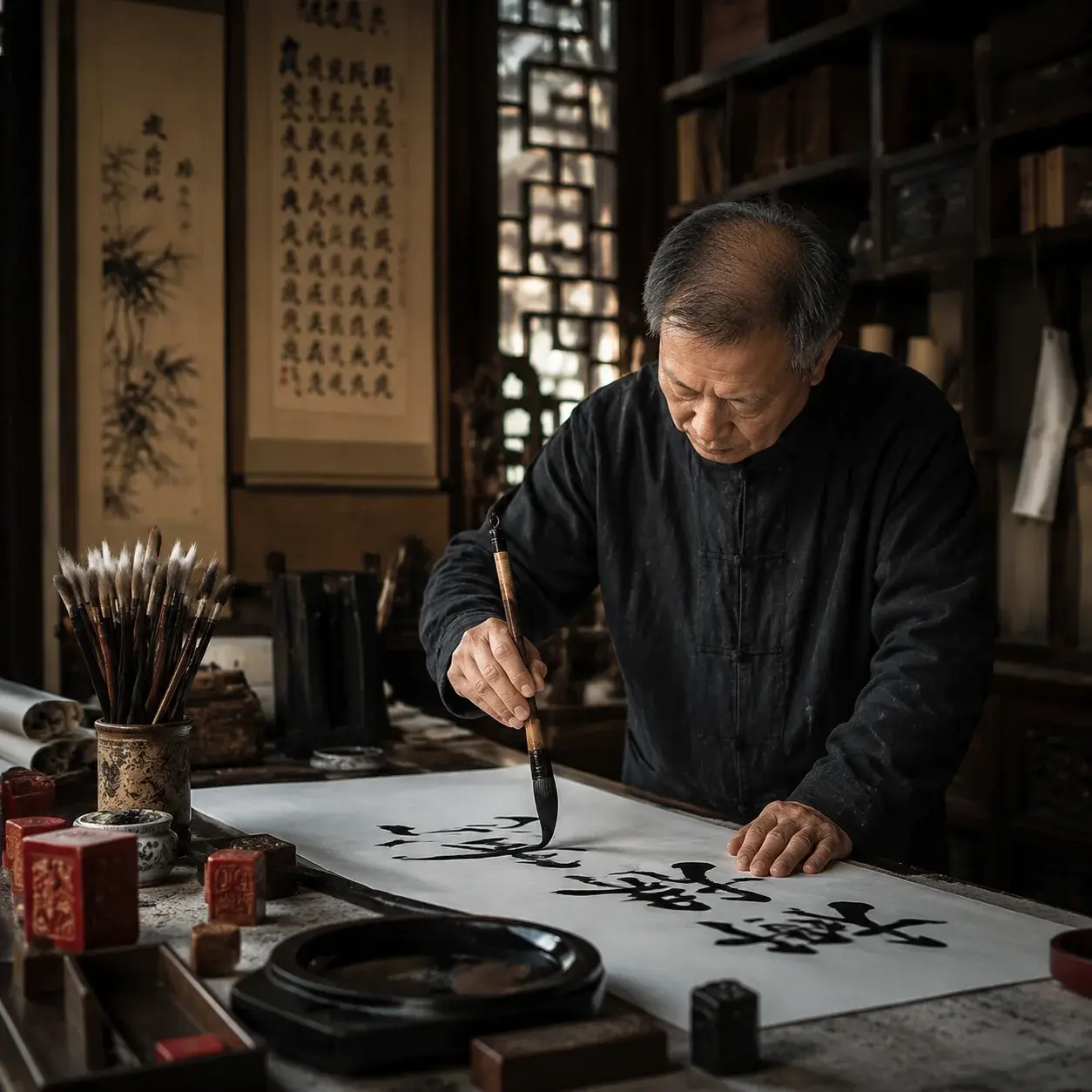
Chinese Calligraphy: How Do You Buy an Authentic Piece in China?
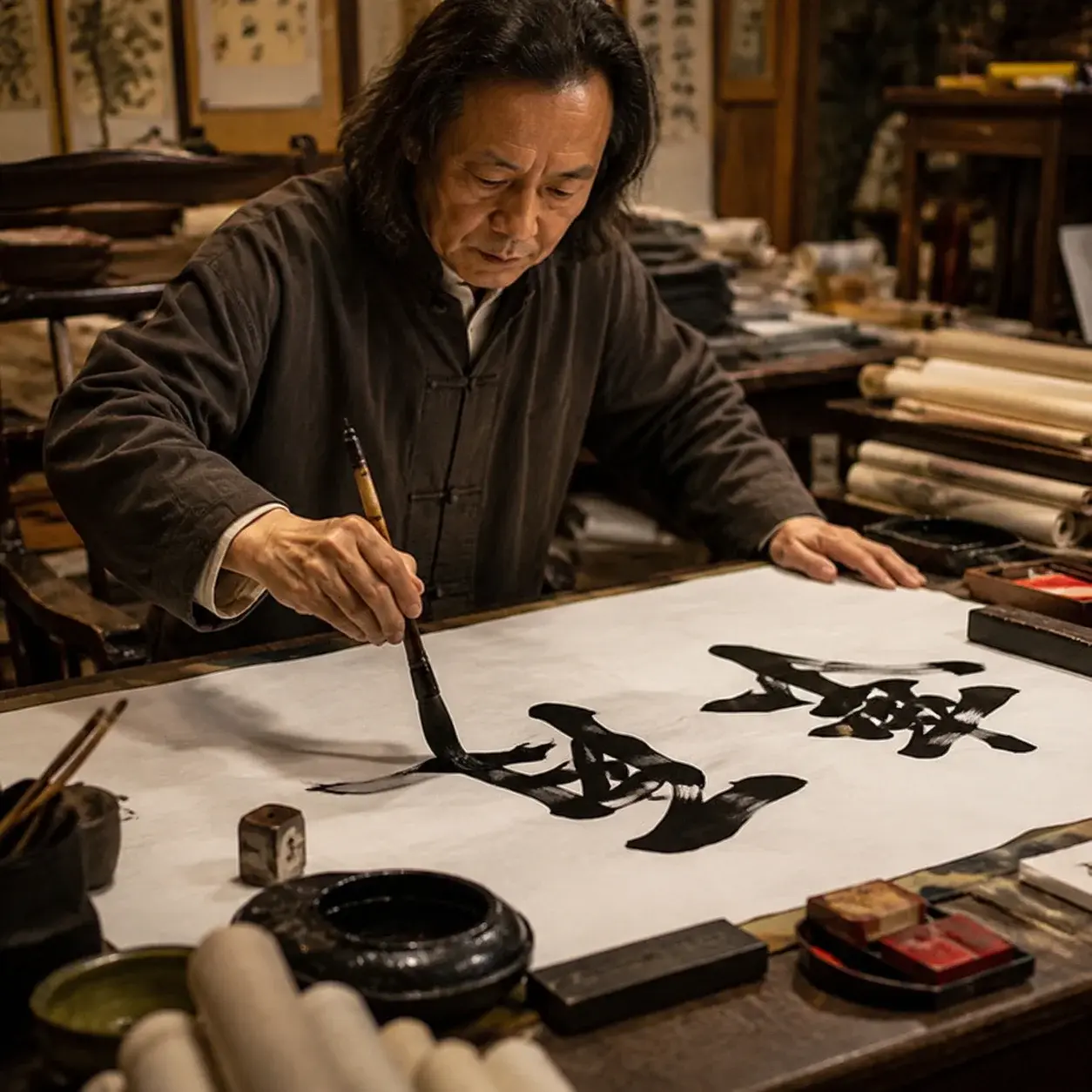
To buy Chinese calligraphy in China, decide what you want first — original scroll art, a personalised name or blessing piece, a Four Treasures gift set, or a single brush. Then price it by the artist's reputation (not the size), watch it being brushed or buy from an old-name shop, and learn one thing above all: how to spot the printed "fake handwritten" scrolls that flood tourist markets.
We wrote this because every calligraphy page we found does half the job. The educational sites explain the five scripts and the Four Treasures beautifully but never tell you where to buy, what to pay, or which phrase to have written. The shopping pages name a street or two and stop. Nobody walks a foreign visitor through the whole arc — choosing the words, turning your own name into Chinese, avoiding the inkjet fakes, and getting a scroll home uncreased. We are a China travel company that commissions pieces for guests, not a gallery, so we can be straight with you.
One honesty note before we start. The evergreen knowledge here — the scripts, the phrase meanings, the authentication tests, the transport method — is solid. The RMB figures, named shops, and turnaround times are indicative ranges to orient you, not firm quotes. Treat money numbers as "expect roughly," confirm on the ground, and never pay real-artist prices for something you watched come out of a printer.
Key Takeaways
- Chinese calligraphy is China's most revered visual art and a UNESCO intangible cultural heritage — a single brushed character carries real meaning, which is what makes it a keepsake with substance.
- Choose the words for the recipient. 寿 (longevity) is only for elders; 财 (wealth) is shop-counter material; the safest gifts are 福, 家和万事兴, or 宁静致远. Our 30-plus-phrase library below is keyed to exactly who should receive each one.
- Price follows the artist, not the size. China prices calligraphy per 平尺 (píngchǐ, ~one square foot), and the same phrase at the same size can cost a few hundred RMB from a street writer or tens of thousands from a famous name.
- The biggest risk is the printed fake. A wall of ¥30 "厚德载物" scrolls is ~99% inkjet. Check the back of the paper for ink bleed and the seal for raised paste — real hand-brushing always carries real labour cost.
- For gifts, readability wins: regular (楷书) or clerical (隶书) script plus a translation card. Never gift cursive (草书) as a "meaningful" piece — even Chinese readers can't fully decode it.
- Buy unmounted, roll it in a rigid tube, and mount it after you get home.
What Is Chinese Calligraphy, and Why Does It Make a Keepsake?
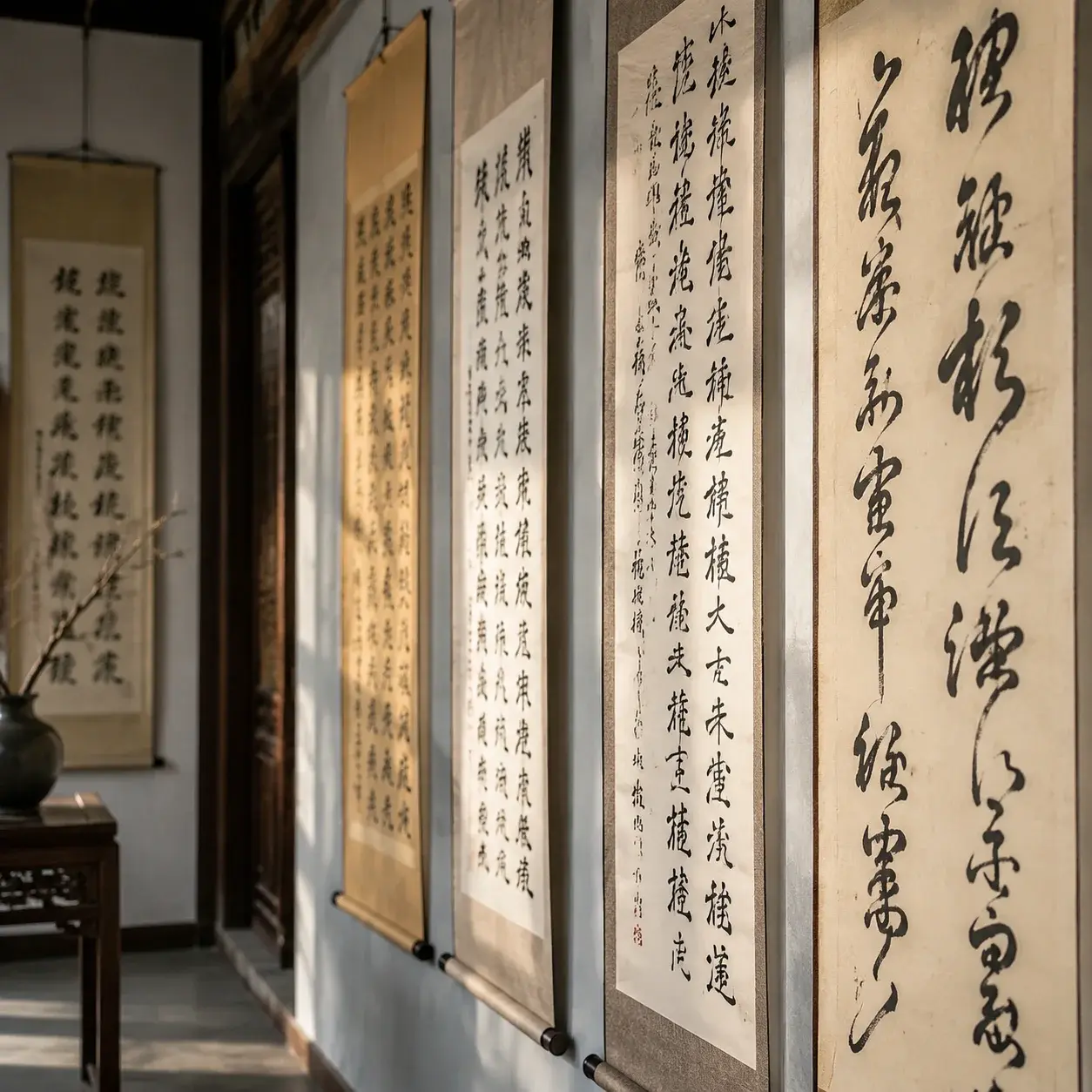
Chinese calligraphy (书法, shūfǎ) is the art of writing Chinese characters with a brush and ink — revered for over two millennia as the country's highest visual art and inscribed on UNESCO's list of the Intangible Cultural Heritage of Humanity. Unlike a printed poster, a brushed character records the movement, breath, and skill of one person's hand, which is exactly why it makes a souvenir with meaning rather than a magnet-and-keychain trinket.
It comes in five scripts (五体, wǔ tǐ), and knowing them shapes every buying decision that follows:
- Seal script (篆书, zhuànshū) — the oldest, rounded and symmetrical, reads like a pattern; the script used on name seals.
- Clerical script (隶书, lìshū) — broad and flat with flared strokes, archaic but still legible.
- Regular script (楷书, kǎishū) — the clear, upright, "textbook" form; the easiest for a non-reader to make out.
- Running script (行书, xíngshū) — semi-connected and flowing, the most popular for display.
- Cursive script (草书, cǎoshū) — highly connected and expressive; closer to abstract art than readable text.
We turn these five into an actual buying decision in the [script selector](#which-script-should-you-choose-gift-vs-display-selector) further down. First, the two things travelers most want and can least easily get right: which words to have written, and how to render your own name.
Source: five-script framework per Wikipedia "Chinese script styles," the Asian Art Museum's Chinese Calligraphy Scripts teaching materials, and StudyCLI (verify + date before publishing).
Which Auspicious Phrase Should You Have Written, and for Whom?
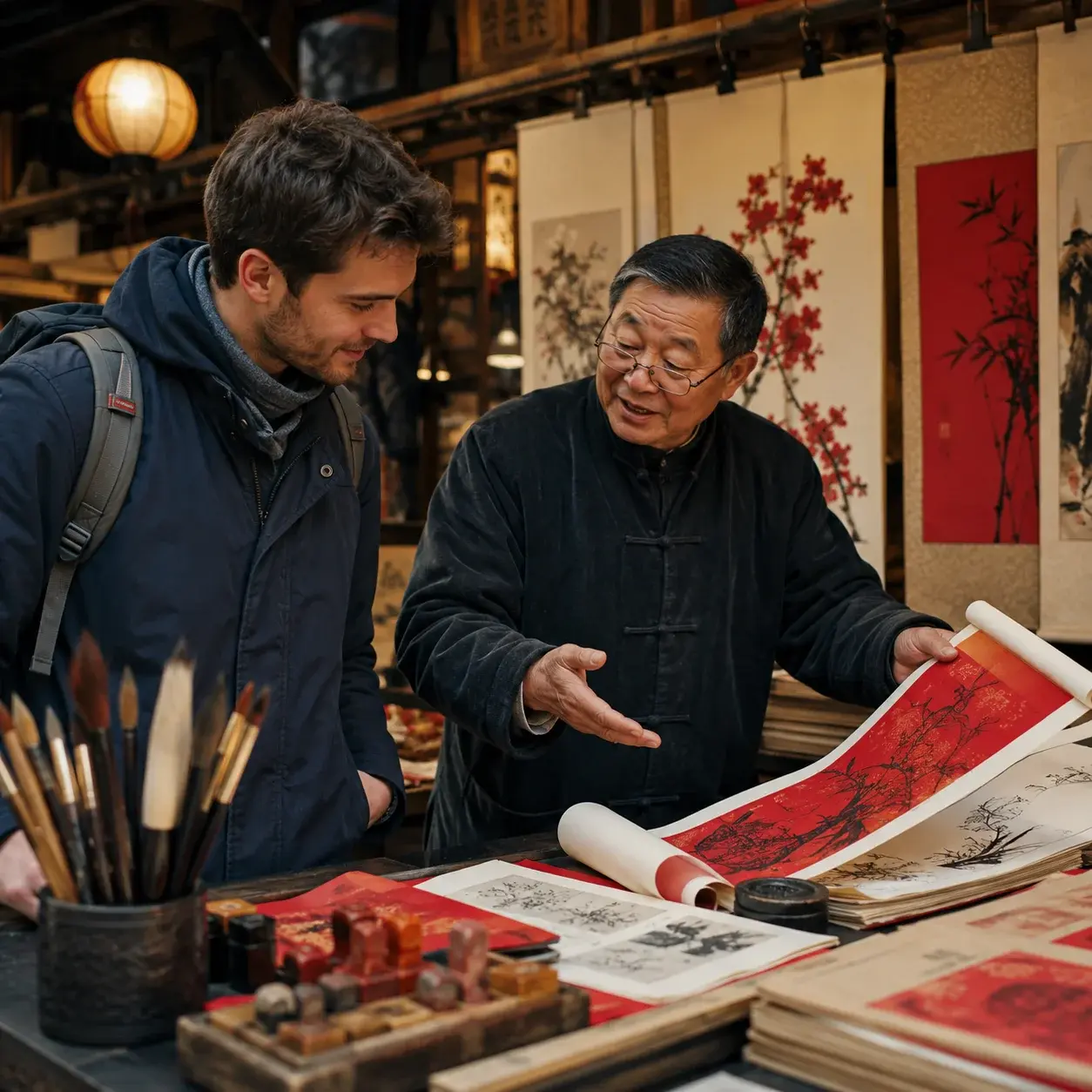
Pick the phrase to fit the recipient, not just the meaning — the wrong blessing lands badly. 寿 (longevity) flatters an elder but unsettles a young person; 财 (wealth) suits a shop counter but reads mercenary as a personal gift. Below is our library of single characters and four-character phrases, each tagged with pinyin, a literal sense, and exactly who it's for. Competitor guides list four or five phrases; this is the reference the rest can't match. Show the vendor the Chinese and they'll know precisely what to brush.
Single characters (best for small standalone pieces, 福字, framed 斗方)
| Character | Pinyin | Literal sense | Best for whom |
|---|---|---|---|
| 福 | fú | fortune / blessing | Anyone; the all-purpose home piece. Often hung upside-down at New Year (倒福 = "fortune has arrived"). |
| 寿 | shòu | longevity | Elders only — a milestone birthday (60/70/80). Awkward for anyone young. |
| 禄 | lù | prosperity / rank | Careers, promotions, business contacts. |
| 喜 | xǐ | joy | Everyday "喜"; the doubled 囍 is for weddings only. |
| 和 | hé | harmony | Home or office; a safe, universal choice. |
| 德 | dé | virtue | Teachers, mentors, respected elders. |
| 静 | jìng | stillness / calm | A study; anyone who meditates or does yoga. |
| 忍 | rěn | forbearance | ⚠️ Give with care — reads as "learn to put up with it." Self-motivation only, not a gift. |
| 安 | ān | peace / safety | Home; wishing someone safe travels. |
| 道 | dào | the Way (Tao) | The philosophical type; anyone drawn to Eastern thought. |
| 龙 | lóng | dragon | Men, those born in Dragon years, companies. Not a default for an older woman. |
| 财 | cái | wealth | ⚠️ Shop counters and business owners — too blunt as a personal gift. |
Four-character phrases and couplets (best for scrolls, horizontal boards, 对联)
| Phrase | Pinyin | Sense | Source / note | Best for whom |
|---|---|---|---|---|
| 家和万事兴 | jiā hé wàn shì xīng | a harmonious family, all things flourish | folk saying | The home classic; married couples, parents, housewarmings. |
| 厚德载物 | hòu dé zài wù | great virtue bears all things | I Ching (Kun hexagram) | First choice for a boss, mentor, or senior man — dignified and weighty. |
| 上善若水 | shàng shàn ruò shuǐ | the highest good is like water | Tao Te Ching, ch. 8 | The wise, the modest, cultured friends, self-display. |
| 宁静致远 | níng jìng zhì yuǎn | tranquility reaches far | Zhuge Liang, Admonition to His Son | The top study piece — students, professionals, yourself. |
| 自强不息 | zì qiáng bù xī | strive without ceasing | I Ching (Qian hexagram) | Strivers, graduates, founders. Pairs with 厚德载物. |
| 海纳百川 | hǎi nà bǎi chuān | the sea admits a hundred rivers | popularised by Lin Zexu (林则徐) | Leaders, entrepreneurs, the broad-minded. |
| 鹏程万里 | péng chéng wàn lǐ | the roc soars ten thousand li | Zhuangzi, "Free and Easy Wandering" | Graduates and young people starting out. |
| 马到成功 | mǎ dào chéng gōng | success the moment the horse arrives | folk idiom | Openings, exams, a new job, a competition. |
| 福寿康宁 | fú shòu kāng níng | fortune, longevity, health, peace | folk saying | The premium elder / birthday gift — all four blessings. |
| 室雅人和 | shì yǎ rén hé | elegant room, harmonious people | folk saying | Housewarmings and new homes. |
| 万事如意 | wàn shì rú yì | all things as you wish | folk saying | Anyone; the most versatile New Year phrase. |
| 知足常乐 | zhī zú cháng lè | contentment brings lasting joy | folk saying | Friends, the easygoing, self-display. |
| 一帆风顺 | yī fān fēng shùn | smooth sailing with the wind | folk saying | New ventures, farewells, graduations. |
| 难得糊涂 | nán dé hú tú | rare to play the fool wisely | Zheng Banqiao | ⚠️ High-level irony — only for a friend who gets the joke, or it reads as calling them foolish. |
💬 Editor's honest take: two traps foreigners can't hear. 招财进宝 (usher in wealth) belongs behind a cash register, not on a friend's wall. And a translation is never one-to-one — the English above is sense-for-sense, so read it for the spirit, not a literal word-swap.
How Do You Turn Your English Name Into Chinese?
The most-wanted personalization is "write my name in Chinese," and almost nobody explains it — so travelers walk away with a stiff, phonetic transcription that means nothing. There are three paths, and for a keepsake you almost always want the third.
| Path | How it works | Result | Best when |
|---|---|---|---|
| Pure phonetic (音译) | Match near-sounding characters only | Obviously a "foreign name," neutral or empty meaning | You need the standard media spelling |
| Semantic (意译) | Translate the name's meaning into characters | Reads like a real Chinese name, but the sound diverges | The name has a clear meaning (Grace, Faith, Victor) |
| Sound-plus-meaning (音义结合) ⭐ | Near-sound characters chosen for good meaning, arranged as a 2–3 character surname-plus-given name | The most name-like result, echoing your original sound | Almost every keepsake |
Three worked examples show the trade-off:
| English name | Pure phonetic | Sound-plus-meaning (recommended) | Why |
|---|---|---|---|
| Lisa | 丽莎 (lì shā) | 李丽莎 (lǐ lì shā) | Borrows 李 as a surname; 丽 = beautiful, 莎 = a graceful herb character. Close sound, lovely meaning. |
| David | 大卫 (dà wèi) — "big guard," no elegance | 戴伟 (dài wěi) | 戴 is a real surname near "Da"; 伟 = great. Sounds right and means something. |
| Grace | 格蕾丝 (gé lěi sī) — three stiff syllables | 雅恩 (yǎ ēn) | Goes semantic: 雅 = elegant, 恩 = grace. A real name, not a transcription. |
Rules and pitfalls: shorter is more name-like (Chinese names are usually two or three characters — don't force "Christopher" into six); choose auspicious characters (伟, 睿, 嘉, 欣, 安, 乐) and avoid obscure ones; and above all, have a native speaker check for unlucky homophones you can't hear — this is the single most common foreign mistake. It's also where a good operator earns its keep: LyrikTrip runs a native-speaker name review precisely to catch the homophone traps before ink hits paper.
💬 Editor's honest take: don't pay for a custom name piece in pure phonetic transcription — that just spells the sound of your name, soulless. Spend the extra ten minutes on sound-plus-meaning and you'll get a name with a story you can actually tell your guests.
What Should You Buy? Four Ways to Take Calligraphy Home
There are four distinct things a visitor buys, and each has its own shops, prices, and risks. Match the path to what you actually want before you start browsing.
Original calligraphy art and scrolls
Buy this when you want a finished work to hang. A gallery original or an artist's hanging scroll is "chinese calligraphy for sale" in the truest sense — a one-off, signed and sealed. What makes a piece collectible is the artist's reputation and skill, not the size, and older or antique calligraphy commands more for its provenance. Quick buyer checklist: confirm it's hand-brushed (see the scorecard below), check for a signature and a red seal, ask who the artist is and whether they have a published 润格 (price list), and decide mounted-or-not based on how you'll carry it home.
Personalized and custom pieces (your name or a blessing phrase)
This is the heart of the guide and the most meaningful buy: choose a phrase from the library above or a transliterated name, then have it brushed for you — on the spot at a temple or culture-street stall, or to order at a gallery. What to ask for: the exact characters, the script (use the selector below), the size, whether you want it mounted, and the turnaround. On-the-spot pieces are done while you watch; gallery work takes hours to days. Ask to watch it written — that both guarantees it's genuine and makes the story yours.
The Four Treasures gift set (brush, ink, paper, inkstone)
The Four Treasures of the Study (文房四宝, wén fáng sì bǎo) make the classic presentable gift. A real set contains four things, and you choose display quality over toy quality:
| Piece | Chinese | What to look for |
|---|---|---|
| Brush | 毛笔 (máobǐ) | Goat hair (软, soft), weasel (狼毫, firm), or mixed (兼毫, beginner-friendly). Huzhou brushes (e.g. Daiyuexuan 戴月轩) are the famous name. |
| Ink | 墨 / 墨条 (mò) | A hand-ground ink stick (ritual, elegant) versus ready-made ink liquid (Yidege 一得阁, instant). Huizhou ink is prized. |
| Paper | 宣纸 (xuānzhǐ) | Raw Xuan (absorbent, for expressive work) versus sized Xuan (crisp, for neat work). Anhui Xuan paper is the benchmark. |
| Inkstone | 砚 (yàn) | Duan and She inkstones are the celebrated types; a small practical one is fine for a set. |
Many sets add a name seal (印章, yìnzhāng) — carved on the spot with your name or initials — plus a tin of red seal paste (印泥). Sets come in three tiers: entry display (looks the part, may not write well), mid (genuinely usable), and collector (fine materials, open-ended price).
💬 Editor's honest take: if someone just wants a handsome gift, the entry display tier is fine. If they actually want to write, skip the toy sets and go straight to the mid tier — a bad brush and slick paper will put a beginner off for life. (Prices below.)
Choosing a calligraphy brush on its own
A single good brush is the cheapest meaningful souvenir and, by search volume, the thing most people look for. Match the hair type to the user, then buy from a named brush house rather than a market bin.
| Brush type | Chinese | Feel | Best for |
|---|---|---|---|
| Goat hair | 羊毫 (yángháo) | Soft, holds lots of ink | Expressive strokes, experienced hands |
| Weasel hair | 狼毫 (lángháo) | Firm, springy | Precise, controlled strokes |
| Mixed hair | 兼毫 (jiānháo) | Balanced | Beginners and gifts |
Which Script Should You Choose? Gift vs Display Selector
Match the script to the job: if the recipient must read and remember the meaning, choose regular or clerical; if it's for beauty and flow on your own wall, choose running or cursive; if you want a pattern or a name seal, choose seal script. Here's the trade-off between readability and artistry made concrete.
| Script | Chinese | Look | Foreigner readability | Artistry | Best for | ⚠️ Pitfall |
|---|---|---|---|---|---|---|
| Regular | 楷书 (kǎishū) | Upright, clear, one stroke at a time | ★★★★★ | ★★★ | Gifts, elders, beginners — anyone who wants to read every character | A little "by the book," less flowing |
| Clerical | 隶书 (lìshū) | Broad, flared, archaic | ★★★★ | ★★★★ | An antique feel without losing legibility; horizontal boards | — |
| Seal | 篆书 (zhuànshū) | Rounded, symmetrical, pattern-like | ★ | ★★★★ | Name seals and decorative motifs | As body text it's unreadable to the recipient |
| Running | 行书 (xíngshū) | Flowing, semi-connected, popular | ★★★ | ★★★★★ | Your own wall, a literary feel, gifts for those in the know | Elders or non-readers may struggle |
| Cursive | 草书 (cǎoshū) | Highly connected, expressive | ☆ | ★★★★★ | Pure art, self-expression, big wall statements | Even Chinese readers can't fully decode it |
💬 Editor's honest take: never gift cursive (草书) as a "meaningful" piece — it's an abstract painting, not text, and your recipient won't know what it says. For anyone who can't read Chinese, regular script (楷书) plus a small translation card is the only safe call.
Where Can You Buy Chinese Calligraphy in China?
Buy from culture streets and old-name shops for originals and Four Treasures, art districts for contemporary work, and temple or scenic-spot stalls for a phrase brushed on the spot — while watching those stalls for printed scrolls mixed in. Here's the city-by-city map.
Beijing — Liulichang Cultural Street
The single best starting point. Liulichang is a historic culture street lined with brush, ink, and scroll shops. Named old houses include Rongbaozhai (荣宝斋, the "home of painters and calligraphers," for original works), Daiyuexuan (戴月轩) for Huzhou brushes, and Yidege (一得阁) for ink. Nearby, the Panjiayuan Antique Market is the weekend hunting ground for older pieces — with a strong "buyer beware" culture and plenty of reproductions.
Shanghai, Xi'an and the art districts
For contemporary and mid-career artists, head to the art zones: Shanghai's M50, Beijing's 798, and Xi'an's Shuyuanmen (书院门), a dedicated calligraphy-and-painting street near the city wall. Antique streets, temple stalls, and museum shops across these cities also carry work, with a wide price and quality spread.
Temples, scenic spots and on-the-spot calligraphers
At major temples, gardens, and old towns you'll find calligraphers who will brush a phrase or your name while you watch — the most memorable way to buy, and self-authenticating because you see the hand at work. The caveat: many such stalls also hang pre-printed scrolls alongside the live work, so keep the [authentication scorecard](#how-do-you-spot-a-mass-printed-fake-handwritten-scroll) in mind.
How Much Does Chinese Calligraphy Cost?
Here's the counterintuitive rule foreign buyers most need: price is set by who wrote it, not how big it is. China prices calligraphy per 平尺 (píngchǐ, roughly one square foot), and the per-unit rate jumps by tier of reputation. The same 厚德载物 at the same size can cost a few hundred RMB from a street writer or tens of thousands from a famous name — the difference is the name, not the paper.
Cited context (last verified 2026-06): pricing by paper area (per 平尺 / per chi) is the traditional convention, and an artist's reputation has a decisive effect on value — work by well-known contemporary calligraphers can reach thousands to tens of thousands of RMB per unit, pushed higher as collectors treat famous-name calligraphy as an investment. Source: Chinese calligraphy — Wikipedia (fetched 2026-06-30). As a magnitude check, China Calligraphers Association members list around ¥3,000–8,000/平尺, while top names run into the tens or hundreds of thousands per 平尺. These are public list-price magnitudes to illustrate the tiering — not LyrikTrip quotes, and still pending field verification.
The table below is organized by artist tier, because that — not product type — is what moves the price:
| Artist tier | Typical product | Indicative RMB range | Turnaround | 💬 Our take |
|---|---|---|---|---|
| On-the-spot writer (street / temple) | A phrase or name, small, unmounted | ¥50–200 (usually priced per piece, not per 平尺) — indicative | Written while you wait | Best value keepsake; skill varies, and watch for printed stock mixed in |
| Gallery mid-career artist | Original scroll with a listed 润格 | ¥300–2,000 (roughly a few hundred to low thousands per 平尺) — indicative | In stock or a few days | The sweet spot; a real original you can bargain on |
| Established / famous (association members, known names) | Collector-grade original, priced per 平尺 | ¥2,000–10,000+ per 平尺, top names open-ended — indicative | Days to weeks (scheduling) | You're paying for the name; value rises with reputation |
| Mounting (装裱) | Scroll mounting — a craft cost, separate from the artist | +¥100–500+ — indicative | 2–5 days and up | For travel, skip it: roll unmounted and mount at home |
Four Treasures sets, for reference: entry display sets around ¥150–500, genuinely usable mid sets ¥800–3,000, collector sets open-ended; a quality standalone brush runs ¥50–400. All figures indicative and pending field verification. Markets expect bargaining and mark up for tourists.
💬 Editor's honest take — the price floor: a "calligraphy street" hung wall-to-wall with £30 "厚德载物" scrolls is 99% inkjet — real hand-brushing always carries real labour cost, so a "hand-written" piece cheap enough to have no labour in it is a print. Want the real thing? Watch it brushed in front of you, or buy from a proper gallery or old-name shop.
How Do You Spot a Mass-Printed "Fake Handwritten" Scroll?
Inkjet-printed scrolls sold as hand-brushed are everywhere in tourist markets. You can screen one in under a minute with eight field tests — no tools beyond your phone. Score a point for each genuine sign; the verdict rule is at the bottom.
| # | Test | Real (hand-brushed) | Printed | How to check |
|---|---|---|---|---|
| 1 | Ink relief | Faint raised "ink ridge," uneven sheen | Flat ink, even sheen across the whole sheet | Tilt the scroll against a side light |
| 2 | Xuan-paper feathering | Ink feathers softly into the paper fibres | Razor-sharp edges, no bleed | Look closely at a stroke edge |
| 3 | Back-of-paper bleed ⭐ | Ink shows through to the back, matching the front | Clean back, or a faint print-oil smell | Turn it over — the hardcore tell |
| 4 | Thick/thin & 飞白 | Real pressure variation; wispy "flying white" gaps in fast strokes | Uniform thickness; identical, dead flying-white shapes | Find a quick sweeping stroke |
| 5 | Seal (印泥) | Vermilion paste sits slightly raised, oily, faintly off-register | Flat printed red, part of the same single print pass | Touch the seal; is it above the paper? |
| 6 | The "twins" test | Every hand-written piece is unique | Two identical scrolls on the wall = printed | Ask to see two of the same design |
| 7 | Loupe for dots | Fibrous, feathered stroke edges | Regular CMYK halftone dots | Phone macro or a loupe |
| 8 | Smell + price | Faint ink scent; a sane labour cost | No scent; absurdly cheap (¥20–50 by the wall) | Sniff, and cross-check the price ranges above |
Verdict: one to three suspicious hits — ask to see the back. If back-bleed (#3) + raised seal paste (#5) + not-a-twin (#6) are all true, it's almost certainly genuine hand-brushing. All three failing means it's a print — smile and move on.
How Do You Commission a Custom Piece?
Commissioning is a six-step flow: choose the words, choose the script, choose the channel, confirm the specs, authenticate, then pay and arrange transport. Here it is in order.
- Pick the words — a phrase from the [library](#which-auspicious-phrase-should-you-have-written-and-for-whom) or your name via the [transliteration paths](#how-do-you-turn-your-english-name-into-chinese).
- Pick the script — use the [selector](#which-script-should-you-choose-gift-vs-display-selector): readable regular/clerical for gifts, flowing running/cursive for your own wall, seal for a name chop.
- Pick the channel — see the table below.
- Confirm the specs — exact characters, size, mounted or unmounted, and turnaround, in writing where possible.
- Authenticate — watch it brushed, or run the scorecard on a finished piece.
- Pay and arrange transport — keep the receipt and the artist's details; buy unmounted for travel.
| Channel | Where | Best for | 💬 Note |
|---|---|---|---|
| Culture street / old-name shop | Beijing Liulichang; culture streets in most cities | Originals, famous names, one-stop Four Treasures | Safest and priciest; you can inspect real work |
| Art district / gallery | Shanghai M50, Beijing 798, Xi'an Shuyuanmen | Mid-career originals, contemporary styles | Wide price range, room to bargain |
| Temple / scenic on-the-spot | Temples, gardens, old towns | A phrase or name brushed live, immediate, memorable | Best story; check for printed stock mixed in |
| University / calligraphy association | Art academies, local associations | Skilled writers at fair value | Needs a local contact to arrange (a LyrikTrip value-add) |
Turnaround: on-the-spot is immediate; a gallery original is in stock to a few days; an established artist can take days to weeks by appointment. All turnaround and price figures indicative and pending field verification.
Who Is It For? What to Gift, in Which Script
Route the gift by recipient. This is the decision most buyers get wrong, so here it is as one table — phrase, script, format, and the trap to avoid for each person.
| Recipient | Recommended phrases | Script | Format | ⚠️ Pitfall |
|---|---|---|---|---|
| Boss / superior | 厚德载物, 海纳百川, 宁静致远 | Regular / clerical | Mounted scroll, generous margins | No 财/招财进宝 (mercenary); no cursive (flippant) |
| Elder / parent | 福寿康宁, 家和万事兴, 寿, 龙马精神 | Regular (most legible) | Red or warm mounting | 寿 only for the genuinely elderly; avoid plain black-and-white mounting (funeral association) |
| Friend / peer | 知足常乐, 上善若水, 一帆风顺, 难得糊涂 | Running / regular | Small framed 斗方, easy to carry | 难得糊涂 only for those who get the irony; skip 忍 |
| Newlyweds | 家和万事兴, 心想事成; the doubled 囍 | Regular / running | Red, paired or a couplet | Single 喜 isn't enough — weddings use 囍 |
| Housewarming | 室雅人和, 竹报平安, 花开富贵 | Clerical / regular | Horizontal board for the living room | — |
| Business launch | 马到成功, 鹏程万里, 天道酬勤 | Running / clerical | Standing scroll, bold presence | — |
| Yourself / a study | 宁静致远, 上善若水, 静, 道 | Running / cursive | Unmounted, rolled home, mount later | Anything goes — please yourself |
💬 Three governing rules: (1) gifts must be readable — favor regular/clerical plus a character-pinyin-English card, or your recipient won't know what they're hanging; (2) self-use can run wild — running and cursive give the most flow; (3) avoid plain white or black mounting for elders (a funeral association) — choose red or warm tones.
How Do You Get a Scroll Home Safely?
Buy it unmounted, roll it (never fold), and slide it into a rigid mailing tube — then have it mounted after you get home. Mounting a scroll makes it stiffer, bulkier, and far more prone to creasing in a suitcase, and it adds cost and lead time you don't need on the road. Packing checklist: roll loosely with the ink facing out, add a sheet of acid-free tissue if you have one, cap both ends of the tube, keep it out of humidity (a scroll absorbs damp and cockles), hand-carry rather than check it when you can, and keep the receipt and the artist's card with it for customs or later authentication. A crease in Xuan paper is usually permanent — the tube is your whole insurance policy.
Frequently Asked Questions
Where can I buy authentic Chinese calligraphy in China? The most reliable places are culture streets and old-name shops — Beijing's Liulichang (Rongbaozhai, Daiyuexuan, Yidege) is the best starting point — plus art districts like Shanghai M50 and Xi'an Shuyuanmen. For a personalised piece, buy from a calligrapher who brushes it while you watch.
How can I tell if a piece is hand-written and not printed? Run three key checks: turn the paper over and look for ink bleeding through the back, feel whether the red seal paste sits slightly raised, and confirm no identical "twin" scroll hangs beside it. If all three point to genuine, it's almost certainly hand-brushed. A wall of cheap identical scrolls is inkjet.
Can I get my name written in Chinese calligraphy? Yes, and it's a favorite keepsake. Choose sound-plus-meaning transliteration — near-sounding characters picked for good meaning — rather than a stiff phonetic spelling. Have a native speaker check for unlucky homophones first, then have it brushed in readable regular script with a translation card.
Which auspicious phrase should I choose, and for whom? Match the phrase to the recipient. 福 (fortune) suits anyone; 福寿康宁 or 寿 is for elders; 厚德载物 suits a boss or mentor; 宁静致远 fits a study; 家和万事兴 is the home classic. Avoid 财 and 招财进宝 as personal gifts — they read as mercenary.
Does Chinese calligraphy make a good gift or souvenir? Excellent — a brushed phrase carries genuine cultural meaning, unlike a mass-made trinket. The keys are choosing a phrase that fits the recipient, using a readable script with a translation card, and confirming it's hand-written, not a printed reproduction sold as original.
What's the best Chinese calligraphy to bring home? For most travelers, a personalised name or blessing piece in regular script offers the best mix of meaning, readability, and value — bought unmounted and rolled home. Collectors should look at a gallery original priced by the artist's 润格; gift-givers should pair the piece with a translation card.
Conclusion
Chinese calligraphy is one of the few souvenirs from China that records a real human hand and carries words you can live with for years — provided you buy the genuine article. Choose the phrase for the person, render your name with meaning rather than mere sound, price by the artist rather than the size, screen hard for printed fakes, and roll it home in a tube. Do that and you'll bring back not a wall decoration but a small, brushed story.
Internal Links
- For the wider picture, see our guide to the
 best souvenirs to buy in China.
 - Drawn to brushwork and scrolls more broadly? Read about buying a Chinese ink painting scroll — it shares the Xuan-paper, mounting, and hand-brushed-versus-printed authenticity problem.
- Pairing a set with a stamp? See how to get a personalized Chinese name seal.
- Planning the Beijing leg? Our guide to shopping on Liulichang Cultural Street has the market logistics.
- The frameworks above — the phrase library, transliteration paths, script selector, and authentication scorecard — come from [our Chinese calligraphy methodology source](./chinese-calligraphy-deep-dive.md).
Volez-vous qu'un guide vous mène au calligraphe approprié ? LyrikTrip conçoit des